2nd grade STEM activities

The marble run rebuilt so 2nd graders define the problem from what they see, five more build challenges fixed, a free printable, and every 2nd grade Mission by subject.

Who we are. Mission.io makes Missions: teacher-led, whole-class simulations where students use what they’re learning to work through a real scenario together. We build every one on the six things in our STEM activities for students, K-8 guide, and every student gets a report on how well they did.

You don’t need us to use this page: the marble run, the five challenges, and the sheet all work on their own. Every 2nd grade Mission is at the end, by subject, free. (The one after the marble run stars a fish named Ziggy, stuck in seaweed, and takes ten minutes. That’s less time than finding the marble that rolled under the bookshelf.)

On this page

What 2nd grade STEM looks like

2nd grade STEM activities are challenges in which a team looks closely at a problem, builds something to solve it, tests it, and compares what happened, with each student answerable for a part. This page rebuilds the paper-tube marble run to the grade’s engineering standard (K-2-ETS1-1 and K-2-ETS1-3: define a simple problem from what you observe, then compare the strengths and weaknesses of two tested solutions), fixes five more build challenges, and lists every 2nd grade Mission by subject. The year’s content (the properties of materials and how heating and cooling change them; what plants need and how seeds travel; habitats; how wind and water change the land; addition and subtraction) lives on the subject pages.

Most of what gets called a STEM challenge is a contest, or a craft project with a STEM sticker on it. In 2nd grade the marble run stands in for all of it, and most years it goes the same way: a pile of paper towel tubes, a stretch of wall, a roll of tape, and whoever holds the tape runs the build.

The tubes are fine. The trouble is everything around them. Did the team decide what the run had to do before the tape came out, and can anyone say afterward which piece made it work? A run that lands in the cup by luck and a run that lands there on purpose look the same on the wall. The challenges on this page put the deciding and the explaining back, with the same tubes in the same period.

Six things that turn a build contest into engineering

We’ve run this check with STEM teams in the districts we work with, and the craft project skips the same three every time: a real problem, criteria for success, and any pressure to iterate. If the finished product is all the activity asks for, the learning is optional. The fix is a small step before the build and a small step after it, and nothing on the wall changes. One number is worth carrying down: when a group shared a goal and each student answered for a part, 84% of studies found a positive effect; without both, 17% (Slavin, 1991).

  1. 1. A real problem with stakes the class can feel.

    “Get the marble to the cup” is a goal. “The mine cart has to reach the dock without smashing it” is a problem.

  2. 2. Apply, don't recall.

    A second test that changes the run. If a team can tape the whole thing without the tilt chart you made that morning, the chart wasn’t needed.

  3. 3. Group goals with individual accountability.

    The one most build challenges miss: whoever holds the tape runs it. Four roles, one job each, and a box each child signs.

  4. 4. The teacher leads the thinking.

    The questions are yours, asked at the wall while they’re still building. The marbles aren’t yours: the Timer calls each one, and you listen for which team can say why it went the way it did.

  5. 5. A debrief where the class argues it out.

    Runs stay on the wall, and the question is what the slow ones had in common.

  6. 6. A way to see who did what.

    If you can’t tell which child moved the turn and which one held whatever they were handed, the tally on the sheet is how you find out.

The engineering happens between the first marble and the second.

The free printable at the end of the next section puts all six on the wall, ready to copy. Get the sheet →

The paper-tube marble run, rebuilt for 2nd grade

The paper-tube marble run is the build challenge 2nd grade teachers reach for because the tubes are free and the failure is instant: the marble flies off. Teams tape tubes and paper track to a wall so a marble travels from the top to a cup at the bottom. The way it usually runs is a free build and a cheer when a marble lands. Here’s the version that hits all six.

Needs
Per team: 4 cardboard tubes, a strip of paper, an arm’s length of masking tape, 3 marbles, a paper cup, and a patch of wall. One spare tube for the demo. About $5 for seven teams, if families send the tubes (ask a week ahead).
Time
55 minutes with the wall taping and cleanup. 45 with the tubes pre-cut in half and 6-minute builds, or two visits.
Groups
Fours. With 26 students, six fours and a pair; in the pair, one child tapes and holds, and the other times and records.
Standards
K-2-ETS1-1 (define a simple problem from what you observe) and K-2-ETS1-3 (compare two tested solutions). The slow-marble version brushes 2-PS1 only loosely, so the claim stays at the engineering codes.
  1. Teach first, 8 minutesApply

    Roll a marble down one tube held at three angles and ask what changed. Chart it: steeper is faster, a turn slows it, a gap loses it. That chart is the content, and it stays on the wall beside the runs.

  2. The problem, 2 minutesStakes

    A mine cart (the marble) has to get from the top of the mountain to the loading dock (the cup) without leaving the track, and it has to take at least 5 seconds, because a cart that arrives too fast smashes the dock. The class writes the two criteria in the box before anyone tapes.

    • Criteria: the marble lands in the cup; the run takes 5 seconds or more.
    • Constraints: four tubes, one strip of paper, one arm’s length of tape, the wall space you were given.
  3. Four roles, one job eachAccountability

    On the sheet, and every child signs their role’s box.

    • Taper

      The only hands on the tape.

    • Tube Holder

      Places each piece before it's taped and says why there.

    • Timer

      Counts one-Mississippi out loud and calls the number at the cup.

    • Recorder

      Draws the run after each test and writes the time and whether the marble stayed on.

  4. Build, 8 minutes, then three marblesApply

    The Timer calls each of the three marbles. A marble that leaves the track still gets drawn: the Recorder marks the spot where it left.

  5. Move one piece, 2 minutesApply

    One piece, and only one, and the Recorder writes which. The Taper and the Tube Holder swap jobs, and the team tests three more marbles.

  6. Your three questions, at the wallTeacher leads

    Ask while they’re still building. Where did the marble leave the track, and why there? What’s slowing it down right now? What one piece would you move? Then wait, and let the Tube Holder answer.

  7. The debrief, 8 minutesDebrief

    Runs still on the wall. Which runs hit 5 seconds, and what did they have that the fast ones didn’t? What did your team move, and what happened to the time? Who in your group noticed something before the marble did? Expect a second grader to point at a teammate and say the turn was too sharp, which is the answer you were waiting for.

  8. See who did whatSee who did what

    The observation sheet, four behaviors per child: proposed a change, built on a teammate’s idea, gave a reason, recorded a test honestly (the misses too). The wall spreads the teams out, which helps. You’ll catch about half the room in one period; the signed box and the Recorder’s drawings catch the rest, at a glance, before you grade anything.

  9. Once a week, or four sections in a row

    The two-visit version, for a short block or a once-a-week lab: the tilt chart, the criteria, and the first round on visit one, with each run left taped to a labeled board; the move, the second round, and the debrief on visit two. Four sections in a row: tubes pre-cut and bagged by team the day before, a board per team instead of the wall so the next period has a clean start, and the marbles counted back into a cup at the end of every period. A box lid under each run keeps them from touring the room.

(Every wall has one team that builds straight down. Their marble is fast, confident, and nowhere near the cup.)

Same tubes, same wall. The team just decides what the run has to do before the tape comes out.

The paper-tube marble run, free

Emailed now, ready to copy: the teacher page, four role cards, the team page (the criteria box, the run drawings, and the test log), and the four-behavior tally.

It’s on its way.

Check your inbox for the paper-tube marble run.

Email me the sheet. It comes as a PDF, ready to print. Unsubscribe anytime.

Five more 2nd grade STEM challenges, fixed

Five more that every 2nd grade list carries: what each one is, how it usually runs, and the couple of changes that fix it.

Five more for 2nd grade

2. The straw raft with a sail

Needs straws, tape, a paper sail, a tub of water, a fan, pennies. Groups of three.

Teams tape straws into a raft, add a paper sail, and use a fan to push it across a tub of water. Watching it sail is the fun part, and 2nd graders will happily rebuild a raft that tips. As usually run, though, it’s a float test with nothing on board, so there’s no problem to solve, and one student usually does the taping and the fanning while the rest watch.

The fix

  1. Give the raft a cargo: a stack of pennies that has to reach the far side of the tub.
  2. Give each team three roles: a Loader who sets the pennies on, a Fanner who runs the fan, and a Recorder.
  3. Have the Recorder log how many pennies made the trip on each run.

No page for this one; the fix above is the whole of it.
3. The foil tower from one roll

Needs one roll of aluminum foil per team, nothing else. Groups of four.

Each team gets one roll of aluminum foil and nothing else, and the tallest tower when the timer runs out wins. Every student can shape foil, so everybody gets their hands in. As usually run, though, it’s a race: teams crumple and stack without an idea to build on, and when towers fall nobody stops to ask where.

The fix

  1. Before the build, teach one idea and show it with foil: a wide base holds up a tall top.
  2. After the first try, debrief before anyone builds again: what fell, and where did it bend?

No page for this one; it’s a race with a lesson in front of it.

4. The fork bridge between two desks

Needs plastic forks, a gap between two desks. Groups of four.

Teams build a bridge from plastic forks to span the gap between two desks. 2nd graders like the strange material, and every student can add forks. As usually run, though, it’s a novelty build: nothing has to cross the bridge, so any bridge that reaches counts, and nothing records who built what.

The fix

  1. Keep the fork bridge as a free-choice station, where students can tinker on their own.
  2. For the lesson itself, teach the index card bridge instead, which carries a load and keeps a log on its own sheet.

2nd grade engineering activities →

5. The popcorn container from one sheet

Needs one sheet of paper per team, popcorn, a measuring cup. Groups of three.

Each team folds one sheet of paper into a container, and the one that holds the most popcorn wins. If you’ve taught the words for how much something holds, it puts them to work, and the popcorn gives it a small stake. As usually run, though, it’s a measuring contest where one student folds and pours, and the counts are forgotten before the next team’s turn.

The fix

  1. Give each team three jobs: a Folder, a Filler who pours the popcorn, and a Counter who counts the measuring cups it holds.
  2. Write each team’s count on the board before the next team pours.

No page for this one; the count goes on the board.

6. The kite from a grocery bag

Needs a plastic bag, two straws, string, tape, a windy day. Pairs.

Pairs build a kite from a plastic grocery bag, two straws, and string, then run across the field to fly it. 2nd graders will run all day for a kite that lifts. As usually run, though, it’s build and run: whoever holds the string has the fun, nothing changes between flights, and nobody talks about why one kite flew and another dragged.

The fix

  1. Give each pair one job each: a Builder and a Flyer.
  2. Fly it twice, with one change between flights, like adding a tail or taking it off.
  3. Back inside, debrief what the tails did.

No page for this one; it needs the weather more than it needs a sheet.

  • Our part · We make Missions

    Then the standard has somewhere to go

    Plenty of teachers rebuild these by hand every unit, and it works. A Mission is a teacher-led, whole-class simulation on the standard the unit was teaching: the scenario is built from the unit you just taught, and the only way through is using it. Run the marble run first, then the Mission on the same standard, and the engineering unit has a day two.

    You're at the helm, not on the hook.

    Tools of the Trade: the marble run's standard, as a Mission

    Tools of the Trade · Grades K to 2 · About 10 minutes · One device per student, plus your projector · Free with a teacher account

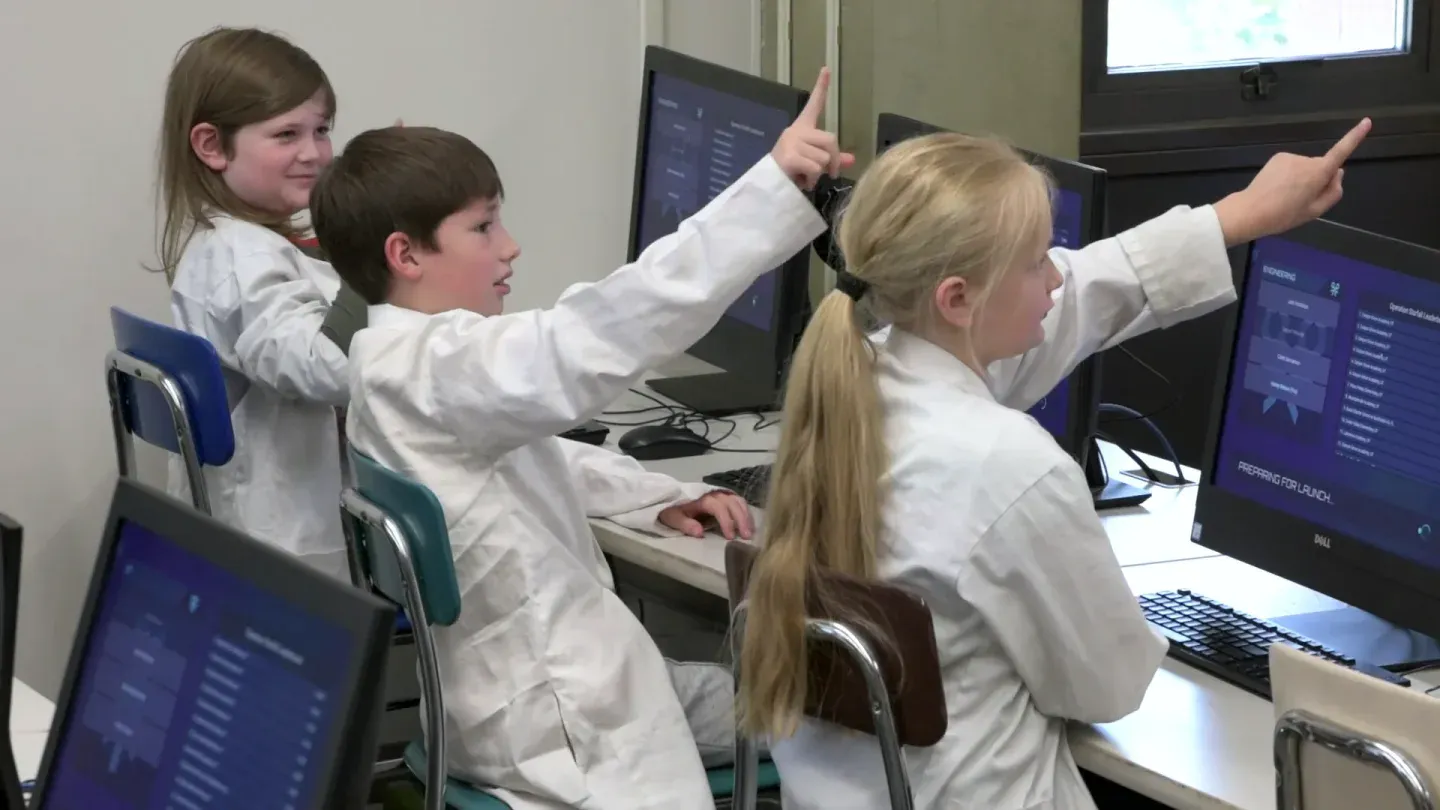
    Three students in white lab coats point toward the front of the room from their computer stations; one screen reads Preparing for launch.
    What you'll see: the whole row pointing at the same screen, and you asking what the problem is, in their words, before anyone picks a fix.

    A fish named Ziggy is caught in seaweed, and the class has to look at the situation, define the problem, and weigh different solutions to find the best way to rescue him with the materials on hand (K-2-ETS1-1). The story plays on the projector. Every student works on their own screen. The story goes the way most of the class chooses, and each child’s own choices and answers go into their report.

    The technology carries the story and collects every answer. You lead the thinking: What is the problem, in your words? Which tool could reach him? What could go wrong with that one?

    Run the marble run first, and tell the class why: the marble run is where they practiced looking before fixing, and Ziggy needs exactly that. The lesson prepares them. The Mission is what they’re preparing for. Tools of the Trade carries the marble run’s first code, K-2-ETS1-1; Beach Frenzy carries both.

    “My students ask every time they walk in the door, ‘IS IT A MISSION DAY?’”

    Kate Fallon, Teacher, St. Amelia School, NY

    Will it work in my room?

    Students join with a class code: no student accounts, no student email, no passwords. Chromebooks, laptops, or tablets, plus your projector. Free for teachers, no credit card. Student data is covered by COPPA and FERPA, and we signed the Student Privacy Pledge. See every class once a week in a lab? Then the lab is where the Mission runs and the classroom is where the unit runs: ask the 2nd grade team what they just finished, pick that row below, and run it the week after.

    START FREE →

    Communication first, then the marble run's two

    What the report shows

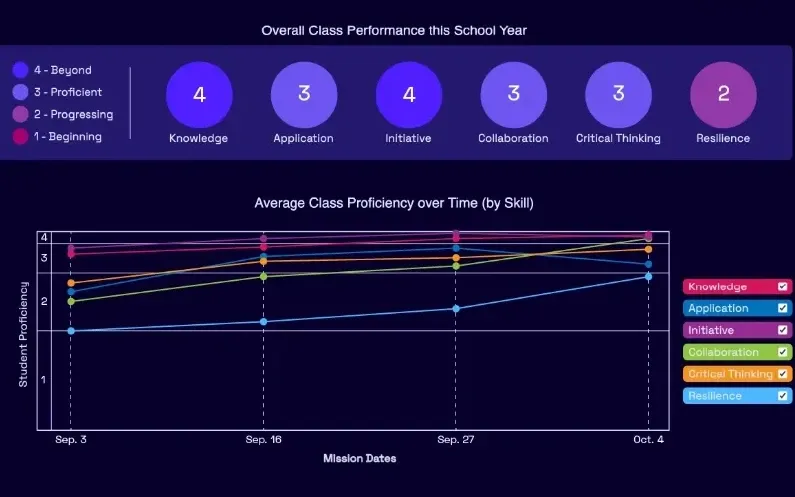
    A Mission.io class report: the class score in each of six skills, from knowledge and application to collaboration, critical thinking, and resilience, with the class chart across the year below.
    A class report from a real Mission: the class score in each of six skills, then each skill across the year.

    Every Mission produces a report for every student, built from what that student did across the whole Mission, on the skills the Mission captured. The six it can capture are Knowledge, Application, Initiative, Collaboration, Critical Thinking, and Resilience. The first two are what a test already sees. The other four are the human skills every school promises. The test shows what they know. The report shows the rest. SEE THE EVIDENCE →

    You taught it. Now find out who can use it.

    Who's behind it

    Mission.io is a research and design organization with one job: make collaborative, active learning something a teacher can run every unit instead of once a semester, and put a report in your hands when it’s over. Over a million students have run a Mission. The research behind them is funded by the National Science Foundation and the U.S. Department of Education’s Institute of Education Sciences, and Mission.io meets ESSA Level II standards, as validated by Instructure.

    “Observe a mission in another classroom. It will change the way you think about them.”

    Danica Puente, Teacher, Holbrook Elementary, UT

    Every 2nd grade Mission, by subject

    Tools of the Trade is one. There are 18 STEM Missions at 2nd grade, numbered 7 to 24 below, and each one is where a unit can end: the engineering unit ends at Tools of the Trade, plants end at Botanical Break-In, addition and subtraction end at A Blue Storm. Every lesson finally has somewhere to go. Cart once this week and no unit in mind? Tools of the Trade is 10 minutes, and Brik by Brik is 12. No technology Mission is built for 2nd grade; the 2nd grade technology activities page carries activities a room can run without one, and Technology activities for students has every grade, K to 8.

    Engineering

    Two, both on the K-2 engineering design standard, both 15 minutes or less. The 2nd grade engineering activities page rebuilds a classic of its own. Engineering activities for students has every grade, K to 8.

    Engineering Missions at 2nd grade, both on the NGSS K-2 engineering design standard.
    NumberMissionTopic (code)Minutes
    7Tools of the TradeLook closely, define the problem, pick the best fix (K-2-ETS1-1; grades K to 2)10
    8Beach FrenzyDesign and compare ways to shade a robot from the sun (K-2-ETS1-1, K-2-ETS1-2, K-2-ETS1-3, K-PS3-1, K-PS3-2, 1-PS4-3; grades K to 2)15

    Science

    Fourteen numbered, the deepest shelf at the grade. The 2nd grade science activities page sets each one against the investigation that teaches it. The first nine carry 2nd grade codes; the last five carry codes from other grades and run at 2nd too. (The Speed of Change has no time estimate in the library.) Science activities for the classroom has every grade, K to 8.

    Science Missions at 2nd grade, by NGSS code; the last five carry codes from other grades.
    NumberMissionTopic (code)Minutes
    9The Speed of ChangeQuick and slow changes to Earth’s surface, sorted by the evidence (2-ESS1-1)not listed
    10Playground PerilDescribe materials and test which one suits the job (2-PS1-1, 2-PS1-2; grades 1 to 2)20
    11Brik by BrikTake an object apart and build something new from its pieces (2-PS1-3)12
    12Hot and Cold ChangesHeating and cooling change matter, and some changes can’t be undone (2-PS1-4; grades 2 to 3)17
    13Botanical Break-InWhat plants need to grow (2-LS2-1; grades 1 to 2)21
    14Flight of the PollinatorsHow animals move seeds and pollen (2-LS2-2)18
    15All Mixed UpWhich plants and animals live in which habitat (2-LS4-1)24
    16Wind and WaterCompare ways to keep wind and water from changing the land (2-ESS2-1; grades 1 to 2)16
    17Treasure HuntLandforms and bodies of water as map clues (2-ESS2-2; grades 1 to 3)22
    18Botspace BoysMake a light device to send a message (1-PS4-4; grades 1 to 2)18
    19Dark Side of the MoonMoon phases (1-ESS1-1; grades K to 2)27
    21Forecast FiascoRead the forecast and prepare for severe weather (K-ESS3-2; grades K to 2)22
    22Off the Rails (2nd-3rd)Balanced and unbalanced forces; predict a train’s motion (3-PS2-1, 3-PS2-2; grades 2 to 3)23

    Math

    One, on the addition and subtraction that runs through 2nd grade math. The 2nd grade math activities page rebuilds a classic of its own. Math activities for students has every grade, K to 8.

    The math Mission at 2nd grade, by CCSS code.
    NumberMissionTopic (code)Minutes
    23A Blue StormAdd and subtract within 100, lengths included (2.OA.A.1, 2.MD.B.5)21

    Careers and creativity

    One that doesn’t belong to a unit: a creativity Mission for K to 5.

    The creativity Mission at 2nd grade.
    NumberMissionTopic (code)Minutes
    24Sky's the LimitCreativity and imagination (no standards codes; grades K to 5)18
    START FREEMISSION BRIEF →

    Free teacher account, no card. Start with the Communication Mission, marked Start here in your library, then Tools of the Trade, each after its 5-minute Teacher Preview.

    Also at this grade

    The Collaboration and Critical Thinking Missions for 2nd and 3rd grade (15 minutes each; they live on the 2nd grade collaboration activities and 2nd grade critical thinking activities pages), the Communication Mission for 2nd and 3rd grade (19 minutes, the first one to run), and two story Missions outside the STEM tables: Dawn of the Scarecrow, a scarecrow history built for listening for key details (W.2.8, SL.2.1, SL.2.2), and Showstopper, a costume design for RALF (K to 2; no standards codes).

Questions 2nd grade teachers ask

I see my 2nd graders once a week for STEM. What fits?

The foil tower and the popcorn container are the short ones; the marble run fits a 45-minute special with the tubes pre-cut, or two visits with the second round on the second. A Mission is one visit, and three on this page run 15 minutes or less (Tools of the Trade, 10; Brik by Brik, 12; Beach Frenzy, 15). Ask the classroom teacher what unit just ended and pick that row.

What makes a marble run engineering and not a craft?

A problem the class defined from what it saw (one tube, three tilts), two criteria written before the taping, and a second test after one change (K-2-ETS1-1, K-2-ETS1-3). Without the first, it’s decorating a wall. Without the second, nobody knows what moving the piece did.

Can 2nd graders really hold a role for a whole challenge?

Yes, if the role is one job they can say out loud: the Taper tapes, the Timer counts. Swap the Taper and the Tube Holder between rounds so nobody spends the period holding tubes, and tape the role cards to the wall beside the run so the job is always in sight.

How do I grade a STEM challenge in 2nd grade?

Grade the criteria box and the behaviors, not whether the marble made it. The signed box and the Recorder’s drawings are one grade; the four-behavior tally over two or three challenges is the other. “Recorded a test honestly, the misses too” is the behavior worth praising out loud.