2nd grade science activities

Bean seedlings rebuilt as a fair test of what plants need, five more investigations by NGSS standard, a free printable, and every 2nd grade science Mission by standard.

Who we are. Mission.io makes Missions: teacher-led, whole-class simulations where students use what they’re learning to work through a real scenario together.

Everything on this page works without us. Every 2nd grade science Mission is at the end, by standard, free. (The pollinator Mission’s vocabulary list includes the word “poop.” Seed dispersal is honest like that.)

On this page

What 2nd grade science looks like

Second grade science activities are investigations in which the class gathers evidence about something the standards name, has to argue from that evidence, and leaves each student answerable for a piece. This page covers the 2nd grade performance expectations, 2-PS1-1 to 2-ESS2-3, plus the K-2 engineering standards, with an investigation and a Mission for each where one exists. The 2nd grade STEM activities page carries the build challenges.

The year is materials, plants, and land. Sorting materials by their properties and picking the right one for a job (2-PS1-1, 2-PS1-2), taking an object apart into small pieces and building something new (2-PS1-3), and the changes heating and cooling can and can’t undo (2-PS1-4). Then what plants need (2-LS2-1) and what animals do for them (2-LS2-2), how much life a habitat holds (2-LS4-1), Earth changes fast and slow (2-ESS1-1), wind and water reshaping the land (2-ESS2-1), mapping land and water (2-ESS2-2), and where water is found, solid or liquid (2-ESS2-3).

You know the activity that usually stands in for the plants part. Beans in cups on the windowsill, the teacher doing all the watering, and two weeks later a tall plant, a yellow plant, and a trip to the trash can. Watching something grow is a fine thing to do. Science starts when the class has to say why one plant died, and prove it.

Six things that turn a demo into an investigation

Inquiry-based science teaching outperformed traditional instruction across 37 studies, and the surprise inside the finding is who leads it: teacher-led inquiry beat student-led by a clear margin (Furtak, Seidel, Iverson, and Briggs, 2012). Hands-on helped most when students also had to think and talk about what they saw (Minner, Levy, and Century, 2010). The uncomfortable part is the clock: grades K to 2 average about 17 minutes a day on science, against 89 on reading (2018 NSSME+). That’s a master schedule, not a choice, and it means the 17 minutes have to be an investigation.

  1. 1. A real problem with stakes the class can feel.

    “Grow some beans” is a craft. “Prove where 100 seedlings have to go before the garden club plants them” is a problem.

  2. 2. Apply, don't recall.

    A second week that only works with the data from the first. If the activity can be finished without the science, it isn’t a science activity.

  3. 3. Group goals with individual accountability.

    The one most science classics miss: the teacher waters every cup, and the class watches. When the group shared a goal and each student answered for a part, 84% of studies found a positive effect; without both, 17% (Slavin, 1991).

  4. 4. The teacher leads the thinking.

    The inquiry finding above settles it. Three questions at the windowsill beat a worksheet of twenty at the desk.

  5. 5. A debrief where the class argues it out.

    The investigation is the setup. The argument afterward is the practice the standards name: engaging in argument from evidence, even at seven.

  6. 6. A way to see who did what.

    If you can’t tell which child measured the seedling and which one copied the number, you can’t teach the practice. You can only hope for it.

One plant in a cup is decoration. Three cups and one difference is an experiment.

The sheet at the end of the next section has the seedlings ready to run at the windowsill: the role cards, the ten-day grid, the week-two prediction, and the tally. Get the sheet →

Bean seedlings, rebuilt for 2nd grade (2-LS2-1)

Do plants need light and water? Bean seedlings in three cups: one in the window with water, one in the closet with water, one in the window with none, checked over two weeks. It’s the investigation 2-LS2-1 names in its own words, and the way it usually runs is the teacher doing the watering, nobody saying why the closet plant matters, and the cups thrown away at the end. Here’s the version that hits all six.

Time
45 minutes to set up, then 5 minutes a day for ten school days, then a 20-minute debrief. The 45-minute cut is the setup day; the daily check rides on the morning routine. For a 17-minute block, set up across two days (the teach-first and the roles, then the planting), and split the debrief the same way. The daily check already fits.
Groups
Fours. With 25 children, six groups of four and one of three, where the Checker also records.
Supplies for seven teams
21 cups, a bag of bean seeds, potting soil, a measuring spoon per team, and a centimeter ruler per team (paper ones work). About $8 all in.
Standards
2-LS2-1 (plan and conduct an investigation to determine if plants need sunlight and water to grow). The standard’s own boundary is testing one variable at a time, and the rebuild keeps it exactly.
  1. Teach first, 10 minutesApply

    Show a healthy seedling and ask the class to list what it might need. Chart the list, then say the rule out loud: to find out if one thing matters, change only that thing. Draw the three cups on the board: window and water, closet and water, window and no water.

  2. The problemStakes

    The school garden club has 100 seedlings to start indoors, one windowsill, and one closet. Before they commit, they need the class to prove, with evidence, where the seedlings have to go and whether watering can skip the weekends. Say the stakes out loud: a wrong answer is 100 dead plants.

  3. Four roles, one job eachAccountability

    On the cards, rotating weekly, and every child signs their role’s box on the team’s role chart.

    • Waterer

      Measures the same amount into the two watered cups each day, and says the number aloud.

    • Measurer

      Holds the paper ruler against each seedling and reads the height in centimeters.

    • Recorder

      Writes the three heights and one color word on the grid every day.

    • Checker

      Says whether the team changed only one thing, and reports any accident.

  4. You lead the thinkingTeacher leads

    Three questions, at the cups every other day: Which cup are you comparing to which, and what’s the one difference? What does today’s measurement tell you that yesterday’s didn’t? What do you predict for the end of the week? The hardest part is not answering the third one for them.

  5. Two weeks, so the numbers have to be usedApply

    Week one is the setup and the daily checks. At the end of it, each team writes a prediction for week two on the sheet and rotates roles. Week two checks the prediction, so the week-one numbers have a job.

  6. The debrief, at the end of week twoDebrief

    Cups on the table. Which cup grew, which didn’t, and what was the one difference? Did your week-two prediction come true, and if it didn’t, what fooled you? Who in your group caught a mistake, a cup that moved or a watering that got missed? Someone will name the Checker who noticed the closet cup had been moved.

  7. See who did whatSee who did what

    The observation sheet, four behaviors per child: measured or watered accurately, gave a reason for a prediction, used “only one thing changed,” told a teammate something they noticed. The daily check is short and the roles are visible, so over two weeks the tally catches most of the room. One period alone catches about a third.

(Tape a label to the closet shelf. Somebody, possibly the custodian, will move that cup anyway, and the Checker gets to report it.)

The one-variable rule is printed across the top of the sheet. Point at it every time a team wants to give the closet cup a little light, just to be nice.

The bean seedling fair test, free

Emailed now, ready to copy: the teacher page, four role cards (Waterer, Measurer, Recorder, Checker), the team’s ten-day record grid with the one-variable rule across the top, the role chart with its weekly rotation, the week-two prediction box, and the four-behavior tally.

It’s on its way.

Check your inbox for the bean seedling fair test.

Email me the sheet. It comes as a PDF, ready to print. Unsubscribe anytime.

Five more 2nd grade investigations, by standard

Five more on every 2nd grade list: what each one is, how it usually runs, and the fix, in the order the standards run.

Matter, life, and Earth

2. Sink or float: which materials? (2-PS1-1)

Needs a tub of water and a pile of objects made of different materials.

A tub of water and a pile of objects made of wood, metal, plastic, and rubber: students sort them by material, then test which ones float. It already asks students to use what they know about materials, and the teacher usually leads it well. As usually run, though, everyone splashes and nobody commits, so you can’t tell who predicted what.

The fix

  1. Give each student a few objects to own, and have them sort their own by material first.
  2. Before the tub, each student writes sink or float next to each of their objects.
  3. Only the owner drops each object in and marks the result, and then the class looks at whether the material told them anything.

The Mission on this standard is Playground Peril, row 7.
3. Melting crayons and hardening them back (2-PS1-4)

Needs broken crayons, a muffin tin, a warm day.

Broken crayon pieces go in a muffin tin in the sun on a warm day, melt into puddles, and harden into new crayons as they cool. It’s a change that goes back, which is half of what this standard asks second graders to argue, and the result is pretty. As usually run, though, it’s a demo where nobody owns a cup or has to say whether the change went back.

The fix

  1. Give it a stake: the class’s broken crayons have to come back as crayons the class can use.
  2. Each student fills one muffin cup with their own pieces and draws them before the tin goes out.
  3. When the crayons cool, each student draws theirs again and uses the two drawings to say whether the change went back.

The Mission on this standard is Hot and Cold Changes, row 9.

4. Pipe cleaner pollinators (2-LS2-2)

Needs pipe cleaners and a real flower to pollinate by hand. Pairs: a Tester and a Recorder.

Pipe cleaner bees carry cheese-puff pollen from paper flower to paper flower, and the orange dust on the bee shows how pollen moves. It asks students to use the idea, since the bee has to pick up the dust and leave some behind. As usually run, though, it’s a craft and a giggle: nothing rides on it, and you can’t see which partner did the thinking.

The fix

  1. Make it a design problem: each pair builds a hand pollinator from pipe cleaners for a real flower.
  2. The Tester tries it on the flower, and the Recorder writes down whether it picked up pollen.
  3. Pairs compare what their Recorders wrote and say which design picked up the most, and why.

Flight of the Pollinators is the Mission on this standard, row 11, and this is the one to run before it.

5. Sugar cube weathering (2-ESS1-1)

Needs sugar cubes, a jar with a lid, pebbles, and a record of the cube at 10, 20, and 30 shakes.

Sugar cubes go in a jar with pebbles, and shaking it wears the cubes down the way rocks tumbling in a stream wear each other down. It’s a quick model of a change too slow to watch outside. As usually run, though, it’s a one-shot demo: somebody shakes, everyone looks, and nobody can say how much the shaking did.

The fix

  1. Pass the jar so each student shakes a set of ten, and count the shakes out loud.
  2. At 10, 20, and 30 shakes, take the cube out and draw it on the record.
  3. Lay the three drawings side by side, so the class has evidence that slow change still adds up.

The Mission on this standard is The Speed of Change, row 13.

6. The schoolyard water map (2-ESS2-2)

Needs a schoolyard map to draw on, the day after rain. Pairs, one zone each.

The day after it rains, the class walks the schoolyard and draws on a map where the water collects. It has real stakes if you ask where the puddles are a problem, like under the slide or along the bus line. As usually run, though, it’s a walk where a few kids point and the map belongs to nobody.

The fix

  1. Before the walk, ask where puddles get in the way at recess or pickup.
  2. Split the map into zones, one per pair, and each pair draws the water in its own zone.
  3. Back inside, each pair adds its zone to one class map and says where the water collects and what the ground is like there.

Treasure Hunt is the Mission on this standard, row 15.

  • Our part · We make Missions

    Then the unit has somewhere to go

    Plenty of teachers rebuild these by hand every unit, and it works. A Mission is a teacher-led, whole-class simulation on the standard the unit was teaching: the story plays on your projector, the scenario is built from the unit you just taught, and the only way through is using it. The bean seedlings and Flight of the Pollinators belong to the same plants unit. The seedlings ask what a plant needs (2-LS2-1), and the Mission asks what animals do for plants (2-LS2-2). The nearest Mission to the seedlings is Botanical Break-In, row 10 in the life science table below.

    You're at the helm, not on the hook.

    Flight of the Pollinators: the plants unit, as a Mission

    Flight of the Pollinators · 2nd grade · About 18 minutes · One device per student, plus your projector · Free with a teacher account

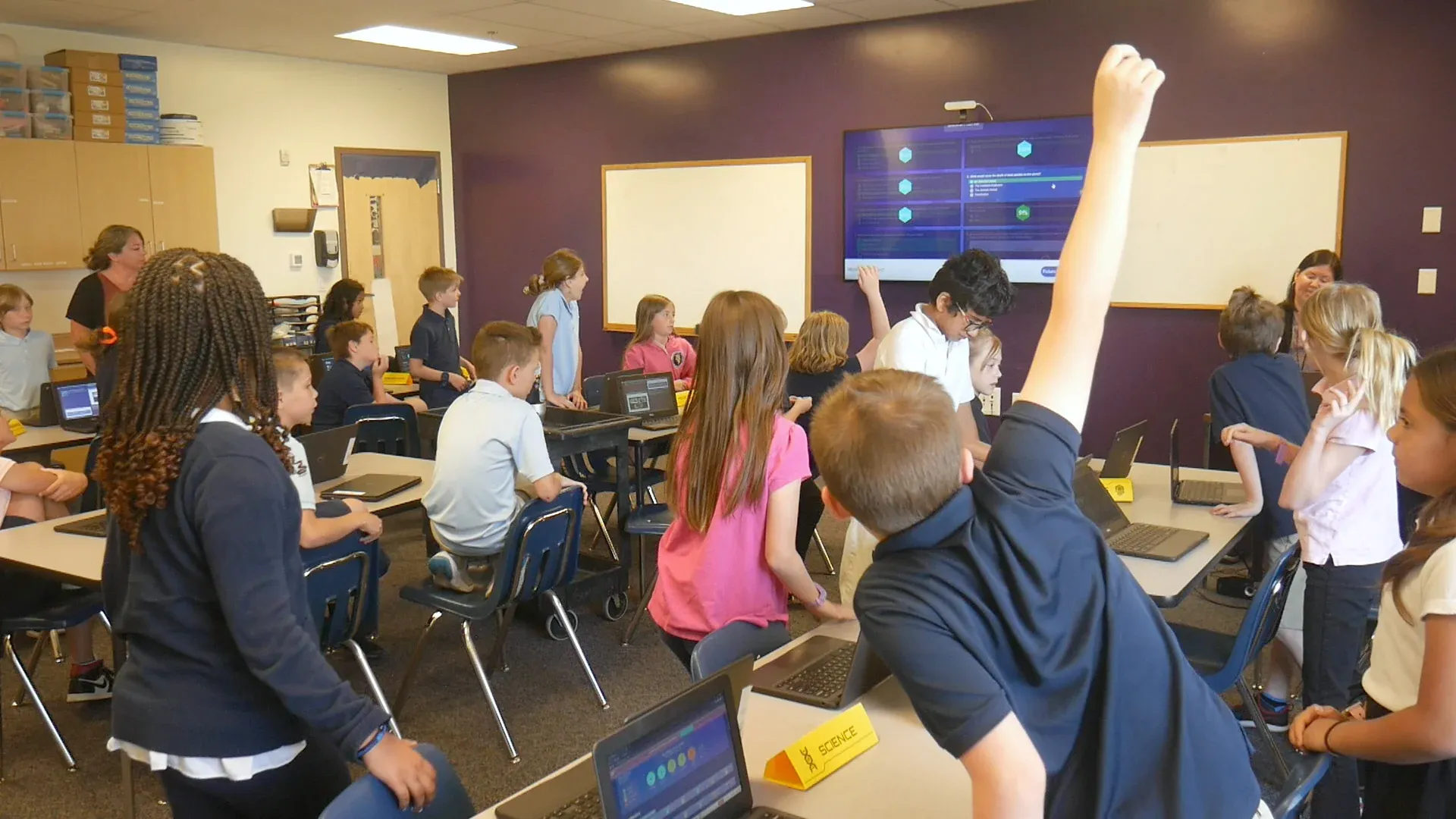
    A class of young students on their feet between tables of open Chromebooks, one boy's arm stretched high, while a question shows on the big screen at the front of the room.
    What you'll see: a class on its feet between the tables, one hand up high, and a question on the big screen.

    A new terraforming project on Tellenor is at risk of failing, because there aren’t enough animals yet to help the plants reseed and pollinate. The class’s job is to build upgrades for droids that copy the features of pollinators and of the animals that carry seeds around. The story plays on the projector.

    There are no crews or stations in this one. Every student works on their own screen. The story goes the way most of the class chooses, and each child’s own choices and answers go into their report. We run the story and every screen; you walk the room and ask the questions: what does the bee actually do for the plant, which droid part copies that, and what would it miss?

    It’s built to 2-LS2-2 (develop a simple model that mimics the function of an animal in dispersing seeds or pollinating plants). Run the pipe cleaner pollinators first (number 4 above), and tell the class why: the droids are going to need whatever the bees taught them. The lesson prepares them. The Mission is what they’re preparing for.

    “I even sent an email to my whole building encouraging everyone to try it.”

    Jen, Veteran teacher, OH

    Will it work in my room?

    Students join with a class code: no student accounts, no student email, no passwords. Chromebooks, laptops, or tablets, plus your projector. Free for teachers, no credit card. Student data is covered by COPPA and FERPA, and we signed the Student Privacy Pledge. At about 18 minutes, Flight of the Pollinators runs one minute past the average K to 2 science block. Borrow the minute, or run it on cart day.

    START FREE →

    Communication first, then the plants unit's two

    What the report shows

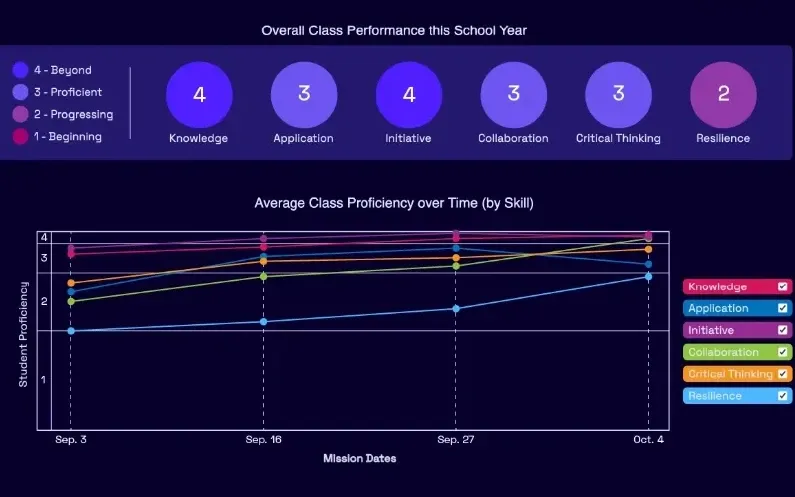
    A Mission.io class report: the class score in each of six skills, from knowledge and application to collaboration, critical thinking, and resilience, with the class chart across the year below.
    A class report from a real Mission: the class score in each of six skills, then each skill across the year.

    Every Mission produces a report for every student, built from what that student did across the whole Mission, on the skills the Mission captured. The six it can capture are Knowledge, Application, Initiative, Collaboration, Critical Thinking, and Resilience. The first two are what a test already sees. The other four are the human skills every school promises. The test shows what they know. The report shows the rest. SEE THE EVIDENCE →

    You taught it. Now find out who can use it.

    Who's behind it

    Mission.io is a research and design organization with one job: make collaborative, active learning something a teacher can run every unit instead of once a semester, and put a report in your hands when it’s over. Over a million students have run a Mission. The research behind them is funded by the National Science Foundation and the U.S. Department of Education’s Institute of Education Sciences, and Mission.io meets ESSA Level II standards, as validated by Instructure.

    2nd grade science Missions by NGSS standard

    Flight of the Pollinators is one. There are 16 science and engineering Missions at 2nd grade, numbered 7 to 22 below, and each one is where a unit can end: materials end at the playground, plant needs end in Moodoo’s greenhouse, landforms end at the Treasure Hunt. Every lesson finally has somewhere to go. Each code links to its standard on nextgenscience.org.

    Matter and its interactions (2-PS1)

    Every standard has a Mission, and Brik by Brik, at 12 minutes, fits a 17-minute block.

    Matter Missions for 2nd grade, by NGSS code.
    NumberThe standardMissionMinutes
    72-PS1-1, 2-PS1-2 Sort materials by their properties, then test which one is best for the job. On this page: 2. Sink or float.Playground Peril20
    82-PS1-3 An object made of small pieces can be taken apart and built into something newBrik by Brik12
    92-PS1-4 Heating and cooling cause changes, and some can be undone and some can’t. On this page: 3. Melting crayons.Hot and Cold Changes17

    Ecosystems and biodiversity (2-LS2, 2-LS4)

    Every standard has one. The seedlings above teach the first and the pipe cleaner bees teach the second.

    Life science Missions for 2nd grade, by NGSS code.
    NumberThe standardMissionMinutes
    102-LS2-1 Plan and run an investigation: do plants need sunlight and water to grow? On this page: 1. Bean seedlings.Botanical Break-In21
    112-LS2-2 Build a model that does an animal’s job for plants: carrying seeds or pollen. On this page: 4. Pipe cleaner pollinators.Flight of the Pollinators18
    122-LS4-1 Compare the variety of plants and animals in different habitatsAll Mixed Up24

    Earth's systems and changes (2-ESS1, 2-ESS2)

    Three Missions, and one standard, where water is found, has no Mission.

    Earth science Missions for 2nd grade, by NGSS code, with the standard that has no Mission.
    NumberThe standardMissionMinutes
    132-ESS1-1 Some Earth events happen fast and some happen slowly. On this page: 5. Sugar cube weathering.The Speed of Changenot listed
    142-ESS2-1 Compare solutions that slow wind and water from changing the shape of the landWind and Water16
    152-ESS2-2 Model the shapes and kinds of land and bodies of water in an area. On this page: 6. The schoolyard water map.Treasure Hunt22
    2-ESS2-3 Where water is found on Earth, and that it can be solid or liquidNo Mission

    Engineering design (K-2-ETS1)

    Built to the K-2 engineering standards, which run from kindergarten to 2nd grade. Tools of the Trade at 10 minutes is the shortest Mission on the page. The 2nd grade engineering activities page maps these standards with the design challenges that teach them.

    Engineering Missions for grades K to 2, by NGSS code.
    NumberThe standardMissionMinutes
    16K-2-ETS1-1 Define a simple problem a new tool could solve, then pick the best way to solve itTools of the Trade10
    17K-PS3-1, K-PS3-2, 1-PS4-3, K-2-ETS1-1, K-2-ETS1-2, K-2-ETS1-3 Test and compare designs that protect RALF from the sun’s warming (grades K to 2)Beach Frenzy15

    Also at 2nd grade, on other grades' standards

    Five more that run at 2nd grade on another grade’s code: three on 1st grade codes, one on a kindergarten code, and one on 3rd grade forces.

    Science Missions that run at 2nd grade on another grade's standards.
    NumberThe standardMissionMinutes
    181-ESS1-1 Patterns of the sun, moon, and stars, and a moon that seems to be disappearing (grades K to 2)Dark Side of the Moon27
    191-ESS1-2 How the hours of daylight change with the seasons (grades K to 3)Season Search18
    201-PS4-4 Build a device that uses light to send a message (grades 1 and 2)Botspace Boys18
    21K-ESS3-2 Weather forecasts help people prepare for severe weather (grades K to 2)Forecast Fiasco22
    223-PS2-1, 3-PS2-2 Balanced and unbalanced forces, and predicting a train’s motion from a pattern (grades 2 and 3)Off the Rails (2nd-3rd)23
    START FREEMISSION BRIEF →

    Free teacher account, no card. Start with the Communication Mission, marked Start here in your library, then the Mission for your unit, each after its 5-minute Teacher Preview.

    Also at this grade

    The 2nd grade STEM activities page lists the math Mission and the build challenges, and the Collaboration and Critical Thinking Missions live on the 2nd grade collaboration activities and 2nd grade critical thinking activities pages.

Questions 2nd grade science teachers ask

I get about 17 minutes for science. Which of these fits?

The seedlings’ daily check is five minutes; the setup and the debrief each split across two blocks. Four Missions on this page fit inside 17 minutes: Tools of the Trade (10), Brik by Brik (12), Beach Frenzy (15), and Wind and Water (16). Hot and Cold Changes takes all 17, and Flight of the Pollinators runs 18.

Which 2nd grade NGSS standards does this page map?

This page maps the 2nd grade performance expectations across matter (2-PS1), ecosystems and biodiversity (2-LS2, 2-LS4), Earth’s systems (2-ESS1, 2-ESS2), and the K-2 engineering standards (K-2-ETS1). The tables map each code to its Mission and to the investigation on this page that teaches it; 2-ESS2-3 has no Mission.

How do 2nd graders keep a test fair for two whole weeks?

They don’t, on their own, which is why the Checker exists. Every day the Checker says out loud whether only one thing changed, and reports a moved cup or a missed watering instead of hiding it. A team that catches its own mistake has learned more about fair tests than a team whose cups never moved.

My students can't read the record grid yet. Can they still do this?

The grid is three numbers and one color word a day, and the Measurer reads it off a centimeter ruler. Pair a strong writer with the Recorder card in week one, then rotate. For the Mission, the story is narrated aloud and shown as text on the main screen, and the text on each student’s own screen can be read aloud to them.

Is this aligned to my state's standards, not just NGSS?

Each Mission page lists its NGSS codes and the state sets it maps to. Flight of the Pollinators maps to 2-LS2-2 and to state science standards including Texas, Georgia, Missouri, and Wisconsin.