2nd grade problem solving activities

One classic rebuilt so 2nd graders read the story before they grab the numbers, five more fixed, a free sheet, and the whole-class Mission we’d run with 2nd graders.

Who we are. Mission.io makes Missions: teacher-led, whole-class simulations where students use what they’re learning to work through a real scenario together.

Everything on this page works without us. The Mission we’d run with 2nd graders waits at the end, free. (Villains tried to recycle a playground in it. Your field trip bus is safe.)

On this page

What problem solving looks like in 2nd grade

Second grade problem solving activities ask seven-year-olds to work out what a story is asking before they do any math, then pick the operation and say why. That small step is the difference between a child who understands a word problem and a child who adds every number in sight. This page rebuilds the routine designed for exactly that.

Seven-year-olds dislike taking risks or making mistakes, they’re bothered by mistakes, and they listen well and speak precisely. Many would rather work alone or with one friend. A numberless problem takes away the thing they’re afraid of getting wrong, the answer, for the first stretch of the lesson, and rewards the careful listening they’re already good at: “some more got on” means adding to.

The standard asks them to solve one- and two-step word problems within 100 (adding to, taking from, putting together, taking apart, and comparing, with the unknown in any position) using drawings and equations with a symbol for the unknown (CCSS 2.OA.A.1). The practice standard asks them to explain to themselves what a problem means and look for a way in (CCSS Mathematical Practice 1). The activity below puts your own field trip on the board.

Six things that make a 2nd grade word problem real

Across 53 studies, students who tried a problem first and got the lesson after outperformed students who were taught first, but most of them were 12 to 18, and the approach worked less well for younger kids without the background yet (Sinha and Kapur, 2021). For 2nd graders, that argues for a short, safe struggle: a prediction, a reveal, then the teaching. Here’s each of the six in 2nd grade; the K to 8 problem solving guide has the studies.

  1. 1. A real problem with stakes the class can feel.

    “Some children were on a bus” belongs to nobody. Your class’s actual field trip, with seats that might run out, belongs to everybody in the room.

  2. 2. Apply, don't recall.

    Hide the numbers and a seven-year-old has to understand the story to say anything at all. Sense-making before computing is what 2.OA.A.1 is really after.

  3. 3. Group goals with individual accountability.

    Hands up means three children think and the rest wait their turn. A prediction strip on every desk means every child commits to something before each reveal.

  4. 4. The teacher leads the thinking.

    The routine is teacher-led by design, so this one’s half done. Take it to the tables: ask a pair what they think the next number will be, and why.

  5. 5. A debrief where the class argues it out.

    As usually run, the routine stops at the answer. Add seven minutes for what the class predicted, whose retelling changed their mind, and what to tell the bus company.

  6. 6. A way to see who did what.

    If you can’t say which child named the operation and which one borrowed it, you can’t teach problem solving yet. The strips and the equation board put both on paper.

Story first. Numbers last.

Numberless word problems already hit two of the six. Here’s how to get the other four without losing the routine you like. Get the sheet, reveal cards and all →

Numberless word problems, rebuilt to hit all six

You know the routine, Brian Bushart’s. A word problem goes up with the numbers taken out (“Some children were on the bus. Some more got on.”), the class talks about what’s happening, the numbers come in one at a time, and the question comes last. It’s the standard cure for the kid who grabs every number and adds it. As usually run, it’s also whole-class talk with hands up, a story nobody needs solved, and an ending at the answer.

Make the bus yours and give every child a prediction to commit to, and it hits all six.

Time
35 minutes: 3 to set the scene, 12 for the first problem’s reveals and partner talk, 5 for the equation boards, 8 for round two, 7 for the debrief. A 45-minute block holds it with room to spare.
Groups
Pairs, then fours for the equation. With 25 children, make one group of five, and the fifth child holds the equation board for round one.
Supplies
The prediction strips and the equation board frame (both on the sheet), whiteboards, and your real field trip numbers. Printing only.
Standards
CCSS 2.OA.A.1 (one- and two-step word problems within 100, with a symbol for the unknown), CCSS Mathematical Practice 1.
  1. The problemStakes

    Use the real trip: “Our class is going on the field trip, and the bus has a number of seats. Some of us are riding, some parents are coming, and some kids from the other class are joining us. Before the numbers come out, tell me what we’ll need to figure out, and what could go wrong.” A bus with too few seats is a problem seven-year-olds take personally.

  2. A prediction before every revealApply

    Every child has a prediction strip. After each reveal, they write the number they think comes next and what they’ll do with it: add it, take it away, or compare it. Use your class’s real numbers, kept within 100, and put the unknown in the middle: how many more seats do we need?

  3. Partner jobs, then foursAccountability

    Partners swap jobs at the halfway reveal. For the last step, two pairs join up: the four have to agree on one equation with a box for the unknown, and a rotating Equation Holder holds it up.

    • Teller

      Retells the story so far in their own words, numbers included.

    • Asker

      Asks "What are we trying to find?" and writes down the partner's answer.

    • Equation Holder

      Holds up the group's equation and has to explain the box.

  4. You lead the thinkingTeacher leads

    Walk the tables with three questions: What is happening in the story, in your words? What do you think the next number will be, and why? What goes in the box, and how do you know? A seven-year-old who says “I don’t know” can still answer the first one.

  5. Round twoApply

    Same bus, new question: now how many seats are empty? The equation has to change, and somebody in each four has to say why.

  6. The debriefDebrief

    Seven minutes, whole class. What did you predict before the question came, and were you right? Whose retelling changed what you thought the problem was? How many seats do we need, and what do we tell the bus company?

  7. See who did whatSee who did what

    Four marks per child: retold the story accurately, predicted a number with a reason, named the operation with a reason, explained the box. The Teller and Asker jobs make each pair audible in a thirty-second visit, and the equation board catches every four, so expect about half the room in one go.

(Somebody will predict that the next number is a hundred. Write it down. It’s a prediction.)

Second graders will hear “some more got on” in the next word problem and know it means adding before they see a single number.

The field trip bus problem, free

Emailed now, ready to copy: the teacher page, the Teller, Asker, and Equation Holder cards, the field trip problem on six reveal cards with an answer key, the prediction strip, the equation board, and the four-behavior tally.

It’s on its way.

Check your inbox for the field trip bus problem.

Email me the sheet. It comes as a PDF, ready to print. Unsubscribe anytime.

Five more classics, and the fix each needs

Second grade word problems come with plenty of advice and more worksheets. These are five classics teachers actually run. Here’s how each one usually runs, and what to change.

Five more for 2nd grade

1. Act-it-out story problems (K to 1)

Needs cubes or counters, or just bodies. Whole class.

Children act out a story problem with bodies or cubes before writing the number sentence. It’s a kindergarten and 1st grade classic that 2nd graders grew up on, and it still puts the math to use. As usually run at this grade, though, it’s a whole-class warmup a few children act out, with no record of who did the thinking.

The fix

  1. Save it for a pair that’s stuck on the equation.
  2. Have them act out only the part they can’t picture, then go back to the equation.

See act-it-out problems rebuilt for kindergarten →

2. Tangram puzzles (1 to 2)

Needs a tangram set and outline cards. Solo, at a center.

Seven pieces fill one outline, with no gaps and no overlaps. Fitting them takes real thinking about shapes. As a center, though, it’s one child at a time, and nobody talks about it after.

The fix

  1. Give each partner half the pieces, so the outline needs both of them.
  2. Every placement gets said out loud before the piece goes down, like “the square goes in the corner.”

See tangrams rebuilt for 1st grade →

3. Three-act math tasks (K to 5)

Needs a short video or photo on the projector. Whole class.

A short video raises a question with no numbers given; the class decides what it needs to know, then sees the reveal. Students apply the math, you lead it, and there’s often a debrief built in. As usually run, though, a few voices ask for all the information, and nothing shows who did the thinking.

The fix

  1. Give each group a limit, like three asks for information.
  2. Before anyone raises a hand, the group argues for the ask and agrees it’s worth one of the three.

See a three-act task rebuilt for 3rd grade →

4. Number talks

Needs a whiteboard. Whole class. 10 minutes a day.

You put one computation on the board, students solve it in their heads, and they share strategies out loud, ten minutes a day. It puts number sense to use, and you lead the talk. As usually run, though, the same few hands share, and nobody has to listen to anybody else.

The fix

  1. Before anyone shares the next strategy, a partner restates the last one in their own words.
  2. Tally each restatement on a class list as it happens.

No page for this one; with the restate rule it’s ten minutes well spent.

5. Which One Doesn't Belong (K to 8)

Needs four pictures or numbers on the board. Whole class.

Four pictures or numbers go on the board, and any one of them could be the odd one out, for a reason. Every pick can be defended, so students put what they know to use, with you leading. As usually run, though, hands go up and one reason gets heard, and it’s closer to critical thinking than problem solving.

The fix

  1. Every child writes a pick and a reason on a card before anyone shares.
  2. Give one child in each group the job of disagreeing, by arguing the picked one does belong.

See Which One Doesn't Belong rebuilt for 2nd grade critical thinking →

  • Our part · We make Missions

    Or let a Mission tell the story. You ask why.

    Plenty of 2nd grade teachers run numberless problems by hand every week, and they work. A Mission is a teacher-led, whole-class simulation: we connect every screen, tell the story, and keep it moving, so you’re free to walk the room and ask a seven-year-old what she thinks comes next.

    You're at the helm, not on the hook.

    Playground Peril: the Mission we'd run in 2nd grade

    Playground Peril · Grades 1 to 2 · About 20 minutes · One device per student, plus your projector · Free with a teacher account

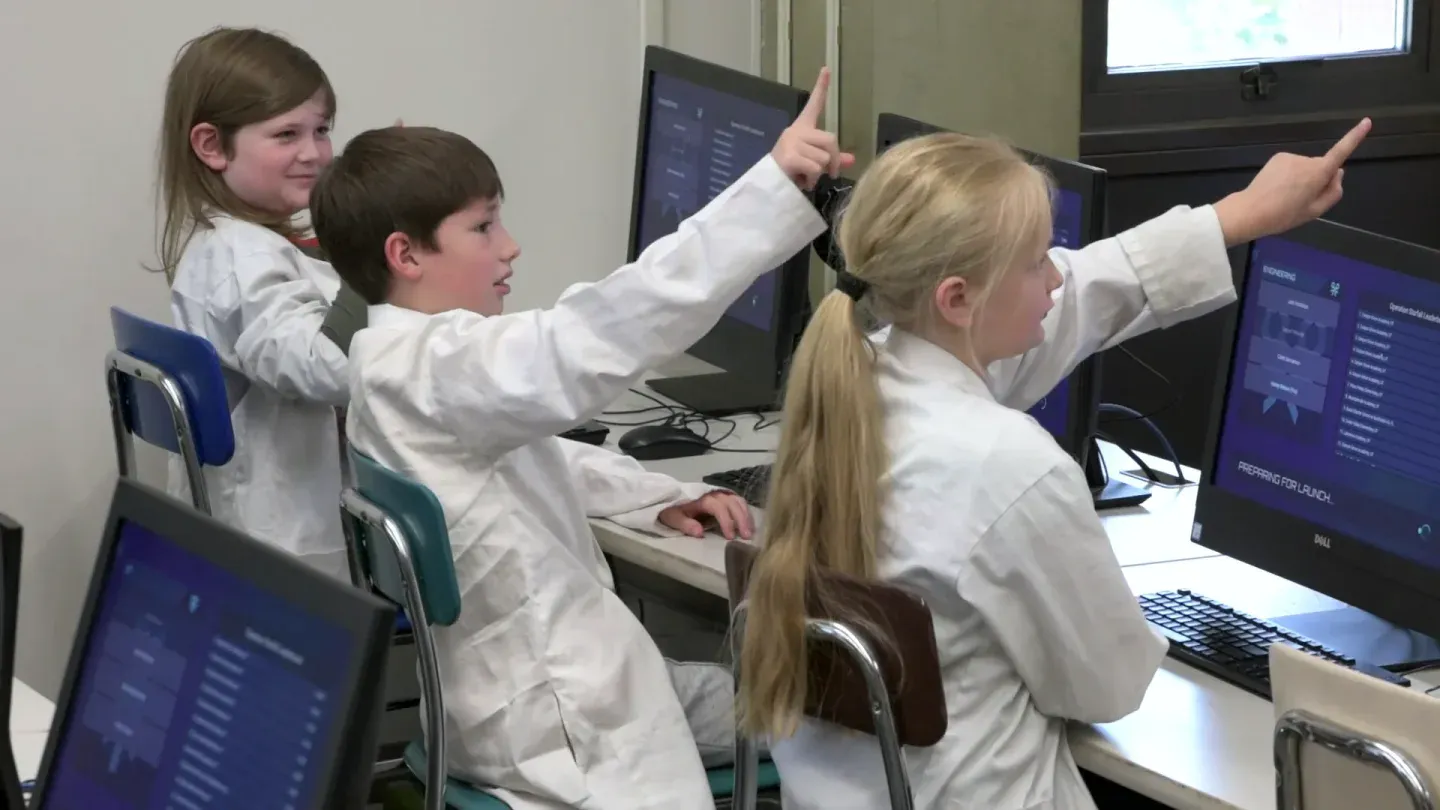
    Three young students in white lab coats at desktop computers, two of them pointing up toward the front of the room.
    What you'll see: kids in lab coats pointing at the front of the room, sure they've spotted something, and you a few steps away instead of at the board.

    The GAL-Delilahs, the crew’s old rivals, tried to recycle pieces of a playground, and now some are missing. Your class has to work out how the materials were sorted, then come up with a temporary fix for the missing pieces. The mess plays out on your projector, and each child makes the calls on their own screen.

    In Playground Peril every child works solo at a screen; it has no stations or crew teams. The story goes the way most of the class chooses, and each child’s own choices and answers go into their report. You’re walking the room, asking why that fix and not another one.

    Against the six:

    • Stakes. Pieces of the playground are missing, and the crew has to patch it for now.
    • Apply. Children work out how the materials were sorted, then devise a temporary fix. The library files it under the 2nd grade materials standard (NGSS 2-PS1-2).
    • Accountability. Every 2nd grader decides the sorting and the fix for themselves.
    • Teacher leads. Watch the 5-minute Teacher Preview, press Start, and work the room with three questions: How were these sorted? What could fix the missing piece for now? Why that one?
    • Debrief. The library’s Mission Guide lists three debrief activities, starting with Hot and Cold Changes.
    • See who did what. Every child gets a report on how well they did, built from their own choices and answers across the Mission.

    “My students ask every time they walk in the door, ‘IS IT A MISSION DAY?’”

    Kate Fallon, Teacher, St. Amelia School, NY

    Will it work in my room?

    Students join with a class code: no student accounts, no student email, no passwords. Chromebooks, laptops, or tablets, plus your projector. Free for teachers, no credit card. Student data is covered by COPPA and FERPA, and we signed the Student Privacy Pledge. No projector or devices? The bus problem needs neither, and the sheet still works.

    START FREE →

    Communication first, then this one

    This is one Mission. The library holds more than 100 built the same way, fossils to fractions, each one a destination for a unit and a report on every student.

    What the report shows

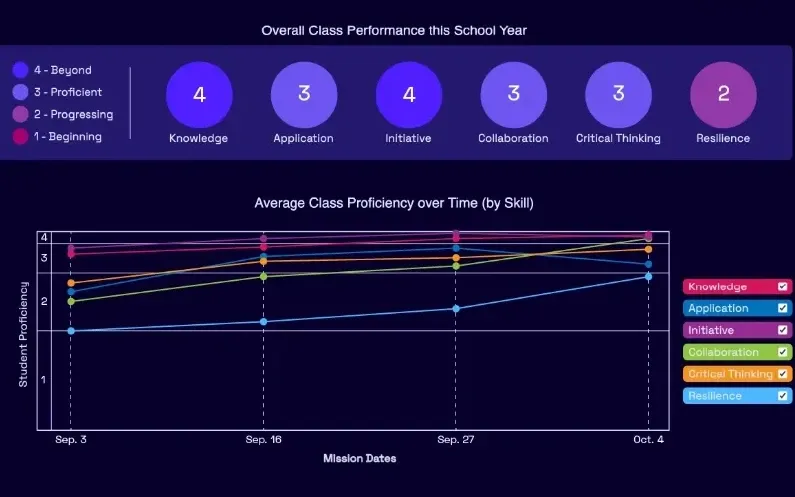
    A Mission.io class report: the class score in each of six skills, from knowledge and application to collaboration, critical thinking, and resilience, with the class chart across the year below.
    A class report from a real Mission: the class score in each of six skills, then each skill across the year.

    Every Mission produces a report for every student, built from what that student did across the whole Mission, on the skills the Mission captured. The six it can capture are Knowledge, Application, Initiative, Collaboration, Critical Thinking, and Resilience. The first two are what a test already sees. The other four are the human skills every school promises. There’s no row called problem solving, and we won’t pretend there is. It lives in the rows around it: whether a student could apply what they knew, think it through, and keep going when the first try failed. The test shows what they know. The report shows the rest. This is where problem solving gets practiced, and the only place the skills under it get measured. SEE THE EVIDENCE →

    You taught it. Now find out who can use it.

    Who's behind it

    Mission.io is a research and design organization with one job: make collaborative, active learning something a teacher can run every unit instead of once a semester, and put a report in your hands when it’s over. Over a million students have run a Mission. The research behind them is funded by the National Science Foundation and the U.S. Department of Education’s Institute of Education Sciences, and Mission.io meets ESSA Level II standards, as validated by Instructure.

    “Unlike other tech programs in the district that often have students working in isolation or in pairs, Mission.io emphasizes true collaboration.”

    Lorilee Johnson, District specialist, Alpine School District, UT
    START FREEMISSION BRIEF →

    Free teacher account, no card. Start with the Communication Mission, marked Start here in your library, then Playground Peril, each after its 5-minute Teacher Preview.

Questions 2nd grade teachers ask

My 2nd graders grab every number and add it. Will this actually fix that?

It’s the routine built for exactly that habit. With the numbers hidden, there’s nothing to grab, so the opening minutes are all about what the story is doing. By the time a number arrives, each child has already written whether they’ll add it, take it away, or compare it, and why. That’s the habit you’re building, one prediction at a time.

What about the child who won't predict because she might be wrong?

Seven-year-olds are bothered by mistakes, so make a wrong prediction ordinary. A prediction is a guess with a reason, and the strip has a box for the reason, not a box for right. Praise the best reason, not the closest number, and the careful kids start writing.

Many of my 2nd graders prefer to work alone. Why put them in fours?

They start in pairs for that reason; at seven, many children would rather work alone or with one friend. The four only forms for the last step, agreeing on one equation, and by then each pair has done its own thinking. The Equation Holder job rotates so the quiet partner gets a turn to explain the box.

How does this fit into my math block?

It runs 35 minutes as written, so a 45-minute block has ten minutes left over. Spend them on one more question about the same bus, and the equation has to change again. The sheet keeps the setup to printing.