Critical thinking activities for students

Eleven classics and the fix each needs, what critical thinking looks like at every grade from kindergarten to 8th, the six things that separate it from a show of hands, a free observation sheet, and a Mission built to measure it.

Who we are. Mission.io makes Missions: teacher-led, whole-class simulations where students use what they’re learning to work through a real scenario together. We build every one on the six things this page teaches, and every student gets a report on how well they did.

You don’t need us to use this page: the classics, the fixes, and the observation sheet all work on their own. But the Mission we built for critical thinking is waiting at the end, free. (Its big call is which door hides a robot and which one hides explosives. Evidence strongly recommended.)

On this page

What is a critical thinking activity?

Critical thinking activities are classroom tasks in which students have to reach a judgment from evidence and give reasons someone else can check. Most things called critical thinking activities stop one step short, and you know the discussion where it shows. A great question, twenty-eight kids, and the same four hands.

That isn’t a thinking problem. It’s a design problem, and design problems are fixable, because critical thinking is a skill: purposeful judgment that interprets, analyzes, evaluates, and infers, in the experts’ consensus definition (Facione, 1990). A skill can be taught, so it has to be built into the activity on purpose. And it can be seen, so you should be able to walk past any table and say who made a claim, who backed it with evidence, who found the hole in it, and who changed their mind.

The standards ask for exactly that. Science calls it arguing from evidence (NGSS practice 7): an argument with evidence for a claim in K to 2, a critique that cites evidence by 3rd grade, a spoken and written argument from evidence in middle school. Math says it in one sentence from kindergarten to 8th: construct viable arguments and critique the reasoning of others (CCSS MP3). This page is about the activities that make it happen, and each grade’s page shows you how to run one.

Six things that make an activity build critical thinking

What separates a discussion that builds the skill from one that fills a period? The research is blunt about it, and specific.

Start with the review built for this question. 341 studies of teaching students to think critically, and the teaching worked, with an overall effect of g = 0.30. The largest effect, g = 0.57, came from three things used together: dialogue, authentic problems, and mentoring (Abrami et al., 2015). The same research names what the activity has to look like.

  1. 1. A real problem with stakes the class can feel.

    Ask a question nothing depends on and you get opinions. Authentic, applied problems are one of the three ingredients in the strongest combination Abrami’s team found.

  2. 2. Apply, don't recall.

    There’s no stand-alone thinking skill a student can carry from subject to subject. Thinking is intertwined with what you know about the thing you’re thinking about (Willingham, 2007), so the thinking has to happen inside the unit, with the content.

  3. 3. Group goals with individual accountability.

    One most classics miss. Hands go up, the quick kids answer, and the class moves on believing it thought. The loudest finding here comes from cooperative learning research rather than critical thinking studies: when the group shared a goal and each student answered for a part, 84% of studies found a positive effect on achievement. Without both, 17% (Slavin, 1991).

  4. 4. The teacher leads the thinking.

    Asking is the job. Teacher questioning moved critical thinking in Abrami’s review (g = 0.38), and mentoring is one of the three ingredients in the combination that worked best.

  5. 5. A debrief where the class argues it out.

    The activity is the setup. The argument afterward is the learning: guided discussion moved critical thinking whether it ran with the whole class (g = 0.42) or in small groups (g = 0.41), in the same review.

  6. 6. A way to see who did what.

    If the only thinking you can see belongs to the kids with their hands up, you’ll start to believe only they can do it. In one national survey of 499 teachers, 35% said critical thinking mainly benefits high-ability students (Reboot Foundation, 2020). Count the moves by name and you stop guessing.

Discussion is a format. Critical thinking is a skill.

Every grade page on this site takes one classic and rebuilds it to hit all six, step by step, with a printable. Get the free observation sheet that works for any of them →

Find your grade: what changes from kindergarten to 8th

The skill changes shape every year, which is why the activity has to. Kindergartners have to be taught to ask before they guess. Eighth graders have to be taught to switch sides out loud, with a reason, in front of their friends. Same skill, nine different jobs. One line per grade, one page per grade, and the classic you’ll see rebuilt there.

  1. Kindergarten

    Five-year-olds think out loud before acting, so every guess is a hypothesis you can hear.

    The mystery bag, rebuilt. Kindergarten critical thinking activities →

  2. 1st grade

    Competitive and extremely sensitive to criticism, so a choice with no wrong answer, only a reason to check, fits.

    Would You Rather, rebuilt. 1st grade critical thinking activities →

  3. 2nd grade

    Bothered by mistakes, and precise talkers; four answers that can all be right take the risk out.

    Which One Doesn't Belong, rebuilt. 2nd grade critical thinking activities →

  4. 3rd grade

    Full of ideas and still thinking concretely: claims about whether a cactus survives in the schoolyard, not about values.

    Four corners, rebuilt. 3rd grade critical thinking activities →

  5. 4th grade

    Nine-year-olds want to know how things work, and their group work often involves arguing. Give the argument a rule to find.

    Guess My Rule, rebuilt. 4th grade critical thinking activities →

  6. 5th grade

    Rules and logic, and the first year most of a class can hold the other side’s argument long enough to answer it.

    The classroom debate, rebuilt. 5th grade critical thinking activities →

  7. 6th grade

    Eleven-year-olds challenge adult assumptions and enjoy brain teasers. “Is this real?” is both.

    Real or fake, rebuilt. 6th grade critical thinking activities →

  8. 7th grade

    Twelve-year-olds see both sides but like to argue one, so the argument becomes a model that has to survive a test.

    The mystery tube, rebuilt. 7th grade critical thinking activities →

  9. 8th grade

    Strong opinions and a reluctance to take risks; the year to make changing sides a legal move.

    Philosophical chairs, rebuilt. 8th grade critical thinking activities →

Developmental lines from Responsive Classroom’s Common Developmental Traits by Age (2024); the grade pages carry the sources.

Eleven critical thinking classics, each one fixed

If you’ve ever asked a great question and gotten one answer and twenty-seven nods, one of these eleven is probably the reason. They’re on every list. Here is what each one is, how it usually runs, the tweaks that make it earn the word, and the grade page that rebuilds it start to finish.

A filled dot means the classic, as it usually runs, has that criterion; a ring means it usually misses it. Tap a number to read the criterion.

(Look down columns 3 and 6: ten of the eleven usually miss accountability, and all eleven miss a way to see who did what.)

Eleven critical thinking classics against the six criteria above, as they usually run.
#Activity1 Stakes2 Apply3 Accountability4 Teacher leads5 Debrief6 See who did whatSee it rebuilt
1Mystery bagK to 1Usually misses: apply, accountability, seeing who did whathas Stakesmisses Applymisses Accountabilityhas Teacher leadshas Debriefmisses See who did whatKindergarten
2Would You Rather, math edition1 to 5Usually misses: stakes, accountability, debrief, seeing who did whatmisses Stakeshas Applymisses Accountabilityhas Teacher leadsmisses Debriefmisses See who did what1st grade
3Which One Doesn't BelongK to 8Usually misses: stakes, accountability, seeing who did whatmisses Stakeshas Applymisses Accountabilityhas Teacher leadshas Debriefmisses See who did what2nd grade
4Four corners3 to 8Usually misses: accountability, seeing who did whathas Stakeshas Applymisses Accountabilityhas Teacher leadshas Debriefmisses See who did what3rd grade
5Guess My Rule3 to 5Usually misses: stakes, accountability, seeing who did whatmisses Stakeshas Applymisses Accountabilityhas Teacher leadshas Debriefmisses See who did what4th grade
6Classroom debate4 to 8Usually misses: stakes, accountability, seeing who did whatmisses Stakeshas Applymisses Accountabilityhas Teacher leadshas Debriefmisses See who did what5th grade
7Socratic seminar4 to 8Usually misses: stakes, accountability, seeing who did whatmisses Stakeshas Applymisses Accountabilityhas Teacher leadshas Debriefmisses See who did what8th grade collaboration
8Logic grid puzzles3 to 8Usually misses: all sixmisses Stakesmisses Applymisses Accountabilitymisses Teacher leadsmisses Debriefmisses See who did whatNo page
9Real or fake5 to 8Usually misses: stakes, accountability, seeing who did whatmisses Stakeshas Applymisses Accountabilityhas Teacher leadshas Debriefmisses See who did what6th grade
10Mystery tube6 to 8Usually misses: stakes, accountability, seeing who did whatmisses Stakeshas Applymisses Accountabilityhas Teacher leadshas Debriefmisses See who did what7th grade
11Philosophical chairs6 to 8Usually misses: stakes, seeing who did whatmisses Stakeshas Applyhas Accountabilityhas Teacher leadshas Debriefmisses See who did what8th grade
How many have it2 of 11 have Stakes9 of 11 have Apply1 of 11 have Accountability10 of 11 have Teacher leads9 of 11 have Debrief0 of 11 have See who did what

K to 2

1. Mystery bag (K to 1)

Needs a cloth bag, an object from your unit. Whole class on the rug. 15 minutes.

Something hides in a cloth bag, and the class guesses what it is from clues before the reveal. It runs on the rug with you leading, a natural fit for five- and six-year-olds. As usually run, though, it’s circle time where the loudest guesser wins, nobody has to reason from what they know about the object, and most children never get a turn.

The fix

  1. Put an object from your unit in the bag, and give the class ten questions, tallied on the board.
  2. Allow only questions about properties, like hard or soft, legs or no legs.
  3. Make every guess cost one question.

See the mystery bag rebuilt for kindergarten, with a ten-question budget and a reason to be right →

2. Would You Rather, math edition (1 to 5)

Needs two option cards with numbers on them, half sheets. Pairs, then fours. About 30 minutes done right.

Three boxes of six crackers, or two boxes of nine? Students pick and defend the pick with math, and you get to ask why. As usually run, though, it’s a bell-ringer: three hands go up, nothing comes of the pick, and then the lesson starts.

The fix

  1. Make the class live with the choice, so the snack they pick is the snack they get.
  2. Have every child draw both options and circle a pick before anyone talks.
  3. Give each pair a Checker who counts the partner’s drawing.

See Would You Rather rebuilt for 1st grade, where the class actually buys the snack it picks →

3. Which One Doesn't Belong (K to 8)

Needs four shapes or numbers on the board, index cards. Groups of four. About 35 minutes done right.

Four shapes or numbers go up, and every one can be argued not to belong. The reasons are real, and you’re the one asking why. As usually run, though, it’s a warmup with hands up, so one reason gets heard, and it’s often “it looks weird.”

The fix

  1. Give the set a job with a true answer, like four shapes the art teacher needs sorted for a mural.
  2. Have every student put a pick and a reason on a card first.
  3. Assign a Defender who argues for the shape everyone else rejected.

See Which One Doesn't Belong rebuilt for 2nd grade, Defender included →

3 to 5

4. Four corners (3 to 8)

Needs four corner signs. Whole class. 45 minutes done right.

The teacher reads a statement, students walk to the corner that matches their position, and anyone persuaded may move. The reasons are real, and you’re steering. As usually run, though, it’s a get-up-and-move where the corner’s loudest kid speaks for ten, and nothing gets written down.

The fix

  1. Make each corner a claim students have to back with evidence.
  2. Before anyone moves, every student writes a reason on a card.
  3. Anyone who switches says which fact moved them.

See four corners rebuilt for 3rd grade, where the class decides which animal the school garden gets built for →

5. Guess My Rule (3 to 5)

Needs an in-out table and a rule only you know. Groups of four. 40 minutes done right.

Numbers go into the machine and come out changed, and the class hunts for the rule. It’s real math reasoning, with you running the machine. As usually run, though, it’s a game on the board, and the fastest kid calls the rule before anyone else has done the math.

The fix

  1. Give each group three tests.
  2. Before each test, the Tester says why that input will tell the group something new.
  3. A Checker tries every candidate rule on every pair before the group commits.

See Guess My Rule rebuilt for 4th grade, around a vending machine that charges the wrong prices →

6. Classroom debate (4 to 8)

Needs four source cards a side, scorecards, a timer. Teams of six. Two periods done right.

Two teams, a resolution, speeches, and a judge. There are real arguments in it, and the speakers work hard. As usually run, though, it’s a performance: three speakers per team carry it, and everyone else waits to hear who won.

The fix

  1. Debate a decision the class will actually send somewhere, like a letter to the principal.
  2. Give every student a job on the team.
  3. Strike any citation that doesn’t have its source card.
  4. Hand the judges a scorecard that counts evidence and gives nothing for volume.

See the classroom debate rebuilt for 5th grade, where the winning case goes out in a real letter →

7. Socratic seminar (4 to 8)

Needs one text, read beforehand, and a circle of chairs. Whole class. 55 minutes done right.

Students read a text in advance, sit in a circle, and discuss open-ended questions about it, citing the text, while the teacher asks instead of tells. Of everything on this list, it sits closest to the research above: talk, a text to think with, and a teacher asking the questions. As usually run, though, four students talk while twenty listen, and the seminar still counts as a success. Nothing turns on the answer, either.

The fix

  1. Before anyone reads, announce a decision the text bears on, like “Was this character right?” or “Does this evidence support the claim?”
  2. Before the circle starts, collect a card from every student with one claim, one line from the text, and one question for someone else.

Thirty is too many for one circle: see the fishbowl split on the 8th grade collaboration page, with a job for everyone in the outer ring →

8. Logic grid puzzles (3 to 8)

Needs a puzzle sheet. Solo. A quiet period.

Five people, five pets, a list of clues, and a grid. The deduction is real. As usually run, though, it’s a worksheet and a silent room, with nobody to argue with and nothing riding on it.

The fix

  1. Use one as a five-minute warmup at the start of class.
  2. Call it a warmup in your plans, and keep the words critical thinking for work students have to argue over.

No page for this one; it’s a worksheet with a grid.

6 to 8

9. Real or fake (5 to 8)

Needs one article or post, a device per team. Teams of three. 50 minutes done right.

Students decide whether to trust a website, post, or video. It’s a question every student with a phone already faces. As usually run, though, it’s a checklist lesson (does it have an About page?), done alone, which teaches kids to grade a page on its looks.

The fix

  1. Give the class a real decision with a deadline, like what the school posts tomorrow.
  2. Teach lateral reading, the fact-checker’s method from the Stanford History Education Group’s Civic Online Reasoning curriculum.
  3. Split it into three jobs, one per student: who’s behind it, what’s the evidence, and what other sources say.

See real or fake rebuilt for 6th grade, where a fact-check team decides what the school posts tomorrow →

10. Mystery tube (6 to 8)

Needs a sealed tube with four rope ends, string, tape. Groups of four. 55 minutes done right.

Pull one rope and another moves in a way that seems impossible, and groups work out the inside without opening the tube. It’s how scientists model things they can’t see. As usually run, though, it’s a one-period mystery where one student pulls, three watch, and nothing rides on the answer.

The fix

  1. Give the tube a stake, like engineers who need the inside rebuilt and can’t cut it open.
  2. Put one pair of hands on the tube at a time.
  3. Log every pull before anyone proposes anything.
  4. Assign a Skeptic whose job is the pull that breaks the group’s model.

See the mystery tube rebuilt for 7th grade, where nobody gets to look inside, same as real scientists →

11. Philosophical chairs (6 to 8)

Needs a statement, a source packet read the day before, two sides of the room. Whole class. 55 minutes done right.

A statement, two sides of the room, and one rule: summarize the last speaker before you add your point. Anyone may switch sides by saying why, and it comes closer than any other classic here to building in accountability on its own. As usually run, though, it’s a debate with movement on a values question, and the kids who never speak leave no trace.

The fix

  1. Make the statement a policy the school could adopt.
  2. Require a line from the packet for every point.
  3. Give the quiet side a job: tallying the other side’s moves, by name.

See philosophical chairs rebuilt for 8th grade, where the quiet side keeps the tally →

The observation sheet, for any activity in any grade

Free, emailed now, ready to print: the six as a checklist, with room to write how your activity hits each one, three questions to ask at the table (What’s your claim? What’s your evidence? What would change your mind?), and the four-move tally (made a claim, gave evidence, named a counterexample or limit, revised a view with a reason).

It’s on its way.

Check your inbox for the observation sheet.

Email me the sheet. It comes as a PDF, ready to print. Unsubscribe anytime.

  • Our part · We make Missions

    Or run all six as a Mission, in one class period

    Plenty of teachers rebuild these by hand every unit, and it works. A Mission is a teacher-led, whole-class simulation: your class can become the crew, the crisis is built from what you just taught, and the only way through is using it together. It does the same six things in one class period and carries the story, the setup, and the measuring. The thinking stays yours.

    You're at the helm, not on the hook.

    The Critical Thinking Mission

    Critical Thinking (4+) · Grades 4 to 8 · About 24 minutes · One device per student, plus your projector · Free with a teacher account

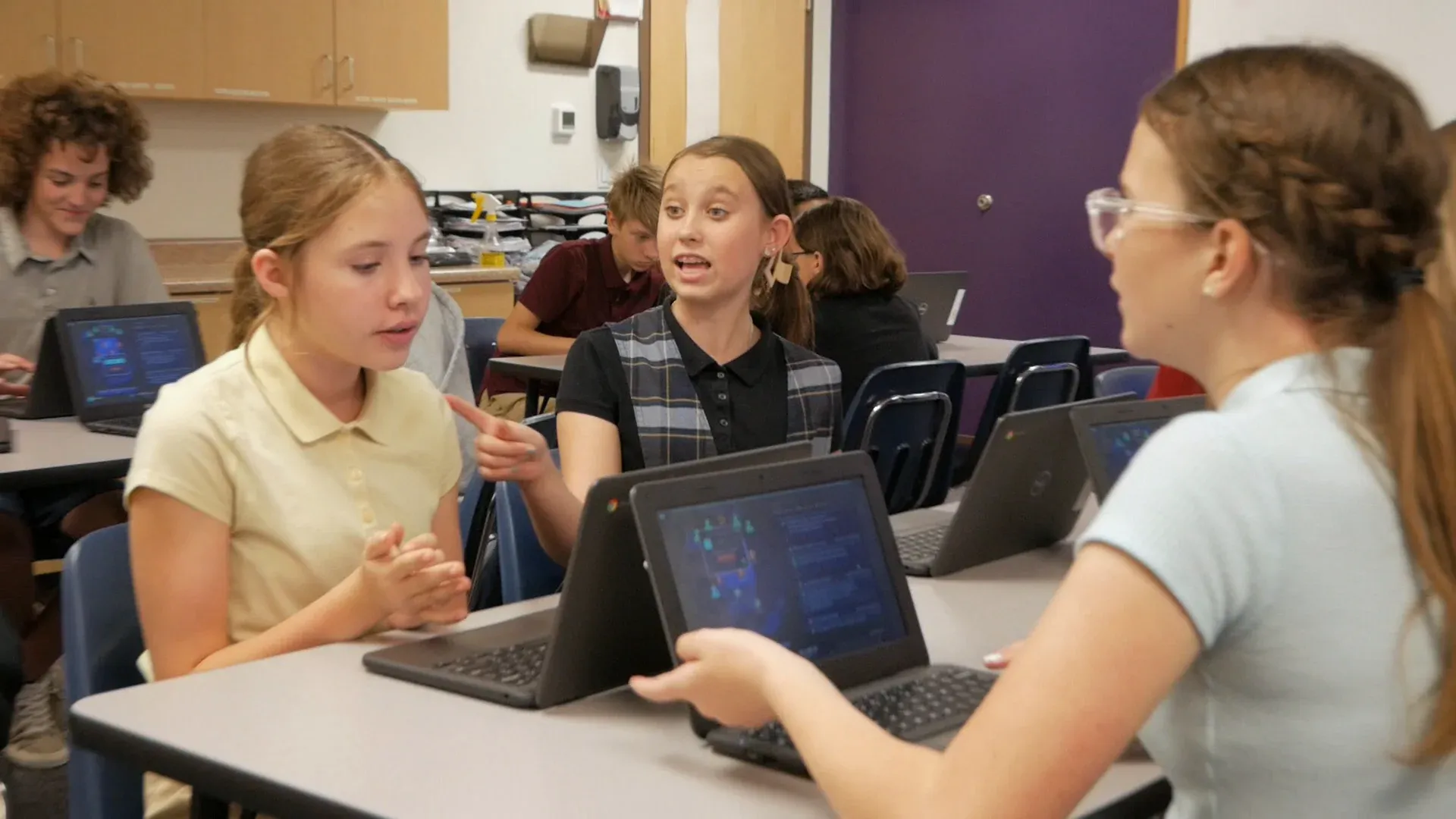
    Three middle schoolers at their Chromebooks argue a point across the desks, one pointing as she makes it.
    What you'll see: a table that can't agree on which door, one kid pointing at the evidence, and you moving between them instead of standing at the front.

    There’s a critical thinking Mission for each band. This is the 4 and up build; the K to 1 and 2 to 3 builds run about 15 minutes, and your grade’s page names yours. New to Missions? Run the Communication Mission first, the first tile below. It prepares your class for every Mission in the library, this one included.

    Our friend RALF has been swept up by the GAL-Delilahs and tagged for recycling. The crew hacks into their base with Cobalt and finds several containment doors. One holds RALF; the others hold explosives or an active Security unit. The crew reads the base’s door-status lights to find the right one, then gets RALF out with whatever’s on hand. The story plays on the projector. The work happens at seven stations (Command, Engineering, Medical, Security, Science, I.T., Operations) and in the arguments between them.

    Every student is assigned to a team, and each team’s work is themed to it, from its own information and challenge to the same problem the rest of the crew is solving. The team gives a student a role in the story and people to lean on while you move between teams. You’re at the helm, asking what that light means, which doors it rules out, and how sure they are before anyone opens one.

    It’s built to the collaborative-discussion standards for grades 4 through 8 (CCSS SL.4.1 to SL.8.1) and to making sense of information presented visually and in other formats (SL.4.2, SL.5.2). The two criteria that are hardest to build by hand, stakes the class can feel and a way to see who did what, come built in: the wrong door holds explosives, everyone works the problem on a team, and every student gets a report on how well they did when it’s over.

    “The missions are so engaging and entertaining my students don’t realize I am giving them an assessment.”

    Savannah Watson, Teacher, Orchard Elementary, UT

    Will it work in my room?

    Students join with a class code; no student accounts, no student email. Chromebooks, laptops, or tablets, plus your projector. Free for teachers, no credit card.

    START FREE →

    Communication first, then three builds by band

    Communication Mission briefs by grade: K to 1, 2 to 3, 4 and up.

    This is one Mission. There are more than 100 built the same way, from fossils to fractions, each one somewhere for a unit to go: a unit that ends this way, then the next one, then the one after that, with a report on every student each time. Every lesson finally has somewhere to go. Every grade page above names the Mission built for its grade.

    What the report shows

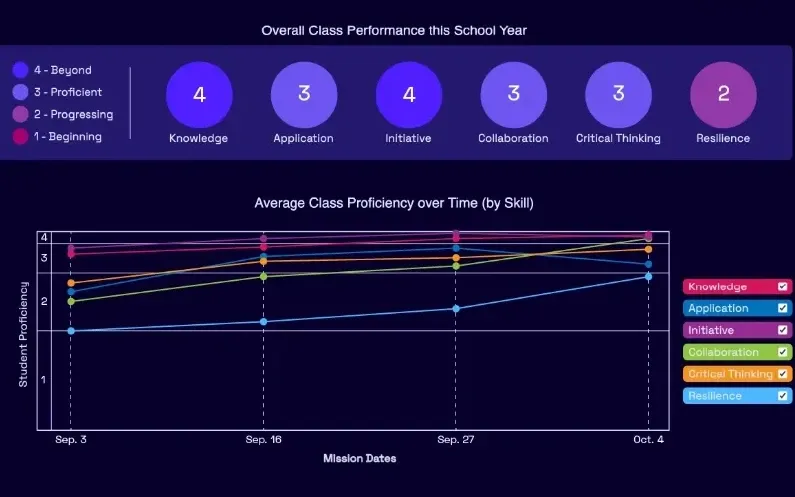
    A Mission.io class report: the class score in each of six skills, from knowledge and application to collaboration, critical thinking, and resilience, with the class chart across the year below.
    A class report from a real Mission: the class score in each of six skills, then each skill across the year.

    Every Mission produces a report for every student, built from what that student did across the whole Mission, on the skills the Mission captured. The six it can capture are Knowledge, Application, Initiative, Collaboration, Critical Thinking, and Resilience. The first two are what a test already sees. The other four are the human skills every school promises: collaboration, critical thinking, initiative, and resilience. The test shows what they know. The report shows the rest. This is where critical thinking gets practiced, and the only place it gets measured. SEE THE EVIDENCE →

    You taught it. Now find out who can use it.

    Who's behind it

    Mission.io is a research and design organization with one job: make collaborative, active learning something a teacher can run every unit instead of once a semester, and put a report in your hands when it’s over. Over a million students have run a Mission. The research behind them is funded by the National Science Foundation and the U.S. Department of Education’s Institute of Education Sciences. Mission.io meets ESSA Level II standards, as validated by Instructure, and the work has won multiple national awards. Districts bring us in to elevate the curriculum they already own. The six criteria above are the ones we build to, in every one of the 100+ Missions.

    “It’s been a while since students left my period saying that was the best class ever.”

    Will Crowther, Middle school teacher, Canyon View Middle School, UT
    START FREEMISSION BRIEF →

    Free teacher account, no card. Your account opens on the Mission library, with the Communication Mission marked Start here. Run it, then the Critical Thinking Mission for grades 4 to 8, each after its 5-minute Teacher Preview. Teaching K to 3? Your grade’s page names yours.

Questions teachers ask about critical thinking

How do I get the whole class thinking out loud, not just the regulars?

Make every student commit on a card (a claim, a reason, a question) before anyone talks, and collect it. Then give the quiet ones a job that has to be done out loud, like Checker or Skeptic. That is criterion 3, and it’s the difference between a discussion and an audience.

How do I grade critical thinking fairly?

Grade the moves. Four countable things per student (made a claim, gave evidence, named a counterexample or limit, revised with a reason) over two or three activities gives you a pattern you can defend to a parent. The kid who talks the most and never backs anything up shows up as one full row and three empty ones.

Are logic puzzles and brain teasers critical thinking activities?

Close, and usually no. Puzzles practice deduction, which matters. A critical thinking activity asks for a judgment from evidence, with reasons another student can check and argue with. Most puzzles have one answer and nobody to argue with, which is why the logic grid puzzles above get a warmup slot and no page.

Is critical thinking the same as problem solving?

They overlap, and they’re different jobs. Critical thinking is judging: is this claim true, is this source trustworthy, does this evidence support that conclusion. Problem solving is getting from stuck to done. Most good activities need both. Our problem solving activities for students take the second one grade by grade.

My class has never done this. Where do I start?

Which One Doesn’t Belong, for a week. Every pick can be defended, so nobody’s afraid to try. The 2nd grade page adds the true answer. Then one of the eleven above, rebuilt the way your grade’s page shows. The grade pages start every grade where it actually is.

Sources