7th grade critical thinking activities

The mystery tube rebuilt so every 7th grader builds and defends a model, fixes for five more classics, a free pull log, and the Mission we’d run with 7th graders.

Who we are. Mission.io makes Missions: teacher-led, whole-class simulations where students use what they’re learning to work through a real scenario together.

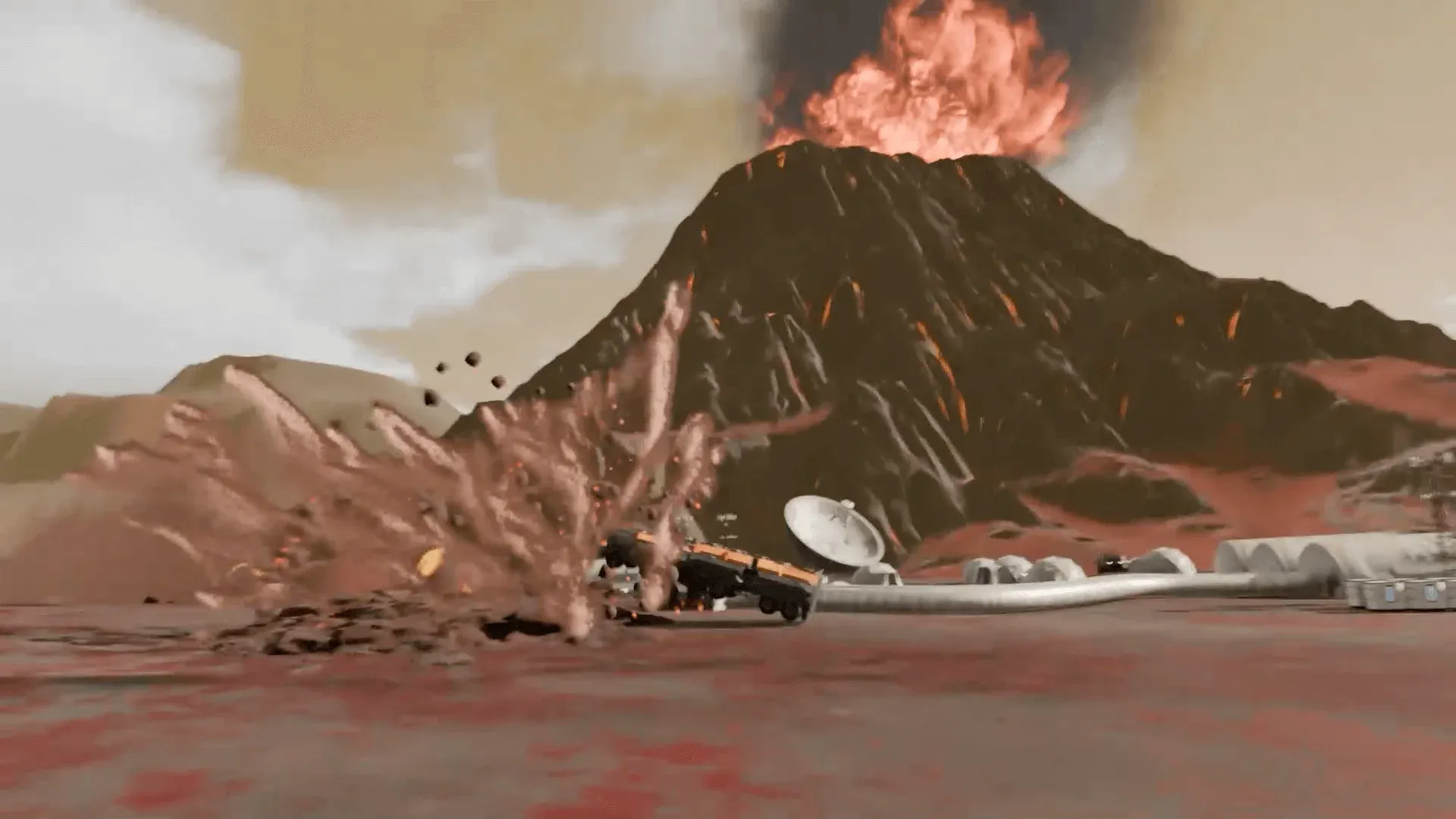
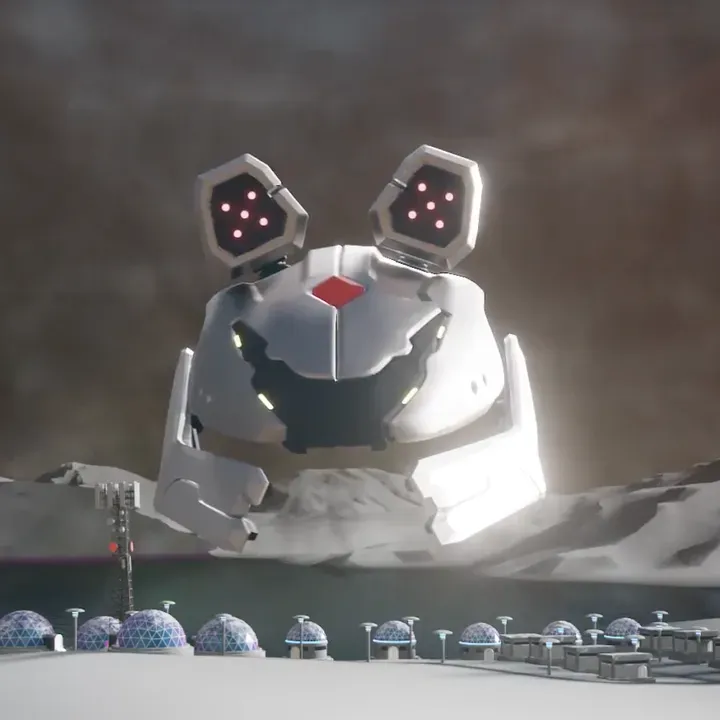
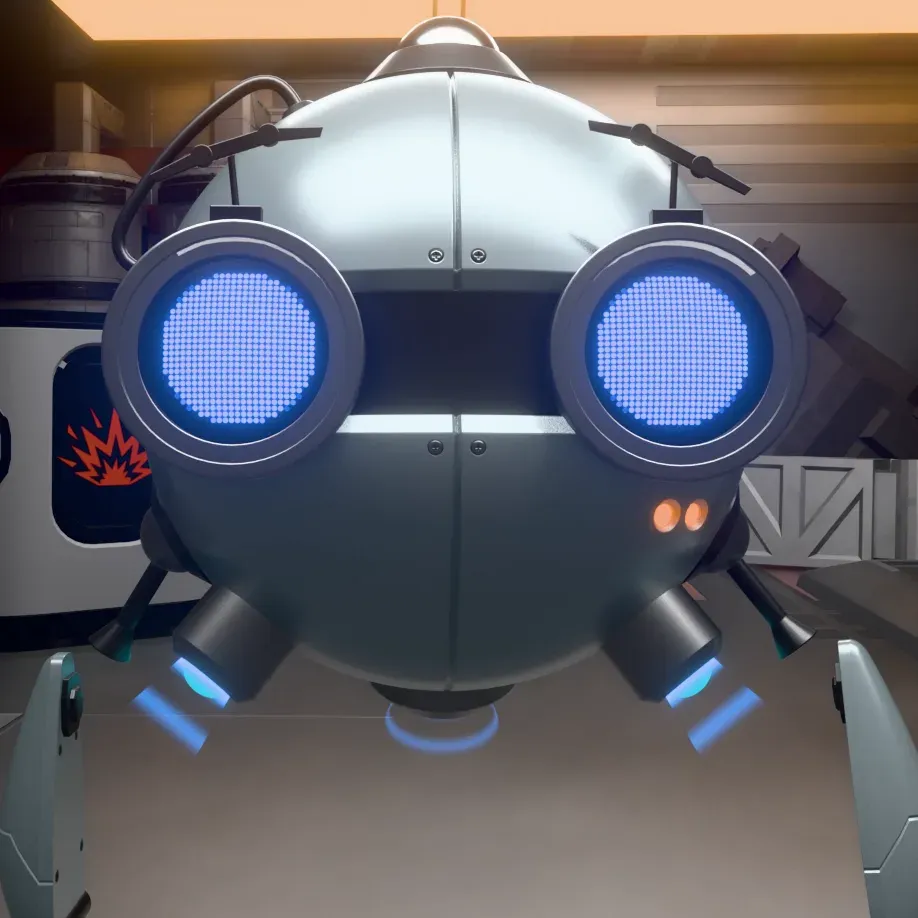
Everything on this page works without us. The Mission we’d run with 7th graders is at the end, free. (Partway through saving five patients, the crew gets interrupted by Moodoo’s drones. Seventh graders take it personally.)

On this page

What critical thinking looks like in 7th grade

For 7th graders, critical thinking means twelve-year-olds explaining something they can’t see directly, then holding that explanation up against evidence and against each other. Below, the string-and-cardboard-tube classic gets rebuilt so the explanation belongs to the whole group and survives a real test.

Twelve-year-olds can see both sides of an issue but like to argue one point. They’re also capable of self-awareness and insight, and increasingly able to plan, organize, and set short-term goals. The mystery tube takes the one point they want to argue and turns it into a model that has to predict the next pull. The insight comes free: scientists don’t get to look inside either.

The standards say this plainly. In the middle grades, NGSS wants students to develop a model to describe mechanisms nobody can observe (NGSS practice 2), and to respectfully give and receive critiques of each other’s models by citing relevant evidence (NGSS practice 7). Math’s third practice standard frames the same exchange: build a viable argument, then pick apart someone else’s (CCSS MP3).

Six things that make 7th graders think critically

Two findings from a 341-study review of critical thinking instruction matter in a 7th grade room. Guided discussion moved the skill whether it ran with the whole class (g = 0.42) or in small groups (g = 0.41), and teacher questioning moved it too (g = 0.38) (Abrami et al., 2015). The six at 7th grade come next; the studies sit in the K to 8 guide.

  1. 1. A real problem with stakes the class can feel.

    A mystery is fun for a few pulls. A part a company will build from their model, with no second tube to check against, keeps them careful for the whole period.

  2. 2. Apply, don't recall.

    The whole activity is inference, and inference leans on content knowledge (Willingham, 2007). Run it the week your unit starts building models (NGSS practice 2).

  3. 3. Group goals with individual accountability.

    As usually run, one student pulls the ropes and three watch. Rotating the jobs every three pulls means everyone operates and everyone models before the bell.

  4. 4. The teacher leads the thinking.

    Seventh graders will defend a model long after it should have died. One question at the table, what pull would break it, makes it die on time.

  5. 5. A debrief where the class argues it out.

    The Berkeley lesson already ends well, with confidence ratings and a comparison of models. Keep both, and add the question working scientists live with: what did we never find out?

  6. 6. A way to see who did what.

    The model drawings put every Modeler’s thinking on paper. Your tally covers what paper misses: who proposed a test, who predicted, who named a limit, who changed the model.

A model has to survive a test.

The mystery tube already lands more of the six than most classics do. The version below lands every one. Download the pull log and tally, free →

The mystery tube, rebuilt to hit all six

You know it. A sealed tube with four rope ends sticking out. Pull one, and another moves in a way that seems impossible. Groups work out how the ropes connect inside without opening it, draw a model, and test it. Understanding Science at UC Berkeley publishes it for grades 6 and up, and it’s how plenty of middle school science classes spend their first weeks.

It’s good already. The whole thing is inference, and the Berkeley version comes with real discussion questions. What it usually lacks is a reason to get it right and a way to see who did the thinking: one student pulls, three watch, and the model on the board belongs to whoever held the marker.

Time
55 minutes in all: 5 for the scene, 2 to hand out rope, 15 for pulls and the log, 15 to build, 8 to swap and test, 10 for the debrief. In a 45-minute block: 5 for the scene, 15 for pulls, 10 to build, 5 for you to test two groups’ models at the front, and the full 10 for the debrief.
Groups
Fours. With 29 students, run six fours plus a five, where the extra student doubles as Skeptic.
Supplies
Per group: one mystery tube (a cardboard tube, two lengths of rope, tape, end caps; the Berkeley page has the build), one blank tube, string, tape. About fifteen dollars for a class set, and you can reuse it.
Standards
NGSS practice 2 (a model of an unobservable mechanism) and practice 7 (critique a model by citing evidence).
  1. The problemStakes

    The tube is a part from a machine in a factory that closed. The company that bought the factory needs the inside rebuilt, and its engineers aren’t allowed to cut it open, because it’s the last one. Your group’s model goes to the engineers. If the model is wrong, they build the wrong part.

  2. The log comes firstApply

    Before anyone proposes a theory, the Recorder writes down every pull and every result. A model has to explain every line in the log, including the lines that make no sense. That’s practice 2: a model of something nobody can see, judged by what it predicts.

  3. Four jobs, rotatingAccountability

    One job each, and the jobs rotate every three pulls so everyone operates and everyone models.

    • Operator

      The only hands on the tube. Pulls only the rope the group names.

    • Recorder

      Logs every pull and its result before anyone proposes anything.

    • Modeler

      Draws the current best model after every three pulls and marks what it predicts next.

    • Skeptic

      Proposes one pull that would break the current model. The group has to try it.

  4. You lead the thinkingTeacher leads

    At each table, three questions: What did the last pull do, and did your model predict it? What pull would break your model? What can’t you know without opening it? The middle one does most of the work.

  5. Build it, then swap itApply

    Each group builds a physical model from a paper towel tube, string, and tape that reproduces every logged result, and the Recorder reads the log aloud to test it line by line. Then groups swap builds. The other group runs the original log against yours and writes down one result your model fails to reproduce. That written critique is practice 7.

  6. The debriefDebrief

    Ten minutes, whole class, with confidence ratings before and after, as in the Berkeley lesson. Which pull broke the most models? Whose model survived the other group’s test, and what was different about it? What did we never find out, and what would a scientist do about that?

  7. See who did whatSee who did what

    On your tally, four moves per student: proposed a test with a reason, made a prediction from the model, named a limit of the model, revised the model with evidence. The rotation puts every student in a speaking job twice in fifteen minutes, so you’ll tally about half the room, and the model drawings catch every Modeler on paper.

(Nobody opens the tube. Not at the end, and not for the group that begs. Real scientists don’t get to either.)

Twelve-year-olds will defend a model right up until one line in the log kills it, and then they’ll argue for the next one with that line in hand.

The factory mystery tube, free

Emailed now, ready to copy: the teacher page, four job cards, the factory scene with the pull log (pull, result, prediction, matched or not), the model sheet with its prediction line, the swap-and-test slip, the confidence strip, and the four-behavior tally. The tube build is on the Berkeley page.

It’s on its way.

Check your inbox for the factory mystery tube.

Email me the sheet. It comes as a PDF, ready to print. Unsubscribe anytime.

Five more classics a 7th grade room runs, fixed

Middle school science opens with mysteries because kids lean in. The question is how many lean in at each table. Here are five more classics, each with the changes that put the whole table to work.

Five more for 7th grade

1. Real or fake (5 to 8)

Needs one article or post, a checklist. Solo. A period.

Students look at an article or post and decide whether to trust it. Most rooms run it with a credibility checklist (is there an About page, is there a date), done solo in a period. The question matters to students who scroll all day. As usually run, though, nobody answers to a team, and the reasoning never leaves each student’s head.

The fix

  1. Put students in teams of three, and give each one a job from the fact-checker’s method: who’s behind it, what’s the evidence, or what other sources say.
  2. Each student writes up their job’s finding and signs it.
  3. The team can’t reach a verdict until all three findings are signed.

Real or fake, rebuilt on the 6th grade page →

2. Philosophical chairs (6 to 8)

Needs one statement on the board, an agree side and a disagree side. A period.

One statement goes on the board, students pick the agree side or the disagree side, and nobody adds a point without restating the previous one. That rule keeps students listening to each other, and anyone may switch sides by saying why. As usually run, though, the statement is a debate topic with nothing riding on it, and students who never stand up to speak leave no trace.

The fix

  1. Choose a statement the school could really adopt, like a change to the phone policy.
  2. Give the quiet students a job: tallying the opposing side’s moves, by name.

Philosophical chairs, the 8th grade rebuild →

3. CSI classroom mystery

Needs evidence stations (fingerprints, fibers, a missing object) and a suspect list. Groups. Often a kit.

Groups move through evidence stations (fingerprints, fibers, a missing object) and use what they find to pick a culprit from a suspect list, usually as the forensics unit opener and often from a kit. It has stakes, and it’s all application. As usually run, though, a couple of students in each group do the looking, and the accusation comes with no record of who inferred what.

The fix

  1. Make each station one student’s job, so every student owns a piece of the evidence.
  2. Before the group accuses anyone, every student writes an inference from their station.

No page for it; the tube’s jobs and tally carry over.

4. Discrepant event demonstrations

Needs one surprising demo (the can crush, the egg in the bottle). Whole class.

You crush a can with air pressure or slip an egg into a bottle, and the class gasps and asks why. The surprise gives it stakes, and you’re leading the thinking. As usually run, though, it’s a teacher show: students watch, one or two call out a guess, and the explanation comes from you.

The fix

  1. Before the demo, every student writes a prediction of what will happen.
  2. After it, each group draws a model that explains what they saw, with arrows for the air pushing on the can.

See the demos on the 7th grade science activities page →

5. Logic grid puzzles (3 to 8)

Needs a grid and a list of clues. Solo. A quiet period.

Five people, five pets, and a list of clues to sort out on a grid. It’s genuine deduction. As usually run, though, it’s done alone and in silence, with nothing at stake, no one to argue with, and no talk afterward.

The fix

  1. Use one as a warmup in the first five minutes.
  2. Leave it out of the lesson plan, and save the period for work the whole table has to do together.

No page; it stays a warmup.

  • Our part · We make Missions

    Or let a Mission carry everything but the reasoning

    Plenty of teachers run a tube like this every year, and it works. System Shutdown runs the same six in about 34 minutes, story and stations and student reports included. The reasoning stays with your crew, and the questions stay with you.

    You're at the helm, not on the hook.

    System Shutdown: a whole-class Mission for 7th grade

    System Shutdown · Grades 5 to 8 · About 34 minutes · One device per student, plus your projector · Free with a teacher account

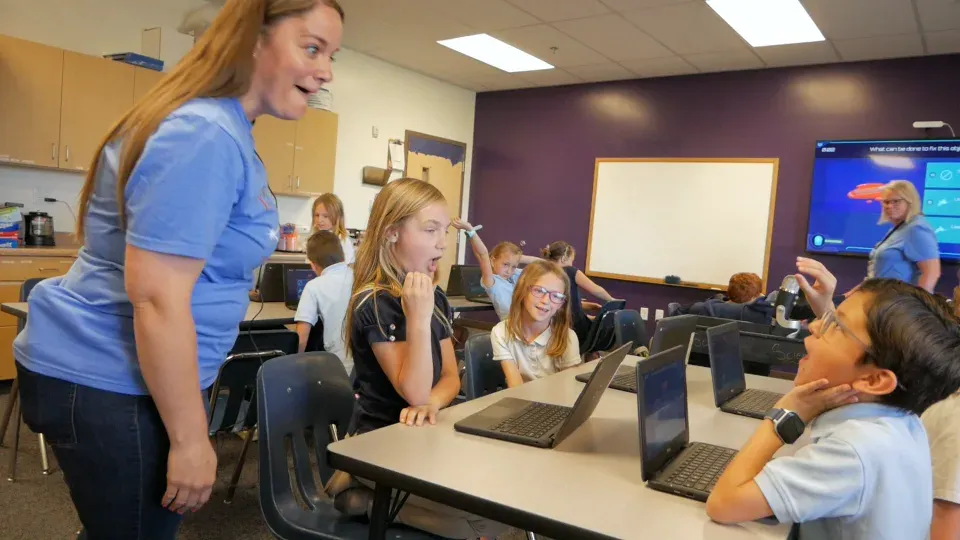
    A teacher leans down toward a table of students who stare back wide-eyed, one boy holding his cheek, while another adult stands by the big screen at the front.
    What you'll see: a table stunned by what the last graph just showed, you leaning in to ask what it means, and nobody ready to give up on their antidote yet.

    Moodoo’s toxin is making the cells, tissues, organs, and systems of five patients on Tristell slowly self-destruct. The crew reads each patient’s symptoms to find the two body systems hit hardest, makes an antidote, gets interrupted by Moodoo’s drones, and then reads graphs of how the body changes over time to decide whether to keep the antidote or change course. The story plays on the projector. The work happens at seven stations (Command, Engineering, Medical, Security, Science, I.T., Operations) and in the arguments between them.

    Every student is assigned to a team, and each team’s work is themed to it, from its own information and challenge to the same problem the rest of the crew is solving. The team gives a student a role in the story and people to lean on while you move between teams. You’re at the helm, asking what the graph says the antidote is doing.

    Against the six:

    • Stakes. Five patients are getting worse while the crew decides.
    • Apply. The crew argues from evidence that the body is a system of interacting subsystems made of groups of cells (NGSS MS-LS1-3).
    • Accountability. Every student is assigned to a team, and each team’s work is themed to it.
    • Teacher leads. Take the 5-minute Teacher Preview, press Start, and ask: Which systems do these symptoms point to? What does the graph say the antidote is doing? Stay or switch?
    • Debrief. Two follow-up activities are in its Mission Guide.
    • See who did what. Every student gets a report on how well they did, shaped by what this Mission asked of them.

    “Even my quiet or reluctant students participate because the missions are structured in a way where everyone’s voice matters.”

    Adriana Lopez, Junior high teacher, Clint Jr. High School

    Will it work in my room?

    Students join with a class code: no student accounts, no student email, no passwords. Chromebooks, laptops, or tablets, plus your projector. Free for teachers, no credit card. Student data is covered by COPPA and FERPA, and we signed the Student Privacy Pledge. No projector or devices? The tube needs neither, and the sheet still works.

    START FREE →

    Communication first, then this one

    This is one Mission. Behind it sit more than 100 more, fossils to fractions, any of which can be where a unit lands, and each ends in a report on every student. Every lesson finally has somewhere to go.

    What the report shows

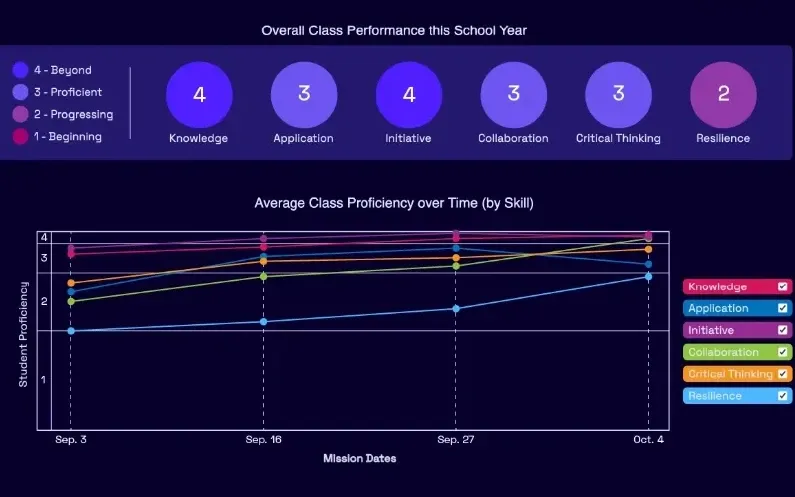
    A Mission.io class report: the class score in each of six skills, from knowledge and application to collaboration, critical thinking, and resilience, with the class chart across the year below.
    A class report from a real Mission: the class score in each of six skills, then each skill across the year.

    Every Mission produces a report for every student, built from what that student did across the whole Mission, on the skills the Mission captured. The six it can capture are Knowledge, Application, Initiative, Collaboration, Critical Thinking, and Resilience. The first two are what a test already sees. The other four are the human skills every school promises. The test shows what they know. The report shows the rest. This is where critical thinking gets practiced, and the only place it gets measured. SEE THE EVIDENCE →

    You taught it. Now find out who can use it.

    Who's behind it

    Mission.io is a research and design organization with one job: make collaborative, active learning something a teacher can run every unit instead of once a semester, and put a report in your hands when it’s over. Over a million students have run a Mission. The research behind them is funded by the National Science Foundation and the U.S. Department of Education’s Institute of Education Sciences, and Mission.io meets ESSA Level II standards, as validated by Instructure.

    “What I love most is that it’s low-prep but high-impact.”

    Ginger Marsh, Middle school teacher, Cedar Middle School
    START FREEMISSION BRIEF →

    Free teacher account, no card. Run the Communication Mission, marked Start here in your library, ahead of System Shutdown, and give each its 5-minute Teacher Preview.

Questions 7th grade teachers ask

What if a group cracks the tube in five minutes?

Then the Skeptic has a job. A model that explains every pull so far still has to survive the pull designed to break it, and then the swap round, where another group runs your log against your build.

My 7th graders keep defending a model after it fails. What do I do?

Let the log referee. Twelve-year-olds like to argue one point, so give the argument a judge they can’t out-talk: the Recorder reads the line, and the model either predicts it or it doesn’t. Ask what pull would break it, then make them run that pull.

Do I ever open the tube?

No. Real scientists work on systems they can’t take apart, and the debrief question “what did we never find out?” only lands if the answer stays unknown. If a student can’t stand it, have them build a tube that reproduces the log. That’s as close as anyone gets.

How do I build the tubes?

A cardboard tube, two lengths of rope, tape, and end caps per group; Understanding Science at UC Berkeley has the step-by-step. A class set costs about fifteen dollars and it’s reusable, so build them once and keep them in a bin.