8th grade critical thinking activities

Philosophical chairs rebuilt so 8th graders change their minds for a reason, five more classics put right, a free Tracker sheet, and the Mission we’d run with 8th graders.

Who we are. Mission.io makes Missions: teacher-led, whole-class simulations where students use what they’re learning to work through a real scenario together.

Everything on this page works without us. The Mission we’d run with 8th graders is at the end, free. (In this one, the doors that aren’t RALF’s hide explosives or an active Security unit. Read the lights carefully.)

On this page

What critical thinking looks like in 8th grade

An 8th grade critical thinking activity makes thirteen-year-olds take a position on evidence, answer the strongest version of the other side, and switch positions publicly once the evidence says so. That last part is the hard one, and this page rebuilds the classic built around it.

Thirteen-year-olds hold strong opinions, argue in groups, are reluctant to take risks, and often complain about fairness. By fourteen they respond well to academic challenge and are more willing to make mistakes and learn from them. Philosophical chairs suits the age because switching sides is written into the rules, so being wrong in front of your friends becomes a legal move instead of a loss.

The standards build to exactly this. Science asks 8th graders to construct and present an oral and written argument supported by evidence and scientific reasoning (NGSS practice 7). The speaking and listening standard asks them to acknowledge new information from others and, when it’s warranted, qualify or justify their own views (CCSS SL.8.1d). Math has asked since kindergarten for viable arguments and a critique of the reasoning of others (CCSS MP3), and philosophical chairs asks for both at once, out loud.

Six things that make 8th graders think critically

Engagement drops hard across middle school. In Gallup’s 2015 student poll, 67% of 6th graders were engaged and 45% of 8th graders were, though the poll’s sample wasn’t nationally representative (Education Week). The better news: Abrami’s 341-study review found g = 0.37 for ages 11 to 15, above its 0.30 average (Abrami et al., 2015). Below, the six at 8th grade; see the K to 8 guide for the research behind each.

  1. 1. A real problem with stakes the class can feel.

    A values statement gets opinions. A policy the student council will carry to the principal, with the class’s evidence attached, gives those strong thirteen-year-old opinions somewhere to land.

  2. 2. Apply, don't recall.

    The argument is about how consumption affects Earth’s systems (NGSS MS-ESS3-4), and it has to come from a four-source packet. Nobody speaks without a line from it.

  3. 3. Group goals with individual accountability.

    The summarize rule already holds the speakers to account. The quiet two-thirds of the room get there once each of them holds a job the discussion can’t run without.

  4. 4. The teacher leads the thinking.

    You moderate, and you speak rarely: three questions, used when the room stalls or when a claim floats free of the packet.

  5. 5. A debrief where the class argues it out.

    Open with the line that moved the most people. Eighth graders remember who switched sides; the debrief makes them say what did it.

  6. 6. A way to see who did what.

    Built this way, it’s the one classic that catches the whole room: Trackers catch every speaker, position cards catch every student’s preparation, and the Clerk catches every switch.

Changing your mind is a move.

Philosophical chairs gets closer to accountability on its own than most classics do. Rebuilt below, it covers all six. The Tracker sheet is on the free download →

Philosophical chairs, rebuilt to hit all six

You know it, maybe from AVID. A statement goes up, students take the agree side or the disagree side of the room, speakers alternate, and each one summarizes the last speaker before adding a point. Anyone may switch sides at any time by saying why. The K20 Center and the Orange County AVID office both publish it, and it’s the usual 8th grade answer to “can we debate without a winner?”

As usually run, the statement is a values question with nothing riding on it, and the kids who never speak leave no trace. The rebuild fixes both.

Time
55 minutes, with the packet read the day before: 5 to post the statement and assign jobs, 5 for position cards, 15 for round one, 5 for the fifth source, 12 for round two, 10 for the debrief, 3 to put the chairs back. In a 45-minute block, do the position cards the day before and run rounds of 12 and 10: that’s 5, 12, 5, 10, 10, and 3.
Groups
Whole class, and the leftover problem runs backward here: the structure needs non-speakers. With 30 students, seven hold room jobs (four Trackers, two Packet Keepers, one Mover’s Clerk), and the jobs rotate at the round break.
Supplies
The four-source packet, a position card for every student, the Tracker sheet, and the fifth-source card. Printing only.
Standards
NGSS MS-ESS3-4 and practice 7 (an oral argument supported by evidence), CCSS SL.8.1d (qualify or justify a view in light of new information).
  1. The problemStakes

    The statement: the school should ban single-use plastic water bottles starting next semester. The student council will take the class’s recommendation, with its evidence, to the principal. Say that part out loud: whatever the room decides is going to leave the room.

  2. The packetApply

    Four sources, read the day before: the district’s waste audit, a life-cycle comparison of bottles and fountains, the cafeteria’s sales data, and a student survey. The sheet has the packet template, with a slot and a date for each source you find. Nobody speaks without a line from the packet.

  3. A job for the whole roomAccountability

    Before anyone sits, every student fills a position card: my side, my line from the packet, what would move me. Then the jobs.

    • Speaker

      Anyone. Summarizes the previous speaker first, then cites a packet line.

    • Tracker

      Two per side. Tallies the other side's moves on the observation sheet.

    • Packet Keeper

      One per side. Confirms every cited line is real, and reads it aloud if it's challenged.

    • Mover's Clerk

      Records every side switch and the reason given for it.

  4. You lead the thinkingTeacher leads

    You’re the moderator, and you speak rarely. Three questions: What does the packet say, exactly? What has the other side said that nobody has answered? What would move you, and has anyone said it?

  5. Two rounds, new evidenceApply

    After round one, hand out a fifth source: the cost of installing refill stations. Round two runs on a revised statement (ban the bottles if the district pays for refill stations), so the room has to argue again with new information. That’s SL.8.1d turned into a rule.

  6. The debriefDebrief

    Ten minutes, whole class. Which line moved the most people? Which summary was wrong, and what did the speaker actually say? What’s the room’s recommendation, and which source carries it?

  7. See who did whatSee who did what

    The Trackers’ sheet counts four moves by name: cited a line, summarized accurately, moved with a reason, qualified a view. You tally the Trackers during the debrief. With the position cards and the Clerk’s log alongside, every student in the room leaves a record.

(The Packet Keeper is the one person allowed to say ‘that’s not what it says.’ Give it to the kid who reads the fine print.)

Somebody will cross the room in round two and name the exact line that moved them, and the rest of the class will hear what changing your mind with a reason sounds like.

The water bottle philosophical chairs, free

Emailed now, ready to copy: the teacher page, four job cards, the statement for each round, the position card, the packet template with four dated source slots, the fifth-source card, the Tracker sheet (the four moves, by name), and the Mover’s Clerk’s log.

It’s on its way.

Check your inbox for the water bottle philosophical chairs.

Email me the sheet. It comes as a PDF, ready to print. Unsubscribe anytime.

Five more 8th grade classics, and the fix each needs

Eighth graders can argue anyone into the ground. The trouble with most classroom arguments is how few of them are doing the arguing. Five more follow, each with what it takes to make it count.

Five more for 8th grade

1. Fishbowl (6 to 8)

Needs a text or question, an inner and an outer circle of chairs. Whole class. A period.

An inner circle discusses a text or a question while an outer circle sits around them and watches. The inner circle gets a real discussion, with you steering. As usually run, though, the watchers answer for nothing, and nobody’s moves get recorded.

The fix

  1. Pair each student in the outer ring with one student inside the circle.
  2. Give each watcher a job on that partner: tally their moves, check every text line they cite, or write the question they should have been asked.

See the fishbowl rebuilt on the 8th grade collaboration page →

2. Classroom debate (4 to 8)

Needs a resolution and two teams of speakers. One or two periods.

Two teams of speakers argue a resolution over a period or two. It’s the format 8th graders know best, and the arguments get sharp. As usually run, though, three speakers carry each team, claims go in without sources, and the judges reward whoever sounds surest.

The fix

  1. Give every student a job on the team.
  2. Strike any claim that doesn’t come with a source card.
  3. Have the judges score the claims that are backed up, and give nothing for volume.

See the debate rebuilt for 5th grade, sprinkler bids and all →

3. Real or fake (5 to 8)

Needs an article and a credibility checklist. Done alone, in a period.

Students read an article and decide whether to trust it, usually alone with a credibility checklist in a single period. Eighth graders care about the question, since they meet these posts every day. As usually run, though, the reasoning stays in each student’s head, so nobody can see how anyone decided.

The fix

  1. Split lateral reading into three jobs: who’s behind it, what’s the evidence, and what other sources say.
  2. Each student takes one job and writes down what they found.
  3. Nobody votes on the article until every job is written down.

Real or fake, the 6th grade rebuild →

4. Mock trial

Needs a case file, roles for lawyers and witnesses, a jury box. Whole class. Days, not a period.

Students try a case as lawyers, witnesses, and a jury, usually over several days. With every student in a role, it has stakes, applying, and accountability built in. As usually run, though, nothing shows who reasoned from the case file and who recited lines.

The fix

  1. Turn the Tracker sheet into a jury scorecard, with a row for each lawyer and witness.
  2. Jurors tally every piece of evidence each one uses, as it’s used, the way the Trackers count moves on this page.

Nothing extra to download; the Tracker sheet adapts into a jury scorecard.

5. Mystery tube (6 to 8)

Needs a sealed tube, rope, string, tape. Groups of four. 55 minutes.

Groups tug the ropes on a sealed tube and work out what’s inside from how the ropes move. It’s the 7th grade science opener, and still a good one in 8th, since every pull is evidence. As usually run, though, a single kid holds the ropes, and nobody records what each pull showed.

The fix

  1. Rotate the hands, so each student takes a turn on the ropes.
  2. Log every pull before anyone offers a theory.
  3. Make breaking the group’s model one student’s assignment.

The 7th grade mystery tube rebuild →

  • Our part · We make Missions

    Or let a Mission carry everything but the mind-changing

    Teachers run chairs by hand every unit, with good results. Critical Thinking (4 and up) packs the same six into about 24 minutes, story, seven stations, and per-student reports included. Making the call is your crew’s job, and pushing them on how sure they are is yours.

    You're at the helm, not on the hook.

    Critical Thinking (4 and up): a whole-class Mission for 8th grade

    Critical Thinking (4 and up) · Grades 4 to 8 · About 24 minutes · One device per student, plus your projector · Free with a teacher account

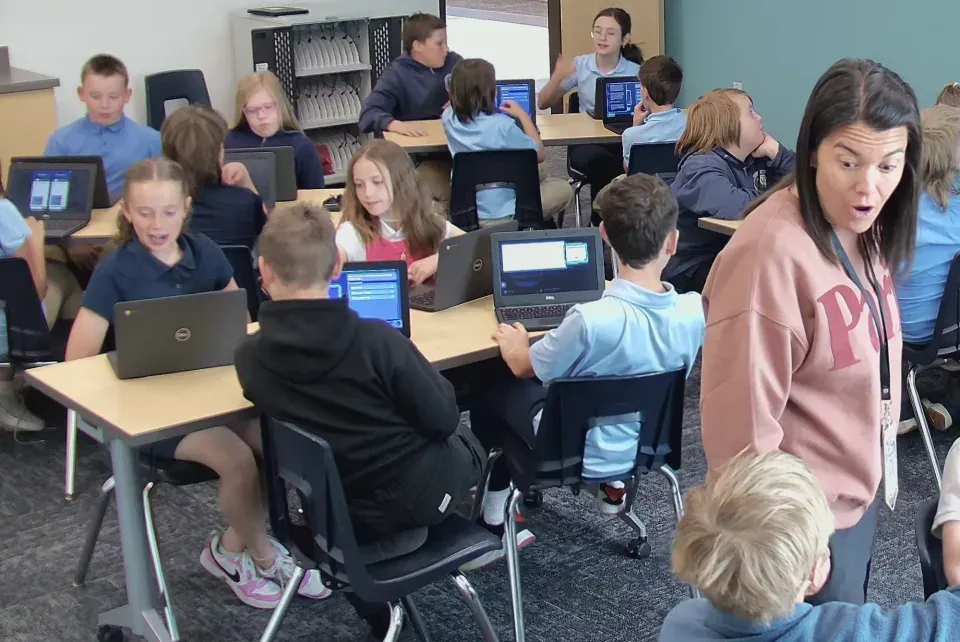
    A teacher turns in surprise beside a room of students working in teams at their laptops, one girl mid-sentence across her table.
    What you'll see: teams arguing over what a light means, and a teacher turning to hear the case.

    RALF was swept up by the GAL-Delilahs by mistake and tagged for recycling. The crew hacks into their base with Cobalt and reads its door-status lighting system to find which of several containment doors holds RALF, then helps him escape with whatever is on hand. The story plays on the projector. The work happens at seven stations (Command, Engineering, Medical, Security, Science, I.T., Operations) and in the arguments between them.

    Every student is assigned to a team, and each team’s work is themed to it, from its own information and challenge to the same problem the rest of the crew is solving. The team gives a student a role in the story and people to lean on while you move between teams.

    It’s built to the 8th grade collaborative-discussion standard (CCSS SL.8.1: engage effectively in collaborative discussions, building on others’ ideas and expressing their own clearly).

    Against the six:

    • Stakes. Only one door holds RALF. The others hold explosives or an active Security unit.
    • Apply. The crew deduces RALF’s door from the lighting system.
    • Accountability. Every student is assigned to a team, and each team’s work is themed to it.
    • Teacher leads. Watch the Teacher Preview (5 minutes), then start the Mission and ask: What does that light mean? Which doors does it rule out? How sure are you before you choose?
    • Debrief. Its Mission Guide lists no follow-up activities, so hold your own: which light settled it, and who saw it first?
    • See who did what. Every student gets a report on how well they did, shaped by what this Mission asked of them.

    “It’s been a while since students left my period saying that was the best class ever.”

    Will Crowther, Middle school teacher, Canyon View Middle School, UT

    Will it work in my room?

    Students join with a class code: no student accounts, no student email, no passwords. Chromebooks, laptops, or tablets, plus your projector. Free for teachers, no credit card. Student data is covered by COPPA and FERPA, and we signed the Student Privacy Pledge. No projector or devices? The chairs need neither, and the sheet still works.

    START FREE →

    Communication and Collaboration first

    This is one Mission. Pick from more than 100 like it, fossils to fractions, the one your unit points toward, and every student gets a report when it’s over. Every lesson finally has somewhere to go.

    What the report shows

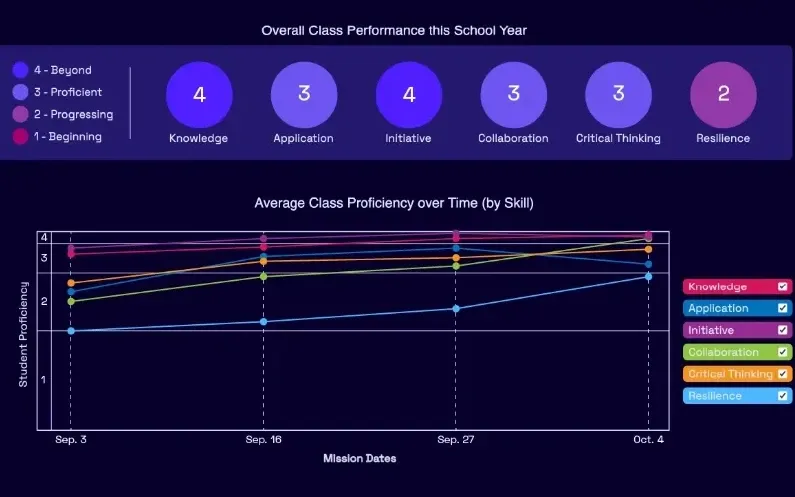
    A Mission.io class report: the class score in each of six skills, from knowledge and application to collaboration, critical thinking, and resilience, with the class chart across the year below.
    A class report from a real Mission: the class score in each of six skills, then each skill across the year.

    Every Mission produces a report for every student, built from what that student did across the whole Mission, on the skills the Mission captured. The six it can capture are Knowledge, Application, Initiative, Collaboration, Critical Thinking, and Resilience. The first two are what a test already sees. The other four are the human skills every school promises. The test shows what they know. The report shows the rest. This is where critical thinking gets practiced, and the only place it gets measured. SEE THE EVIDENCE →

    You taught it. Now find out who can use it.

    Who's behind it

    Mission.io is a research and design organization with one job: make collaborative, active learning something a teacher can run every unit instead of once a semester, and put a report in your hands when it’s over. Over a million students have run a Mission. The research behind them is funded by the National Science Foundation and the U.S. Department of Education’s Institute of Education Sciences, and Mission.io meets ESSA Level II standards, as validated by Instructure.

    “Unlike other tech programs in the district that often have students working in isolation or in pairs, Mission.io emphasizes true collaboration.”

    Lorilee Johnson, District specialist, Alpine School District, UT
    START FREEMISSION BRIEF →

    Free teacher account, no card. Run the Communication Mission (marked Start here in your library) and the Collaboration Mission first, then Critical Thinking (4 and up), with a 5-minute Teacher Preview before each.

Questions 8th grade teachers ask

My 8th graders won't switch sides in front of their friends. How do I make it safe?

Make switching count for something. Thirteen-year-olds are reluctant to take risks, so the rules have to turn the risk into a move: the Mover’s Clerk records every switch with its reason, and the Trackers count “moved with a reason” as a point.

What about the students who never speak?

Give them jobs that matter to the speakers. Trackers tally the other side’s moves, Packet Keepers can challenge any cited line, and the Clerk logs every switch. Everyone fills a position card before sitting down, so even a student who never stands up has a claim and a source on paper.

Can I use a values statement instead of a policy?

You can, but the evidence rule breaks. A values question can be argued without a source, so the packet stops mattering and the loudest opinions win again. A policy the school could actually adopt keeps every point tied to a line someone can check.

What separates this from a classroom debate?

Nobody wins. A debate assigns sides and scores a winner; philosophical chairs lets anyone move and scores the moves, including the summary of the person who spoke before you. If your class has never debated with source cards, the 5th grade page is a good warmup.

Changed minds you can finally count

Either way works this unit: philosophical chairs by hand with the Tracker sheet, or Critical Thinking (4 and up) once the Communication and Collaboration Missions are done.