8th grade STEM activities

The water bottle rocket rebuilt so 8th graders test for a range, not a record, five more build challenges fixed, a free sheet, and every 8th grade Mission by subject.

Who we are. Mission.io makes Missions: teacher-led, whole-class simulations where students use what they’re learning to work through a real scenario together. We build every one on the six things in our STEM activities for students, K-8 guide, and every student gets a report on how well they did.

You don’t need us to use this page: the rocket, the five challenges, and the sheet all work on their own. Every 8th grade Mission is at the end, by subject, free. (The one we’d run after the rocket sends the crew through a laser maze for a stolen crystal, and the only way past is force, mass, and acceleration. It may be the first time F = ma has been anyone’s way out.)

On this page

What 8th grade STEM looks like

8th grade STEM activities are challenges in which a team designs, builds, and tests something against criteria the standards name, argues from what the test showed, and leaves each student answerable for a part. This page rebuilds the water bottle rocket to two middle school standards: MS-PS2-2 (plan an investigation showing that a change in an object’s motion depends on the sum of the forces on it and its mass) and MS-ETS1-3 (analyze test data from several designs and combine the best of each into a better one). Then it fixes five more build challenges and lists every 8th grade Mission by subject. NGSS treats 6th to 8th as one band, and many districts put physical science in 8th: forces and motion, energy, waves, and chemistry. The Missions at this grade cover those and more, with coordinate graphing and digital citizenship, and each has its subject page.

The water bottle rocket is launch day, and for most students it’s the last launch day they get. It usually runs the same way: a field, a pump, a line of bottles, one kid pumping, one kid building, two kids filming, and a cheer for whichever rocket went highest.

Keep the launch. Nobody forgets the sound. Ask one question about it afterward: could the team tell you why their best launch beat their worst one? One high flight and a consistent design look identical on the video. The difference is whether anyone held the water and the pump strokes the same, and whether anyone could say what to keep from the other teams’ rockets. The challenges on this page put both of those back, with the same bottles on the same field.

Six things that turn a build contest into engineering

We’ve run this check with STEM teams in the districts we work with, and the craft project skips the same three every time: a real problem, criteria for success, and any pressure to iterate. If the finished product is all the activity asks for, the learning is optional. The fix is a small step before the build and a small step after it, and nothing at the launcher changes. One number is worth carrying down: when a group shared a goal and each student answered for a part, 84% of studies found a positive effect; without both, 17% (Slavin, 1991).

  1. 1. A real problem with stakes the class can feel.

    “Whose rocket goes highest?” is a contest. “The agency only buys a sensor rocket it can count on” is a problem.

  2. 2. Apply, don't recall.

    A prediction before every change, made with Newton’s laws. If a team can tune the rocket without the forces you taught that week, the forces weren’t needed.

  3. 3. Group goals with individual accountability.

    The one most launch days miss: one kid pumps, one kid builds, two kids film. Four roles, one job each, and a box each student signs.

  4. 4. The teacher leads the thinking.

    The questions are yours, asked at the pad while the next team loads. The numbers aren’t yours: the Timer calls the hang, and the Data Lead calls the change.

  5. 5. A debrief where the class argues it out.

    Every team’s two ranges on the board, and the question is what you’d take from whose rocket.

  6. 6. A way to see who did what.

    If you can’t tell who called the change that worked and who held the bottle, all you’ve got is a highlight reel.

One great launch is luck. Three close ones are engineering.

The free printable at the end of the next section puts all six at the pad, ready to copy. Get the sheet →

The water bottle rocket, rebuilt for 8th grade

The water bottle rocket is a 2-liter bottle part-filled with water, pressurized with a bike pump on a launcher, with fins and a nose cone added, launched for height or hang time. The way it usually runs is a build, a line at the launcher, and “how high did it go?” Here’s the version that hits all six.

Needs
Per team: one clean 2-liter bottle, a sheet of cardstock for fins, a cone, duct tape, a washer for the sensor. For the class: a launcher (about $30 to $60 for a commercial one, or a build from PVC and a bike pump), a bike pump, safety glasses for the launch crew, a field. About $50 the first year, then $5.
Time
Two periods. Day one: teach, build, and the first round of launches. Day two: the second round and the debrief.
Groups
Fours. With 30 students, seven teams of four and one pair, where the Timer also records.
Standards
MS-PS2-2 (motion changes with net force and mass) and MS-ETS1-3 (combine the best features of tested designs). Newton’s third law (MS-PS2-1) is the conversation at the pad.
  1. Teach first, 10 minutes, the day beforeApply

    Show two launches at the same pressure with different water, one a quarter full and one half full, and time the hang. Ask: more water is more mass to push out and more mass to lift, so which wins? Then name the three things a team can change (water volume, fin design, nose cone) and the rule for a fair test: same pump strokes, one change at a time.

  2. The problem, 2 minutesStakes

    A weather agency needs a rocket that carries a sensor (a marked washer taped to the nose) to a hang time of at least 4 seconds and brings it back undamaged. The agency will only buy from a team whose three launches land within one second of each other, because a sensor rocket nobody can predict is useless. Each team writes the criteria and constraints in the box before touching a bottle.

    • Criteria: a hang time of 4 seconds or more; the three launches within one second of each other; the sensor still attached.
    • Constraints: one bottle, one sheet of cardstock for fins, one cone, 500 mL of water at most, 20 pump strokes.
  3. Four roles, one job eachAccountability

    On the sheet, and everyone signs their role’s box.

    • Builder

      Fins and cone. The only hands on the bottle.

    • Fuel Lead

      Measures the water and says the volume aloud, the same every launch within a round.

    • Timer

      Times the hang from launch to touchdown and says it aloud.

    • Data Lead

      Records the three launches, works out the range, and names the one variable to change for round two.

  4. Round one, three launches per teamApply

    Launches go one at a time, so the sheet carries a queue order. A team that isn’t launching is planning round two on paper with its Data Lead, so nobody stands on the sideline holding a bottle.

  5. The questions, at the padTeacher leads

    While the next team loads: What are you changing, and what does Newton’s third law predict it does? What did your range tell you that your best launch didn’t? What are you keeping identical? Then let the Timer and the Data Lead do the talking. The pad is yours for safety; the call is theirs.

  6. Round two, one change, three launchesApply

    Each team changes the one variable its Data Lead named, keeps everything else identical, and launches three more. Team one’s second round comes after the last team’s first, so the queue keeps the field moving.

  7. The debrief, 12 minutesDebrief

    Every team’s two ranges on the board. Which variable moved hang time most across the room, and which one tightened the range? If the agency let you combine two teams’ designs, what would you take from each, and why? (That’s MS-ETS1-3 as a question.) Who on your team made the call that worked? Wait on the last one.

  8. See who did whatSee who did what

    The observation sheet, four behaviors per student: made a prediction with a forces reason, measured or recorded accurately, disagreed with a reason, changed their mind when the data said to. On launch day you’re at the pad, so the tally catches about a third of the room; catch the rest during the build period, when the room is quiet. The signed criteria box and the Data Lead’s log fill in the gaps, at a glance, before you grade anything.

  9. Short periods, or four sections in a row

    A 45-minute launch day: eight teams at three launches is 24 launches, and at a brisk 90 seconds each that’s 36 minutes, so cut round two to two launches per team, or run two launchers. Ask for the bottles a week ahead. Four sections in a row: one launcher, one field, and the queue on the sheet; each section’s bottles keep in a labeled bin, with the Data Lead’s log in the bin. The safety line rides on the sheet for every section: glasses on the launch crew, everyone back from the pad, nobody downrange.

(The highest launch of the day doesn’t win the contract if its other two came down early. The agency is buying the range.)

Keep launch day. Hand the teams the agency’s criteria before the first pump, and the cheering has numbers under it.

The water bottle rocket, free

Emailed now, ready to copy: the teacher page, four role cards, the team page (the criteria box, the six-launch log, and the two range boxes), the launch queue with the safety line, and the four-behavior tally.

It’s on its way.

Check your inbox for the water bottle rocket.

Email me the sheet. It comes as a PDF, ready to print. Unsubscribe anytime.

Five more 8th grade STEM challenges, fixed

Five more that every 8th grade list carries: what each one is, how it usually runs, and the couple of changes that fix it.

Five more for 8th grade

2. The mousetrap car

Needs a mousetrap, axles, wheels or CDs, string, a body of wood or cardboard. Groups of four.

The snap of a mousetrap pulls a string wound around the axle, and the car rolls as far as it can. Storing energy in a spring and spending it on distance is squarely 8th grade science. As usually run, though, it’s a weekend project that one parent builds, so nobody in class sees who built it or who understands it.

The fix

  1. Build it in class, in teams of four.
  2. Give each of the four one job, so every part of the car has an owner.
  3. Keep a run log for every run in class.

See it rebuilt for 8th grade →

3. The Rube Goldberg machine

Needs dominoes, ramps, string, cups, marbles, whatever's in the closet. Groups of four to six. Several sessions.

Teams of four to six build a chain of steps from dominoes, ramps, string, cups, and marbles that does one simple task. There’s plenty of physics in every link. As usually run, though, it runs over weeks, the design belongs to whoever drew it, and you can’t tell who understands any link but their own.

The fix

  1. Give each student one step of the chain to own.
  2. Each student explains in writing how their step works and how it triggers the next, so every link in the chain has a name on it.

No page for this one; a name on every step is the whole fix.

4. The cardboard and string hand

Needs cardboard, straws, string, tape. Groups of four.

Students cut a hand from cardboard and thread strings through straw pieces like tendons, so the fingers curl when the strings are pulled. It shows how tendons work in a way students remember. As usually run in 8th grade, though, it’s a craft, traced and decorated: the hand never has to do anything, and nobody tracks what made the fingers curl better.

The fix

  1. Give the hand a task it has to do: pick up a cup.
  2. Keep a log of each string change and whether the grip worked after it.

See it rebuilt for 7th grade →

5. The egg drop

Needs straws, tape, cotton, a bag, a raw egg. Groups of four.

Teams build a container from straws, tape, cotton, and a bag that keeps a raw egg intact when it’s dropped from a set height. The egg is a stake everyone feels, and most 8th graders remember it from elementary school. As usually run in 8th grade, though, it’s a nostalgia day: one student builds while the rest wait for the drop, and nobody can say who did what.

The fix

  1. Fill in a criteria box before anyone builds (the drop height, the materials, the egg intact), and give each student one of four roles: Builder, Materials Lead, Tester, and Recorder.
  2. Debrief in forces words: what did the cushion do to the stop?

See it rebuilt for 5th grade →

6. The Newton's cradle build

Needs marbles or small balls, string, craft sticks, tape. Pairs.

Pairs hang marbles or small balls from string on a craft stick frame, pull one back, and watch the knock pass through to the far end. It’s a striking way to show momentum. As usually run, though, the class watches it work and nothing shows who understood what, so keep it as the opener.

The fix

  1. Build it in pairs as the opener, before the lesson starts.
  2. Before they let go, each pair predicts what two balls pulled back will do.

No page for this one; it’s a warmup, and that’s fine.

  • Our part · We make Missions

    Then the standard has somewhere to go

    Plenty of teachers rebuild these by hand every unit, and it works. A Mission is a teacher-led, whole-class simulation on the standard the unit was teaching: your class becomes the crew, the scenario is built from the unit you just taught, and the only way through is using it together. Run the rocket first, then the Mission on the same standard, and the forces unit has a day two.

    You're at the helm, not on the hook.

    Laser Labyrinth: the rocket's standard, as a Mission

    Laser Labyrinth · Grades 5 to 8 · About 32 minutes · One device per student, plus your projector · Free with a teacher account

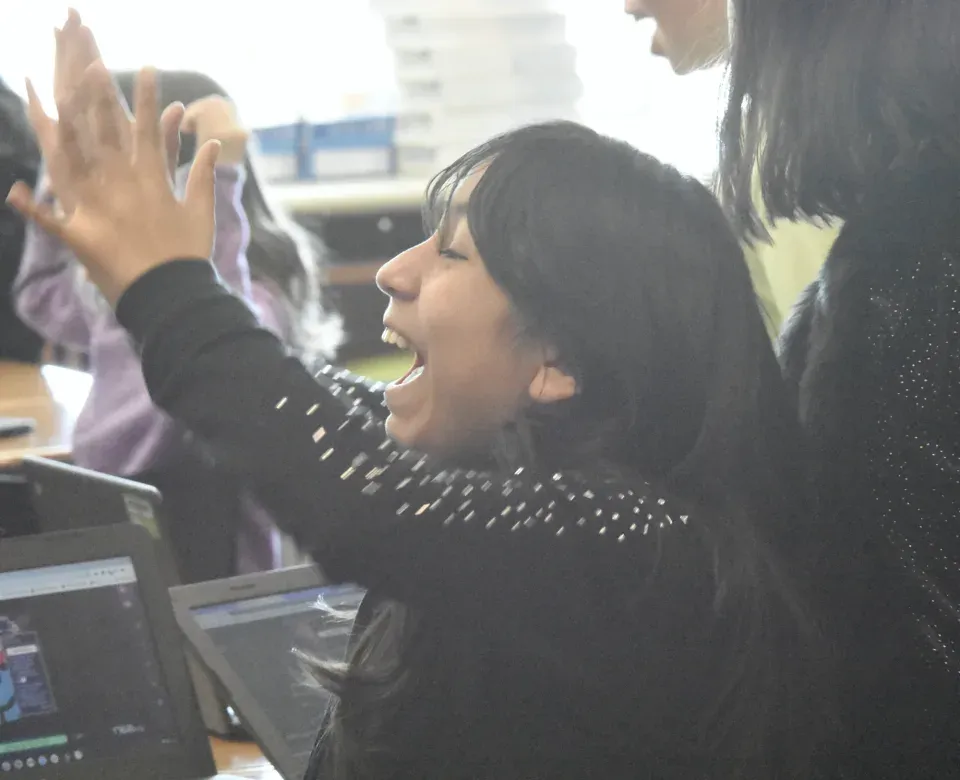
    A student laughs with both hands up, mid high five, at a table of laptops while a classmate leans in behind her.
    What you'll see: a crew that just got one right, and you asking what the net force was before they move on.

    Moodoo has stolen the crystal that powered the planet Tellenor and taken it back to his stronghold, behind a maze of lasers. To get past, the crew works out the combination of force, acceleration, and mass that deactivates the lasers, which means showing that a change in an object’s motion depends on the sum of the forces on it and its mass (MS-PS2-2). The story plays on the projector. The work happens at seven stations (Command, Engineering, Medical, Security, Science, I.T., Operations) and in the arguments between them.

    Every student is assigned to a team, and each team’s work is themed to it, from its own information and challenge to the same problem the rest of the crew is solving. The team gives a student a role in the story and people to lean on while you move between teams. You’re at the helm, asking what the net force is and what more mass does to the result.

    Run the rocket first, and tell the class why: on the field they watched water, mass, and thrust change a flight, and in the maze they have to use that to get through. The library asks for some force and motion background first, and launch day is it. The lesson prepares them. The Mission is what they’re preparing for.

    “What I love most is that it’s low-prep but high-impact.”

    Ginger Marsh, Middle school teacher, Cedar Middle School

    Will it work in my room?

    Students join with a class code: no student accounts, no student email, no passwords. Chromebooks, laptops, or tablets, plus your projector. Free for teachers, no credit card. Student data is covered by COPPA and FERPA, and we signed the Student Privacy Pledge. Teach a STEM elective or a once-a-week lab? Then the lab is where the Mission runs and the science classroom is where the unit runs: ask the 8th grade science teacher what they just finished, pick that row below, and run it the week after.

    START FREE →

    Communication first, then the rocket's two

    What the report shows

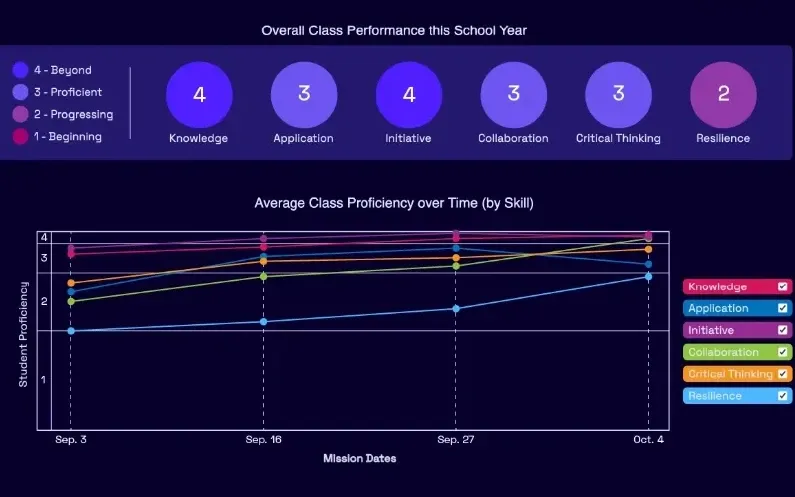
    A Mission.io class report: the class score in each of six skills, from knowledge and application to collaboration, critical thinking, and resilience, with the class chart across the year below.
    A class report from a real Mission: the class score in each of six skills, then each skill across the year.

    Every Mission produces a report for every student, built from what that student did across the whole Mission, on the skills the Mission captured. The six it can capture are Knowledge, Application, Initiative, Collaboration, Critical Thinking, and Resilience. The first two are what a test already sees. The other four are the human skills every school promises. The test shows what they know. The report shows the rest. SEE THE EVIDENCE →

    You taught it. Now find out who can use it.

    Who's behind it

    Mission.io is a research and design organization with one job: make collaborative, active learning something a teacher can run every unit instead of once a semester, and put a report in your hands when it’s over. Over a million students have run a Mission. The research behind them is funded by the National Science Foundation and the U.S. Department of Education’s Institute of Education Sciences, and Mission.io meets ESSA Level II standards, as validated by Instructure.

    “My students ask every time they walk in the door, ‘IS IT A MISSION DAY?’”

    Kate Fallon, Teacher, St. Amelia School, NY

    Every 8th grade Mission, by subject

    Laser Labyrinth is one. There are 18 STEM Missions at 8th grade, numbered 7 to 24 below, and each one is where a unit can end: atoms and molecules end at Escape Route, waves end at Cold Dark Planet, the engineering unit ends at Spine-Backed Globster. Every lesson finally has somewhere to go. Cart once this week and no unit in mind? Storm Front is 16 minutes.

    Engineering

    Three on the band’s engineering design standard, two about the job rather than the standard. Spine-Backed Globster is the one on the rocket’s other code, MS-ETS1-3. The 8th grade engineering activities page rebuilds a classic of its own. For every grade, K to 8, see Engineering activities for students.

    Engineering Missions at 8th grade: three on the NGSS engineering design standard, two career and technical.
    NumberMissionTopic (code)Minutes
    7Spine-Backed GlobsterStop an invasive species and restore a reef (MS-ETS1-1, MS-ETS1-2, MS-ETS1-3, MS-LS2-4, MS-LS2-5; grades 6 to 12)36
    8TsunamiDesign defenses for islands in a tsunami’s path (MS-ETS1-2, MS-ETS1-3, with its 3-5 codes; grades 5 to 8)33
    9InfectionMap infected tissue by area and plan a clean removal (6.G.A.1, MS-ETS1-2; grades 6 to 9)34
    10Unstoppable ForcePick the drill bits to tunnel through an asteroid (career and technical; no NGSS code)34
    11Mission to MarsSpace engineering: a route, a landing point, a first shelter (career and technical; no NGSS code)45

    Science

    Ten, and the forces Mission leads because it’s the rocket’s. The 8th grade science activities page sets each one against the investigation that teaches it. Four also run at earlier grades: Laser Labyrinth, System Shutdown, and Mount Katastrofi from 5th, and Ecosystem Patterns at 3rd and 6th. For every grade, K to 8, see Science activities for the classroom.

    Science Missions at 8th grade, by NGSS code, the rocket's forces code first.
    NumberMissionTopic (code)Minutes
    12Laser LabyrinthForce, mass, and motion (MS-PS2-2; grades 5 to 8)32
    13Escape RouteAtoms and molecules (MS-PS1-1)34
    14The State of ThingsStates of matter: contain a new element (MS-PS1-4)40
    15Cold Dark PlanetWaves and the energy they carry (MS-PS4-1, MS-PS4-2; grades 7 to 8)34
    16System ShutdownBody systems, from cells to organs (MS-LS1-3; grades 5 to 8)34
    17Chloroplast ChaosPhotosynthesis: why the plants are dying (MS-LS1-6; grades 7 to 8)31
    18Ecosystem PatternsPatterns in ecosystems (MS-LS2-2; grades 3 and 6 to 8)39
    19Encrypted EscapeProperties of planets and other bodies in the solar system (MS-ESS1-3)30
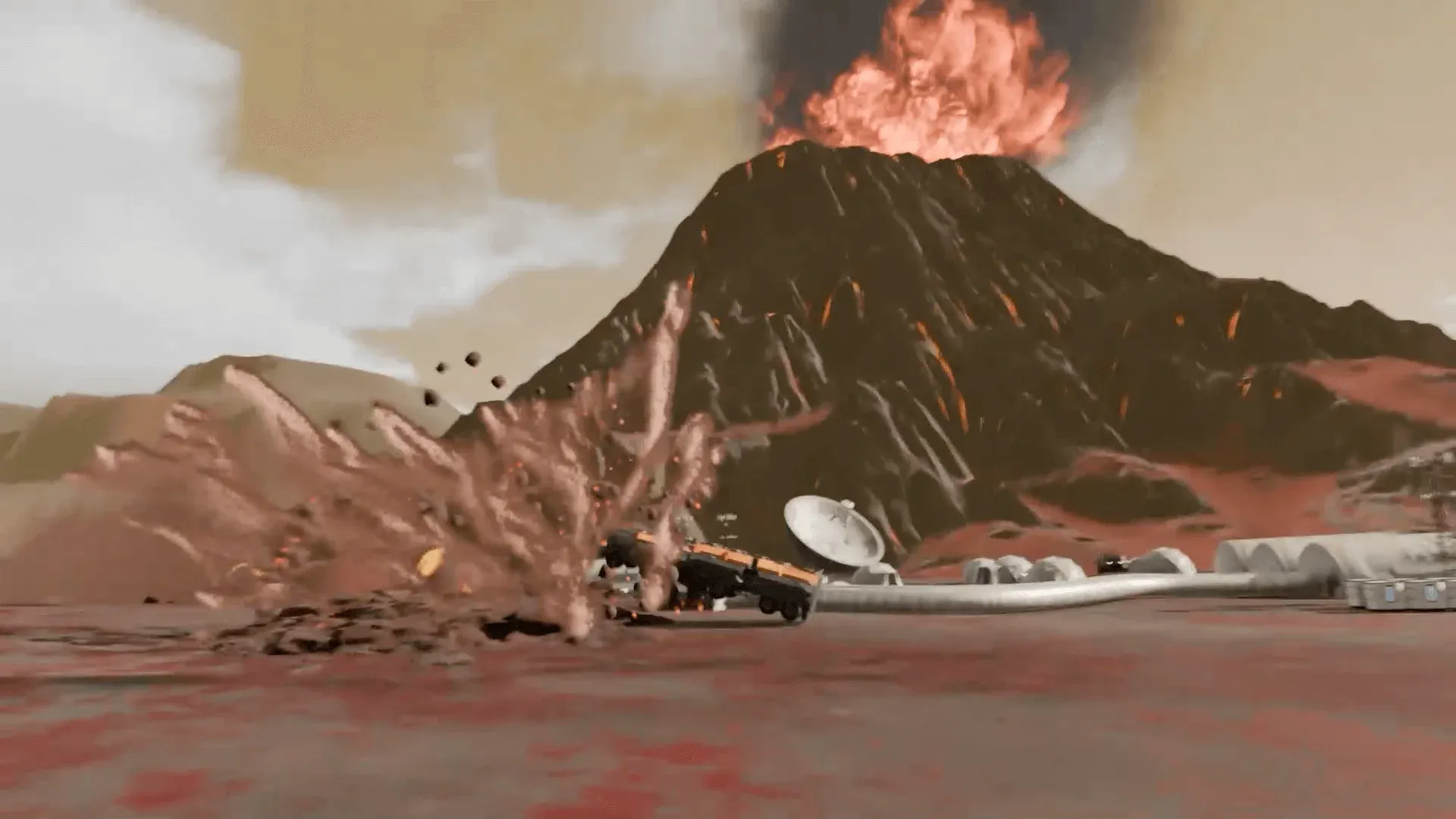
    20Mount KatastrofiHow geological events change the surface (MS-ESS2-2; grades 5 to 8)24
    21Storm FrontWarm fronts, cold fronts, and where the storm goes (MS-ESS2-5)16

    Math

    One, and it carries a 6th grade code: a quick coordinate plane review before graphing lines and functions. The 8th grade math activities page rebuilds a classic of its own. For every grade, K to 8, see Math activities for students.

    The math Mission at 8th grade, by CCSS code.
    NumberMissionTopic (code)Minutes
    22Brace for ImpactCoordinate graphing: protect a power plant from an asteroid (6.NS.C.8; grades 6 to 8)30

    Technology

    One at this grade; if the unit is digital citizenship, this is where it ends. The 8th grade technology activities page carries activities a room can run without a lab. For every grade, K to 8, see Technology activities for students.

    The technology Mission at 8th grade.
    NumberMissionTopic (code)Minutes
    23Cyber Defense ForceDigital citizenship: spot the phishing scams (grades 4 to 12)37

    Careers

    One that doesn’t belong to a unit: a veterinary case read from body system data, for the week a class is thinking about what comes after 8th grade.

    The career Mission at 8th grade.
    NumberMissionTopic (code)Minutes
    24Do No HarmVeterinary science (career and technical; grades 5 to 12)28
    START FREEMISSION BRIEF →

    Free teacher account, no card. Start with the Communication Mission, marked Start here in your library, then Laser Labyrinth, each after its 5-minute Teacher Preview.

    Also at this grade

    The Collaboration and Critical Thinking Missions for 4th grade and up (24 minutes each), plus the Communication Mission in the tiles above; the skill Missions live on the 8th grade collaboration activities and 8th grade critical thinking activities pages. And the reading, writing, and design Missions: At Odds, Dawn of the Scarecrow, On the Edge of Tomorrow, Strokes of Genius, and Showstopper.

Questions 8th grade teachers ask

No field, no launcher, no budget. What then?

The Newton’s cradle and the cardboard hand cost nothing you don’t have, and the egg drop runs on straws and a carton of eggs. A launcher is the one real cost on this page (about $30 to $60, or PVC and a bike pump), and it lasts for years of launch days. A Mission needs none of it: Storm Front is 16 minutes and Mount Katastrofi is 24.

Is a water bottle rocket safe to run with 8th graders?

Run it the way the sheet does: safety glasses on the launch crew, everyone back from the pad, nobody downrange, the launcher maker’s pressure limit, and you at the pad the whole time. The queue on the sheet keeps one rocket on the pad at a time.

Where does Newton's third law come in if the standard is MS-PS2-2?

At the pad. MS-PS2-2 is the investigation: hold the pump strokes the same, change the water, and watch what mass does to the flight. Newton’s third law (MS-PS2-1) is why the bottle moves at all: water pushed down, rocket pushed up. It’s the first teacher question at the pad, and the debrief is where it gets argued.

How do I grade launch day fairly?

Grade the range and the reasoning, not the height. The criteria box and the Data Lead’s log with both ranges are one grade; the four-behavior tally over the build and the launches is the other. A team that flew highest once and never repeated it has a log that says so, and the team can read it as well as you can.