8th grade science activities

The sealed-bag reaction rebuilt so 8th graders prove mass is conserved, five more investigations by NGSS standard, a free printable, and every 8th grade science Mission.

Who we are. Mission.io makes Missions: teacher-led, whole-class simulations where students use what they’re learning to work through a real scenario together.

Everything on this page works without us. Every 8th grade science Mission is at the end, by standard, free. (The one we’d run in 8th grade is set on a planet whose star is dying. Bring a sweater.)

On this page

What 8th grade science looks like

Eighth grade science activities are investigations in which the class gathers evidence about something the standards name, has to argue from that evidence, and leaves each student answerable for a piece. NGSS writes middle school as one 6 to 8 band, and each state orders it its own way. Most sequences put physical science in 8th, so this page does too, with an investigation and a Mission for each standard where one exists. The 8th grade STEM activities page carries the build challenges.

The year is the one where matter turns into atoms you can count: atoms and molecules (MS-PS1-1), substances that react into new ones (MS-PS1-2), and mass that stays put through a reaction because the atoms do (MS-PS1-5). Then forces and motion (MS-PS2), energy (MS-PS3), and waves (MS-PS4). At this level a chemistry claim is a model of atoms rearranging, not an equation balanced by formula.

The activity that usually stands in for all of it is a lunch bag of baking soda and vinegar that pops, or a balloon on a bottle that fills. Big reaction, big cheer, and one question nobody weighs: where did the mass go? Science is what happens when the class has to put the reaction on a balance, predict the number, and defend it.

Six things that turn a demo into an investigation

Inquiry-based science teaching outperformed traditional instruction across 37 studies, and the surprise inside the finding is who leads it: teacher-led inquiry beat student-led by a clear margin (Furtak, Seidel, Iverson, and Briggs, 2012). Hands-on helped most when students also had to think and talk about what they saw (Minner, Levy, and Century, 2010). The uncomfortable part is this grade’s scoreboard: the 2024 national science test assessed only 8th grade, and 38% of 8th graders scored below Basic, up 5 points from 2019 (NAEP 2024). So an 8th grade lab has to end in a claim the class defends.

  1. 1. A real problem with stakes the class can feel.

    “Show that mass is conserved” is a worksheet. “Prove nobody stole from the factory” is a problem.

  2. 2. Apply, don't recall.

    A second round that only works with the data from the first. If the activity can be finished without the science, it isn’t a science activity.

  3. 3. Group goals with individual accountability.

    The one most science classics miss: one kid zips the bag, one kid reads the scale, two kids wait for the pop. When the group shared a goal and each student answered for a part, 84% of studies found a positive effect; without both, 17% (Slavin, 1991).

  4. 4. The teacher leads the thinking.

    The inquiry finding above settles it. Three questions at the balance beat a worksheet of twenty at the desk.

  5. 5. A debrief where the class argues it out.

    The investigation is the setup. The argument afterward is the practice the standards name: engaging in argument from evidence.

  6. 6. A way to see who did what.

    If you can’t tell which student predicted with a reason and which one copied the number, you can’t teach the practice. You can only hope for it.

If nobody predicted the number, nobody learned from it.

The sheet at the end of the next section has the sealed bag ready to run next to the balance: the role cards, the team’s mass table and atom model, the factory finding, and the tally. Get the sheet →

The sealed bag, rebuilt for 8th grade (MS-PS1-5)

Baking soda and vinegar go into a zipped bag on a balance, the mass gets read before and after, and then the bag is opened and weighed again. The American Chemical Society’s middle school chemistry lessons run this exact lab for MS-PS1-5, and the usual version runs with one kid zipping, one kid reading the scale, and a conclusion the teacher already said out loud. Here’s the version that makes the class predict the number, defend it, and hit all six.

Time
50 minutes. The 45-minute cut: one amount in round two, not two, and skip the re-zeroing drills; the Weigher practices once at the start.
Groups
Fours. With 30 students, seven groups of four and one of two, where the Mixer also models.
Supplies for eight teams
16 quart zip bags, a box of baking soda, a liter of vinegar, 16 small cups, balances that read to 0.1 g (one per two teams; about $15 each if the room has none), and goggles. About $6 beyond the balances.
Standards
MS-PS1-5 (use a model to describe how the number of atoms doesn’t change in a chemical reaction, so mass is conserved). The open-bag weigh is the second half of the model: the mass that “leaves” is gas, not lost.
  1. Teach first, 10 minutesApply

    Pour vinegar on baking soda in an open cup on a balance, and let the class watch the reading drop. Ask where the mass went. Don’t answer. Name the claim the class will test: if atoms are only rearranged, the mass before and after has to match, as long as nothing escapes.

  2. The problemStakes

    A food company’s factory line mixes two ingredients in sealed pouches and keeps finding the pouches lighter than what went in. The accountants say product is being stolen; the chemist says nothing is missing. The team owes the company a one-page finding with data: is mass lost in a sealed reaction, and where does it go when the pouch is opened? Say the stakes out loud: the finding decides whether a worker gets accused.

  3. Four roles, one job eachAccountability

    On the sheet, and everyone signs their role’s box. Mixer and Weigher swap between rounds.

    • Mixer

      The only hands on the bag; seals it with the vinegar cup upright inside, then tips it.

    • Weigher

      Zeros the balance and reads before, sealed after, and opened after, aloud to a tenth of a gram.

    • Modeler

      Draws the atoms before and after: the same count, rearranged, with the gas leaving when the bag opens.

    • Recorder

      Keeps the mass table and the differences.

  4. You lead the thinkingTeacher leads

    Three questions, asked at the balance: What’s your mass before, and what do you predict after? Where did the mass go when you opened the bag, in atom words? What would have to be true for mass to really disappear? The hardest part is not answering the first time a team says “the gas weighs something.” Let them prove it.

  5. Two rounds, so the claim has to holdApply

    Round one is the sealed run. Round two is a second run with a different amount of baking soda, to test whether the sealed result holds. A team that only believed round one because the teacher said so finds out in round two whether it can predict the number on its own.

  6. The debrief, 12 minutesDebrief

    Every team’s three masses on the board. Did any sealed bag lose mass, and if a reading dropped, what’s the explanation: a leak, the scale, or physics? What is the accountants’ mistake, in atom words? Who on your team predicted the open-bag number before it was read? Then the hard one: the bag that puffs up reads lighter, and it isn’t a leak. Who can explain it? The first question is the lesson: a dropped reading has more than one cause, and the class has to say which one it was and how it knows.

  7. See who did whatSee who did what

    The observation sheet, four behaviors per student: predicted with an atom-level reason, measured accurately, disagreed with a reason, changed their mind when the data said to. A tally catches about half the room in one period; the bag inflating on the balance pulls every eye in the room, and that’s your moment to walk.

(The bag that puffs up reads a little lighter, and nothing got out. It’s pushing aside more air now, and that air holds it up, roughly a milligram for every milliliter it swells. Let the class find that one.)

Goggles on, every round. That line is on the sheet’s supply list.

The sealed bag lab, free

Emailed now, ready to copy: the teacher page, four role cards (Mixer, Weigher, Modeler, Recorder), the team’s mass table for both rounds with the atom-model box for before, sealed, and opened, the factory finding frame, a key to what to expect, and the four-behavior tally.

It’s on its way.

Check your inbox for the sealed bag lab.

Email me the sheet. It comes as a PDF, ready to print. Unsubscribe anytime.

Five more 8th grade investigations, by standard

Five more from 8th grade lists: what each one is, how it usually runs, and the fix, in the order the standards run.

Reactions, forces, and waves

2. Elephant toothpaste (MS-PS1-2)

Needs hydrogen peroxide, yeast, dish soap, goggles. A teacher demo.

Hydrogen peroxide, yeast, and dish soap go in a bottle, and a tower of foam pours out. The yeast speeds up the breakdown of the peroxide into water and oxygen, the soap traps the oxygen as foam, and the bottle gets warm. It runs as a teacher demo, and it should: it has the stakes, and you lead the thinking. It leaves out accountability and seeing who did what on purpose, because the sealed bag is this page’s investigation.

The fix

  1. Run it as the demo right before the sealed bag, with goggles on everyone near the bottle.
  2. Ask the class for the evidence that a new substance formed (oxygen in the foam, a warm bottle), and carry that question into the sealed bag.

No Mission on this standard.

3. Mentos and soda (and why it isn't chemistry)

Needs Mentos, a bottle of soda, the parking lot.

Drop the candy into a bottle of soda, and a geyser shoots up in the parking lot. It often gets called a chemical reaction. It’s a physical change: the gas was already dissolved in the soda, the candy’s rough surface lets it out all at once, and no new substance forms. As usually run, it’s a spectacle with nothing to apply and no debrief, which is why its job on this page is the contrast.

The fix

  1. Run it after the sealed bag, so the class has a new substance to compare it with.
  2. Ask whether anything new formed, and let the class argue it from the evidence: the sealed bag makes a new substance, and the geyser doesn’t.

No standard claims this one; it earns its place as the contrast.

4. Balloon rocket on a string (MS-PS2-1)

Needs a balloon, a straw, tape, string, a target to hit.

A balloon taped to a straw rides a string across the room, and when it’s let go it shoots along until the air runs out. Newton’s third law is right there: the balloon pushes air out the back, and the air pushes the balloon forward. As usually run, though, it’s a race with no target, no jobs, and nobody’s numbers on paper.

The fix

  1. Set a target, like a tape mark on the string the rocket has to reach.
  2. Give each team a Launcher, a Measurer, and a Recorder.
  3. Run three trials and record every distance, so each team argues from its own numbers.

No Mission on this standard.

5. Marble ramp and mass (MS-PS2-2)

Needs marbles of different masses, a ramp, a cup, a ruler. Pairs: a Launcher and a Measurer.

A marble rolls down a ramp into a paper cup, and students measure how far the cup gets pushed as they change the marble’s mass or the ramp’s height. It asks the standard’s question: how mass and force change motion. As usually run, though, it’s a demo, with one roll per change and nobody responsible for the numbers.

The fix

  1. Pair students up: a Launcher who releases the marble from the same spot every time, and a Measurer who measures how far the cup moved.
  2. Change one thing at a time, the mass or the height, and run three trials for each change.
  3. Make the claim about mass and motion from all three trials, so it rests on more than one lucky roll.

Laser Labyrinth, in the tables below, is the Mission on this standard.

6. Slinky waves (MS-PS4-1)

Needs a Slinky, a meter stick. Pairs: a Shaker and a Measurer.

Partners stretch a Slinky along the floor and send transverse and longitudinal pulses down it. A bigger shake makes a bigger pulse, so it’s a clean model of how a wave’s amplitude relates to its energy. As usually run, though, it’s a demo with no numbers, so the claim about energy rests on what the class thinks it saw.

The fix

  1. Pair students up: a Shaker who sends the pulses, and a Measurer who reads each pulse’s amplitude against the meter stick.
  2. Write the amplitude on the sheet for every pulse, next to whether it came from a small, medium, or big shake.
  3. Make the claim about amplitude and energy from the sheet, so it has numbers under it.

Cold Dark Planet, in the tables below, is the Mission on this standard.

  • Our part · We make Missions

    Then the unit has somewhere to go

    Plenty of teachers rebuild these by hand every unit, and it works. A Mission is a teacher-led, whole-class simulation on a middle school standard: your class becomes the crew, the scenario is built from a unit you teach, and the only way through is using it together. The sealed bag belongs to the reactions unit, and Cold Dark Planet belongs to the waves unit. No Mission is built on the bag’s own standard, MS-PS1-5. The nearest is Escape Route, on atoms and molecules, first in the physical science table below.

    You're at the helm, not on the hook.

    Cold Dark Planet: the Mission we'd run in 8th grade

    Cold Dark Planet · Grades 7 and 8 · About 34 minutes · One device per student, plus your projector · Free with a teacher account

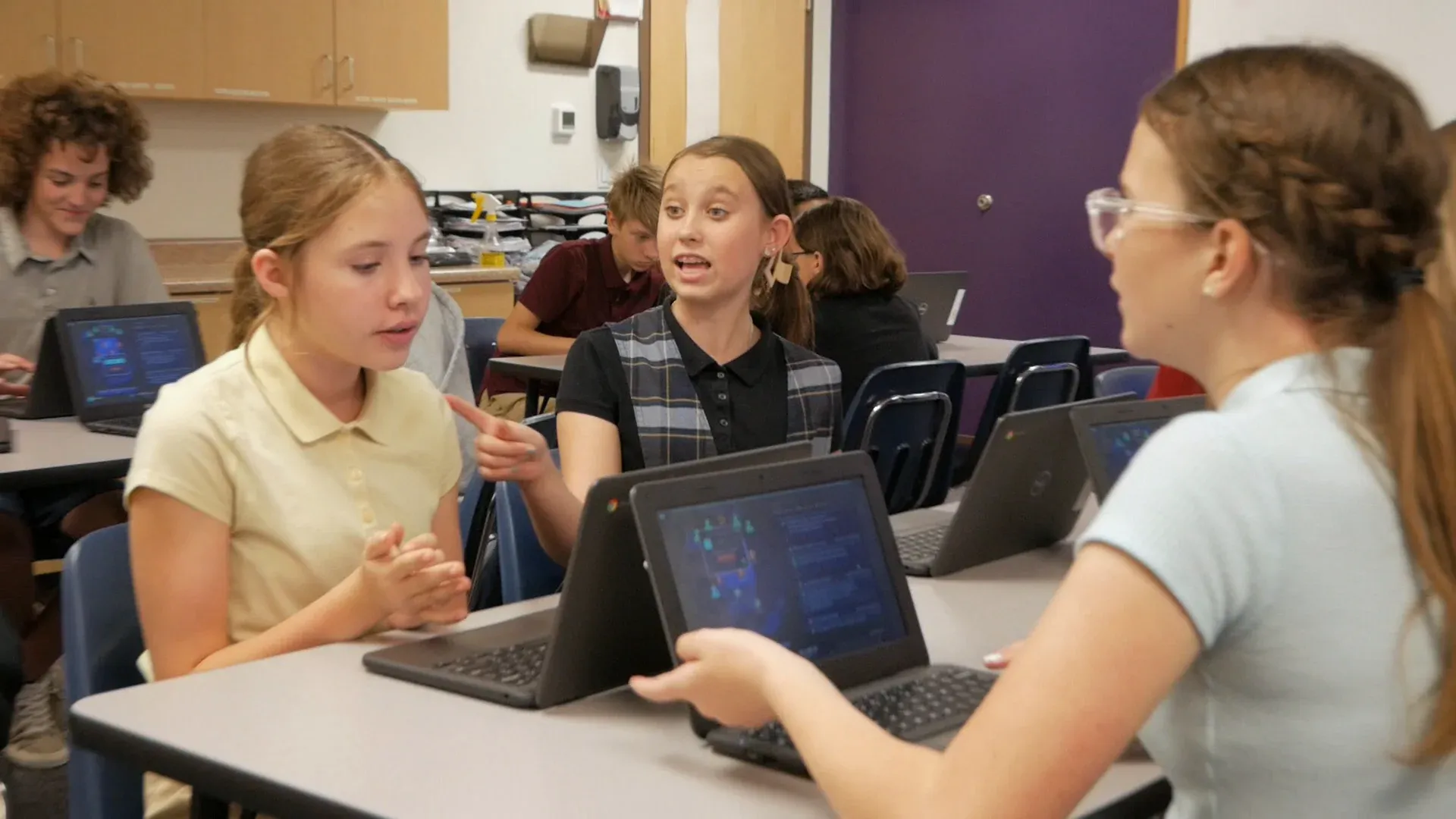
    Across a table of open Chromebooks, one middle schooler points at a classmate mid-argument while a third, hand on her laptop, turns to listen.
    Three students talk across a table of open Chromebooks, one of them pointing as she makes her case.

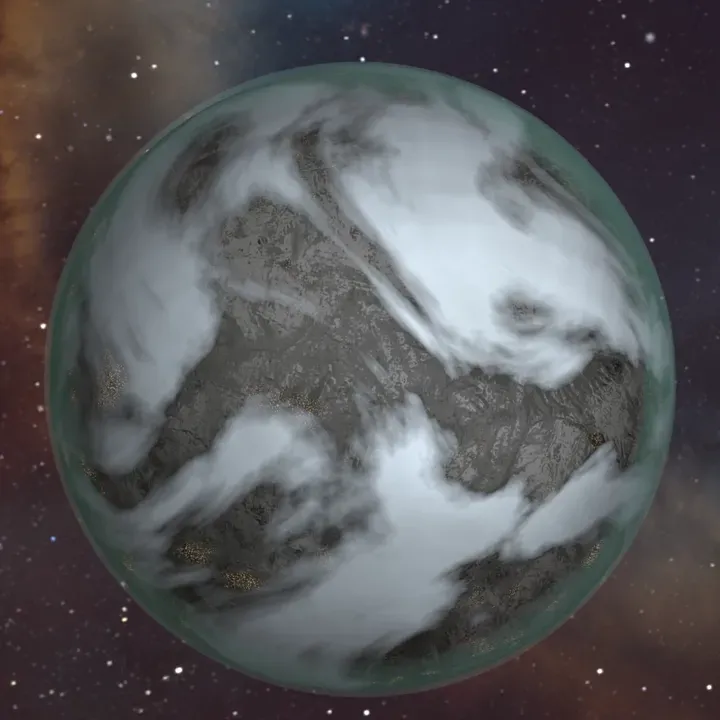
    Tractum’s star is reaching the end of its life and no longer gives the planet enough heat or light to sustain life. Dr. Zyla is working on a long-term fix, but the people of Tractum are in danger now, and she needs the crew of the Infini-D to handle it. The crew uses what it knows about waves and energy to get the planet through a bitter winter. The story plays on the projector. The work happens at seven stations (Command, Engineering, Medical, Security, Science, I.T., Operations) and in the arguments between them.

    Every student is assigned to a team, and each team’s work is themed to it, from its own information and challenge to the same problem the rest of the crew is solving. The team gives a student a role in the story and people to lean on while you move between teams. You’re at the helm, asking which wave carries more energy and what this material does to it.

    It’s built to MS-PS4-1 and MS-PS4-2: how a wave’s amplitude relates to its energy, and how waves are reflected, absorbed, or transmitted through materials. It asks that students already know how amplitude changes a wave’s energy and how light changes as it passes through different-shaped prisms, so it fits the end of the waves unit, and its Mission Guide lists a Slinky wave lab among the prep, which makes entry 6 above a head start. Tell the class it’s coming the day waves start: they’re going to need amplitude when Tractum starts freezing. The lesson prepares them. The Mission is what they’re preparing for.

    “It’s been a while since students left my period saying that was the best class ever.”

    Will Crowther, Middle school teacher, Canyon View Middle School, UT

    Will it work in my room?

    Students join with a class code: no student accounts, no student email, no passwords. Chromebooks, laptops, or tablets, plus your projector. Free for teachers, no credit card. Student data is covered by COPPA and FERPA, and we signed the Student Privacy Pledge. Teach five sections of the same course? Run the Mission with each one, and every student still gets a report. On a shared cart it’s the day you have the cart, and that’s fine, as long as the class knows from the start of the unit where it’s headed. At about 34 minutes, Cold Dark Planet fits inside a 45-minute period with about 11 minutes left to talk.

    START FREE →

    Communication first, then waves, then atoms

    What the report shows

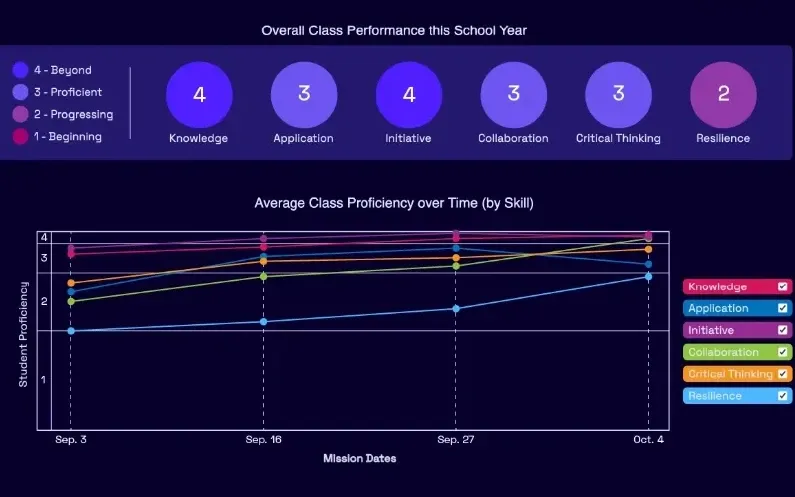
    A Mission.io class report: the class score in each of six skills, from knowledge and application to collaboration, critical thinking, and resilience, with the class chart across the year below.
    A class report from a real Mission: the class score in each of six skills, then each skill across the year.

    Every Mission produces a report for every student, built from what that student did across the whole Mission, on the skills the Mission captured. The six it can capture are Knowledge, Application, Initiative, Collaboration, Critical Thinking, and Resilience. The first two are what a test already sees. The other four are the human skills every school promises. The test shows what they know. The report shows the rest. SEE THE EVIDENCE →

    You taught it. Now find out who can use it.

    Who's behind it

    Mission.io is a research and design organization with one job: make collaborative, active learning something a teacher can run every unit instead of once a semester, and put a report in your hands when it’s over. Over a million students have run a Mission. The research behind them is funded by the National Science Foundation and the U.S. Department of Education’s Institute of Education Sciences, and Mission.io meets ESSA Level II standards, as validated by Instructure.

    8th grade science Missions by NGSS standard

    Cold Dark Planet is one. There are 13 science and engineering Missions at 8th grade, numbered 7 to 19 below, and each one is where a unit can end: waves end at Cold Dark Planet, atoms end at Escape Route, forces end at Laser Labyrinth. Every lesson finally has somewhere to go. The 6 to 8 standards are one band that each state orders its own way, so the tables group every Mission we run at 8th grade by the band’s codes, whatever year your state teaches them. Each code links to its standard on nextgenscience.org.

    Physical science (MS-PS1, MS-PS2, MS-PS4)

    The year’s home table if your state puts physical science in 8th. Three standards here have no Mission, and an investigation on this page teaches each one; Escape Route works on the atoms the sealed bag’s model counts.

    Physical science Missions at 8th grade, by NGSS code, with the three standards that have no Mission.
    NumberThe standardMissionMinutes
    7MS-PS1-1 Model the atoms in simple molecules, then rebuild toxic air into something safe (grades 6 to 8)Escape Route34
    8MS-PS1-4 Heat in or heat out: how thermal energy changes particle motion and a substance’s state (grades 6 to 8)The State of Things40
    9MS-PS2-2 A change in motion depends on the forces and the mass (grades 5 to 8). On this page: 5. Marble ramp.Laser Labyrinth32
    10MS-PS4-1, MS-PS4-2 A wave’s amplitude and its energy; waves reflected, absorbed, or transmitted (grades 7 and 8). On this page: 6. Slinky waves.Cold Dark Planet34
    MS-PS1-2 Properties before and after two substances interact show whether a chemical reaction happened. On this page: 2. Elephant toothpaste.No Mission
    MS-PS1-5 Atoms rearrange in a chemical reaction and none are lost, so mass is conserved. On this page: 1. The sealed bag.No Mission
    MS-PS2-1 Newton’s third law, applied to a design problem where two objects push on each other. On this page: 4. Balloon rocket on a string.No Mission

    Life science (MS-LS1, MS-LS2)

    Three, for the states that teach some life science in 8th. Chloroplast Chaos is the other Mission on this page made for grades 7 and 8 alone.

    Life science Missions at 8th grade, by NGSS code.
    NumberThe standardMissionMinutes
    11MS-LS1-3 How cells build tissues, organs, and the systems that keep a body alive (grades 5 to 8)System Shutdown34
    12MS-LS1-6 How photosynthesis cycles matter and moves energy through living things (grades 7 and 8)Chloroplast Chaos31
    13MS-LS2-2 Competition, predation, and partnership: the same patterns of interaction in every ecosystem (grades 3 and 6 to 8)Ecosystem Patterns39

    Earth and space (MS-ESS1, MS-ESS2)

    Three, and Storm Front at 16 minutes is the shortest Mission on the page.

    Earth and space Missions at 8th grade, by NGSS code.
    NumberThe standardMissionMinutes
    14MS-ESS1-3 Size, distance, and other scale properties of planets and moons, worked from data (grades 6 to 8)Encrypted Escape30
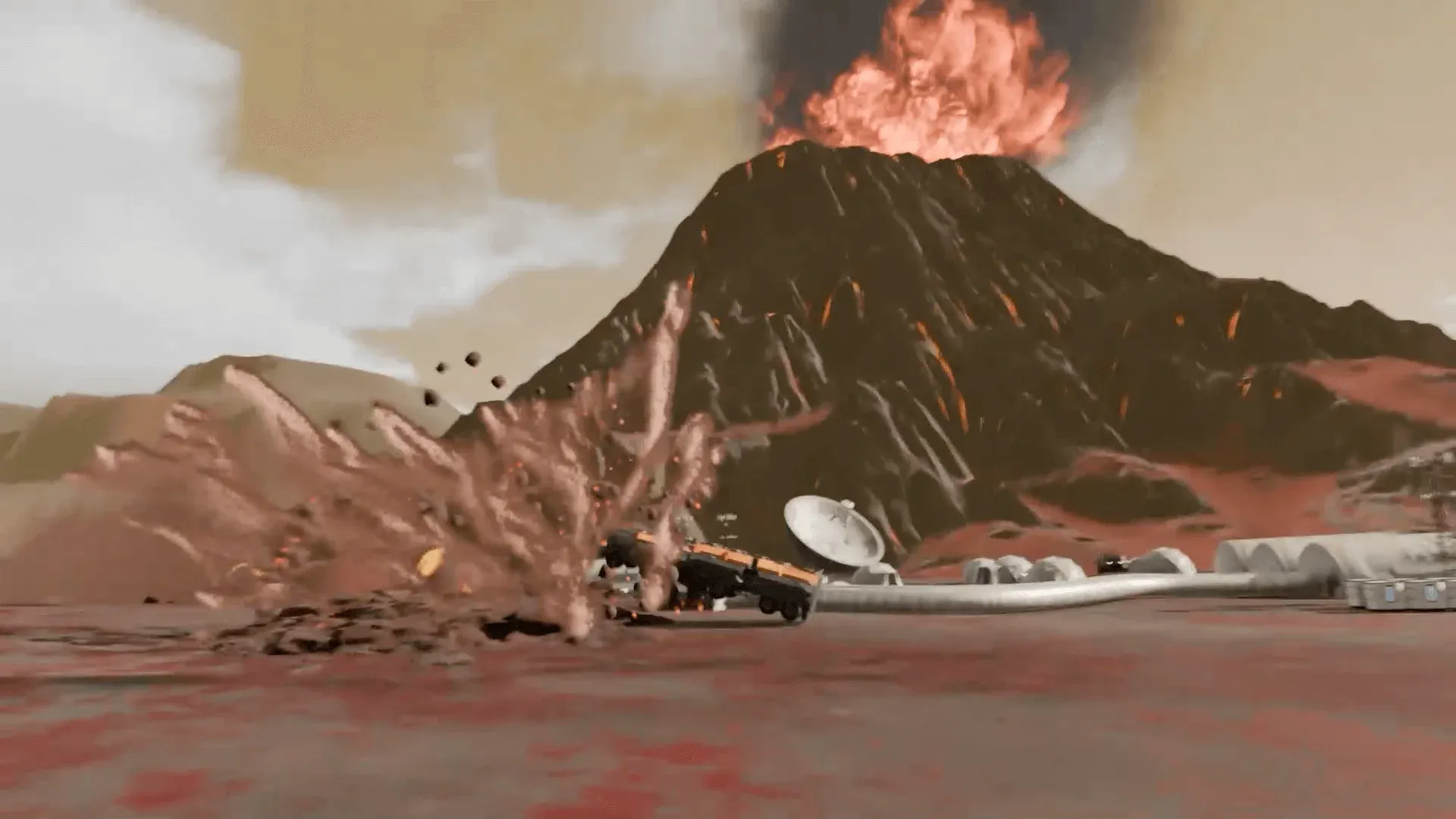
    15MS-ESS2-2 Plate boundaries, earthquakes, and volcanoes as evidence of a surface that changes (grades 5 to 8)Mount Katastrofi24
    16MS-ESS2-5 Warm and cold front data as evidence for how the weather changes (grades 6 to 8)Storm Front16

    Engineering design (MS-ETS1)

    Three on the band’s engineering design standards. Spine-Backed Globster carries three of the band’s four engineering codes in one story, plus two ecosystem codes. The 8th grade engineering activities page maps these standards with the design challenges that teach them.

    Engineering Missions at 8th grade, by NGSS code.
    NumberThe standardMissionMinutes
    17MS-ETS1-1, MS-ETS1-2, MS-ETS1-3, MS-LS2-4, MS-LS2-5 Fight an invasive species in a marine ecosystem: set the criteria, test the fixes, combine the best (grades 6 to 12)Spine-Backed Globster36
    18MS-ETS1-2 Compare plans for removing infected tissue by how well each meets the criteria (grades 6 to 9)Infection34
    19MS-ETS1-3, MS-ETS1-2, 3-5-ETS1-1, 3-5-ETS1-2 Weigh ways to protect three islands from a tsunami against criteria and constraints (the grades 5 to 8 build)Tsunami33
    START FREEMISSION BRIEF →

    Free teacher account, no card. Start with the Communication Mission, marked Start here in your library, then the Mission for your unit, each after its 5-minute Teacher Preview.

    Also at this grade

    The 8th grade STEM activities page lists the math, technology, and career Missions; the 8th grade engineering activities page rebuilds a build of its own; and the Collaboration and Critical Thinking Missions live on the 8th grade collaboration activities and 8th grade critical thinking activities pages.

Questions 8th grade science teachers ask

I have a 45-minute period. Which of these fit?

The sealed bag runs 50 minutes; the 45-minute cut runs one amount in round two and skips the re-zeroing drills, with the Weigher practicing once at the start. Most Missions fit one period with time left to talk, and three on this page run 30 minutes or less: Storm Front (16 minutes), Mount Katastrofi (24), and Encrypted Escape (30).

Which NGSS standards do these 8th grade activities map to?

NGSS sets middle school as one 6 to 8 band, and each state decides what lands in 8th. This page follows the common order, physical science in 8th: the sealed bag is MS-PS1-5, and the five run MS-PS1-2, MS-PS2-1, MS-PS2-2, and MS-PS4-1, with Mentos and soda as the one no standard claims. MS-PS1-5, MS-PS1-2, and MS-PS2-1 have no Mission. The tables map every 8th grade Mission across physical science (MS-PS1, MS-PS2, MS-PS4), life science (MS-LS1, MS-LS2), Earth and space (MS-ESS1, MS-ESS2), and engineering (MS-ETS1).

A sealed bag lost mass. Did the lab fail?

Not necessarily. A leak at the zip, a drifting balance, and the bag itself can each lower the reading. A bag that puffs up pushes aside more air, and that air holds it up, so it reads lighter with nothing lost, roughly a milligram for every milliliter it swells. Sorting out which one happened is the best part of the debrief. A team that can name the cause has done more science than a team that matched to the tenth of a gram and can’t say why.

Is Mentos and soda a chemical reaction?

No. It’s a physical change: the gas was already in the soda, and no new substance forms. That’s why it sits on this page as the contrast to the sealed bag, where the class has to show that a new substance did form and the mass still didn’t change.

How do I grade the sealed-bag lab fairly?

Grade the finding and the behaviors. The factory finding is one grade: is mass lost in a sealed reaction, and where does it go when the pouch opens, in atom words, with the three masses as evidence. The four-behavior tally over two or three investigations is the other. A team that got the right number with no atom-level reason shows up as a weak finding, and now you can say why.