8th grade math activities

Barbie bungee rebuilt so 8th graders bet the doll on their own equation, five more activities by standard, a free printable, and the 7 standards the page teaches.

Who we are. Mission.io makes Missions: teacher-led, whole-class simulations where students use what they’re learning to work through a real scenario together.

Everything on this page works without us. The 7 standards this page teaches are at the end, free, with the two Missions that run at 8th grade. (One is Infection, which runs grades 6 to 9, so some of your 8th graders may have run it in 6th. They will tell you.)

On this page

What 8th grade math looks like

Eighth grade math activities are problems where the class has to use the math to decide something, argue about whether the numbers are right, and leave each student answerable for a piece. This page teaches 7 of the grade’s 28 Common Core math standards, each with an activity, and carries the two Missions that run at 8th grade.

The year has three big jobs. Expressions and equations, including linear equations and systems of two (8.EE). Functions, new this year, as a way to describe how one quantity depends on another (8.F). And geometry: transformations, congruence and similarity, angles, and the Pythagorean theorem (8.G). Around them sit scatter plots with lines of fit (8.SP) and irrational numbers.

You know the activity that usually stands in for linear functions. A doll, a chain of rubber bands, a few drops off a desk, and a graph that gets turned in. The graph is usually fine. The lab just never asks the class to trust it, with the doll’s head a few centimeters off the floor.

Six things that turn an exercise into math

In 2024, 28% of eighth graders scored at or above Proficient in math (NAEP). Eighth grade is the year that test measures, and functions are new in it. How the class works on them counts, because cooperative learning beat whole-class instruction on achievement, and the effect was stronger in science and math than in social sciences and languages, and stronger in elementary grades than in middle and high school (Kyndt and colleagues, 2013).

  1. 1. A real problem with stakes the class can feel.

    “Find the slope” is an exercise. “One band too many and the customer hits the floor” is a problem.

  2. 2. Apply, don't recall.

    A check drop that only works if the first fit was right. If the jump can be called without the equation, it isn’t a math activity.

  3. 3. Group goals with individual accountability.

    The one most bungee labs miss: one dropper, one measurer, one grapher, one filmer, and nobody answerable for the equation. When the group shared a goal and each student answered for a part, 84% of studies found a positive effect; without both, 17% (Slavin, 1991).

  4. 4. The teacher leads the thinking.

    Three questions at the wall tape (what does your slope mean in this room, why isn’t your intercept zero, how sure are you about the stairwell) beat a worksheet of twenty at the desk.

  5. 5. A debrief where the class argues it out.

    The jump is the setup. The argument afterward, about why the slopes match and the intercepts don’t, is the practice the standards name: construct viable arguments and critique the reasoning of others (MP3).

  6. 6. A way to see who did what.

    If you can’t tell which student put the slope into words and which one only dropped the doll, you can’t teach functions. You can only grade the jump.

Every slope gets a test drop. The floor grades it.

The sheet at the end of the next section has the data table, the scatter grid, the equation lines, and the stairwell prediction, with a worked example for you. Get the sheet →

Barbie bungee, rebuilt for 8th grade (8.F.B.4)

A doll on a chain of rubber bands drops from increasing heights. Students record the fall distance for each number of bands, fit a line, and predict how many bands give the biggest thrill from a set height without hitting the floor. It’s the linear functions lab in program after program, and the NCTM Illuminations lesson that outlived the site, because building a linear model (8.F.B.4) and fitting a line to data (8.SP.A) are both 8th grade. The way it usually runs, the jobs split four ways and nobody owns the equation. Here’s the version that hits all six.

Time
Two periods: data and the fit on day one, the stairwell jumps and the debrief on day two. The 45-minute cut: data for 2, 4, 6, and 8 bands only, two drops each, the fit on the sheet with a straightedge (no software), and the final jump from a shorter height (a doorframe, 2 meters) in the same period.
Groups
Fours. With 30 students, seven groups of four and one of two, where the Data Lead also models.
Supplies
8 dolls (dollar store, or action figures), 200 rubber bands of one size, meter tapes taped to the wall, and graph paper. About $15.
Standards
8.F.B.4 (construct a linear function, and read its rate of change and initial value in context), with 8.SP.A.2 and 8.SP.A.3 (fit a line to a scatter plot, and use its equation to solve problems), and the practice MP4 (model with mathematics).
  1. Teach first, 10 minutesApply

    Drop the doll from the desk with two bands, then with four, and ask what each extra band adds. Name the two numbers they’ll find: the rate of change (centimeters per band) and the initial value (the drop with zero bands: the doll’s own length plus the first band’s slack). Name the lab’s rule: three drops per band count, record the lowest point, use the mean.

  2. The problemStakes

    An adventure company is opening a bungee platform at the top of the stairwell (a measured height; say 3.2 meters) and wants the maximum thrill: the doll’s head as close to the floor as possible without touching it. The company runs one jump on the team’s prediction, in front of the class. The team delivers one number, the bands, and the equation that produced it. Say the stakes out loud: too few bands and the customer asks for a refund; one band too many and the customer hits the floor.

  3. Four roles, one job eachAccountability

    On the sheet, and everyone signs their role’s box.

    • Jump Master

      Attaches the bands, holds the doll's feet at the mark, and drops without a push.

    • Spotter

      Watches the lowest point against the wall tape and calls it in centimeters.

    • Data Lead

      Records three drops per band count, computes the mean, and plots the scatter.

    • Modeler

      Fits the line, writes the equation, puts the slope and intercept into words on the sheet, and solves for the stairwell.

  4. You lead the thinkingTeacher leads

    Three questions, asked at the wall tape: What does your slope mean in this room, in words? What’s your intercept, and why isn’t it zero? What does your equation predict for the stairwell, and how sure are you? The hardest part is not fitting the line for them. Hand the Modeler the straightedge and wait.

  5. Two rounds, so the first answer has to be rightApply

    Round one: data for 2, 4, 6, 8, and 10 bands with three drops each, a fit, and a prediction. Round two: a check drop at 12 bands to test the model, a revised fit if it misses, and the final prediction. The Jump Master and the Spotter swap between rounds.

  6. The debrief, 12 minutesDebrief

    Every team’s equation on the board, then the stairwell jumps. Why are the slopes similar across teams and the intercepts different? Whose model predicted the 12-band check best, and what did the misses have in common: a bad band, a pushed drop, a misread? After the jumps: which teams hit the thrill zone, and what in their equation got them there? Who on your team caught a bad data point before it went into the fit?

  7. See who did whatSee who did what

    The observation sheet, four behaviors per student: interpreted the slope or intercept in context, measured or recorded accurately, disagreed with a reason, changed their mind when the data said to. The drop stations are loud, so tally during the fitting; you’ll catch about half the room.

(Expect “can we try it on a person?” No. Then ask why the equation couldn’t answer that, since it only knows this doll.)

Write every team’s band count on the board before the stairwell jumps. Nobody changes it after the first doll drops.

The Barbie bungee lab, free

Emailed now, ready to copy: the teacher page, the Jump Master, Spotter, Data Lead, and Modeler role cards, the data table with the equation lines, the 12-band check, and the stairwell prediction, the scatter-plot grid, a worked example, and the four-behavior tally.

It’s on its way.

Check your inbox for the Barbie bungee lab.

Email me the sheet. It comes as a PDF, ready to print. Unsubscribe anytime.

Five more 8th grade math activities, by standard

Five more on every 8th grade list: what each one is, how it usually runs, and what it needs to be a math activity, in the order the standards run.

Systems, functions, transformations, Pythagoras, scatter plots

2. Systems of equations: cell phone plans (8.EE.C.8)

Needs two plan descriptions and graph paper. Individual, usually.

Students compare two cell phone plans, one with a higher monthly fee and one that charges more as you use it, write an equation for each, and graph them to find where the costs are equal. It has a real problem and the core math of the standard, since the crossing point answers the question. As usually run, though, it’s a solo worksheet, and a correct crossing point can’t tell you who wrote the equations and who read it off a friend’s graph.

The fix

  1. Work in pairs, with one student writing and graphing each plan, so each one owns an equation.
  2. Have the pair find the crossing point two ways, from the graph and by solving, and agree before they answer.

No page for this one; the two misses are the fix.
3. The stacking cups linear model (8.F.B.4)

Needs a stack of identical cups and a ruler.

Students measure the height of a stack as they add cups one at a time, fit a line to the data, and predict how many cups will fit under the classroom door. It’s the bungee’s structure with cups, and the debrief is usually there, since the groups’ predictions differ and the door settles it. As usually run, though, one student stacks and measures while the group watches, and you can’t tell who could explain what the slope means.

The fix

  1. Borrow the bungee’s jobs: one student stacks, one measures and calls out each height, and one records and plots.
  2. The fourth writes the equation and says in words what the slope and the starting height mean, before the group tests the door.

No page for this one; it’s the bungee’s structure, so the bungee above is the model.

4. Transformations with patty paper (8.G.A.1)

Needs patty paper or tracing paper, and a shape to trace. A station.

Students trace a shape on patty paper, then slide, flip, and turn the paper to test what stays the same: side lengths, angles, parallel lines. It’s hands-on proof that rigid motions keep a shape’s measurements, and students can check it themselves. As usually run, though, it’s a quiet station with no question to answer, and a stack of tracings can’t tell you who tested a claim and who traced.

The fix

  1. Give each pair a question to settle, like whether a flip can ever change an angle.
  2. One student moves the paper and the other measures before and after and records it, and then they swap.
  3. Have each student write one thing that stayed the same and how they checked it, with their name on it.

No page for this one; the three misses are the fix.

5. The Pythagorean theorem with squares on a grid (8.G.B.6)

Needs grid paper. Individual, usually.

Students draw a right triangle on grid paper, build a square on each leg and on the hypotenuse, and compare the areas until they see the two smaller squares add up to the big one. The proof gets built by hand. As usually run, though, it’s a solo worksheet with no problem to solve, and a page of squares can’t tell you who saw why it works.

The fix

  1. Work in pairs: one builds the squares and the other finds their areas, and they swap on the next triangle.
  2. Have each student write, in their own words, why the two smaller squares equal the big one, on a card you collect.

No page for this one; the three misses are the fix.

6. A scatter plot of arm span and height (8.SP.A.1)

Needs tape measures, a class data table, graph paper.

The class measures each student’s arm span and height, collects the numbers in a class table, and plots arm span against height, with you at the board pointing out the pattern. The data is the class’s own, and the plot shows a clear pattern. As usually run, though, the plotting and the line happen at the board, and you can’t tell who could build or read the scatter plot alone.

The fix

  1. Work in groups of four, where the Measurer measures each person’s arm span and height.
  2. The Recorder writes down each pair of numbers, and the Plotter puts every point on the group’s graph.
  3. The Fitter draws the line and uses it to predict the arm span for a new height, and the group checks it against a real student.

No page for this one; the four roles are the fix.

  • Our part · We make Missions

    Then the unit has somewhere to go

    Plenty of teachers rebuild these by hand every unit, and it works. A Mission is a teacher-led, whole-class simulation built from a unit you teach. The bungee is linear functions (8.F.B.4), and no Mission carries an 8th grade code. Squares on a grid find a tilted square’s area by breaking it into pieces, which is Infection’s own move. After the squares on a grid, run Infection.

    You're at the helm, not on the hook.

    Infection: the area of polygons, as a Mission

    Infection · Grades 6 to 9 · About 34 minutes · One device per student, plus your projector · Free with a teacher account

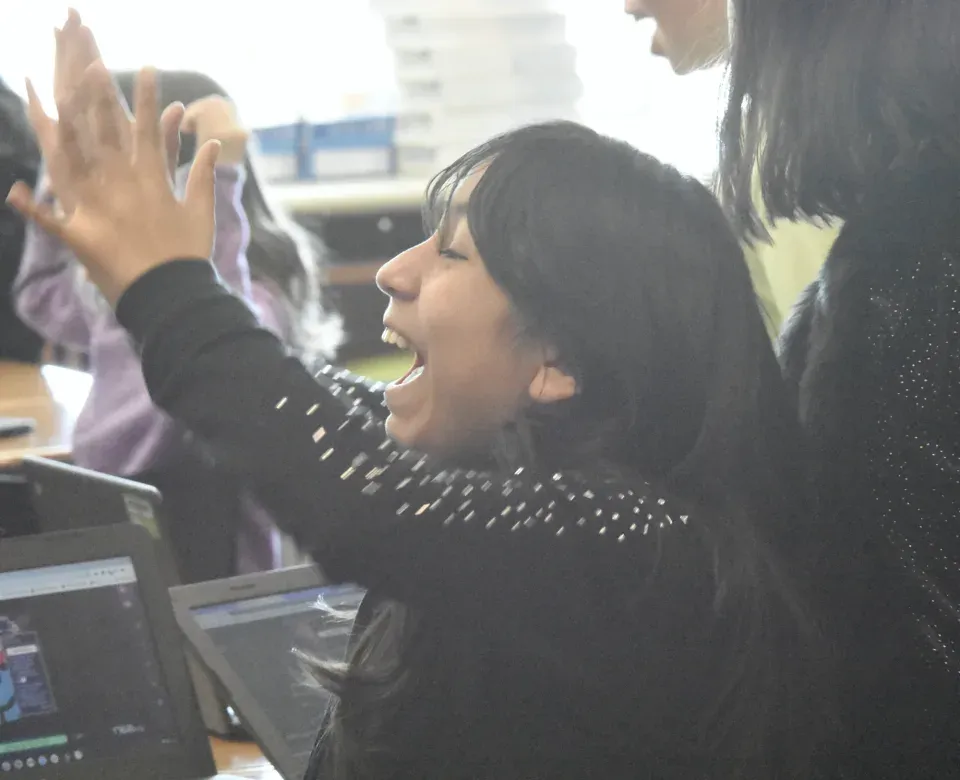
    A student throws both hands up and cheers at her laptop.
    A student cheering at her laptop.

    One of the crew’s astronauts has been infected by a mysterious alien bacteria that spreads fast and resists every known treatment, and the infected tissue is growing close to vital organs. The crew has to map the infected zone with what it knows about area and quadrilaterals, and work out how to remove the bacteria without harming healthy tissue. The story plays on the projector. The work happens at seven stations (Command, Engineering, Medical, Security, Science, I.T., Operations) and in the arguments between them.

    Every student is assigned to a team, and each team’s work is themed to it, from its own information and challenge to the same problem the rest of the crew is solving. The team gives a student a role in the story and people to lean on while you move between teams. You’re at the helm, asking how they’d break this shape up, and how much healthy tissue their cut takes.

    It’s built to a 6th grade standard, 6.G.A.1 (the area of polygons, by composing and decomposing), with reading and speaking codes alongside (RST.6-8.3, RST.6-8.7, SL.6.1) and an engineering design code (MS-ETS1-2). The vocabulary crosses into science: tissue, immune system, vital organs, cell membrane, grid. For 8th graders it’s geometry review with stakes. Run the squares on a grid first, and tell the class why: the cut only comes out right for a crew that can find a polygon’s area by breaking it into pieces. The lesson prepares them. The Mission is what they’re preparing for.

    “It’s been a while since students left my period saying that was the best class ever.”

    Will Crowther, Middle school teacher, Canyon View Middle School, UT

    Will it work in my room?

    Students join with a class code: no student accounts, no student email, no passwords. Chromebooks, laptops, or tablets, plus your projector. Free for teachers, no credit card. Student data is covered by COPPA and FERPA, and we signed the Student Privacy Pledge. At about 34 minutes, Infection fits inside a 45-minute period with time left for the debrief.

    START FREE →

    Communication first, then the two at 8th grade

    What the report shows

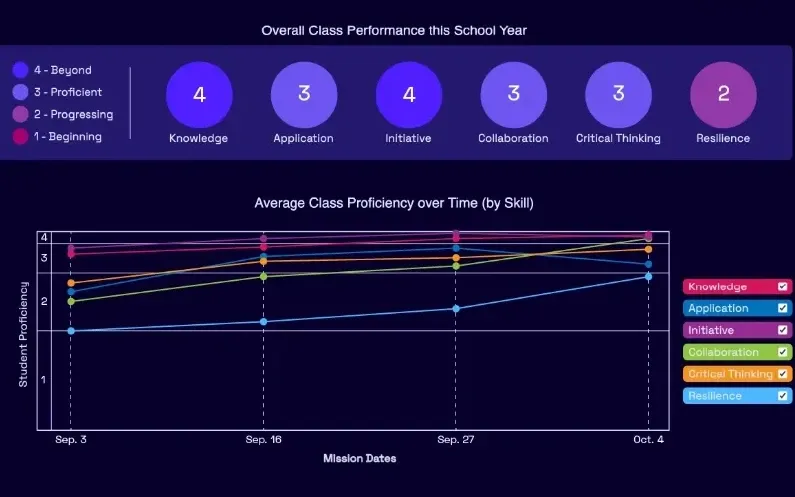
    A Mission.io class report: the class score in each of six skills, from knowledge and application to collaboration, critical thinking, and resilience, with the class chart across the year below.
    A class report from a real Mission: the class score in each of six skills, then each skill across the year.

    Every Mission produces a report for every student, built from what that student did across the whole Mission, on the skills the Mission captured. The six it can capture are Knowledge, Application, Initiative, Collaboration, Critical Thinking, and Resilience. The first two are what a test already sees. The other four are the human skills every school promises. The test shows what they know. The report shows the rest. SEE THE EVIDENCE →

    You taught it. Now find out who can use it.

    Who's behind it

    Mission.io is a research and design organization with one job: make collaborative, active learning something a teacher can run every unit instead of once a semester, and put a report in your hands when it’s over. Over a million students have run a Mission. The research behind them is funded by the National Science Foundation and the U.S. Department of Education’s Institute of Education Sciences, and Mission.io meets ESSA Level II standards, as validated by Instructure.

    8th grade math standards, plus two 6th grade Missions

    Below are 7 of the 28 8th grade Common Core math standards, each with the activity on this page that covers it. No Mission carries an 8th grade code, so the 2 that run at 8th grade come first, numbered 7 and 8, on their 6th grade codes. Each code links to thecorestandards.org.

    Also at 8th grade, on another grade's standards

    Both run through 8th grade on 6th grade codes: review with stakes, and worth saying so to the class.

    Missions that run at 8th grade on 6th grade Common Core math codes.
    NumberThe standardMissionMinutes
    76.NS.C.8 Graph points in all four quadrants, and find distances along a grid line, the step before 8.G.B.8 (grades 6 to 8; a 6th grade code)Brace for Impact30
    86.G.A.1 Area of polygons by composing and decomposing (grades 6 to 9; a 6th grade code)Infection34

    Expressions and equations (8.EE)

    Systems of two linear equations. The phone plans teach them.

    8th grade expressions and equations standards, with the activity on this page for systems.
    NumberThe standardMissionMinutes
    8.EE.C.8 Analyze and solve systems of two linear equationsOn this page: 2. The phone plans

    Functions (8.F)

    New this year. The bungee and the stacking cups both teach the modeling standard.

    8th grade function standards, with the activities on this page for modeling.
    NumberThe standardMissionMinutes
    8.F.B.4 Build a linear function to model a relationship; rate of change and initial value in contextOn this page: 1. The bungee and 3. Stacking cups

    Geometry (8.G)

    Transformations, and the proof of the Pythagorean theorem. Two activities above teach them.

    8th grade geometry standards, with the activities on this page for the ones they teach.
    NumberThe standardMissionMinutes
    8.G.A.1 Verify the properties of rotations, reflections, and translationsOn this page: 4. Patty paper
    8.G.B.6 Explain a proof of the Pythagorean theorem and its converseOn this page: 5. Squares on a grid

    Statistics and probability (8.SP)

    Scatter plots, lines of fit, and the equations behind them. The bungee and the arm span plot teach them.

    8th grade statistics standards, with the activities on this page for the ones they teach.
    NumberThe standardMissionMinutes
    8.SP.A.1 Scatter plots and patterns of associationOn this page: 6. Arm span and height
    8.SP.A.2 Fit a straight line to a scatter plot, and judge the fitOn this page: 1. The bungee
    8.SP.A.3 Use a linear model’s equation, with slope and intercept in contextOn this page: 1. The bungee
    START FREEMISSION BRIEF →

    Free teacher account, no card. Start with the Communication Mission, marked Start here in your library, then Infection or Brace for Impact, each after its 5-minute Teacher Preview.

    Also at this grade

    The 7th grade math activities page rebuilds the carnival game, with the 7th grade standards it teaches; the 6th grade math activities page covers the year these two Missions are built for. The 8th grade problem solving activities page rebuilds the locker problem, with The State of Things as its Mission, and the 8th grade STEM activities page rebuilds the water bottle rocket and lists every 8th grade Mission by subject.

Questions 8th grade math teachers ask

Which of these fits a 45-minute period?

Both Missions that run at 8th grade do: Brace for Impact at 30 minutes and Infection at 34. The bungee takes two periods, or the 45-minute cut: four band counts, two drops each, and a doorframe instead of the stairwell.

Which 8th grade math standards does this page teach?

Seven of the grade’s 28 Common Core math standards, across four domains: 8.EE, 8.F, 8.G, and 8.SP. Each is taught by an activity on this page, the bungee’s 8.F.B.4 among them. The two Missions that run at 8th grade come first, on 6th grade codes.

Why run a 6th grade Mission in 8th grade?

As review with stakes, said out loud. The two that run at 8th grade are on 6th grade codes: Infection runs grades 6 to 9 on the area of polygons, and Brace for Impact runs grades 6 to 8 on the four-quadrant plane, the step before the Pythagorean distance in 8.G.B.8. The 8th grade problem solving activities page carries The State of Things, which runs grades 6 to 8.

Is a doll on a rubber band really 8th grade math?

Yes, and the equation is the proof. 8.F.B.4 asks for a linear function built from data, with its rate of change and initial value read in context, and the bungee asks the Modeler to write exactly that, in words, on the sheet. Then the class bets the doll on it.

Is this aligned to my state's standards, not just Common Core?

Each Mission page lists its Common Core codes and the state sets it maps to. Infection also maps to North Dakota’s math and ELA standards, Utah’s ELA core, and one NGSS engineering code (MS-ETS1-2).

The stairwell jump runs on their equation

Day one, a problem by hand with the sheet. Day two, Infection after the squares on a grid, or Brace for Impact when the unit is the Pythagorean theorem. Each has a 5-minute Teacher Preview, and neither costs anything.