Best NGSS Science Curriculum (2026)

An NGSS science curriculum is a K-8 (or K-12) program built to the Next Generation Science Standards’ three dimensions, and eleven of them are the ones a science director is most likely to shortlist. This guide puts them on the same tables with the same seven criteria, states what EdReports has and hasn’t said about each, and gives a verdict per program with the full review linked. It’s built for the people who carry the decision: science supervisors, curriculum directors, coaches, principals, and the teachers who’ll teach it five days a week.

Who we are. Mission.io makes Missions, not a curriculum: teacher-led, whole-class simulations built to the same NGSS standards these programs teach. Districts bring us in to get more out of the science curriculum they already own, which is why we know this shelf.

For all eleven we read the EdReports gateways, the state reviews, the contract price lists, the board documents, and the teacher forums. No publisher funds us or gains from a verdict. Our one interest: helping you get more out of whichever program you choose, which is what we already do for districts across the country.

On this page

What is the best NGSS science curriculum? If you read one paragraph

The eleven: Amplify Science, OpenSciEd, FOSS, Inspire Science, HMH Into Science, Savvas Experience Science, Mystery Science, Discovery Education Science Techbook, STEMscopes, Twig Science, and Project Lead The Way.

There is no best NGSS science curriculum. There is the one that fits how your teachers teach, what your building can sustain, and what your students will have to do with the science. On the public alignment record, two programs stand apart:

  • Amplify Science: all-green at EdReports for K-5 (2023) and 6-8 (2019 review), and as of October 2026 the one program on this list rated at every grade a K-8 district would buy.
  • OpenSciEd: all-green for 6-8 and all three high school courses, free to download, with the cost in kits and training; its elementary materials are submitted and not yet rated.

Two more lead on something other than alignment: FOSS on hands-on investigation (its 6-8 edition did not meet EdReports’ first gateway) and HMH Into Science on rollout infrastructure (K-5 partially meets; 6-8 unreviewed). Four of the eleven have no EdReports report at any grade (Mystery Science, Twig, PLTW, and Savvas, whose K-5 is under review), and at K-5 just two do (Amplify meets, HMH partially meets). Unreviewed is not a failure and not a pass; it’s a gap you fill with a pilot. Before you decide, ask three questions. Does this model match how our teachers actually teach? Can we sustain what it asks of us, logistically and professionally? Will our students regularly have to apply what they learned to something they haven’t seen?

How do you choose an NGSS science curriculum? Seven criteria, in budget-meeting order

You’re not buying materials. You’re buying a multi-year implementation, a training system, and an instructional philosophy. No pressure. Seven criteria, in the order a budget meeting asks them:

  1. Standards coverage, as rated. Not the publisher’s alignment chart; the EdReports gateways by grade band (section 3), your state’s review where one exists (Louisiana, Massachusetts CURATE, California, Texas; most states have none, and then EdReports and your pilot are what you have), and the clarification statements the program actually hits.
  2. Hands-on intensity. How often students investigate with materials, and who manages the materials: kits (FOSS, OpenSciEd through its vendors, Inspire, Amplify), digital-first with optional kits (Savvas, STEMscopes, Discovery, Twig), or household materials (Mystery Science).
  3. Assessment and reporting. Embedded and teacher-managed (OpenSciEd’s free version, FOSS in K-2), or centralized reporting (HMH, Inspire, Discovery, Savvas, Amplify, and FOSS’s FOSSmap in grades 3-8). Decide first whether the board will ask for a dashboard; the answer changes the shortlist.
  4. Implementation lift. Section 5. The honest version is a sentence: what does it take to teach this well in year one.
  5. Cost structure, not price. License per student (most), kits and refills (FOSS, Inspire, OpenSciEd’s vendors), subscription per school (Mystery Science), a flat participation fee plus training (PLTW), or open license (OpenSciEd). Price lists drift; the structure tells you where the money goes for six years. Where a price is published, the table carries it with its date.
  6. Device load. One device per student every day (the platform programs), devices for some lessons (Amplify’s simulations), or none (FOSS, most of OpenSciEd).
  7. Teacher autonomy. Scripted to the minute (OpenSciEd), repeatable routines (Amplify), a 5E frame teachers already know (Inspire, STEMscopes), or short video-anchored lessons (Mystery Science). Match it to your teachers, not to your preference.

Vendor alignment charts tell you whether a curriculum claims to address standards. They don’t tell you what year one feels like from the front of the room. The seven above do. The eleven on one sheet →

What does EdReports tell you about an NGSS science curriculum?

What does an EdReports “all-green” rating mean?

EdReports reviews a program by grade band against three gateways: Designed for NGSS (the three dimensions and phenomena), Coherence and Scope, and Usability (renamed Teacher and Student Supports in the 2025 review tool). A program has to meet or partially meet the first to reach the second, and meet both to be scored on the third. “All-green” means Meets Expectations at all three.

Why “not reviewed” is not a verdict

Two things to hold when you read the tables. The review tool has changed twice: version 1.0 for the 2019 to 2021 reports, 1.5 for 2021 to 2025, and 2.0 from July 2025, so percentages across years aren’t apples to apples; the band (Meets, Partially Meets, Does Not Meet) is comparable with the version noted, and EdReports itself says older reports “may not fully align with our current instructional priorities.” And “not reviewed” is not a verdict: a program can be unreviewed because it’s new, because the publisher didn’t submit, or because it isn’t a core program. Four of the eleven have no report at any grade; at K-5, only two of the eleven have one. The elementary field is thin everywhere: of the 30-odd K-8 science reports EdReports has published (31 by our count, 35 by Education Week’s, citing the Center for Education Market Dynamics, October 2026), only two elementary products meet expectations. If a K-5 program on your list claims a green EdReports rating, it’s one of those two. OpenSciEd’s elementary materials are submitted and not yet rated.

Which NGSS science curricula are all-green at EdReports?

As of October 2026, by band, the all-green reports we found:

  • Elementary: Amplify Science K-5 (2022 edition; report May 2023) and Smithsonian Science for the Classroom (K-2, 2024; 3-5, 2025), which is not on most district shortlists and so not on this table.
  • Grades 6-8: Amplify Science (2018 edition; EdReports’ first science review, 2019), OpenSciEd (2022 edition; 2023) and its six certified versions (Kendall Hunt, Activate Learning, Carolina, 2024; Kiddom, PASCO, PocketLab, 2026), and Issues and Science, Third Edition Revised (SEPUP/Lab-Aids, 2024), also not on most shortlists and so not on this table.
  • High school: OpenSciEd Biology, Chemistry, and Physics (2025, the first reports under the 2.0 tool).

How do the eleven NGSS science curricula compare? EdReports results by grade band

EdReports results for eleven NGSS science programs by grade band, as of October 2026, with the edition, report year, and review tool version; "not reviewed" means no published report. Each program name links its review.
ProgramGradesEdReports K-5 (edition; report year; tool; result)EdReports 6-8 (edition; report year; tool; result)Also rated
Amplify ScienceK-82022; 2023; v1.5; Meets, every grade2018; 2019 review; v1.0; Meets, all gateways
OpenSciEdK-12Submitted; not yet rated (K-5 completed Feb 2026)2022; 2023; v1.5; Meets, all gatewaysSix certified 6-8 versions all-green (2024 to 2026); HS biology, chemistry, physics all-green (2025; v2.0)
FOSS Next GenerationPreK-8Not reviewed2019; 2019; v1.0; Does Not Meet, Gateway 1 (30%)
Inspire ScienceK-8Not reviewed2020; 2020; v1.0; Does Not Meet, Gateway 1 (11%)Inspire Biology: Does Not Meet (2023)
HMH Into ScienceK-82022; 2024; v1.5; Partially Meets, every gradeNot reviewedEarlier HMH program Science Dimensions 6-8, still sold: Partially Meets Gateway 1 (2019; v1.0)
Savvas Experience ScienceK-8 (HS biology added Sep 2026)Under review; no reportNot reviewedPredecessor California Elevate Science K-5: Does Not Meet (2020)
Mystery ScienceK-5Not reviewedNot applicable
Discovery Education Science TechbookK-12 (a new K-5 edition for 2026-27)Not reviewed (new edition announced Jan 2026)2020; 2021; v1.5; Partially Meets (G1 Meets 84%, G2 Partially 73%)California edition 6-8: Does Not Meet (2019)
STEMscopesK-12Not reviewed2019; 2020; v1.0; Does Not Meet, Gateway 1 (15%)Louisiana edition, grade 4: Tier III, Not representing quality (Louisiana Department of Education, Oct 2021)
Twig SciencePreK-8Not reviewedNot reviewedLearning List review, 2024 (report not public; the publisher displays a “100% NGSS alignment” badge)
Project Lead The WayPreK-5 Launch, 6-8 GatewayNever reviewedNever reviewed

Model, assessment, hands-on, devices, lift, and cost

Eleven NGSS science programs compared on model, assessment, hands-on load, device load, lift, and cost structure, October 2026; the hands-on and lift columns are our assessment from the reviews, the state reviews, and the forums; prices are as of the dates shown and will drift.
ProgramModelAssessment and reportingHands-onDevice loadLiftCost structure, and the published price where one exists
Amplify ScienceLiteracy and modeling routines; simulations plus investigationsEmbedded unit assessments; class reports in 6-8ModerateSome lessonsModerate; routines scaffold year onePer-student digital license plus classroom kits: $13 per student per year K-5 (NYC contract, 2024-25) and $25 a student for 6-8 (Louisiana list, June 2024; term not printed); kits $2,640 to $3,504 per middle school classroom, plus refills; Seattle budgeted about $12 per middle school student per year for materials and licenses over nine years (2019)
OpenSciEdPhenomenon storylines, open licenseEmbedded, teacher-managed; dashboard via partner platformHighLowModerate to high; train firstNo license; kits roughly $800 to $1,500 per middle school unit per classroom (Louisiana contract, May 2026), print, training
FOSS Next GenerationInvestigation-centered kit labsEmbedded checks and I-Checks; FOSSmap reports in grades 3-8Very highLowModerate; materials management and refillsKits with five-year digital seats (a grade 5 module $2,147 to $2,602; a complete grade 5 kit $4,436; Oct 2026) plus refills
Inspire ScienceStructured 5E, print plus digitalFormative probes and lesson and module assessments; a teacher dashboardModerateDailyLow to moderate; platform setup and kit refillsPer-student print and online bundles plus classroom kits and yearly refills (a grade 3 to 5 student bundle $157.68 for six years; a classroom kit $2,608 to $5,129; Oct 2026)
HMH Into SciencePlatform with centralized pacingClass and student reports by standard on HMH EdModerateDailyLow to moderate; platform and kit reordersPer-student six-year packages: on the Texas state contract (Oct 2026) digital is $12.94 per student per year K-5 and $15.69 for 6-8, $25 to $46 with kits; one New York district paid $8.20 and $9.76 for digital (2023 to 2028)
Savvas Experience Science5E, print or digital, on RealizeTeacher performance views and custom tests (Realize)ModerateDailyLow on the platform; kits add workPer-student six-year packages (Texas edition on the state contract, Oct 2026): digital $12.42 per student per year K-5 and $14.25 for 6-8; $15 to $21.50 with print; a 22-student classroom package with materials $14 to $19 per student per year; the 2025 national edition has no public itemized price yet
Mystery ScienceShort video-anchored lessonsLesson and unit assessments; a usage dashboard, no score reporting foundModerate; low materialsProjectorLowPer-school subscription: Science Only $2,199 a year list (Oct 2026); one district’s two-year renewal about $10,800
Discovery Education Science TechbookMultimedia platform; 5E conceptsPerformance-based assessments in each unit; a Teacher DashboardModerateDailyModerate; daily devices and lesson reworkPer-student license plus optional print and kits; no national prices, but on Florida’s contract (July 2024) digital is $23 for one year or $68 for five, $153 for five years with print in middle school, and a middle school course kit $1,500
STEMscopes5E with simulations and labs; a Texas editionScope assessments and a bundle Action Plan; simulation reports to the teacherHighDailyModerate; planning, daily devices, and kitsPer-district digital license plus optional print and kits: from $10.45 per teacher or student license, $7.32 on an eight-year deal (provider figure to Evidence for ESSA, Sep 2026); the Texas edition is $16.60 to $25.40 per student per year with a consumable notebook, and $1,902 to $2,602 per grade kit (Texas state contract, Oct 2026)
Twig Science5E; video phenomena, labs, and readersEmbedded digital assessmentsModerateDailyModerate; daily devices and kitsDigital license plus per-grade kit bundles; by quote (one district’s one-term pilot about $9,200, 2025)
Project Lead The WayEngineering design modules; runs in class, rotations, or after schoolAssessment opportunities in each module; no district reporting foundHighSomeModerate; scheduling and materialsFlat annual participation fee per school ($950 Launch; $950 Gateway; 2026) plus training ($500 to $1,200 per teacher) and supplies

What drives implementation lift?

Two curricula can look identical on paper and differ by a coach position in what they ask. Six things drive the lift: materials rotation and storage; consumables management; device infrastructure; teacher onboarding and the training that has to outlast it; pacing clarity across grades (a program written for 196 days has to be cut to 180 by someone); and the reporting system, or the absence of one. Districts that cost these six before signing tend to have smoother adoptions; the three questions in section 1 are the short form. For a step-by-step framework, see How to choose the right NGSS science curriculum.

Which NGSS science curriculum is right for your district? One verdict each

Amplify Science

Amplify Science is a K-8 program from Amplify, all-green at EdReports for K-5 (2023) and 6-8 (2019 review), and as of October 2026 the one program on this list rated at every grade a K-8 district would buy.

Best for
Districts that want literacy built into science rather than added on, and that need year one to be predictable across campuses.
Not for
Districts that want high hands-on intensity or wide teacher autonomy; the routines that make year one predictable are what one teacher in the forums called “waaay too repetitive and not engaging enough for kids” (r/ScienceTeachers, Nov 2022).
The tradeoff
Structure.
Lift and cost
Lift is moderate; the cost is a per-student license ($13 a year for K-5 on NYC’s contract; $25 for 6-8 on Louisiana’s list, term not printed) plus classroom kits.

Note that the 6-8 rating is of the 2018 edition under the oldest review tool.

Read the full Amplify Science review (2026) →

OpenSciEd

OpenSciEd is a free, openly licensed K-12 program from an independent nonprofit, all-green at EdReports for 6-8 (2023) and all three high school courses (2025), Louisiana Tier 1, with elementary materials completed in February 2026 and not yet rated.

Best for
Districts with a facilitation-heavy culture, coaching to sustain it, and a real budget constraint.
Not for
Districts that need a dashboard, predictable pacing across many campuses, built-in scaffolding for students below grade level and multilingual students, or that plan to hand teachers the materials without training.
The tradeoff
In the review’s words, free to download and expensive to run badly.
Lift and cost
Lift is moderate to high; the cost is kits, print, and training (one middle school lands near $70,000 over three years in the review’s worked example), bought through a certified vendor.

Read the full OpenSciEd review (2026) →

FOSS

FOSS Next Generation is a PreK-8 kit program from School Specialty, developed at the Lawrence Hall of Science, with 30 years of adoption history; its 6-8 edition did not meet EdReports’ Gateway 1 (30%, 2019) and its K-5 edition has no review.

Best for
Districts that prioritize tactile investigation and have the operational capacity for kits, consumables, and storage.
Not for
Districts that need online reports in K-2, or whose teachers will swap and skip labs often, because FOSS assessments are written tightly to specific lab activities.
The tradeoff
The hands-on record is real and the alignment record is thin.
Lift and cost
Lift is moderate; the cost is kits with five-year digital seats, a grade 5 module $2,147 to $2,602 (October 2026), plus refills.

Read the full FOSS review (2026) →

Inspire Science

Inspire Science is McGraw Hill’s K-8 program on a structured 5E frame, in print and online with classroom kits; its 6-8 edition did not meet EdReports’ Gateway 1 (11%, 2020) and K-5 is unreviewed.

Best for
Large-scale rollout where a frame teachers already know matters, and for districts with high multilingual enrollment (Spanish materials in K-5 and parts of 6-8, formative probes).
Not for
Districts shortlisting on EdReports alone.
The tradeoff
Rollout and language support against the public alignment record.
Lift and cost
Lift is low to moderate; the cost is per-student print and online bundles, about $158 per grade 3 to 5 student for six years (October 2026), plus classroom kits and yearly refills.

Read the full Inspire Science review (2026) →

HMH Into Science

HMH Into Science is HMH’s K-8 platform program with centralized pacing, class and student reports by standard, and district-scale support; K-5 partially meets at every grade (2024) and 6-8 has no EdReports review.

Best for
Multi-campus consistency; the infrastructure is hard to match.
Not for
Districts that want instructional flexibility or that will read the EdReports record as decisive.
The tradeoff
Infrastructure against alignment evidence.
Lift and cost
Lift is low to moderate; the cost is a per-student package (about $13 to $16 a year digital on the Texas contract for the TEKS edition, $25 to $46 with kits).

Read the full HMH Into Science review (2026) →

Savvas Experience Science

Savvas Experience Science is a K-8 program (high school biology added September 2026) delivered on the Realize platform; its national edition launched in March 2025, and the Texas edition has been in Texas classrooms since 2024-25. K-5 is under review at EdReports and 6-8 is unreviewed.

Best for
Districts that want digital-first delivery, virtual labs, and reporting in one environment, and that are comfortable adopting a program in its second year.
Not for
Districts that want a public record before a multi-year commitment.
The tradeoff
Platform integration against a thin track record.
Lift and cost
Lift is low on the platform, and the kits add work; the cost is a per-student package (about $12 to $14 a year digital on the Texas contract, more with print and materials).

Read the full Savvas Experience Science review (2026) →

Mystery Science

Mystery Science is a K-5 program of short, video-anchored lessons, owned by Discovery Education since 2020, with no EdReports review.

Best for
Elementary rooms with short science blocks and no materials capacity; the lowest lift on the table, on a per-school subscription (Science Only lists at $2,199 a year, October 2026).
Not for
Districts that need a full core program with formal reporting, or that will ask for an EdReports result.
The tradeoff
Accessibility against depth and evidence.

Read the full Mystery Science review (2026) →

Discovery Education Science Techbook

Discovery Education Science Techbook is a multimedia platform program; the 6-8 edition partially meets at EdReports (Gateway 1 Meets, Gateway 2 Partially, 2021), and a new K-5 edition announced in January 2026 for 2026-27 has no review.

Best for
Device-rich districts that want dashboards and a 5E structure on screen.
Not for
Buildings where device access is uneven, or districts shortlisting the new K-5 edition on evidence.
The tradeoff
Platform against the newness of the elementary product.
Lift and cost
Lift is moderate, with devices every day and lessons to rework; the cost is a per-student license (about $14 a year digital over five years on Florida’s contract, July 2024) plus optional print and kits.

Read the full Discovery Education Science Techbook review (2026) →

STEMscopes

STEMscopes is Accelerate Learning’s K-12 digital program on a 5E sequence with simulations and labs, with a Texas edition adopted under Proclamation 2024; the one STEMscopes science edition EdReports has reviewed did not meet Gateway 1 at 6-8 (15%, 2020), and the “top marks” the publisher cites are Learning List’s, a subscription review service, not EdReports’.

Best for
Hybrid digital-and-inquiry rooms and Texas districts.
Not for
Districts shortlisting on EdReports.
The tradeoff
Flexibility and Texas fit against the public alignment record.
Lift and cost
Lift is moderate; the cost is a per-district digital license from $10.45 per license (provider figure, Sep 2026) plus optional print and kits, with itemized prices public only for the Texas edition.

Read the full STEMscopes review (2026) →

Twig Science

Twig Science is Imagine Learning’s PreK-8 digital program with per-grade kit bundles, built for blended models, with no EdReports review (Learning List reviewed it in 2024; its report isn’t public, though the publisher displays a 100% alignment badge).

Best for
Blended-learning districts that want concise, media-supported lessons.
Not for
Districts that need an EdReports rating.
The tradeoff
A polished digital program with no public alignment review to cite.
Lift and cost
Lift is moderate; the cost is a digital license plus kit bundles, by quote.

Read the full Twig Science review (2026) →

Project Lead The Way

Project Lead The Way is a nonprofit’s engineering design program, PreK-5 (Launch) and 6-8 (Gateway), never reviewed by EdReports; PLTW says Launch covers every K-5 NGSS performance expectation and some districts teach it as their elementary science, while Gateway’s units connect to 15 of the 55 middle school science standards, so in middle school districts run it beside a core program.

Best for
Schools that want engineering design and applied STEM as a pathway.
Not for
A district looking for its middle school science curriculum, or one that wants an EdReports review before it adopts.
The tradeoff
The strongest engineering design on the table; in K-5 it can carry science by PLTW’s own map, and in 6-8 it isn’t trying to be the whole year.
Lift and cost
The cost is a flat $950 annual participation fee per school for Launch or Gateway plus training ($500 to $1,200 per teacher, 2026) and supplies.

Read the full Project Lead The Way review (2026) →

Which NGSS science curricula should you shortlist for each priority?

Which NGSS programs to shortlist by district priority, October 2026; program names link to their verdicts above.
If your first priority isLook first atThen check
The strongest public alignment recordAmplify Science (K-8), OpenSciEd (6-12)Whether your teachers want routines (Amplify) or scripted storylines (OpenSciEd)
One program, both bands, rated at every gradeAmplify Science; OpenSciEd once its K-5 is ratedWhether K-5 and 6-8 teachers will accept the same model
Elementary, with a public ratingAmplify Science; outside this list, Smithsonian Science for the ClassroomMystery Science and the new Discovery K-5 edition for lift, with no rating
Lowest license costOpenSciEd, then Mystery Science (K-5)Kits, print, and training for OpenSciEd; depth and reporting for Mystery Science
Predictable rollout across many campusesHMH Into Science, Inspire Science, SavvasThe EdReports record for each at the grades you’re buying
Hands-on intensityFOSS, OpenSciEd, STEMscopes, PLTWMaterials logistics and storage; the assessment coupling in FOSS
A dashboard the board will ask forHMH, Inspire, Discovery, Savvas, AmplifyWhether the dashboard reports standards or just completion
A dashboard and hands-on, bothAmplify is the compromise; FOSS with FOSSmap in grades 3-8, or OpenSciEd plus your benchmark system, is the other routeWhat the benchmark system can report per standard
Multilingual supportInspire Science (Spanish in K-5 and parts of 6-8), Discovery (Immersive Reader)Massachusetts’ CURATE on accessibility for OpenSciEd; EdReports’ MLL indicators exist only on 1.5 and 2.0 reports
Engineering designPLTW, FOSS, OpenSciEd’s ETS1 unitsWhether you need a core program beside it
TexasSTEMscopes Science TX, Texas Experience Science, McGraw Hill Texas Science (all Proclamation 2024)Science is not in an IMRA cycle until 2029

Take the one-pager to your adoption meeting

Every table on this page on one printable sheet, front and back: EdReports by grade band, cost and lift for all eleven, the shortlist by priority, and the three questions to ask. Enter your email and we’ll send it now.

It’s on its way.

Check your inbox for the one-pager.

Email me the sheet. It comes as a PDF, ready to print. Unsubscribe anytime.

What do districts pair with an NGSS science curriculum?

Every program above is the curriculum, and most of what a district puts beside it is infrastructure a publisher would otherwise have bundled: a reporting platform where the free or kit-based programs have none, assessment items where the state writes them, training that outlasts the launch. One kind of addition is instructional, and it’s ours. Read that entry knowing who wrote it.

  • A reporting layer. Partner platforms (Kiddom for OpenSciEd, the vendors’ own portals) or the district’s benchmark system, where the program is teacher-managed.
  • Assessment items. State item sets (Louisiana’s per-unit sets for OpenSciEd) or the district’s own, where the program’s assessments are written to its labs (FOSS).
  • Training that lasts. The state reviews that exist and the teachers in the forums agree on one thing across programs: year one without training is where adoptions fail.
  • Our entry · We make Missions

    A Mission, inside the unit

    Whichever program you choose, a Mission gives each unit somewhere to go: one class period where students land in a scenario they haven’t seen and use what the unit taught to work through it together, with a report on every student when it’s over.

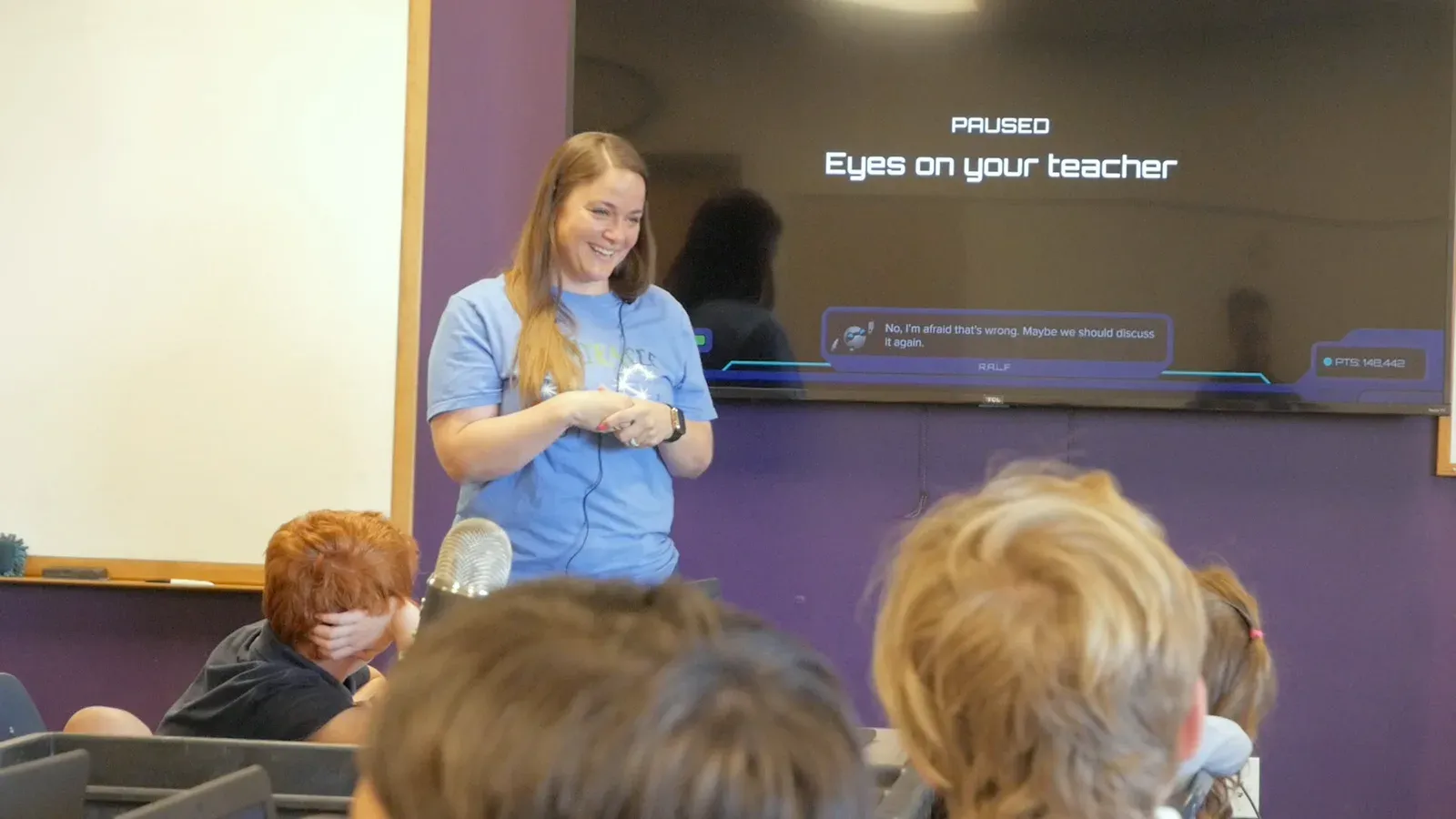
    A teacher smiles at the front of the room while the Mission screen behind her reads Paused: Eyes on your teacher.
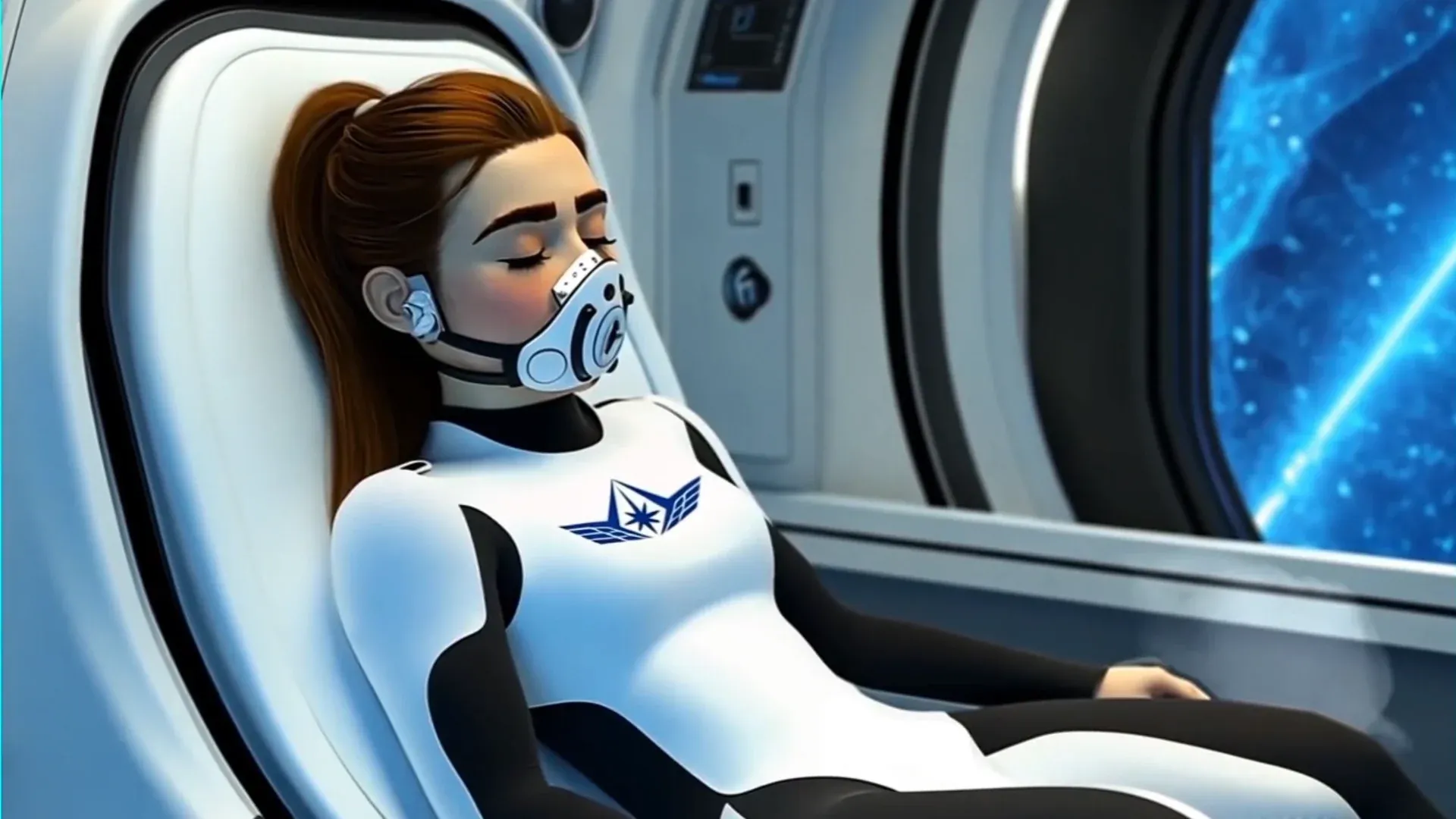
    An astronaut lies unconscious in a medical chair wearing an oxygen mask.
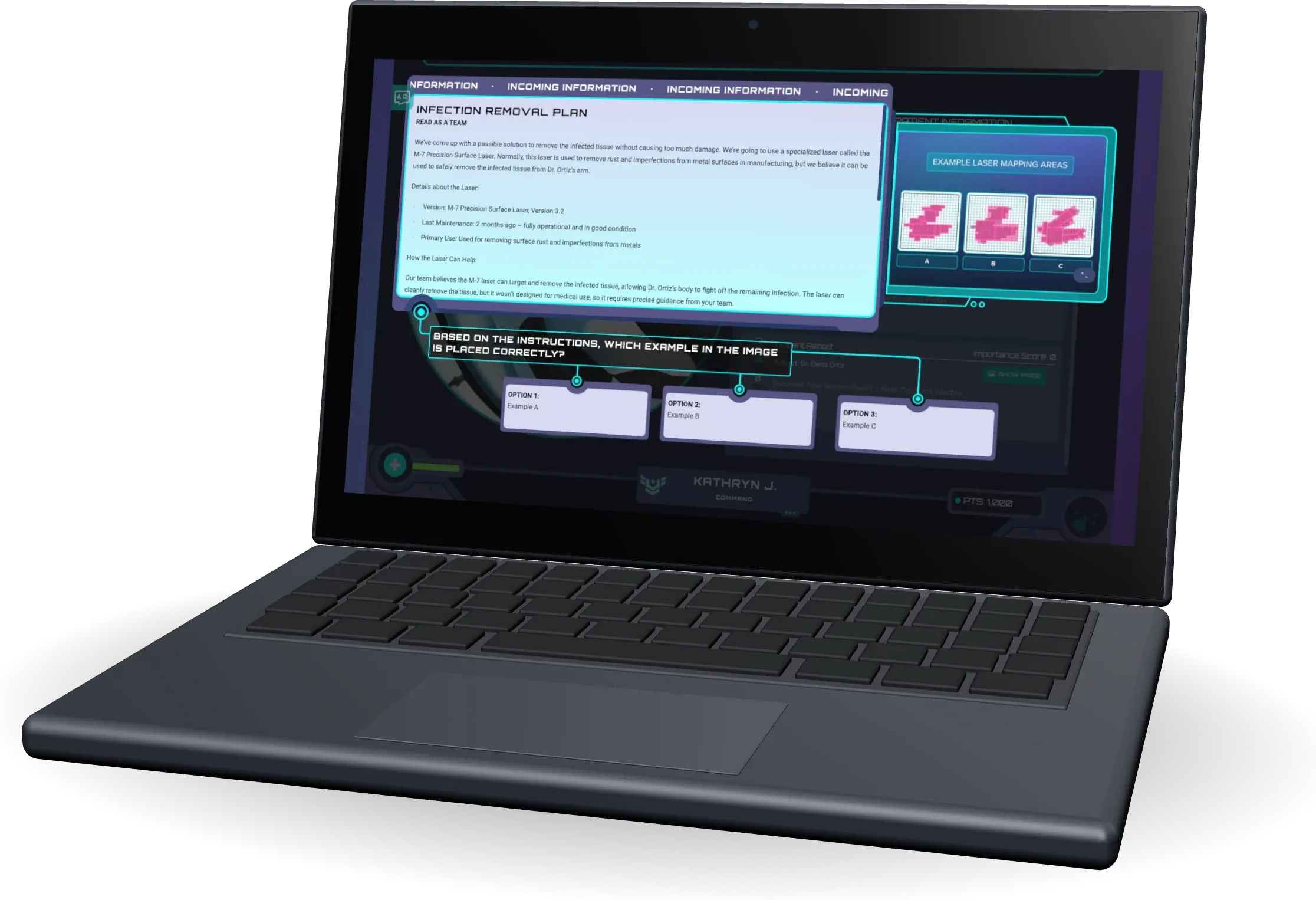
    A student Chromebook shows a team's plan for mapping the infected area with shapes.
    Every Mission puts the class inside a standards-aligned scenario where students analyze data, make decisions, and work together to solve a real problem.

    What it adds

    • The moment the content gets used. A curriculum builds the knowledge. The chance to use it usually arrives as a lab that needs materials and prep time, or a packet that ends up in the resource closet. A Mission is that moment, built to the unit’s own standard.
    • The skills every unit leans on. Every district plan promises collaboration, critical thinking, initiative, and resilience, and these programs’ assessments don’t report on them. A Mission’s report does, for every student, on the skills that Mission captured.

    Where it fits in each program

    Each program's own review carries its full pairing map, unit by unit.
    ProgramWhere a Mission fits
    Amplify ScienceAfter the modeling cycles
    FOSSAfter a key investigation
    OpenSciEdMid-storyline, before the unit’s transfer task
    Inspire Science, STEMscopesAt Elaborate

    How it runs

    • Every student is assigned to a team, and each team’s work is themed to it, from its own information and challenge to the same problem the rest of the crew is solving.
    • The Mission connects every station and moves the story forward.
    • The teacher leads the discussion and pushes for evidence. The teacher stays at the helm.
    • One device per student and a projector, 30 to 45 minutes, 5 minutes of prep.

    What the report shows

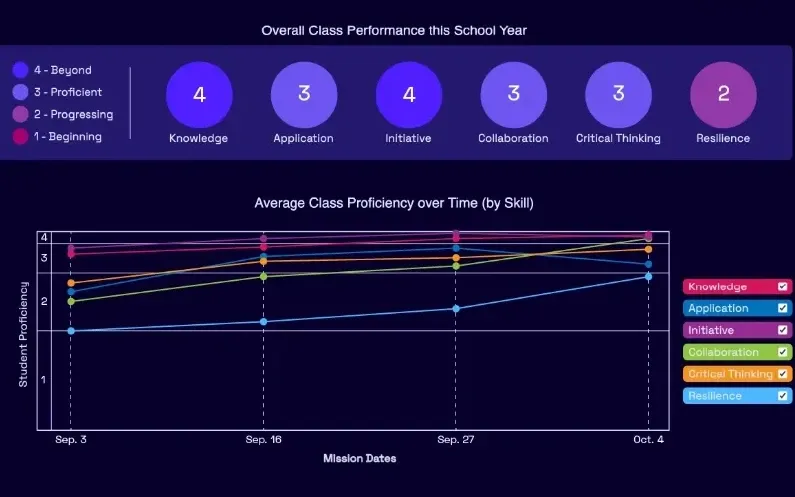
    A Mission.io class report: the class score in each of six skills, from knowledge and application to collaboration, critical thinking, and resilience, with the class chart across the year below.
    A class report from a real Mission: the class score in each of six skills, then each skill across the year.

    Every student gets a report on how well they did, built from what they did across the whole Mission: what they knew, whether they could apply it, and the human skills that Mission captured. The test shows what they know. The report shows the rest.

    We held ourselves to the same seven criteria

    CriterionA Mission
    Standards coverage, as ratedBuilt to the standards; rated by no reviewer
    Hands-on intensityNo materials; it runs on screens
    Assessment and reportingA report on every student
    Implementation lift5 minutes of prep
    Cost structureFree for any teacher to run; a district agreement by quote
    Device loadOne device per student and a projector, 30 to 45 minutes a Mission
    Teacher autonomyThe teacher at the helm

    The evidence

    +0.94percentage points of content knowledge for each Mission a class runs (p < .001)

    Content-knowledge gain, percentage points
    Bar chart of content knowledge rising with the number of Missions run, from one Mission to twenty, a roughly 17.9-percentage-point separation.
    1. +0.91MISSION STARTING LINE
    2. +8.59MISSIONS STUDY AVERAGE
    3. +18.820MISSIONS TOP OF THE RANGE

    Students who ran about 20 Missions scored roughly 17.9 percentage points higher than students who ran one.

    The more Missions a class runs, the more students grow. In Instructure’s 2025-26 study of more than a thousand fifth graders across 53 classrooms, funded by the U.S. Department of Education’s Institute of Education Sciences, students who ran Missions scored higher on content knowledge (g = 0.335, p < .001), rising about 0.94 percentage points with each Mission (p < .001), and on writing (g = 0.269, p = .015), rising about 0.035 rubric points with each Mission (p = .049). Mission.io meets ESSA Level II standards, as validated by Instructure.

    Bautista et al. (2026), Instructure · content knowledge g = 0.335, p < .001; +0.94 pp per Mission, p < .001 · writing g = 0.269, p = .015; +0.035 rubric points per Mission, p = .049

Not sure where to start?

Whichever program you’re leaning toward, we’re glad to talk it through: the two or three you’re weighing, where a Mission would fit in each, and how to begin. Pick a time.

How we reviewed this

Knowing these standards cold is our job. Every Mission is built so students have to use them, and that means knowing what each program asks of the teachers who run it. So we went looking for the people who teach these programs every day.

For each of the eleven we read every EdReports report by gateway with its tool version, the state reviews where they exist (Louisiana, Massachusetts CURATE, Texas’ Proclamation 2024 list and IMRA plan), the publishers’ own product and pricing pages, state-contract price lists, board documents where districts published what they paid (Providence, RI; an Illinois K-4 renewal; Livermore Valley, CA; Antioch, IL; Newark; Henniker, NH), the research syntheses that exist (Digital Promise’s OpenSciEd synthesis, and the two doctoral studies New Jersey’s outcomes page cites), and the teacher forums, from which the individual reviews quote only what we could date and link, as posted, with spelling tidied and nothing else changed. Two fact checks sit behind this page and are linked in Sources. Prices are as of the dates shown and will drift; tell us if one has. We make Missions, districts pair them with these programs, and we said so at the top.

What changed in this review

Corrected the guide against the ten reviews’ fact passes: Amplify’s 6-8 license term and refills; HMH’s and Inspire’s reporting and lift; Inspire’s kit price and Spanish materials; Mystery Science’s hands-on activities; PLTW Launch as elementary science; Savvas’s Texas launch; STEMscopes’ and Science Techbook’s published contract prices; Science Techbook’s grades; and Twig’s Learning List badge.

FOSS corrected to match its review: grades PreK-8; FOSSmap reports by student, class, and standard in grades 3-8 (we had called its assessment teacher-managed throughout and said it needed a dashboard); current list prices.

Fact pass and rebuild. Added EdReports results by grade band with the edition, report year, and tool version for all eleven, and the all-green roster; added cost structures and every published price with its source and date; dated OpenSciEd’s K-5 completion (February 2026) and Discovery’s new K-5 edition (January 2026); noted that STEMscopes’ cited “top marks” came from Learning List, not EdReports; rewrote our reading of PLTW’s fit in our own words; removed a section that argued every curriculum “loses students” over time (unsourced) and the term “structured supplementation”; moved the Mission.io section to the pairing list, put it on the guide’s own seven criteria, and replaced two older usage figures with the per-Mission result from the 2025-26 Instructure study; removed a sales line about Mission.io from the FAQ. Prior version live from TODO(build: date) to October 2026.

Questions leaders ask

What is the best NGSS science curriculum?

There isn’t one. On the public alignment record, Amplify Science (all-green at EdReports K-8) and OpenSciEd (all-green 6-12, free to download) stand apart; the right one depends on your teachers, your building’s capacity, and whether you need a dashboard. The decision table above is the short answer.

Which NGSS curricula have EdReports rated all-green?

At K-5: Amplify Science (2023) and, outside this list, Smithsonian Science for the Classroom. At 6-8: Amplify Science (2019 review), OpenSciEd (2023) and its six certified versions, and, outside this list, Issues and Science (2024). At high school: OpenSciEd’s three courses (2025). The roster above links every report.

Which NGSS science curriculum is best for elementary?

On the public record, Amplify Science K-5 is the only program on this list rated all-green at elementary; Smithsonian Science for the Classroom is the other all-green K-5 product and isn’t on most shortlists; HMH Into Science K-5 partially meets; OpenSciEd’s elementary materials (complete as of February 2026) are submitted and unrated; Mystery Science and the new Discovery K-5 edition have no review and the lowest lift. If your K-5 teachers have 20 minutes a day for science, lift decides more than the rating does.

Which NGSS curriculum is most straightforward to implement?

The platform programs with centralized pacing and dashboards (HMH Into Science, Inspire Science, Savvas Experience Science) roll out most predictably, and Mystery Science has the lowest lift at K-5. A smooth rollout and effective implementation aren’t the same thing; check the EdReports record for each at the grades you’re buying.

Which is most hands-on?

FOSS, OpenSciEd, STEMscopes, and PLTW put the most time into materials and design; all four need stronger materials logistics, and FOSS’s assessments are written to its labs.

Are open-license NGSS curricula really free?

The download is. OpenSciEd’s kits run roughly $800 to $1,500 per middle school unit per classroom on Louisiana’s contract (May 2026), consumables and print are extra, and a four-day launch runs about $1,050 per teacher at NSTA; the OpenSciEd review has a worked example. The license is free. The first year isn’t.

How long does an NGSS adoption take, and how should we pilot?

Plan for years, not a semester: most districts pilot in year one, roll out in year two, and spend years three and beyond on training and cross-campus consistency. For the pilot, put one full unit, with kits, in the hands of the teachers who’ll teach it, run it on the real schedule, and measure the three questions above rather than satisfaction. As of October 2026, three publishers post a free trial with terms: FOSS (30 days of FOSSweb, digital only), Mystery Science (free for first-time users through June 2027, and a year-long district trial), and STEMscopes (a school or district trial of the full digital platform, by request). OpenSciEd is free to download in full, with kits at list price from its distributors. Amplify, Inspire, HMH, Savvas, Discovery, and Twig offer samples, demos, or a reviewer login. Nobody posts a free classroom pilot with physical materials, so ask for one in writing, and ask what it costs if the answer is no.

What do districts add to a core NGSS curriculum?

Reporting where the program has none, assessment items where the state writes them, training that outlasts the launch, and, inside the unit, a Mission where the whole class has to use what the unit built on a scenario it hasn’t seen. The sheet has the placement per program.

Sources

EdReports

States, districts, and price lists

Reddit and other teacher forums

(And yes, we scoured the deepest, darkest corners of Reddit and the teacher forums, and luckily came out alive, to see what teachers were actually saying.)