
Project Lead The Way Review (2026)
Project Lead The Way (PLTW) is a nonprofit’s PreK-8 engineering and STEM curriculum: PLTW Launch for PreK-5 and PLTW Gateway for 6-8. EdReports has never reviewed either. Part of our Best NGSS science curriculum (2026) guide, eleven programs on one rubric.
Who we are. Mission.io makes Missions, not a curriculum: teacher-led, whole-class simulations built to the same NGSS standards these programs teach. Districts bring us in to get more out of the science curriculum they already own, which is why we know this shelf.
For PLTW we read its module and unit standards maps, its price and training pages, its evidence papers, the state lists, the research on PLTW, and the teacher forums. No publisher funds us or gains from a verdict. Our one interest: helping you get more out of whichever program you choose, which is what we already do for districts across the country.
On this page
Is Project Lead The Way a good curriculum? The verdict
Project Lead The Way · reviewed October 2026 · Mission.io
Real design work in every module; full science only in K-5.
Best for
Schools that want students designing, building, and testing in every module, with computer science in the mix and room in the schedule for modules that run long. In K-5, Launch can carry science by PLTW’s own map; in 6-8, Gateway sits beside a core program.
Not for
Districts that shortlist on EdReports or on published outcome studies, or that want Gateway to be their middle school science course: its units connect to 15 of the 55 middle school science standards, by PLTW’s own maps.
- EdReports
- Never reviewed, Launch or Gateway
Key facts, as of October 2026
| Fact | PLTW Launch and Gateway | Source and date |
|---|---|---|
| Publisher | Project Lead The Way, Inc., a nonprofit that writes and publishes the curriculum; founded in 1997, based in Indianapolis. PLTW says it has spent more than 28 years on this work | pltw.org, About us, accessed Oct 2026; Wikipedia, accessed Oct 2026 |
| Programs and grades | PLTW Launch, PreK-5: 42 modules (four in PreK, six in K, five each in grades 1 and 2, seven each in grades 3 and 4, eight in grade 5), in English and Spanish, taught in any order. PLTW Gateway, 6-8: 11 units for 2026-27, three lessons each, which districts place in the grades they choose. PLTW’s high school courses (computer science, engineering, biomedical science) are outside this review | PLTW Launch and PLTW Gateway, accessed Oct 2026; Launch NGSS scope and sequence, Jul 2026 |
| NGSS coverage, by PLTW’s maps | Launch: PLTW claims “full coverage of CA NGSS performance expectations for K-5,” and its module maps cover every grade 3, 4, and 5 standard by our count. Some modules carry only engineering standards. Gateway: PLTW’s unit maps connect to 15 of the 55 middle school science standards, plus the four engineering standards; only four units list a science standard | PLTW California brochure, Apr 2026; Launch modules overview, Jul 2026; Gateway standards connections, 2023 to 2025 |
| State lists | Indiana’s High-Quality Curricular Materials advisory list carries Launch K-5 under Science (2024) and Gateway 6-8 under Computer Science and Engineering. Massachusetts’ 2025 computer science guide reviews the Launch and Gateway computer science units. We didn’t find it on Texas’s Proclamation 2024 science list or in Louisiana’s reviews, but couldn’t confirm it’s absent from either. Check your own state’s list | in.gov/doe, accessed Oct 2026; Massachusetts DESE, Jun 2025 |
| Time as written | A Launch module is 10 to 14 hours of instruction; a Gateway unit about 36 to 45 hours. Launch can run in every classroom, as a specials rotation, by grade-level rotation, after school, or in summer | PLTW California brochure, Apr 2026; PLTW pathway deck, Jan 2024; PLTW Launch, Oct 2026 |
| Devices and software | Launch uses tablets or computers: ScratchJr, RosieCode (replacing Scratch in grades 2 to 5 from 2026-27), and VEX robotics in grade 5. Gateway uses MIT App Inventor, micro:bit, VEX EXP or V5, Autodesk Revit, and CAD. Software licenses are in the annual fee | PLTW curriculum updates, Aug 2026; Massachusetts DESE, Jun 2025; PLTW investment, Oct 2026 |
| Materials | Kits come from the PLTW Store inside myPLTW, priced to your needs; the public bills of materials carry no prices. Refill kits replace consumables. Common classroom supplies (pencils, markers, tape, scissors, glue) are left out of the kits. A 2015-16 price sheet, seen only in a search summary, says a kit serves a classroom of up to 30; we couldn’t confirm that for today’s kits | PLTW equipment and supplies, Oct 2026; Launch assumed items, 2024 |
| Professional learning | Core Training per teacher, a one-time cost: $500 to $700 for Launch, $750 to $1,200 for Gateway, virtual or in person. If a credentialed teacher leaves within four years, PLTW gives a grant to train a replacement | PLTW investment and FAQ, Oct 2026 |
| Scale | The publisher’s figures, across all of PLTW PreK-12: more than 2.4 million students, 116,000 teachers trained, and 12,600 schools. PLTW doesn’t publish a count for Launch or Gateway alone | pltw.org, About us, accessed Oct 2026 |
What EdReports says about PLTW, by gateway
| Review | Designed for NGSS | Coherence and scope | Usability | Report |
|---|---|---|---|---|
| PLTW Launch PreK-5 | Not reviewed | Not reviewed | Not reviewed | EdReports reports list, Oct 2026 |
| PLTW Gateway 6-8 | Not reviewed | Not reviewed | Not reviewed | EdReports reports list, Oct 2026 |
EdReports has never reviewed a PLTW program, and none is on its under-review list. We found no other independent NGSS review of Launch or Gateway either: no Louisiana tiered review, no Massachusetts CURATE review, no NextGenScience peer review. Not reviewed is not a failure and not a pass. What’s public instead is PLTW’s own standards maps, module by module, which are worth checking against your state’s standards, and Indiana’s advisory list. The maps disagree with each other in places: the 2026 overview lists 3-PS2-1 for Forces and Interactions and the module’s own 2025 map doesn’t, and the scope and sequence lists “4-LS2-1,” which isn’t an NGSS standard.
What do teachers say about PLTW?
Open-forum comments on Launch and Gateway are scarce; most PLTW talk on Reddit is about the high school courses, and we found no independent comment on Launch at all. So all five Launch voices on this page, including the one quoted just below, come from PLTW’s own blog, where the publisher chose what to post, and we label each one. The Gateway voices come from Reddit. The praise and the criticism are real, dated, and linked. What runs through both is time: teachers love the projects and tell you to plan for them to take longer than written.
Where teachers see value
The projects. Teachers describe students building, testing, and talking like engineers, and middle school teachers say the training is worth taking. One elementary teacher on PLTW’s blog writes that many students now “enthusiastically declare science as their favorite subject.”
“8th grade using Science of Technology PLTW: students are watching a Deepwater Horizon documentary, then building marine ecosystems with fake flora and fauna. They’re going to simulate an oil spill and have to clean it up. 7th grade using Energy and the Environment PLTW: students are building working windmills in class and testing them.”
“I currently do PLTW for 6th, 7th and 8th. You should definitely do the training. I learned a lot and the teachers they have that teach the class are current teachers and can give you a lot of help. Also take their advice about what to buy as well, they have done this for years and know what you need and what you can cut out.”
“I was blown away! These were 5- and 6-year-olds communicating with each other as engineers.”
“Using PLTW to teach science content has changed the classroom dynamic completely. I have never seen students get so excited about learning science.”
Common concerns
Time, setup, and scaffolding. Teachers say modules take longer than the guide says, kits take real work to organize, and some lessons need more support than the curriculum gives. A middle school teacher adds that a unit can spend weeks on one or two standards, which matters if your district is “pushing standards.” The two oldest comments here come from early Launch classrooms; the modules have been revised since.
“It is very hands on, which is great, but the students get overwhelmed with all the hands on group work. Some of the material needs far more scaffolding than provided for by the curriculum, which can be frustrating. If your district is pushing standards, it’s difficult because while they deep dive into a standard, you’re spending 9-10 weeks covering 1 or 2 standards. The set up of some of the labs is very time consuming.”
“It’s a canned curriculum, but some of the material can be challenging, especially at the higher levels. Because it’s a canned curriculum, it is easy for students to find answer keys, projects, etc online.”
“To be on the safe side, I would double the time for the unit. If the lesson plans state that it will take 10 hours to complete, I would count on 15-20.”
“It took me a week to organize VEX kits, program iPads, print the handouts, and decide which parts of the module to teach.”
A first-year Launch teacher’s advice: double the time for the unit.
PLTW pros and cons, with the evidence
Pros
- Engineering design at every grade. Every Launch module ends in a design problem set up by a story; every Gateway lesson ends in a project, and every unit in a problem. Teachers who like PLTW name the projects first. [PLTW Launch page; Gateway unit outlines, 2026; the quotes above]
- Simple, flat pricing: $950 per school per year for Launch or Gateway, with every module or unit, the software, and updates included, and no increase as you add modules. [PLTW investment page, Oct 2026]
- Public standards maps. Every Launch module’s standards are posted, and by our count they cover every grade 3, 4, and 5 NGSS standard; Indiana lists Launch K-5 for science. [PLTW modules overview, Jul 2026; Indiana DOE]
- It fits many schedules. Launch runs in classrooms, as a rotation, after school, or in summer, in any order, in English and Spanish, and PLTW funds training for a replacement if a credentialed teacher leaves within four years. [PLTW Launch page and FAQ, Oct 2026]
Cons
- Gateway isn’t a middle school science course. Its units connect to 15 of the 55 middle school science standards, with none in ecosystems, heredity, evolution, waves, or Earth’s systems (MS-LS2, LS3, LS4, PS4, ESS2). [PLTW Gateway standards connections, 2023 to 2025]
- No independent alignment review. EdReports has never reviewed Launch or Gateway, so PLTW’s own maps are the record, and they disagree with each other in places. [EdReports; PLTW standards documents, 2025 and 2026]
- Outcome evidence is thin: strong on student interest, not proven on science achievement. Evidence for ESSA lists no PLTW program among its science programs (2026), and a 2016 review of the PLTW research found Launch “was not a focus of any” study it read. The one Gateway outcome study we found, a 2019 dissertation in one district, found no difference in math or science test scores, and more positive attitudes toward STEM courses and careers after one Gateway course; its abstract reports no effect sizes. [Evidence for ESSA; Hess, Sorge, and Feldhaus, 2016; Bellinger, 2019]
- Time. Teachers report modules run longer than written, and a Gateway unit can spend nine or ten weeks on one or two standards. [PLTW blog, Oct 2015; r/ScienceTeachers, Feb 2022]
- The $950 isn’t the whole bill. Kit prices aren’t public, training is per teacher, and Gateway robotics hardware can run about $15,000 a class. [PLTW equipment page, Oct 2026; Massachusetts DESE, Jun 2025]
How it teaches
Instructional model
PLTW calls it activity-, project-, and problem-based: structured hands-on activities first, then a project that asks students to make meaning of them, then an open-ended problem “with no clear or best solution intended.” In Launch, each module of 10 to 14 hours opens on a story with the characters Angelina, Mylo, and Suzi and ends in the design problem the story sets up, like airlifting supplies with a model glider in grade 3 or cleaning contaminated water in grade 5. In Gateway, each unit runs three lessons of about 36 to 45 hours in all, and each lesson ends in a project. That’s the strength and the lift in one design: students spend their time designing, testing, and redesigning, so the schedule has to give them that time.
Assessment and reporting
Each Launch module’s Curriculum Framework, in the Teacher Guide, lists the assessment opportunities in each activity, project, and problem, and PLTW describes a mix of formative and summative assessment. PLTW gives End-of-Course assessments with score reports in its high school courses; we found no standardized assessment or district dashboard for Launch or Gateway. For a district that needs benchmark data in science, that’s a gap to fill.
Materials
Each module or unit has a kit from the PLTW Store, with refill kits for the consumables; prices are in the store, not on PLTW’s public pages. Launch uses tablets or computers for its coding modules and VEX robots in grade 5; Gateway adds micro:bit, VEX, and CAD software. The 2026-27 Launch update promises “minimal supply changes,” and three Gateway units are being replaced by July 2028, with existing certifications carried over.
Implementation lift
Moderate, and mostly about time: Core Training for each teacher, room in the schedule for modules that run long, and someone who orders, organizes, and refills kits. A 2016 review of PLTW research names scheduling and space as a known problem for Gateway; Launch, PLTW says, runs in regular classrooms.
How much does PLTW cost?
PLTW charges each school a flat $950 a year for Launch or for Gateway, with every module or unit included; Core Training is a one-time $500 to $700 per Launch teacher and $750 to $1,200 per Gateway teacher (PLTW’s pages, October 2026). Kit prices aren’t public; the only published ones we found are Massachusetts’ June 2025 figures, $60 to $220 per Launch computer science module kit and about $1,100 to $15,000 per class for Gateway’s computer science and robotics hardware.
A worked example, from the numbers above: one elementary school, two classrooms in each of grades 3 to 5, Launch as its science program, five years
- Annual participation fee$4,750$950 a year for five years, every module included
- Core Training$3,200five classroom teachers at $500 and one lead teacher at $700, one time (Massachusetts' 2025 figures, inside PLTW's range)
- Module kitsabout $6,600the fewest modules that cover each grade's standards by our count of PLTW's maps (five in grade 3, six in grade 4, four in grade 5), one kit per classroom: 30 kits at $220, the top of the only public kit price, which is for the computer science modules
Five-year total, before refills and shipping; science kit prices aren't publicat least $14,500
That’s at least $16 per student per year for 180 students. Read it as a floor. The science kits aren’t priced publicly, so we used the top of the only public kit price, which is for the computer science modules. Refills, robotics kits, and Lead Teacher or District Transformation Training ($9,500 for up to 24 Launch teachers) all come on top, so public numbers give no honest ceiling.
The fee is the small number. Ask for the kit quote first.
Prices as of October 2026. Prices drift; tell us if one has.
PLTW list prices, October 2026
| Item | List price | What it includes |
|---|---|---|
| Launch participation fee | $950 per school per year | Every Launch module, unlimited software licenses, curriculum updates, 24/7 support |
| Gateway participation fee | $950 per school per year | Every Gateway unit, on the same terms |
| Launch Core Training | $500 to $700 per teacher, one time | Virtual or in person; $500 classroom teacher, $700 lead teacher (Massachusetts, June 2025) |
| Gateway Core Training | $750 to $1,200 per teacher, one time | Virtual or in person; Massachusetts lists $1,200 per teacher per unit |
| District Transformation Training (Massachusetts, June 2025) | $9,500 | Training for up to 24 Launch classroom teachers |
| Launch computer science module kits (Massachusetts, June 2025) | $60 to $220 per module | The materials for one module; science module kits aren’t priced publicly |
| Gateway hardware (Massachusetts, June 2025) | About $1,100 per class (CSIM) to about $15,000 per class (VEX robotics), then about $250 a class in consumables | Computer science and robotics units |
PLTW against five NGSS programs, on one chart
| Program | EdReports, K-5 and 6-8 | Instructional model | Lesson architecture | Hands-on intensity | Assessment and reporting | Implementation lift | Cost structure |
|---|---|---|---|---|---|---|---|
| PLTW Launch and Gateway | K-5 never reviewed (Launch)6-8 never reviewed (Gateway) | Engineering design modules; runs in class, rotations, or after school | Modules of 10 to 14 hours (Launch); units of 36 to 45 hours (Gateway) | High | Assessment opportunities in each module; no district reporting found | Moderate; scheduling and materials | Flat $950 a year per school, plus training ($500 to $1,200 a teacher) and kits, whose prices aren’t public |
| Amplify Science | K-5 Meets, every grade (2022 edition; 2023 report)6-8 Meets, all gateways (2018 edition; 2019 review) | Literacy and modeling routines; simulations plus investigations | Repeatable daily routines | Moderate | Embedded unit assessments; class reports in 6-8 | Moderate; routines scaffold year one | Per-student license plus kits: $13 K-5 (NYC), $25 6-8 (Louisiana) |
| OpenSciEd | Meets, all gateways (2022 edition; 2023 report) | Phenomenon storylines, open license | Extended storylines with scripted pacing | High | Embedded, teacher-managed; dashboard via partner platform | Moderate to high; train first | No license; kits, print, training |
| FOSS Next Generation | K-5 not reviewed6-8 Does Not Meet, Gateway 1 (30%; 2019 edition, 2019 report) | Investigation-centered kit labs | Investigations in 45-minute parts | Very high (kits) | Embedded checks and I-Checks; FOSSmap reports in grades 3-8 | Moderate; materials management and refills | Kits with five-year digital seats, plus refills |
| HMH Into Science | K-5 Partially Meets, every grade (2022 edition; 2024)6-8 not reviewed | Platform with centralized pacing | Centralized pacing | Moderate | Class and student reports by standard on HMH Ed | Low to moderate; platform and kit reorders | Per-student six-year packages, kits in the higher tiers; K-5 digital $49.20 per student (Yonkers, NGSS edition, 2023 to 2028) |
| STEMscopes | K-5 not reviewed6-8 Does Not Meet, Gateway 1 (15%; 2019 edition, 2020 report) | 5E with simulations and labs; a Texas edition | 5E scopes in bundles on a digital platform | High | Scope assessments and a bundle Action Plan; simulation reports to the teacher | Moderate; planning, daily devices, and kits | District digital license from $10.45 per license (the publisher’s figure; term not printed), plus optional print and kits |
PLTW head to head with five programs
PLTW vs Amplify Science
For a district’s core science, Amplify has the record PLTW lacks: Amplify Science meets EdReports’ expectations at every K-5 grade (2023) and at 6-8 (2019), and EdReports has never reviewed PLTW. The two teach differently. Amplify runs literacy and modeling routines with simulations beside the investigations; PLTW runs on engineering design, with students building and testing in every module. Amplify is a per-student license plus kits (pricing on its review); PLTW is a flat $950 a year per school plus training and kits. A district doesn’t have to choose between them: PLTW has presented sessions on connecting Launch to an existing science curriculum and names Amplify among the programs it supports (January 2024). For the alignment record, Amplify; for engineering design added to the week, PLTW, often beside it.
PLTW vs OpenSciEd
In middle school this isn’t a close call, because they do different jobs. OpenSciEd 6-8 is a full science course, all-green at EdReports (2023) and free to download; Gateway’s units connect to 15 of the 55 middle school science standards, so it fits as an elective or wheel beside a core program like OpenSciEd. One 8th grade teacher adopting OpenSciEd adds that they’re “also expected to teach PLTW’s Magic of Electrons” (September 2024). In K-5 the comparison is real: OpenSciEd’s K-5, completed in 2026, isn’t rated yet, and neither is Launch, so both rest on their own standards maps and your pilot. OpenSciEd builds understanding through storylines of model revision and argument; Launch builds it through design problems. OpenSciEd has no license and you buy kits from certified vendors; PLTW charges $950 a year per school, plus training and kits.
PLTW vs FOSS
For investigation, FOSS; for design, PLTW; and PLTW itself pitches Launch as a layer beside FOSS. FOSS is built around the science investigation, PLTW around the design problem, and both put materials in students’ hands. Neither has a strong EdReports record to cite: FOSS 6-8 did not meet Gateway 1 (30%, 2019) and FOSS K-5 hasn’t been reviewed; PLTW has never been reviewed at all. Both are kit programs with logistics to match. FOSS sells kits that carry the books and five-year digital seats (a grade 5 module is $2,147 to $2,602, October 2026); PLTW charges a flat fee and sells kits in its store. FOSS has FOSSmap reports in grades 3-8, and we found no equivalent for Launch. In PLTW’s own sessions on fitting Launch beside an existing program (January 2024), FOSS is on the list: FOSS for the investigations, PLTW for the design.
PLTW vs HMH Into Science
Choose HMH for predictable rollout and reports, PLTW for engineering design; they sit at opposite ends of the shelf. HMH Into Science is a K-8 platform with centralized pacing and class and student reports by standard; its K-5 partially meets EdReports’ first gateway at every grade (2022 edition; 2024), and its 6-8 has no Into Science report. It’s sold in per-student six-year packages, with a low to moderate lift. PLTW asks more of teachers and the schedule, gives students far more time designing and building, and has no district reporting we could find. A district that needs science reports by standard can run PLTW beside a program like HMH.
PLTW vs STEMscopes
STEMscopes is the science platform with the better outcome record, and PLTW the design program. STEMscopes is a digital-first K-12 platform on a 5E frame with simulations, optional print, and kits, sold per district by quote; its 6-8 edition did not meet EdReports’ Gateway 1 (15%, 2020), and its K-5 is unreviewed. On outcomes, STEMscopes Science is rated “Promising” on Evidence for ESSA (2026), which lists no PLTW program among its science programs. Both are high on hands-on time. STEMscopes is a science platform teachers use every day; PLTW is a design program built around projects, at a flat $950 per school, and PLTW lists STEMscopes among the programs Launch sits beside (January 2024).
When PLTW fits, and when to think twice
Often a strong fit when a district:
- Wants engineering design and computer science taught every year, K-8
- Will teach Launch as its K-5 science and has checked PLTW’s module maps against its own standards
- Has a core middle school science program and wants Gateway beside it as an elective or wheel
- Can give modules more time than the guide says
- Is in Indiana, where Launch K-5 is on the science advisory list, or has checked its own state’s list
Think twice when a district:
- Shortlists on EdReports results
- Wants published outcome studies of Launch or Gateway before it adopts
- Expects Gateway to cover the middle school science standards
- Needs kit prices up front (PLTW quotes them inside its store)
- Needs a standardized science assessment with district reports
Most districts that adopt it budget for three or four things alongside it. The next section lists them.
What districts pair with PLTW
PLTW arrives with its modules, its kits, and its training. Most of what districts put beside it is the structure around it: a core science program in middle school, room in the schedule, and someone who keeps the kits running. One addition on this list is instructional, and it’s ours. Read that entry knowing who wrote it.
- A core science program in middle school. Gateway’s units connect to 15 of the 55 middle school science standards, so districts run it as an elective or wheel beside a 6-8 program; PLTW runs sessions on fitting Launch beside an existing adoption, too.
- Time and a kit plan. Room in the schedule for modules that run long, and a person who orders, organizes, and refills the kits; PLTW’s own pilot teacher spent a week organizing kits before teaching.
- Training past Core Training. Lead teacher training or PLTW’s District Transformation Training ($9,500 for up to 24 Launch teachers, Massachusetts’ June 2025 figure), then coaching for the teachers who started cold.
Our entry · We make Missions
A Mission, before the design problem
Before a module’s design problem, a Mission gives students one class period to use the module’s science on a scenario they haven’t seen, together, with a report on every student when it’s over.
Four rows from the 5th grade map, one where no Mission fits: placements from PLTW Launch’s public module standards and descriptions Module Mission (code; minutes) Where it sits Matter: Properties and Reactions Into the Asteroid (5-PS1-3, 5-PS1-4; 41 min) After the activities on new substances, before the design problem Ecosystems: Flow of Matter and Energy Finding Balance (5-LS2-1; 42 min) After the unbalanced-ecosystem simulation, before the design problem Patterns in the Universe Operation Starfall (5-ESS1-1, 5-ESS1-2; 40 min) Before the design problem, the exhibit Infection: Detection, the whole module No Mission fits Tracing how an illness spreads through a school The PLTW Launch 2026-27 5th grade pairing map. PLTW Launch’s eight 5th grade modules, one by one: the Mission that fits, where it sits before the design problem, and the modules where no Mission fits. One page, free, emailed now.
It’s on its way.
Check your inbox for the pairing map.
That didn’t send. Try again, or write to info@mission.io and we’ll send the map.
Email me the 5th grade map. It comes as a PDF, ready to print. Unsubscribe anytime.
What it adds
- The moment the science gets used. PLTW builds toward a design problem that students solve in teams. A Mission fits after the activities that teach the idea and before that problem, so students reason with the science out loud, together, first, and the design starts from it.
- The skills every unit leans on. Every district plan promises collaboration, critical thinking, initiative, and resilience, and the curriculum’s assessments don’t report on them. A Mission’s report does, for every student, on the skills that Mission captured.
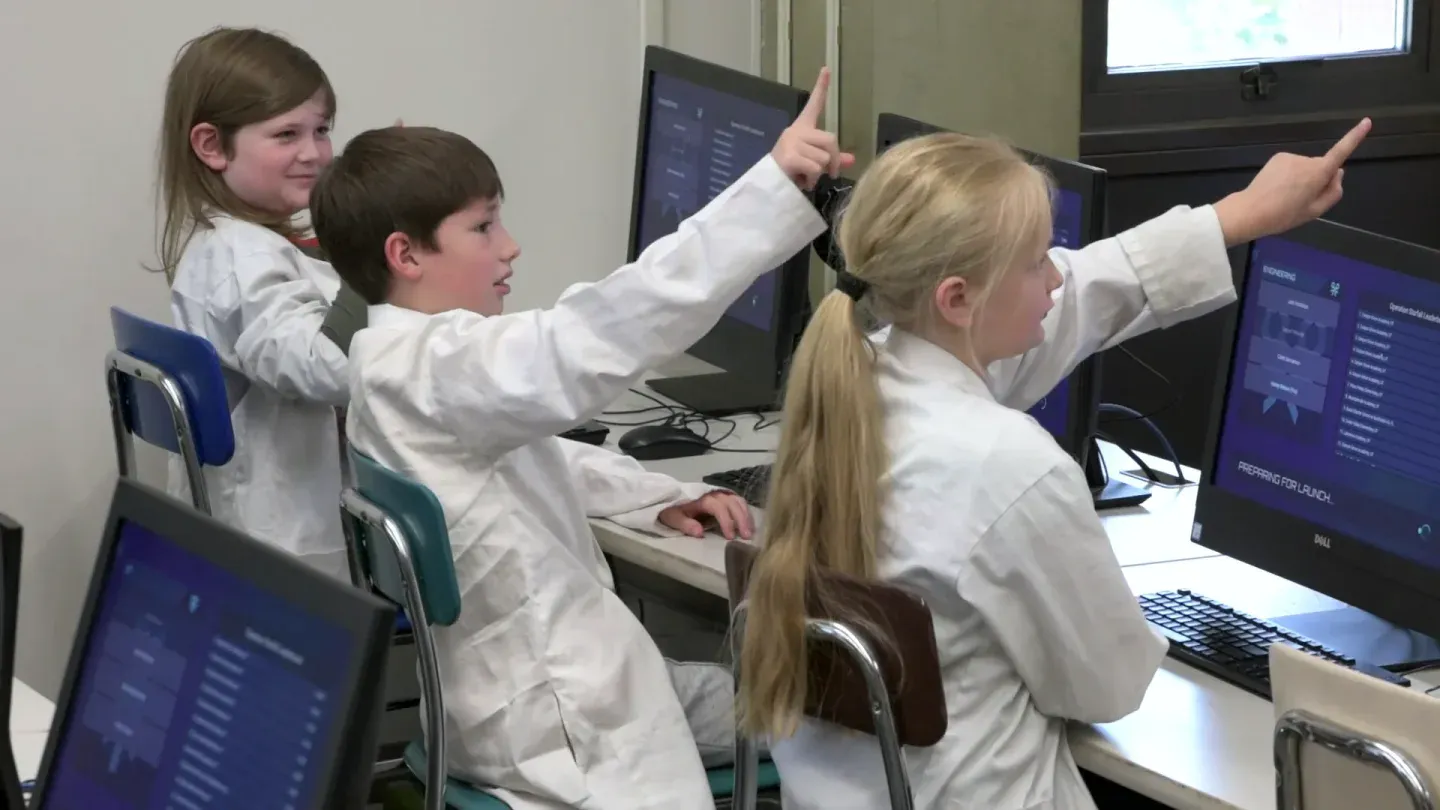

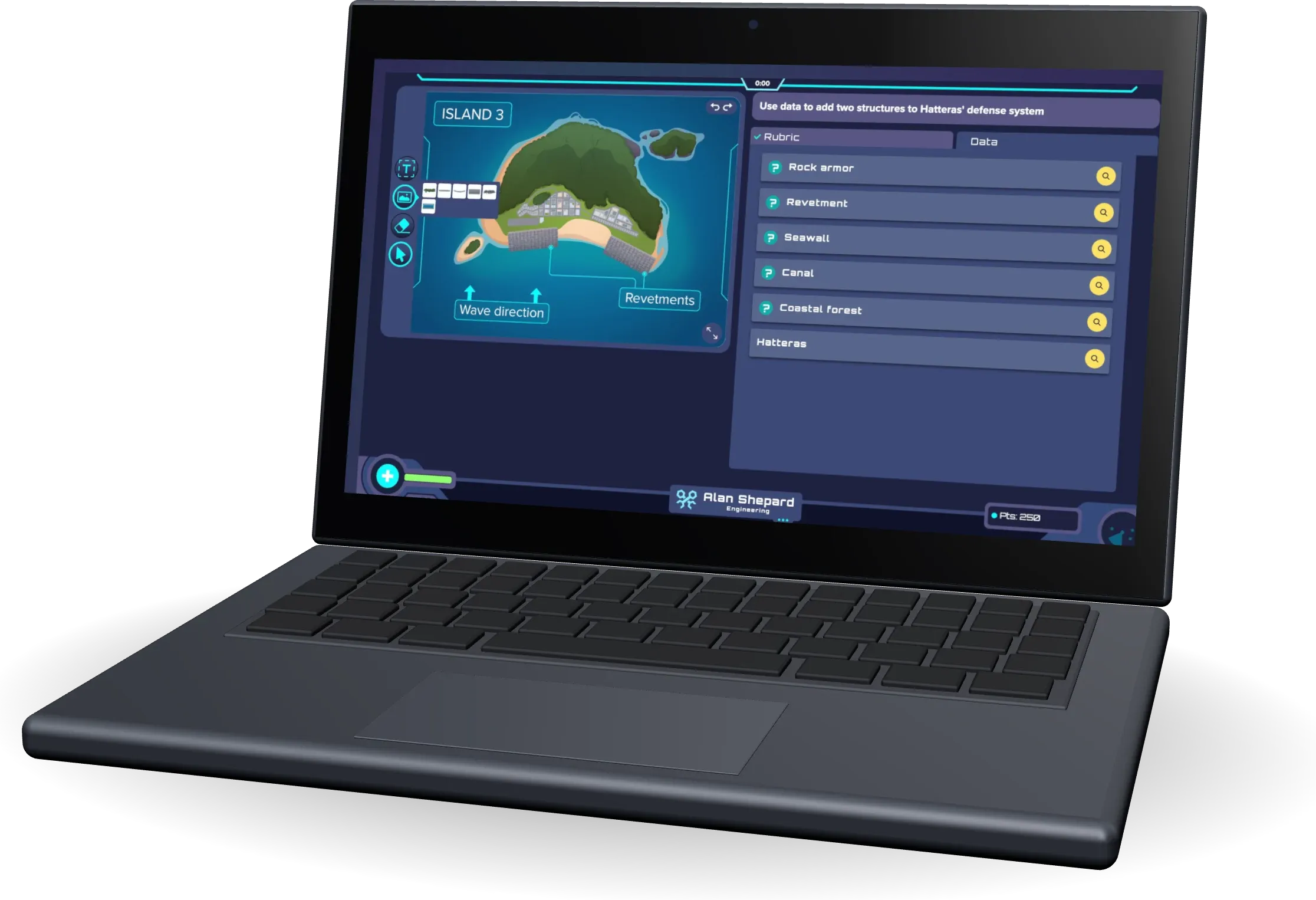
Every Mission puts the class inside a standards-aligned scenario where students analyze data, make decisions, and work together to solve a real problem. How it runs
- Every student is assigned to a team, and each team’s work is themed to it, from its own information and challenge to the same problem the rest of the crew is solving.
- The Mission connects every station and moves the story forward.
- The teacher leads the discussion and pushes for evidence. The teacher stays at the helm.
- One device per student and a projector for that period (Launch’s tablets or computers work, one per student), 30 to 45 minutes a Mission, 5 minutes of prep.
- Any teacher can run one free; districts bring us in when they want it in every science classroom, with district-level reporting across all of them.
What the report shows
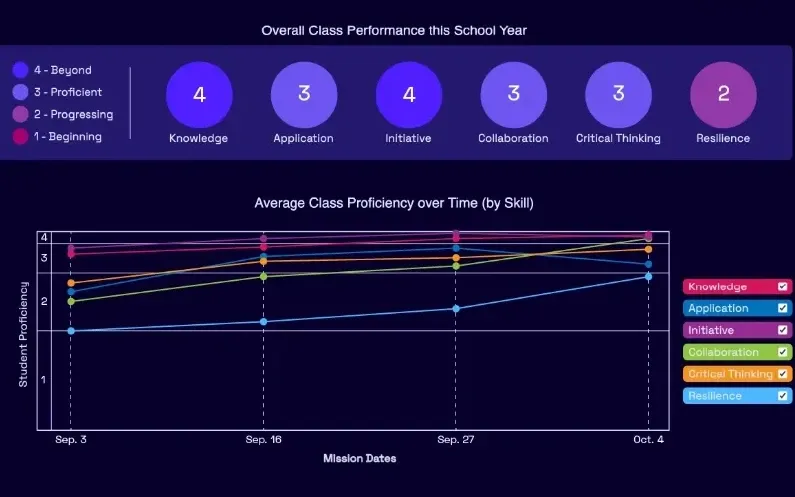
A class report from a real Mission: the class score in each of six skills, then each skill across the year. Every student gets a report on how well they did, built from what they did across the whole Mission: what they knew, whether they could apply it, and the human skills that Mission captured. The test shows what they know. The report shows the rest.
The evidence
+0.94percentage points of content knowledge for each Mission a class runs (p < .001)
Content-knowledge gain, percentage points Bar chart of content knowledge rising with the number of Missions run, from one Mission to twenty, a roughly 17.9-percentage-point separation.Students who ran about 20 Missions scored roughly 17.9 percentage points higher than students who ran one.
The more Missions a class runs, the more students grow. In Instructure’s 2025-26 study of more than a thousand fifth graders across 53 classrooms, funded by the U.S. Department of Education’s Institute of Education Sciences, students who ran Missions scored higher on content knowledge (g = 0.335, p < .001), rising about 0.94 percentage points with each Mission (p < .001), and on writing (g = 0.269, p = .015), rising about 0.035 rubric points with each Mission (p = .049). Mission.io meets ESSA Level II standards, as validated by Instructure.
Bautista et al. (2026), Instructure · content knowledge g = 0.335, p < .001; +0.94 pp per Mission, p < .001 · writing g = 0.269, p = .015; +0.035 rubric points per Mission, p = .049
Teaching Gateway, or your own order?
Launch modules run in any order, and Gateway units sit in whichever grades a district chooses. Bring us your modules or units and we’ll work out together where a Mission fits in each one.
Questions leaders ask about PLTW
- Is PLTW aligned to NGSS?
PLTW says Launch covers every K-5 standard; we counted grades 3 to 5, and its module maps cover every standard there. By PLTW’s own maps, Gateway connects to 15 of the 55 middle school science standards. No independent review has checked either: EdReports has never reviewed PLTW. Indiana lists Launch K-5 for science (2024) and Gateway for computer science and engineering.
- How much does PLTW cost?
$950 per school per year for Launch or for Gateway, with every module or unit included, plus one-time Core Training of $500 to $700 per Launch teacher or $750 to $1,200 per Gateway teacher (PLTW, October 2026), plus kits, which PLTW prices in its store. The worked example above lands six classrooms in grades 3 to 5 at a floor of $14,500 over five years, since science kit prices aren’t public.
- Can PLTW Launch be our elementary science curriculum?
Some districts use it that way: Manassas City, Virginia, and Smithtown, New York, both said so on PLTW’s blog (May 2020), and PLTW claims full K-5 coverage of California’s NGSS. PLTW also offers it as a rotation or after-school program beside a district’s science. Check PLTW’s module maps against your standards, and plan on more modules than a rotation would need: by our count of PLTW’s maps, five in grade 3, six in grade 4, and four in grade 5.
- How does PLTW compare to Amplify?
Amplify meets EdReports’ expectations at K-5 and 6-8; PLTW has never been reviewed. Amplify is built around literacy and modeling routines with central reporting; PLTW around engineering design problems, at a flat fee per school. PLTW also pitches Launch as a layer beside programs like Amplify. The head-to-head above has the rest.
- What do districts add to PLTW?
A core science program in middle school, room in the schedule and a kit plan, training past the first year, and, before a module’s design problem, a Mission where the whole class has to use the module’s science on a scenario it hasn’t seen. The pairing map lists the fit module by module.
How we reviewed this
We read PLTW’s Launch and Gateway pages, its investment, equipment, and FAQ pages, every Launch module’s standards connection and the 2026 modules overview and scope and sequence, the Gateway unit outlines and standards connections, PLTW’s Launch and Gateway evidence papers and its California brochure, EdReports’ site and under-review list, Indiana’s advisory lists and Massachusetts’ 2025 computer science guide, the Evidence for ESSA science list, the 2016 systematic review of PLTW research and the studies it and PLTW cite, and r/ScienceTeachers comments mentioning PLTW from 2021 to October 2026, read through an archive, along with posts on PLTW’s own blog, which we label as PLTW’s. We quote only comments we could date and link, as posted, with spelling and punctuation tidied where a typo would distract and nothing else changed; the link shows the original. The standards counts are ours, from PLTW’s maps. Prices are as of the dates shown and will drift; tell us if one has. We make Missions, districts pair them with PLTW, and we said so at the top. Mission.io is not affiliated with or endorsed by Project Lead The Way, Inc. Everything is linked in Sources.
Sources
EdReports
PLTW and the states
- PLTW, About us
- PLTW Launch
- PLTW Gateway
- PLTW investment
- PLTW equipment and supplies
- PLTW FAQ
- PLTW curriculum updates (Aug 2026)
- PLTW Launch modules overview, NGSS (Jul 2026)
- PLTW Launch NGSS scope and sequence (Jul 2026)
- PLTW Launch California brochure (Apr 2026)
- PLTW Gateway standards connections, Energy and the Environment (2025)
- PLTW Gateway standards connections, Medical Detectives (2023)
- PLTW, Launch assumed classroom items (2024)
- PLTW, Connecting PLTW Launch to your existing science curriculum (Jan 2024)
- PLTW, Completing your PLTW pathway (Jan 2024)
- Indiana DOE, High-Quality Curricular Materials advisory lists
- Massachusetts DESE, Digital Literacy and Computer Science Curriculum Guide (Jun 2025)
- Wikipedia, Project Lead The Way
Evidence
- Evidence for ESSA, science programs (2026)
- Hess, Sorge, and Feldhaus, The Efficacy of Project Lead the Way: A Systematic Literature Review (ASEE, 2016)
- Bellinger, PLTW Gateway program outcomes in a suburban school district (Lindenwood University dissertation, May 2019)
- Tran and Nathan, Journal of Engineering Education (Apr 2010)
- Nomi, DeChane, and Podgursky, EdWorkingPaper 24-981 (Nov 2024)
- PLTW Gateway evidence paper (Apr 2026)
Reddit, other teacher forums, and PLTW's blog
- r/ScienceTeachers, experience teaching PLTW (Feb 2022)
- r/ScienceTeachers, weekly teaching thread (Oct 2021)
- r/ScienceTeachers, help with 7th grade engineering (Aug 2026)
- r/ScienceTeachers, a new district and OpenSciEd (Sep 2024)
- r/ScienceTeachers, a librarian drafted to teach PLTW (May 2026)
- PLTW blog, The Impactful Outcomes of PLTW Launch (Oct 2017)
- PLTW blog, PLTW for Science? (May 2020)
- PLTW blog, A Natural (and Timely) Solution (May 2020)
- PLTW blog, From Uncertainty to Overwhelming Enthusiasm (Jul 2016)
- PLTW blog, A Conversation with Stephanie Cunningham (Oct 2015)
- PLTW blog, Launching a Pilot (Nov 2013)
(And yes, we scoured the deepest, darkest corners of Reddit and the teacher forums, and luckily came out alive, to see what teachers were actually saying.)
Other programs and research
Teacher comments are linked where they are quoted; Reddit comments were read through the Arctic Shift archive of r/ScienceTeachers and linked to their reddit.com permalinks, and blog posts are PLTW’s own.
Know what it covers, whether you’re choosing it or running it
Going through an adoption? We're always glad to talk through your choices and show you how a Mission makes whichever one you pick go further. Already running PLTW? Same conversation, about the year ahead.