
Amplify Science Review (2026)
Amplify Science is a K-8 NGSS program from Amplify Education, written by UC Berkeley’s Lawrence Hall of Science around literacy and modeling. EdReports rated it Meets at every gateway, K-5 (2023) and 6-8 (2019). Part of our Best NGSS science curriculum (2026) guide, eleven programs on one rubric.
Who we are. Mission.io makes Missions, not a curriculum: teacher-led, whole-class simulations built to the same NGSS standards these programs teach. Districts bring us in to get more out of the science curriculum they already own, which is why we know this shelf.
For Amplify Science we read both EdReports reports, Amplify’s program and research pages, the state price lists and adoption notices, Seattle Public Schools’ adoption record, the two WestEd trial briefs, and the teacher forums. No publisher funds us or gains from a verdict. Our one interest: helping you get more out of whichever program you choose, which is what we already do for districts across the country.
On this page
Is Amplify Science a good curriculum? The verdict
Amplify Science · reviewed October 2026 · Mission.io
Top marks on paper, and a daily routine students have to buy into.
Best for
Districts that shortlist on EdReports, want reading, writing, and argument built into science, and need the same predictable routine in every classroom from year one, with devices for the simulation lessons.
Not for
Districts that want students working with materials in most lessons, that can’t put devices in classrooms, or whose teachers want room to set their own pace; teachers report the lessons run long and some classes tune out.
- State adoption
- California, K-8 (November 2018)
Key facts, as of October 2026
| Fact | Amplify Science | Source and date |
|---|---|---|
| Publisher | Amplify Education, Inc., Brooklyn, New York. Developed and written by the Lawrence Hall of Science, University of California, Berkeley, whose Seeds of Science/Roots of Reading program Amplify acquired the rights to in 2012; the curriculum’s copyright lines read The Regents of the University of California | amplify.com, Amplify Science, Oct 2026; Amplify RFI response to Seattle, Jun 2018 |
| Editions and grades | K-5 and 6-8, sold as separate grade bands; Transitional Kindergarten since September 2019. Grades 6-8 come as an NGSS grade-level integrated model or a domain-specific one. State editions for California and Louisiana. Launched in spring 2017 | amplify.com, program FAQ, Oct 2026; Amplify, Sep 2019; Amplify, Nov 2018 |
| State adoptions | California approved Amplify Science for K-8 in November 2018. Louisiana rated K-5 Tier 1 in 2019 and carries 6-8 on a state price-list contract through December 2027; its current rating is not confirmed. New Mexico approved K-8; the date is not confirmed. No Texas science adoption found. Check your own state’s list | Amplify, Nov 2018; Amplify, Oct 2019; Louisiana price list, Jun 2024 |
| Time as written | Grades 3-5: four units a year, each 20 lessons plus a Pre-Unit and an End-of-Unit Assessment, in 60-minute sessions (The Earth System runs 26). Grades 6-8: Core units of 16 lessons plus 3 assessment days in 45-minute sessions, with two Engineering Internships a year | my.amplify.com, K-5 scope, Oct 2026; Amplify RFI response, Jun 2018 |
| Digital | A per-student digital license with simulations and Modeling Tools in grades 2-8, Classroom Slides, and digital Teacher’s Guides; downloadable print guides for classrooms without reliable internet. In 6-8, online assessments assign differentiated lessons from the Critical Juncture result and report class graphs and item analysis; a school or district administrator view is not confirmed. Spanish supports are an add-on license | amplify.com, Oct 2026; Amplify proposal to Seattle, Dec 2018 |
| Materials | Unit kits of hands-on materials, Student Investigation Notebooks, student books in K-5 (five titles a unit), and science articles with read-aloud audio in 6-8. Kit coverage, as Amplify described it in 2018: consumables for two classes of 36 students in K-5, and five classes of 40 in 6-8 | amplify.com, Oct 2026; Amplify RFI response to Seattle, Jun 2018 |
| Professional learning | Sold by Amplify: grade-level orientations, deep-dive days, coaching, and a Master Teacher Institute at the Lawrence Hall of Science (December 2018 bid prices below); current prices by quote | Amplify proposal to Seattle, Dec 2018 |
| Scale | The publisher’s figure: more than two million students nationwide (October 2019), with NYC, Chicago, Denver, San Francisco, and Seattle among its districts. We found no current figure | Amplify, Oct 2019 |
What EdReports says about Amplify Science, by gateway
| Review | Designed for NGSS | Coherence and scope | Usability | Report |
|---|---|---|---|---|
| Amplify Science grades 6-8 (2018 edition) | Meets, 96% | Meets, 87% | Meets, 92% | EdReports, Feb 2019; updated Oct 2020 |
| Amplify Science K-5 (2022 edition), every grade | Meets, 85 to 92% | Meets, 97 to 100% | Meets, 92 to 96% | EdReports, May 2023 |
In EdReports’ first science round (February 2019), Amplify was the one 6-8 series of six that met expectations for alignment, which is where “the only all-green middle school program” comes from. It was true that year. By October 2026 OpenSciEd, Issues and Science, and six certified OpenSciEd versions are all-green at 6-8 too, and Amplify now says “first,” not “only” (amplify.com). Both reports predate EdReports’ current tool (v2.0, July 2025), and EdReports says earlier reports “may not fully align with our current instructional priorities” (review tools). The 6-8 rating is of the 2018 edition on the oldest tool, v1.0.
What do teachers say about Amplify Science?
Teachers split on Amplify Science along one line: the routine. Those who praise it praise the storylines, the readings, and the argument writing; those who criticize it describe the same routine from the other side, as lessons that repeat and run long. Many in both groups say they adapt it. The praise and the criticism below are real, dated, and linked; we’ve kept the harshest ones because a buyer will find them anyway.
Where teachers see value
The storylines, the readings, and the scaffolding for scientific argument. Teachers who like Amplify say the phenomena and the mysteries hold students, the readings reach students at every level, and a new teacher gets everything planned. Most add something of their own. One elementary teacher who likes it calls it “an additional ELA class”, for the reading and writing students do.
“We piloted the program and liked the use of phenomena and storylines. I also like the readings because they are accessible to all my students. They’re short and students can choose to have the readings read aloud to them through the platform. Also, Amplify was the only program we looked at that was truly 3D and meeting the heart of NGSS.”
“I loved Amplify’s storylines, articles, and the Futura engineering internships. I skipped a lot of the content after it became so repetitive ... Students and I loved the “wolf or whale” mystery. They went crazy over the sims for a little while, and got really into the internship.”
“I used Amplify last year with 6th and 7th graders. I modified the curriculum with more hands on activities and used a paper notebook. We used the readings, sims, most of the slides/videos. I modified the assessments. The kids liked it and had a much better understanding than the previous year.”
“Scripted curriculum with lesson plans, handouts, slides, activities has its benefits. As a new teacher it was nice to have so many materials. ... The strategies for scientific explanation/argumentation [are] well scaffolded and I still use them in high school.”
Common concerns
The same routine, from the other side: lessons that repeat an idea for days, a daily lesson that takes more than a day, too little time with materials, and assessments that read like reading tests for multilingual students. One middle school teacher who disliked it had heard the elementary version is better. The complaint hasn’t gone away: in October 2026, one teacher whose school moved from Mystery Science wrote that “with Amplify Science, they tune out and don’t learn as much.”
“Amplify is good, but waaay too repetitive and not engaging enough for kids (though it tries!). Toss things out, modify things, add your own pieces. It’s a good framework, but teaching isn’t one size fits all.”
“It is one of the few curriculums that is actually aligned to the NGSS. It has its strengths . . . but overall I’m not a fan. Amplify is dry, the kids find it boring, it makes weird content choices, and each daily lesson can take 1.5 to 2 days to actually complete. Each lesson has a lot of small tasks, and this can overwhelm students.”
“I’m on my second year of teaching first and second grade amplify. The repetition is brutal and kids are capable of understanding so much more.”
“I hate the amplify assessments. I teach mostly kids for whom English is a second language so the tests are really reading tests rather than like content or skills tests.”
Read these next to the EdReports report; your teachers will.
Amplify Science pros and cons, with the evidence
Pros
- The strongest public alignment record on the shelf: Meets at every gateway in every K-5 grade (2023) and at 6-8 (2019), the one program on our list rated at every grade a K-8 district buys. [EdReports]
- Two independent randomized trials. In grade 7 (WestEd, January 2022; 1,780 students), students scored higher on a study-developed physical science test (g = 0.36, p < 0.001); in grade 1 (WestEd, 2023; 2,035 students), on a study-developed science test (g = 0.24, p < .001) and science vocabulary (g = 0.46, p < .01). [WestEd briefs, 2022 and 2023]
- Literacy built into science: every unit has students do, talk, read, write, and visualize, with student books, articles, and a Differentiation Brief in every lesson. [amplify.com, Oct 2026]
- Support for the adult in the room: print and digital Teacher’s Guides, Classroom Slides, and guides that work offline. Seattle’s field-test panel called the guide “so complete you could give it to a sub.” [amplify.com; Seattle board report, Mar 2019]
- Reporting in 6-8: online assessments that sort students into differentiated lessons after the Critical Juncture, with class graphs and item analysis. [Amplify proposal to Seattle, Dec 2018]
Cons
- Full days and a heavy reading load. One Seattle field-test teacher found too many transitions for one class period, and the panel called the assessments wordy; forum teachers say some classes tune out. [Seattle board report, Mar 2019; the quotes above]
- Outcome evidence is real but narrower than the marketing. Both trials used study-developed tests and are labeled initial results; on the Iowa standardized science test the grade 1 effect was g = 0.09 and not significant, with no difference in reading. The grade 7 trial was cut short by COVID-19. Amplify rates itself ESSA Tier 3, and we found no Evidence for ESSA entry. [WestEd briefs; amplify.com]
- Less time with materials. In the grade 7 trial’s teacher logs, comparison teachers spent a greater share of time on student-planned investigations; one Seattle field-test teacher saw “a need for a little more experimenting.” [WestEd, Jan 2022; Seattle board report, Mar 2019]
- Units in grades 2 to 8 use devices: the simulations and Modeling Tools run on screens, and Seattle planned laptop carts at a 2:1 ratio for classrooms without them. [Seattle board report, May 2019]
- Amplify posts no price. It quotes by district, so public contracts are all a buyer can see, and their terms differ: $13 a student per year (NYC, K-5), $25 a student (Louisiana, 6-8, term not printed), $90 a student for nine years (Seattle bid, 2018). [Order forms and price lists below]
How it teaches
Instructional model
Each unit casts students in a role (astronomers, food scientists, water resource engineers) and opens on an anchoring phenomenon, then works through chapters, each built on a question students investigate. Amplify names five modalities: do, talk, read, write, and visualize. Students gather evidence from hands-on investigations, books and articles, and digital simulations, then use it to explain the phenomenon and argue a claim. Grades 3-5 rotate four unit types a year (investigation, modeling, design, and argumentation); 6-8 adds launch units and two Engineering Internships a year. That’s the strength and the lift in one design: the routine carries the learning, so every lesson asks for the whole period.
Assessment and reporting
Every unit has a Pre-Unit Assessment, a mid-unit Critical Juncture, and an End-of-Unit Assessment; 6-8 Core units end with a Science Seminar and a final written argument, and benchmark assessments are offered from grade 3. In 6-8 the online assessments assign each student differentiated content from the Critical Juncture result and report class graphs and item-level analysis. Seattle’s field-test panel found the formative assessments “good and very helpful,” and of the assessments overall wrote: “A lot of factual recall. Wordy and took a long time” (March 2019).
Materials
Teacher’s Guides in print and digital, Student Investigation Notebooks, unit kits, student books in K-5 and science articles in 6-8, and the simulations and Modeling Tools in grades 2-8. Amplify added optional extra investigations, Flextensions, in 2019. Notebooks are consumable; Amplify’s 2018 proposal to Seattle made them downloadable and printable at no added cost. Amplify’s December 2018 accessibility report rated the simulations and apps not yet keyboard navigable or screen readable in many places; ask for the current one.
Implementation lift
Moderate, and mostly about time and devices: a full period for every lesson, screens for the simulation days, notebooks every year, and training that outlasts the launch. Seattle’s middle school plan budgeted $437,331 for in-house training and $128,526 for a full-time curriculum specialist over nine years (May 2019).
How much does Amplify Science cost?
Amplify posts no national price list; on public contracts the digital license is $13 a student per year for K-5 (NYC’s 2024-25 order form, February 2025) and $25 a student for 6-8 (Louisiana’s price list, June 2024, term not printed), kits run $352 to $664 per grade 3 to 5 unit (30 students) and $2,640 to $3,504 per grade in 6-8, and a training day was $3,200 in Amplify’s Seattle bid (December 2018). Every price is in the table below the example. Seattle’s own board report budgeted $2,069,686 for nine years of middle school Amplify for nearly 12,000 students, with training and a curriculum specialist (Seattle Public Schools, May 2019); that’s about $19 a student per year, by our arithmetic.
A worked example, from NYC's contract prices and Seattle's 2018 training bid: one elementary school, two classrooms in each of grades 3 to 5, five years
- Digital licenses$11,700180 students x $13 a year x 5 years
- Student Investigation Notebooks$12,060the grade 3 to 5 bundle, 180 students x $13.40 a year x 5 years
- Unit kits, year oneabout $12,200four units a grade, one kit per classroom: 24 kits at $352 to $664 each, midpoint
- Training$3,200one deep-dive day for up to 30 teachers, at the December 2018 bid price
Five-year total, before shippingroughly $39,000
That’s about $43 per student per year for 180 students. The honest range is $23,000 to $43,000: lower if you print the notebooks yourself and the kits come in at the low end, higher at the top of the kit range. Kit refills have no public K-5 price, and shipping was 12% on Louisiana’s list.
Price the notebooks and the kits along with the license.
Prices as of October 2026. Prices drift; tell us if one has.
Amplify Science published prices, October 2026
| Item | Price | Where it's from |
|---|---|---|
| K-5 digital license | $13 a student per year; $104 for eight years | NYC 2024-25 order form, terms of 1 to 8 years |
| Grade 3 to 5 notebook bundle | $13.40 a student per year | NYC 2024-25 order form |
| Unit kit, grades 3 to 5 | $352 to $664 per 30 students | NYC 2024-25 order form |
| 6-8 digital student license | $25 a student (term not printed); Spanish add-on $6.25 | Louisiana price list, June 2024 |
| 6-8 Course Model Kit | $2,640 to $3,504 per grade; grade 6 refill bundle $244 | Louisiana price list, June 2024, shipping 12% |
| 6-8 student license, nine years | $90 a student | Amplify’s bid to Seattle, December 2018 |
| Training (December 2018 bid) | $3,200 a deep-dive day; $4,800 a two-day orientation; $3,500 a coaching day | Amplify’s bid to Seattle; current prices by quote |
Amplify Science against five programs, on one chart
| Program | EdReports, K-5 and 6-8 | Instructional model | Lesson architecture | Hands-on intensity | Assessment and reporting | Implementation lift | Cost structure |
|---|---|---|---|---|---|---|---|
| Amplify Science | K-5 Meets, every grade (2022 edition; 2023 report)6-8 Meets, all gateways (2018 edition; 2019 review) | Literacy and modeling routines; simulations plus investigations | Repeatable daily routines | Moderate | Embedded unit assessments; class reports in 6-8 | Moderate; routines scaffold year one | Per-student license plus kits: $13 K-5 (NYC), $25 6-8 (Louisiana) |
| FOSS Next Generation | K-5 not reviewed6-8 Does Not Meet, Gateway 1 (30%; 2019 edition, 2019 report) | Investigation-centered kit labs | Investigations in 45-minute parts | Very high (kits) | Embedded checks and I-Checks; FOSSmap reports in grades 3-8 | Moderate; materials management and refills | Kits with five-year digital seats, plus refills |
| OpenSciEd | Meets, all gateways (2022 edition; 2023 report) | Phenomenon storylines, open license | Extended storylines with scripted pacing | High | Embedded, teacher-managed; dashboard via partner platform | Moderate to high; train first | No license; kits, print, training |
| HMH Into Science | K-5 Partially Meets, every grade (2022 edition; 2024)6-8 not reviewed | Platform with centralized pacing | Centralized pacing | Moderate | Class and student reports by standard on HMH Ed | Low to moderate; platform and kit reorders | Per-student six-year packages, kits in the higher tiers; K-5 digital $49.20 per student (Yonkers, NGSS edition, 2023 to 2028) |
| Mystery Science | K-5 not reviewed; no 6-8 program | Short video-anchored lessons | One video-led lesson and activity per session | Moderate; household materials | Lesson and unit assessments; a usage dashboard, no score reporting found | Low | Per-school subscription: $2,199 a year at list, every teacher; supplies extra |
| STEMscopes | K-5 not reviewed6-8 Does Not Meet, Gateway 1 (15%; 2019 edition, 2020 report) | 5E with simulations and labs; a Texas edition | 5E scopes in bundles on a digital platform | High | Scope assessments and a bundle Action Plan; simulation reports to the teacher | Moderate; planning, daily devices, and kits | District digital license from $10.45 per license (the publisher’s figure; term not printed), plus optional print and kits |
Amplify Science head to head with five programs
Amplify Science vs FOSS
For the alignment record and one routine across many schools, Amplify is the lower-risk adoption; for materials in students’ hands most days, FOSS is the program built for it. Amplify meets EdReports’ expectations at every K-5 grade (2023) and at 6-8 (2019); FOSS 6-8 did not meet Gateway 1 (30%, 2019), and FOSS K-5 has never been reviewed. Amplify runs literacy and modeling routines with simulations beside the investigations and needs devices for them; FOSS runs on the investigation itself, with fewer screens and more materials to manage. Amplify is a per-student license plus kits; FOSS is kits with five-year digital seats, a grade 5 module at $2,147 to $2,602 (October 2026). Both came out of the Lawrence Hall of Science; they differ in how a lesson is built.
Amplify Science vs OpenSciEd
At 6-8, alignment doesn’t separate them; license, lift, and grade span do. Both are all-green at EdReports for 6-8 (Amplify’s 2018 edition in 2019, OpenSciEd’s 2022 edition in 2023). OpenSciEd has no license fee, with kits roughly $800 to $1,500 per middle school unit per classroom (Louisiana contract, May 2026); Amplify has a per-student license. OpenSciEd’s storylines ask teachers to hold weeks of inquiry together with no daily routine to fall back on; Amplify’s routines scaffold year one. Amplify is also rated at K-5, where OpenSciEd’s new elementary materials are submitted and not yet rated. For a district with a facilitation culture and a tight budget, OpenSciEd deserves the evaluation; for consistent pacing from day one across K-8, Amplify.
Amplify Science vs HMH Into Science
On the public record Amplify is ahead; HMH competes on rollout infrastructure and a lighter lift. HMH Into Science K-5 partially meets EdReports’ expectations at every grade (2024), its 6-8 edition has no review, and HMH’s separate Science Dimensions program, still sold, partially met Gateway 1 at 6-8 (2019). The two met head to head in Seattle’s 2019 middle school field test, where the adoption committee scored Amplify 60.7, TCI 44.2, and HMH Science Dimensions 31.2 (each vendor’s own pre and post tests aren’t comparable, so the committee’s scores are the fairer read). HMH’s digital package on the Texas contract is $12.94 a student per year for K-5 and $15.69 for 6-8 (October 2026). Choose HMH for centralized pacing, class and student reports by standard, and a lighter lift; choose Amplify for the alignment record.
Amplify Science vs Mystery Science
Different jobs: Amplify is a full K-8 core program, and Mystery Science is a K-5 subscription of short video-led lessons with household materials, at $2,199 per school per year (Science Only list, October 2026). Amplify is rated at every K-5 grade; Mystery Science has no EdReports review and holds an ESSA Tier 4 logic-model rating (2024). Amplify asks for 60-minute lessons, devices for the simulations, and kits; Mystery Science asks for very little prep. The forums show the trade from both sides, including a teacher who watched students tune out after a move from Mystery Science to Amplify (October 2026). Where elementary science gets a short block, Mystery Science is the lighter lift; where the board wants a rated core program, Amplify is the one built for it.
Amplify Science vs STEMscopes
On alignment Amplify wins by a distance; in one California pilot, teachers chose otherwise. STEMscopes 6-8 did not meet EdReports’ Gateway 1 (15%, 2020), and its K-5 has no review. But in Perris Union High School District’s 2020 middle school pilot, Amplify drew none of the teachers’ first-choice votes (Discovery Education 72%, STEMscopes 28%) and the lowest average rating. STEMscopes is a digital-first K-12 platform on a 5E frame with optional print and kits, with a district digital license from $10.45 per license and a Texas edition; Amplify is a literacy-centered routine with kits and a per-student license. Pilot both with the teachers who’ll teach them; a rating doesn’t tell you which routine your teachers will keep.
When Amplify Science fits, and when to think twice
Often a strong fit when a district:
- Shortlists on EdReports and wants one program rated at every K-8 grade
- Wants reading, writing, and argument built into science
- Needs the same predictable routine across many schools in year one
- Has devices for the simulation lessons, or a plan to add them
- Is in California, where Amplify is on the 2018 approved list, or has checked its own state’s list
Think twice when a district:
- Wants students working with materials in most lessons
- Can’t schedule full periods for science every day
- Has teachers who want room to set their own pace and sequence
- Needs a published price before it starts the conversation
- Wants outcome studies on standardized tests, not study-developed ones
Most districts that adopt it budget for three or four things alongside it. The next section lists them.
What districts pair with Amplify Science
Amplify Science arrives with its routines, its kits, its simulations, and its own assessments. Most of what districts put beside it is the operation that keeps it running: devices and time for the simulation lessons, training that outlasts the launch, and more hands-on time where teachers want it. One addition on this list is instructional, and it’s ours. Read that entry knowing who wrote it.
- Devices and a full period. Screens for the simulation and modeling lessons (Seattle planned carts at a 2:1 ratio where classrooms had none), and a schedule that gives science the whole period each lesson is written for.
- Training that lasts past the launch. Amplify’s orientations and coaching, then a coach of your own; Seattle budgeted in-house training and a full-time curriculum specialist for its middle school adoption.
- More time with materials. Amplify’s optional Flextensions, or the district’s own labs, where teachers want more experimenting than the units carry.
Our entry · We make Missions
A Mission, after the modeling cycles
After a chapter’s modeling cycles, a Mission gives the unit somewhere to go: one class period where students land in a scenario they haven’t seen and use what the chapter built to work through it together, with a report on every student when it’s over.
Four rows from the 5th grade map, one where no Mission fits: placements from Amplify Science’s public grade 5 unit guides Unit Mission (code; minutes) Where it sits Patterns of Earth and Sky Operation Starfall (5-ESS1-1, 5-ESS1-2; 40 min) After Lesson 3.5, before the End-of-Unit Assessment Modeling Matter Into the Asteroid (5-PS1-3, 5-PS1-4; 41 min) After Lesson 3.6, before the End-of-Unit Assessment The Earth System Hydro Heist (5-ESS2-2; 34 min) After Lesson 1.3, before Chapter 2 Ecosystem Restoration, Chapter 2 No Mission fits How plants build their matter from air and water The Amplify Science 5th grade pairing map. Amplify Science’s four 5th grade units, chapter by chapter: the Mission that fits, the lesson it follows, and the chapters where no Mission fits. One page, free, emailed now.
It’s on its way.
Check your inbox for the pairing map.
That didn’t send. Try again, or write to info@mission.io and we’ll send the map.
Email me the 5th grade map. It comes as a PDF, ready to print. Unsubscribe anytime.
What it adds
- The moment the model gets used. Amplify builds understanding chapter by chapter, through reading, investigation, and models students revise. A Mission fits after a chapter’s last modeling lesson and before its Critical Juncture or End-of-Unit Assessment, when students have enough to reason with, so the transfer happens out loud, together, first.
- The skills every unit leans on. Every district plan promises collaboration, critical thinking, initiative, and resilience, and the curriculum’s assessments don’t report on them. A Mission’s report does, for every student, on the skills that Mission captured.
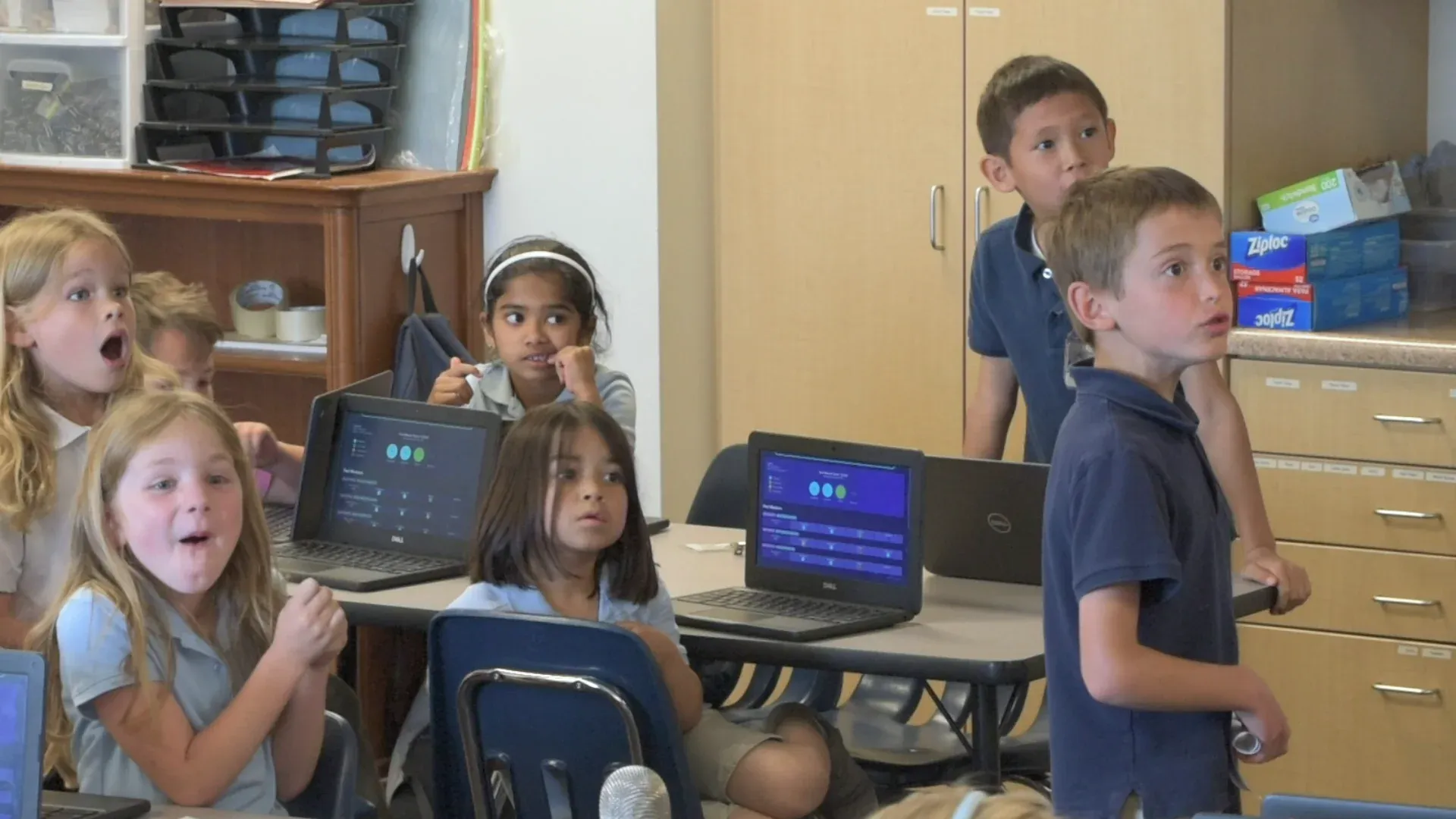
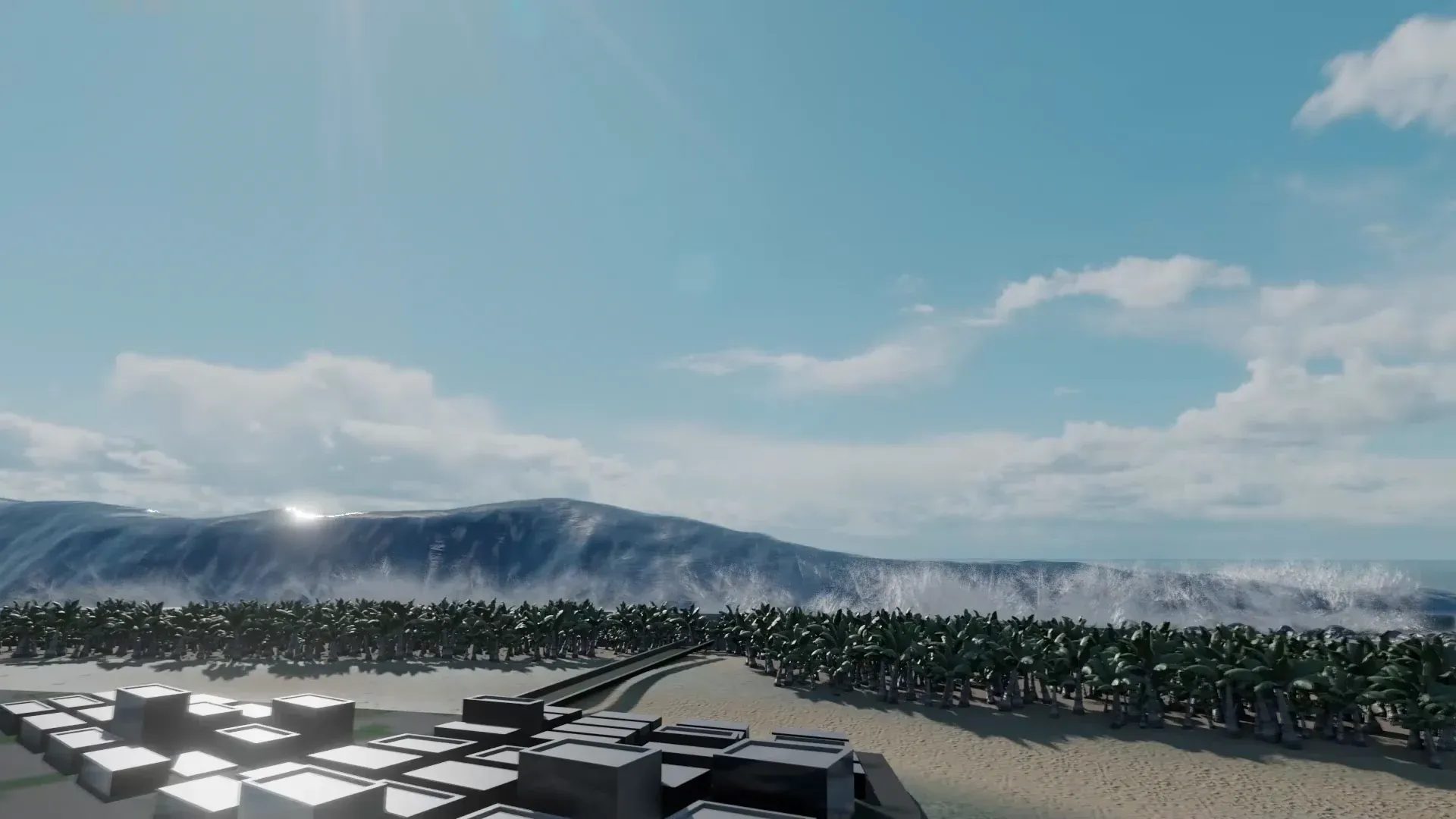
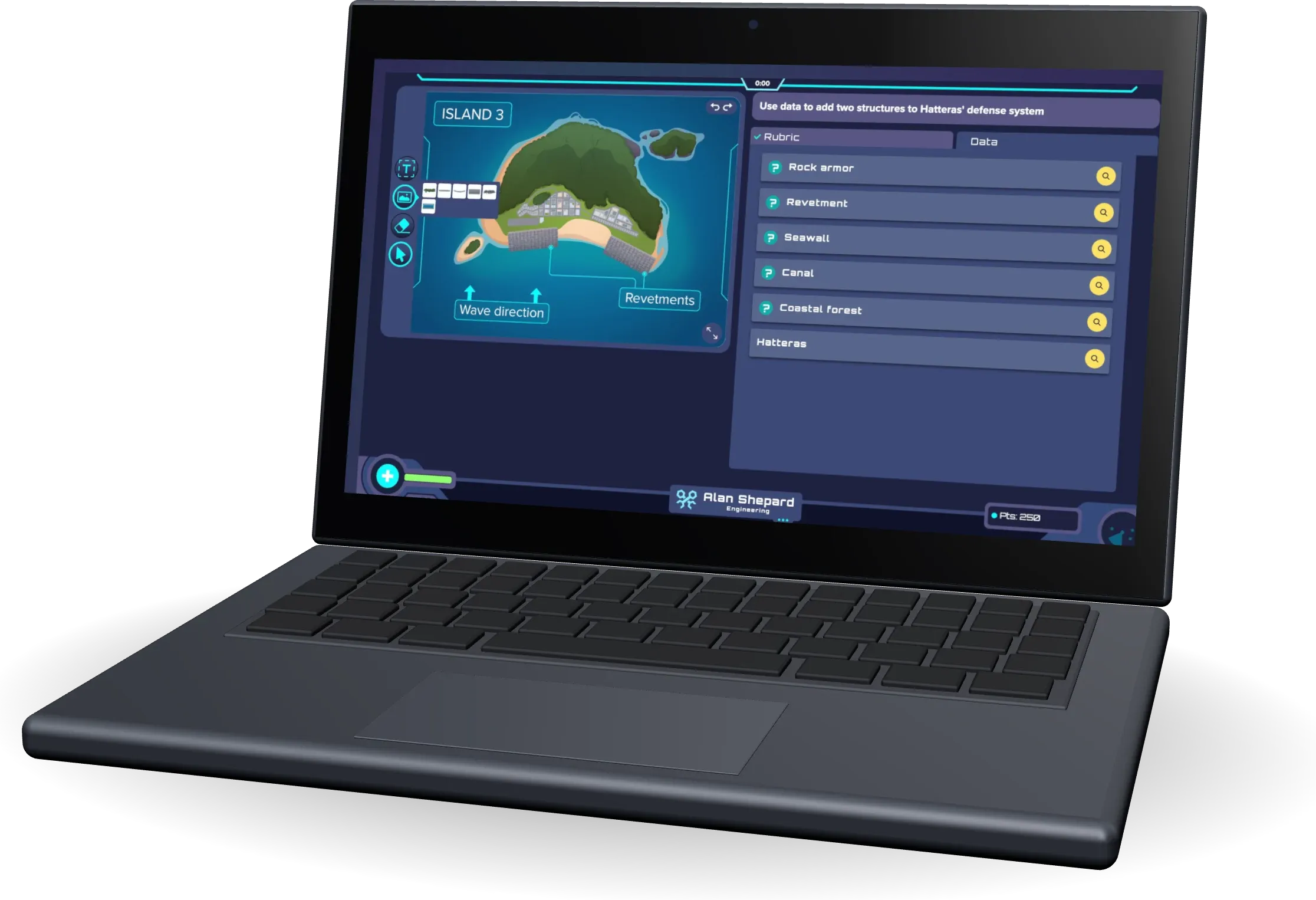
Every Mission puts the class inside a standards-aligned scenario where students analyze data, make decisions, and work together to solve a real problem. How it runs
- Every student is assigned to a team, and each team’s work is themed to it, from its own information and challenge to the same problem the rest of the crew is solving.
- The Mission connects every station and moves the story forward.
- The teacher leads the discussion and pushes for evidence. The teacher stays at the helm.
- One device for every student (a cart shared 2:1 won’t cover it) and a projector for that period; 30 to 45 minutes a Mission, 5 minutes of prep.
- Any teacher can run one free; districts bring us in when they want it in every science classroom, with district-level reporting across all of them.
What the report shows
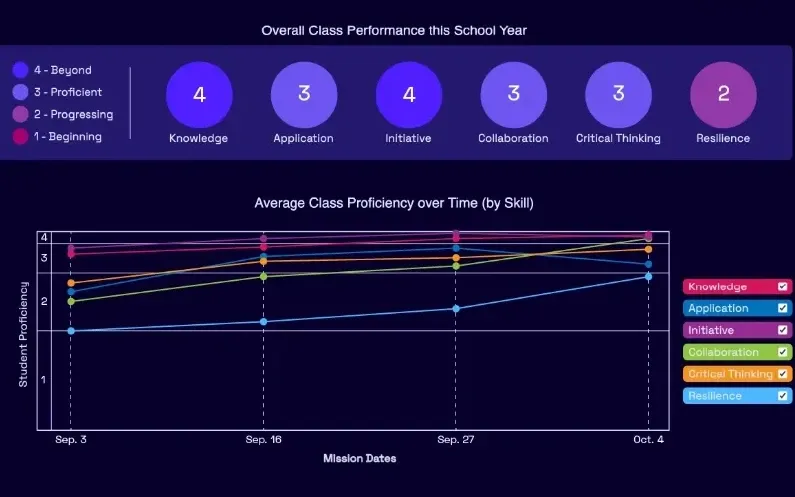
A class report from a real Mission: the class score in each of six skills, then each skill across the year. Every student gets a report on how well they did, built from what they did across the whole Mission: what they knew, whether they could apply it, and the human skills that Mission captured. The test shows what they know. The report shows the rest.
The evidence
+0.94percentage points of content knowledge for each Mission a class runs (p < .001)
Content-knowledge gain, percentage points Bar chart of content knowledge rising with the number of Missions run, from one Mission to twenty, a roughly 17.9-percentage-point separation.Students who ran about 20 Missions scored roughly 17.9 percentage points higher than students who ran one.
The more Missions a class runs, the more students grow. In Instructure’s 2025-26 study of more than a thousand fifth graders across 53 classrooms, funded by the U.S. Department of Education’s Institute of Education Sciences, students who ran Missions scored higher on content knowledge (g = 0.335, p < .001), rising about 0.94 percentage points with each Mission (p < .001), and on writing (g = 0.269, p = .015), rising about 0.035 rubric points with each Mission (p = .049). Mission.io meets ESSA Level II standards, as validated by Instructure.
Bautista et al. (2026), Instructure · content knowledge g = 0.335, p < .001; +0.94 pp per Mission, p < .001 · writing g = 0.269, p = .015; +0.035 rubric points per Mission, p = .049
Teaching your own sequence?
Some districts teach Amplify Science California or Louisiana, run the 6-8 domain model, or teach the units in their own order. Bring us your units and we’ll work out together where a Mission fits in each one.
Questions leaders ask about Amplify Science
- Is Amplify Science aligned to NGSS?
On EdReports’ measure, yes: the K-5 edition (2022) meets expectations at every gateway in every grade (May 2023), and the 6-8 edition (2018) meets at all three gateways (2019, on EdReports’ first science tool). California approved it for K-8 in 2018.
- Is Amplify the only all-green middle school science curriculum?
Not anymore. It was the one 6-8 series to meet EdReports’ alignment expectations in the first science round (February 2019). As of October 2026, OpenSciEd, Issues and Science, and six certified OpenSciEd versions are all-green at 6-8 too. At K-5, Amplify and Smithsonian Science for the Classroom meet at every gateway.
- How much does Amplify Science cost?
Amplify prices by quote. Public contracts show $13 a student per year for the K-5 license (NYC, 2024-25) and $25 a student for 6-8 (Louisiana, June 2024, term not printed), with kits and notebooks on top. The worked example above lands six classrooms in grades 3 to 5 at roughly $39,000 over five years.
- How does Amplify Science compare to OpenSciEd?
Both are all-green at EdReports for 6-8. OpenSciEd has no license fee and a heavier lift; Amplify has a license, repeatable routines that make year one more predictable, and a rated K-5 edition. The head-to-head above has the rest.
- What do districts add to Amplify Science?
Devices and full periods for the simulation lessons, training past the launch, more hands-on time where teachers want it, and, after a chapter’s modeling cycles, a Mission where the whole class has to use what the unit built on a scenario it hasn’t seen. The pairing map lists the fit chapter by chapter.
How we reviewed this
We read both EdReports reports for Amplify Science (K-5, 2023; 6-8, 2019) and EdReports’ account of its first science round, Amplify’s program, research, and news pages, the Amplify Science California unit guides and national unit maps for grade 5, Louisiana’s 6-8 price list and New York City’s 2024-25 order form, Seattle Public Schools’ 2019 adoption records (which include Amplify’s own bid, its field-test notes, and the committee’s scores), Perris Union’s 2020 pilot results, the two WestEd trial briefs (2022 and 2023) and Amplify’s internal studies, and r/ScienceTeachers and r/Teachers comments mentioning Amplify from 2019 to October 2026, read through an archive, from which we quote only comments we could date and link, as posted, with spelling and punctuation tidied where a typo would distract and nothing else changed; the link shows the original. The Seattle field-test lines are the district’s written notes of teacher interviews, quoted as printed. We found no Evidence for ESSA entry for Amplify Science and did not check the What Works Clearinghouse. Prices are as of the dates shown and will drift; tell us if one has. We make Missions, districts pair them with Amplify Science, and we said so at the top. Mission.io is not affiliated with or endorsed by Amplify Science, Amplify Education, or the Lawrence Hall of Science. Everything is linked in Sources.
Sources
EdReports
- Amplify Science K-5 (2022 edition; May 2023)
- Amplify Science 6-8 (2018 edition; Feb 2019, updated Oct 2020)
- Science review tools (v1.0, v1.5, v2.0)
- OpenSciEd grades 6-8 (Feb 2023)
- FOSS Next Generation 6-8 (Dec 2019)
- STEMscopes NGSS 3D 6-8 (Apr 2020)
- Issues and Science and the certified OpenSciEd versions, California Curriculum Collaborative (Oct 2026)
Amplify, the states, and the districts
- amplify.com, Amplify Science program page and FAQ (Oct 2026)
- Amplify Science research and case studies (Oct 2026)
- my.amplify.com, K-5 scope and sequence (Oct 2026)
- Amplify Science California grade 5 unit guides (2021)
- Amplify, California approves Amplify Science for K-8 (Nov 2018)
- Amplify, Tier 1 rating in Louisiana (Oct 2019)
- Amplify, free enhancements and Transitional Kindergarten (Sep 2019)
- Louisiana DOE, Amplify Science Louisiana 6-8 price list (Jun 2024)
- New York City Amplify Science order form, 2024-25 (Feb 2025)
- Seattle Public Schools, middle school science adoption board report, with Amplify's RFI response and proposal (May 2019)
- Seattle Public Schools, elementary science adoption board report (May 2019)
- Perris Union High School District, 2020 middle school science pilot results
Evidence
Reddit and other teacher forums
- r/ScienceTeachers, Amplify curriculum thread (Oct 2020)
- r/ScienceTeachers, Amplify middle school science thread (Aug 2022)
- r/ScienceTeachers, Amplify Science assessments thread (Sep 2022)
- r/ScienceTeachers, "Amplify Science is causing me to slowly die" thread (Nov 2022)
- r/ScienceTeachers, Amplify thread (Jun 2023)
- r/Teachers, thoughts on Mystery Science (Oct 2026)
(And yes, we scoured the deepest, darkest corners of Reddit and the teacher forums, and luckily came out alive, to see what teachers were actually saying.)
Teacher comments are linked where they are quoted; Reddit comments were read through the Arctic Shift archive and are linked to their reddit.com permalinks.
Green at EdReports is where the work starts
Going through an adoption? We're always glad to talk through your choices and show you how a Mission makes whichever one you pick go further. Already running Amplify Science? Same conversation, about the year ahead.