
FOSS Science Review (2026)
FOSS (Full Option Science System) is a PreK-8 kit-based science program from UC Berkeley’s Lawrence Hall of Science, published by School Specialty. Its 6-8 edition did not meet EdReports’ first gateway (30%, 2019); neither elementary edition has been reviewed. Part of our Best NGSS science curriculum (2026) guide, eleven programs on one rubric.
Who we are. Mission.io makes Missions, not a curriculum: teacher-led, whole-class simulations built to the same NGSS standards these programs teach. Districts bring us in to get more out of the science curriculum they already own, which is why we know this shelf.
For FOSS we read the EdReports report and the publisher’s response, the state adoption lists, School Specialty’s price pages, the federal and university evidence reviews, and the teacher forums. No publisher funds us or gains from a verdict. Our one interest: helping you get more out of whichever program you choose, which is what we already do for districts across the country.
On this page
Is FOSS a good curriculum? The verdict
FOSS · reviewed October 2026 · Mission.io
Real labs in every drawer, and someone has to keep the drawers full.
Best for
Districts that want students working with real materials in most science lessons and can run the kit program behind it: storage, refills, live organisms, and someone who owns the logistics.
Not for
Districts that shortlist on EdReports, that can’t staff the materials work, or whose teachers will swap and skip labs often, since teachers report the assessments are written to the specific activities.
- State adoption
- California, K-5 and 6-8 (November 2018)
Key facts, as of October 2026
| Fact | FOSS | Source and date |
|---|---|---|
| Publisher | Delta Education, a division of School Specialty. Developed at the Lawrence Hall of Science, University of California, Berkeley, under four National Science Foundation grants (1988, 1991, 1996, 2004); the Regents of the University of California hold the copyright | Lawrence Hall of Science, FOSS history; foss-science.com, accessed Oct 2026 |
| Editions and grades | FOSS Next Generation (2018), PreK-8: three modules a year in K-5 and eleven middle school courses (six full-length, five half-length) taught in any order. FOSS Pathways, the newer edition, covers PreK-5 only; middle school is still Next Generation | FOSS Next Generation, Jan 2026; FOSS Pathways, Jan 2026 |
| State adoptions | California adopted FOSS Next Generation K-5 and 6-8 (integrated) in November 2018. Not on Texas’s Proclamation 2024 science list (November 2023). The publisher says FOSS Pathways is approved in Idaho and Mississippi. Check your own state’s list | cde.ca.gov; tea.texas.gov, Nov 2023 |
| Time as written | 45-minute sessions. The grade 3 to 5 critical pathways run 92 to 95 sessions a year; Pathways runs 60 in K-2 and 90 in grades 3-5. Middle school courses run 10 to 12 weeks, or 5 to 6 for a half-length course | FOSS grade 5 overview, May 2024; Alabama 6-8 brochure, May 2024 |
| Digital | FOSSweb on ThinkLink, School Specialty’s platform, with Google Classroom and LMS sign-on. Seats come bundled with the kits (a K-5 complete module carries 32 seats for five years). FOSSmap online assessment, grades 3-8, with student, class, standards, and administrator reports. A free 30-day digital trial | School Specialty, Energy module, Oct 2026; Lawrence Hall, FOSSmap |
| Materials | Each module ships in stacking drawers with permanent equipment, consumables, the Investigations Guide, and 32 student books. A K-5 equipment kit is built for up to three class uses before a refill; a middle school kit equips a class of 32 in eight groups, with consumables for five uses. Live organisms are ordered separately | School Specialty, Energy module, Oct 2026; Alabama 6-8 brochure, May 2024 |
| Professional learning | Sold by School Specialty: implementation days, virtual sessions, and packages per 25 teachers (2024 prices below); current packages by request | FOSS price sheet, Feb 2024; foss-science.com, Jun 2026 |
| Scale | The publisher’s figure: 100,000 teachers and more than 3.5 million students a year in all 50 states (December 2019) | Publisher response to EdReports, Dec 2019 |
What EdReports says about FOSS, by gateway
| Review | Designed for NGSS | Coherence and scope | Usability | Report |
|---|---|---|---|---|
| FOSS Next Generation grades 6-8 (2019 edition) | Does Not Meet, 30% | Not eligible | Not eligible | EdReports, Dec 2019 |
| FOSS Next Generation K-5 | Not reviewed | Not reviewed | Not reviewed | EdReports reports list, Oct 2026 |
| FOSS Pathways PreK-5 | Not reviewed | Not reviewed | Not reviewed | EdReports reports list, Oct 2026 |
Inside Gateway 1, the 6-8 report scored three-dimensional learning at 25% and phenomena and problems at 40%, so Gateways 2 and 3 went unscored. It used EdReports’ first science tool (v1.0), which EdReports says “may not fully align with our current instructional priorities” (review tools), and the publisher called it “an insufficient evaluation of FOSS Middle School’s alignment with NGSS” (publisher response, Dec 2019). Not reviewed is not a failure and not a pass: for K-5, California’s 2018 adoption is the public check, and a pilot is yours.
What do teachers say about FOSS?
Teachers split on FOSS along one line: the kits. Those who praise it praise the materials and the teacher guides; those who criticize it describe the work of keeping those materials running. The praise and the criticism below are real, dated, and linked; we’ve kept the harshest ones because a buyer will find them anyway.
Where teachers see value
The kits and the teacher materials. Teachers who like FOSS say the drawers arrive with nearly everything a lab needs, and the guides and prep videos explain the setup and the background science to teachers who don’t have a science background. Even the fans add a caveat: one upper elementary teacher who loves it warns that “replacement costs can be ridiculous and shipping is nuts.”
“When I taught MS science (for 10 years both urban and rural districts) FOSS was hands down the best curriculum. Kits, extensive teaching guides that are clear. Plus videos for teachers to watch beforehand that explain the scientific concepts and what you will be teaching the students.”
“I’ve been using FOSS for six or seven years. Each year I think I might miss the old curriculum. I do not. The kits are very easy to use. ... Teacher guides are excellent. Kits have just about everything you need.”
“I loved teaching with FOSS when I was a 5/6 science teacher more than 10 years ago. It was engaging for students and very easy to follow because materials were very well organized.”
“I teach upper elementary and LOVE FOSS. It’s not as all-inclusive as they make it sound, and you may or may not need all of the supplies, but you won’t know that until you’ve used it for a year or two. That being said, it’s a good program with fantastic hands-on experience for students.”
Common concerns
The same kits, from the other side: setup time for labs with many small parts, materials that run short (one teacher “never had all of the materials I needed” in their first two years), and assessments tied so closely to each activity that adapting a lab breaks the test. Middle school teachers are harder on it than elementary teachers, and some draw a line inside K-5: FOSS is “much better suited for 3-5 than K-2.”
“It requires a lot of prep set up. Unless your teachers have TAs who are good at managing small exact tasks, I think it’s unreasonable, the amount of extra time required to set up some of these labs. ... The assessments (which our district requires) and the Foss textbooks both are very specific to their lab activities, so when we supplement or differentiate or skip anything, the kids will not understand the test question even if they completely understand the science concept and standard.”
“With all that said, I loved FOSS. I still use FOSS labs. It just isn’t aligned with NGSS, no matter how hard they try to say it is.”
“8th grade VA: we use FOSS (or rather are provided FOSS) and I hate it. I use one good lab from them and the others are way too convoluted for my lower children.”
“Pretty sure the entire point of FOSS is to sell boxes of plastic garbage that you don’t actually need to teach science.”
Read them before you order the kits; your teachers will.
FOSS pros and cons, with the evidence
Pros
- Real investigation in every module, from drawers stocked for a class of 32; teachers who like FOSS name the kits first. [School Specialty product pages; the quotes above]
- A long development record: built at the Lawrence Hall of Science under four NSF grants from 1988 to 2004, revised on a five- to seven-year cycle, and adopted by California for K-5 and 6-8 in 2018. [Lawrence Hall; Johns Hopkins, Nov 2024; CDE]
- Support for the adult in the room: a Quick Start Guide for each part of every investigation, teacher prep videos on the science, and Spanish resources, which matters where teachers without a science background teach science. [Alabama 6-8 brochure, May 2024; the quotes above]
- Online assessment with reports in grades 3-8. FOSSmap autocodes answers (except open response) and reports by student, class, and standard, with an administrator view. [Lawrence Hall assessment page; Johns Hopkins, Nov 2024]
Cons
- The alignment record. EdReports rated the 6-8 edition Does Not Meet at Gateway 1 (30%, 2019, v1.0), and neither elementary edition has been reviewed; the publisher disputes the method. [EdReports; publisher response, Dec 2019]
- The logistics are the job: refills, live organisms ordered by card, replacement parts, storage, and setup time that teachers call unreasonable without help, plus materials that run short. [School Specialty, Oct 2026; the quotes above]
- Outcome evidence is thin: strong on pedigree and classroom use, not proven on outcomes. The What Works Clearinghouse found no FOSS study that meets its standards (2020), Evidence for ESSA lists FOSS Next Generation as “No Evidence” (2024), and Pathways holds a Tier 4 rating, a logic model with a study planned (Johns Hopkins, Nov 2024). We found no published FOSS effect size. [WWC; Evidence for ESSA; Johns Hopkins]
- Assessments tied to the activities. Teachers report the assessments and the student books are written so closely to each lab that skipping or swapping one leaves students unable to read the test question; FOSSmap’s items are also revised over time and may not match the printed guide. [r/ScienceTeachers, Apr 2025; Lawrence Hall]
- “No license fee” isn’t the whole picture. The digital seats in a K-5 module run five years, refills recur, and shipping is extra. [School Specialty, Oct 2026]
How it teaches
Instructional model
Each module opens on an anchor phenomenon and a driving question, then works through four or five investigations, each split into parts of one or more 45-minute sessions. Students observe, measure, and model with the kit materials and read in the FOSS Science Resources books. The developers publish a critical pathway, a trimmed route through each module. That’s the strength and the lift in one design: the investigation carries the learning, so the materials have to be there, and set up, every time.
Assessment and reporting
Every module has a Survey before it starts, embedded checks (“What to Look For”), an I-Check at the end of most investigations, and a Posttest. In grades 3-8, FOSSmap puts them online: it autocodes answers except open response and reports by student, item, class, and standard, with an administrator view and suggested next steps; an API for district tools such as Power BI was in development (as of November 2024). K-2 has no FOSSmap, and because FOSSmap items are revised from student data, they may not match the printed guide. What the forums raise is coupling: teachers report the assessments are written to the specific activities, which makes an adapted lab hard to test.
Materials
Each module comes in stacking drawers: equipment, consumables, the Investigations Guide, and 32 student books. Refill kits replace the consumables, live organisms (crayfish, isopods, hissing cockroaches, plants) ship by card at extra cost, and replacement parts are sold separately. Teachers who use it for years say they learn which supplies they don’t need.
Implementation lift
Moderate, and mostly operational: storage, a refill calendar, someone who orders organisms on time, and setup before labs with many small parts. School Specialty’s training covers materials management, the modules, and formative assessment; the Quick Start pages and prep videos carry much of the rest.
How much does FOSS cost?
FOSS has no separate license; you buy kits, and the kits carry the books and the digital seats: a grade 5 FOSS Next Generation module is $2,147 to $2,602 with five years of digital seats, refills run $59 to $459 a module, and training was $3,250 a day on the 2024 price sheet (School Specialty list prices, October 2026, shipping extra; every price is in the table below the example). One Michigan district approved $121,559 for FOSS Pathways materials for grades 3 to 5 (Bloomfield Hills, September 2026, as summarized by Citizen Portal); its enrollment isn’t public, so don’t divide it by yours.
A worked example, from the numbers above: one elementary school, two classrooms in each of grades 3 to 5, five years
- Complete grade-level kits, year oneabout $26,900one per classroom: 2 x ($3,656 grade 3 + $5,380 grade 4 + $4,436 grade 5)
- One round of refills, after year threeabout $2,800each kit is built for up to three class uses before a refill; the nine modules' refills are $1,413, for two classrooms
- Live organisms for Living Systemsabout $1,000one $102 card set a year in each grade 5 classroom; other modules' organisms not counted
- Training$3,250one School Specialty implementation day, at the 2024 price
Five-year total, before shippingroughly $34,000
That’s about $38 per student per year for 180 students. The honest range is $34,000 to $45,000: higher with a second refill round, the $9,999 training package for 25 teachers in place of one day, and shipping. The digital seats expire after year five, and renewal has no public price.
Budget the refills the day you buy the kits.
Prices as of October 2026. Prices drift; tell us if one has.
FOSS list prices, October 2026
| Item | List price | What it includes |
|---|---|---|
| Grade 5 module, print edition | $2,147 to $2,602 | Equipment, consumables, the Investigations Guide, 32 student books, 32 digital seats for five years |
| Grade 5 module, digital only | $1,692 to $2,102 | The same kit without print student books |
| Complete grade 5 kit | $4,436 | All three grade 5 modules |
| Refill kit, grades 3 to 5 | $59 to $459 per module | Consumables for the next round of classes |
| Replacement student book | $22 | One FOSS Science Resources book |
| Middle school course kit | $1,373 to $3,374 | One course for a class of 32, with 160 digital seats |
| Training (February 2024 sheet) | $3,250 a day; $9,999 to $19,999 per 25 teachers | Implementation days and packages; current prices by request |
FOSS against five NGSS programs, on one chart
| Program | EdReports, K-5 and 6-8 | Instructional model | Lesson architecture | Hands-on intensity | Assessment and reporting | Implementation lift | Cost structure |
|---|---|---|---|---|---|---|---|
| FOSS Next Generation | K-5 not reviewed6-8 Does Not Meet, Gateway 1 (30%; 2019 edition, 2019 report) | Investigation-centered kit labs | Investigations in 45-minute parts | Very high (kits) | Embedded checks and I-Checks; FOSSmap reports in grades 3-8 | Moderate; materials management and refills | Kits with five-year digital seats, plus refills |
| Amplify Science | K-5 Meets, every grade (2022 edition; 2023 report)6-8 Meets, all gateways (2018 edition; 2019 review) | Literacy and modeling routines; simulations plus investigations | Repeatable daily routines | Moderate | Embedded unit assessments; class reports in 6-8 | Moderate; routines scaffold year one | Per-student license plus kits: $13 K-5 (NYC), $25 6-8 (Louisiana) |
| Mystery Science | K-5 not reviewed; no 6-8 program | Short video-anchored lessons | One video-led lesson and activity per session | Moderate; household materials | Lesson and unit assessments; a usage dashboard, no score reporting found | Low | Per-school subscription: $2,199 a year at list, every teacher; supplies extra |
| OpenSciEd | Meets, all gateways (2022 edition; 2023 report) | Phenomenon storylines, open license | Extended storylines with scripted pacing | High | Embedded, teacher-managed; dashboard via partner platform | Moderate to high; train first | No license; kits, print, training |
| STEMscopes | K-5 not reviewed6-8 Does Not Meet, Gateway 1 (15%; 2019 edition, 2020 report) | 5E with simulations and labs; a Texas edition | 5E scopes in bundles on a digital platform | High | Scope assessments and a bundle Action Plan; simulation reports to the teacher | Moderate; planning, daily devices, and kits | District digital license from $10.45 per license (the publisher’s figure; term not printed), plus optional print and kits |
| Inspire Science | K-5 not reviewed6-8 Does Not Meet, Gateway 1 (11%; 2020 edition, 2020 report) | Structured 5E, print plus digital | 5E lessons; 30- or 45-minute K-5 tracks | Moderate | Formative probes and lesson and module assessments; a teacher dashboard | Low to moderate; platform setup and kit refills | Per-student bundles plus classroom kits and yearly refills (grade 3 to 5 student bundle $157.68 for six years; grades 3 to 5 classroom kit $2,608 to $5,129; 6-8 up to $6,139) |
FOSS head to head with five programs
FOSS vs Amplify Science
The most common elementary pairing, and the clearest split on the public record: Amplify Science meets EdReports’ expectations at every K-5 grade (2023) and at 6-8 (2019); FOSS 6-8 did not meet Gateway 1 (30%, 2019), and FOSS K-5 has never been reviewed. Amplify runs literacy and modeling routines with simulations beside the investigations; FOSS runs on the investigation itself, with more time on materials and less on devices. Amplify is a per-student license plus kits (pricing on its review); FOSS is kits with five-year seats. For the alignment record and consistent routines across many schools, Amplify is the lower-risk adoption. For a district that puts materials in students’ hands first and can run the kits, FOSS deserves the evaluation.
FOSS vs Mystery Science
Different products for different jobs, often in the same building. Mystery Science is a K-5 subscription of video-led lessons, about 45 minutes each with a hands-on activity built on household items, at $2,199 per school per year (Science Only list, October 2026), with very light prep. FOSS is a full kit program with heavier prep and far more time with materials. Neither has an EdReports review at K-5; Mystery Science and FOSS Pathways each hold an ESSA Tier 4 logic-model rating (2024), and neither has an outcomes study that meets What Works Clearinghouse or Evidence for ESSA standards. Some teachers run both: one elementary specialist uses FOSS “as a framework” and Mystery Science lessons as the assessments. Where classroom teachers without a science background teach science in a short block, Mystery Science is the lighter lift; for a lab program, FOSS is the one built for it.
FOSS vs OpenSciEd
Both are hands-on; they build knowledge differently. OpenSciEd builds it through storylines of model revision and argument from evidence, is free to download, and is all-green at EdReports for 6-8 (2023); its K-5, completed in 2026, isn’t rated yet. FOSS builds it through physical investigation in well-stocked kits, with decades of classroom use, particularly in California. OpenSciEd has no license and you buy kits from certified vendors; FOSS kits carry the books and the digital seats, and FOSS has its own online assessment reports for grades 3-8, which OpenSciEd’s free version lacks. Districts evaluating both usually already know which kind of science class they want.
FOSS vs STEMscopes
STEMscopes and FOSS both ask for a lot of hands-on time, from opposite ends. STEMscopes is a digital-first K-12 platform on a 5E frame with simulations, optional print, and kits, sold per district by quote; FOSS is kit-first, with the digital pieces bundled in. Their EdReports records are close: STEMscopes 6-8 did not meet Gateway 1 (15%, 2020), FOSS 6-8 did not meet it (30%, 2019), and neither has a K-5 review. STEMscopes has a Texas edition on the state’s 2024 adoption list; FOSS isn’t on it. Choose STEMscopes for a platform teachers live in every day, and FOSS for materials first and fewer screens.
FOSS vs Inspire Science
Inspire Science is McGraw Hill’s K-8 program on a structured 5E model, in print and online, with classroom kits that need yearly refills and Spanish materials in K-5 and parts of 6-8. Its 6-8 edition did not meet EdReports’ Gateway 1 (11%, 2020), and its K-5 is unreviewed; FOSS 6-8 scored higher on the same gateway (30%, 2019) and still did not meet it. The bigger difference is the shape of the day: Inspire is print and platform with kits beside it, while FOSS is a kit program with a platform beside it and more for teachers to manage. Inspire suits a large rollout where a familiar frame matters; FOSS suits a district that wants investigation at the center.
When FOSS fits, and when to think twice
Often a strong fit when a district:
- Wants students investigating with materials in most science lessons
- Has storage, a refill budget, and someone who owns the kits
- Has teachers without a science background who will lean on the guides and prep videos
- Will teach the labs largely as written, or plan its own assessments for the ones it changes
- Is in California, where FOSS is on the 2018 adopted list, or has checked its own state’s list
Think twice when a district:
- Shortlists on EdReports results
- Wants published outcome studies before it adopts
- Can’t fund refills, live organisms, and shipping every year
- Expects teachers to swap or skip labs often
- Needs online assessment reports in K-2 (FOSSmap starts at grade 3)
Most districts that adopt it budget for three or four things alongside it. The next section lists them.
What districts pair with FOSS
FOSS arrives with its kits, its books, and its own assessment system. Most of what districts put beside it is the operation that keeps a kit program running: someone to manage the materials, training that outlasts the launch, and a plan for the labs teachers adapt. One addition on this list is instructional, and it’s ours. Read that entry knowing who wrote it.
- A materials manager and a refill budget. A person or a district kit center that inventories, refills, and rotates the drawers and orders organisms on time; teachers in the forums name missing materials as the first thing that goes wrong.
- Training that lasts past the launch. School Specialty’s implementation days or packages, then coaching; its menu covers materials management, the modules, and formative assessment.
- An assessment plan for adapted labs. The district’s own items, or FOSSmap’s next-step strategies, so the test still matches what students did when a teacher swaps or skips a part.
Our entry · We make Missions
A Mission, after a key investigation
After a key investigation, a Mission gives the module somewhere to go: one class period where students land in a scenario they haven’t seen and use what the labs built to work through it together, with a report on every student when it’s over.
Four rows from the 5th grade map, one where no Mission fits: placements from FOSS Next Generation’s public critical pathways Module Mission (code; minutes) Where it sits Earth and Sun Operation Starfall (5-ESS1-1, 5-ESS1-2; 40 min) After Part 2.5, before I-Check 2 Mixtures and Solutions Into the Asteroid (5-PS1-3, 5-PS1-4; 41 min) After Part 5.2, before the Posttest Living Systems Finding Balance (5-LS2-1; 42 min) After Part 1.4, before I-Check 1 Earth and Sun, Investigation 3 No Mission fits Air and the atmosphere The FOSS Next Generation 5th grade pairing map. FOSS Next Generation’s three 5th grade modules, investigation by investigation: the Mission that fits, the part it follows, and the investigations where no Mission fits. One page, free, emailed now.
It’s on its way.
Check your inbox for the pairing map.
That didn’t send. Try again, or write to info@mission.io and we’ll send the map.
Email me the 5th grade map. It comes as a PDF, ready to print. Unsubscribe anytime.
What it adds
- The moment the labs get used. FOSS builds understanding one investigation at a time, with materials in students’ hands. A Mission fits after an investigation’s last part and before its I-Check, when students have enough to reason with, so the transfer happens out loud, together, first.
- The skills every unit leans on. Every district plan promises collaboration, critical thinking, initiative, and resilience, and the curriculum’s assessments don’t report on them. A Mission’s report does, for every student, on the skills that Mission captured.
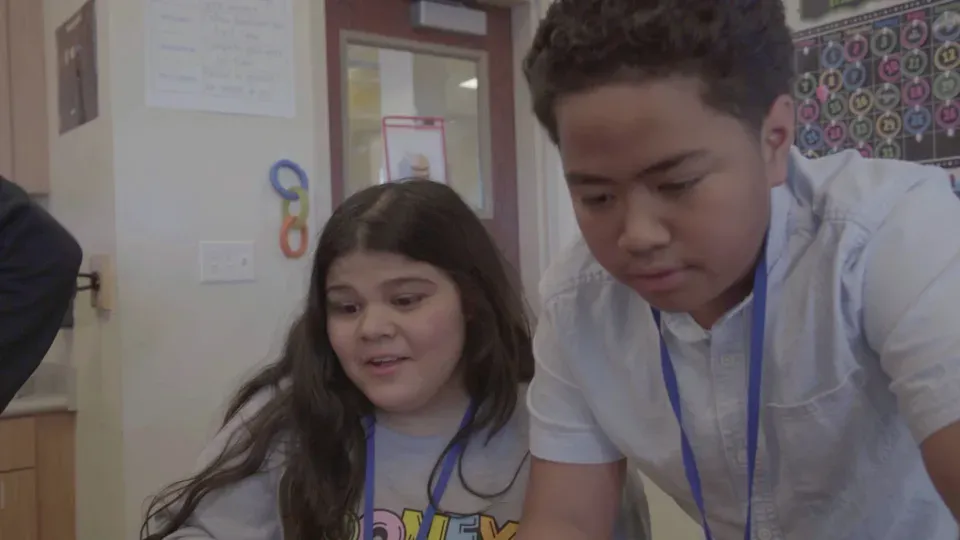
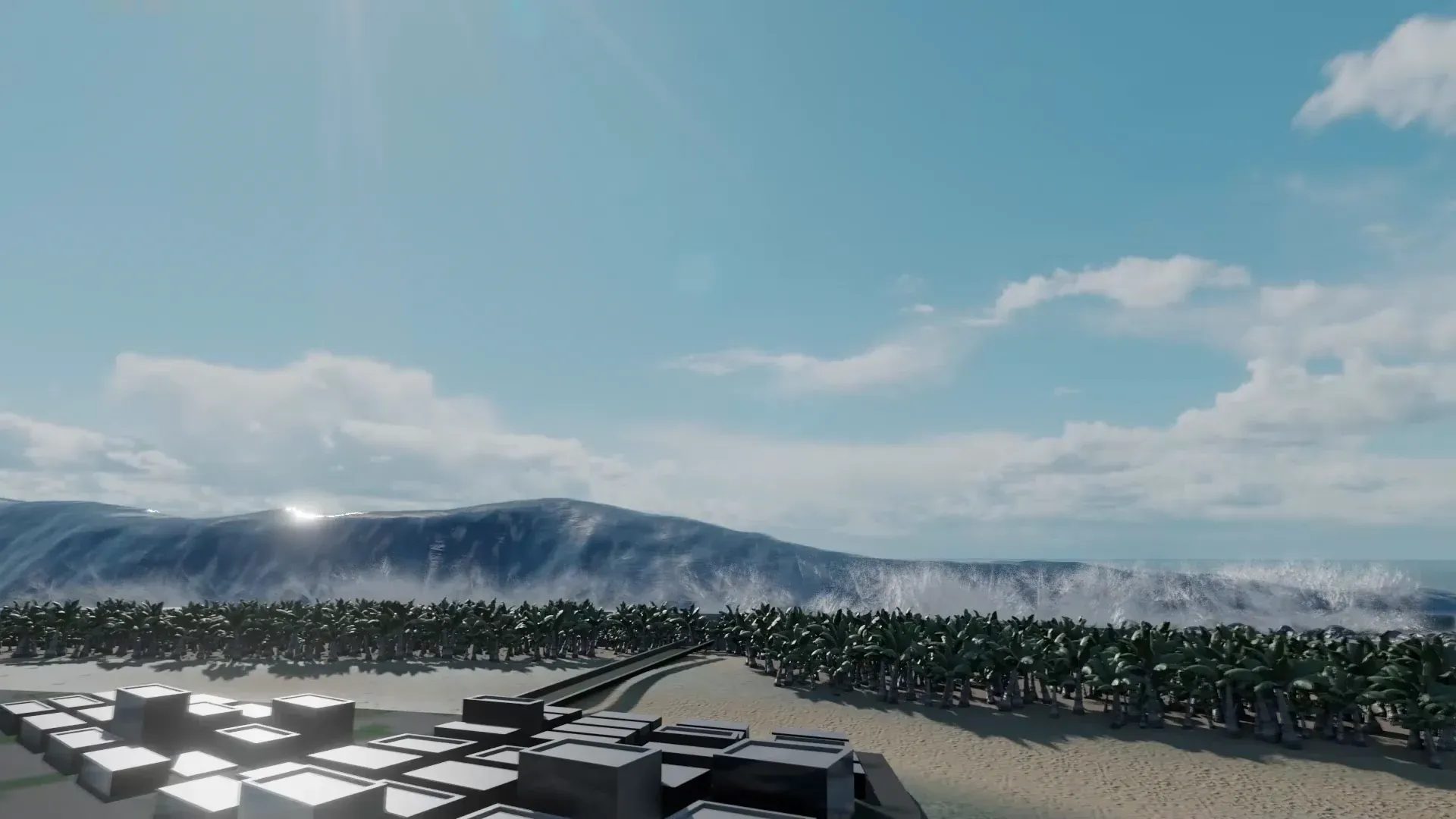
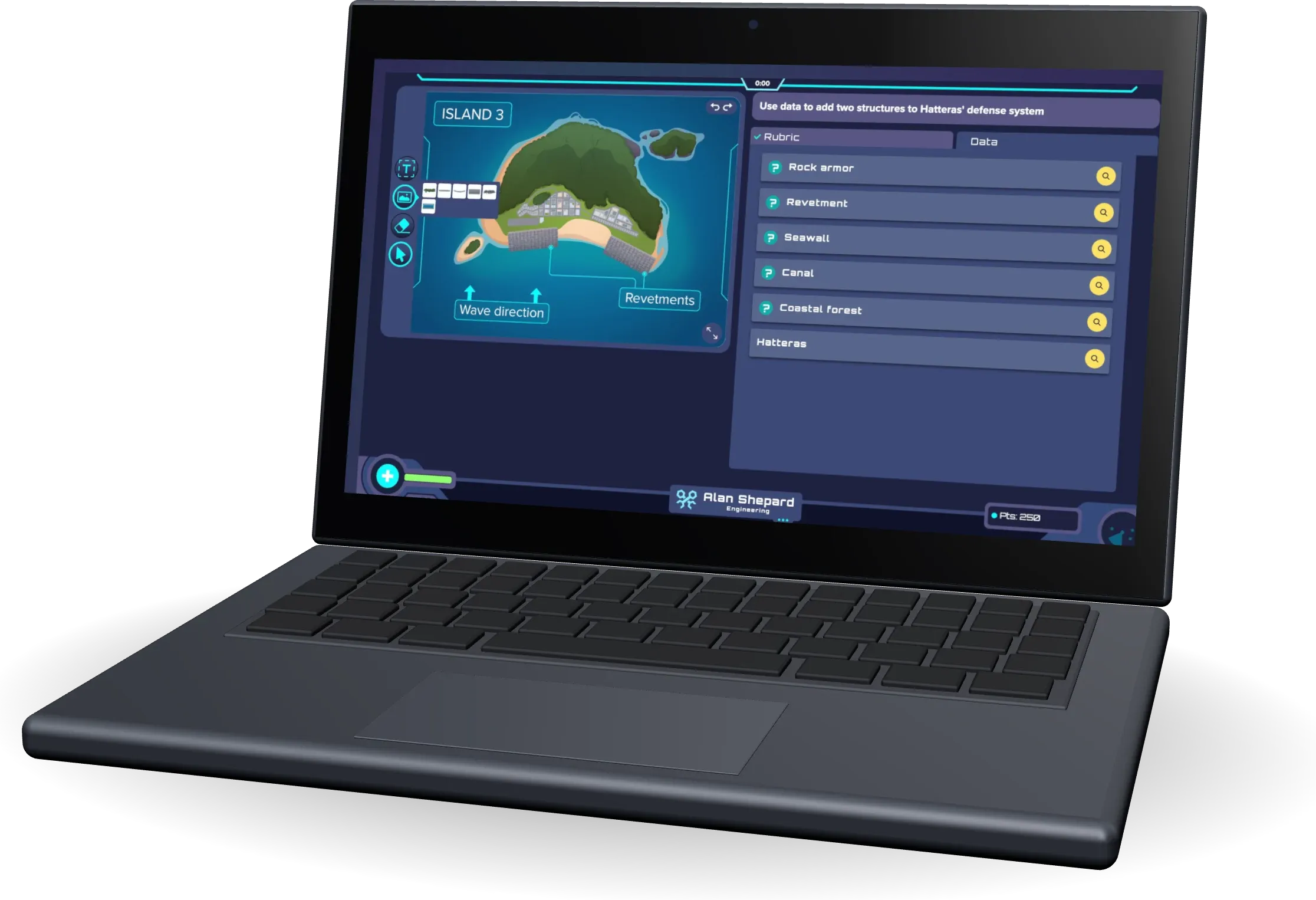
Every Mission puts the class inside a standards-aligned scenario where students analyze data, make decisions, and work together to solve a real problem. How it runs
- Every student is assigned to a team, and each team’s work is themed to it, from its own information and challenge to the same problem the rest of the crew is solving.
- The Mission connects every station and moves the story forward.
- The teacher leads the discussion and pushes for evidence. The teacher stays at the helm.
- One device per student and a projector for that period (most FOSS sessions need none), 30 to 45 minutes a Mission, 5 minutes of prep.
- Any teacher can run one free; districts bring us in when they want it in every science classroom, with district-level reporting across all of them.
What the report shows
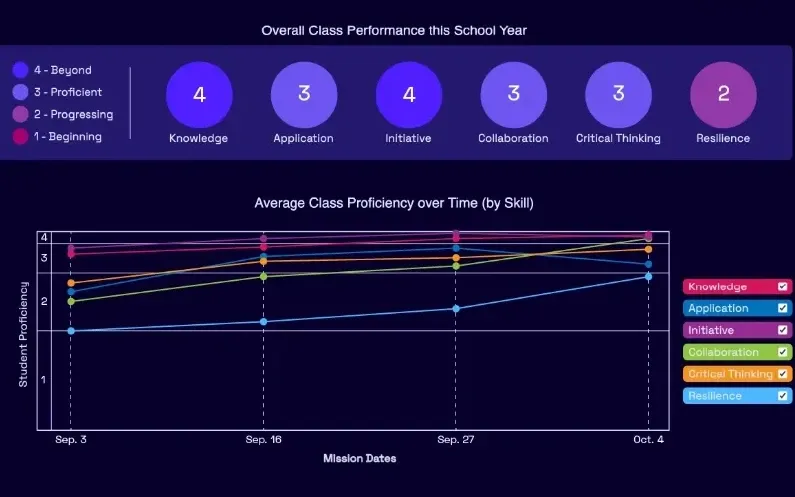
A class report from a real Mission: the class score in each of six skills, then each skill across the year. Every student gets a report on how well they did, built from what they did across the whole Mission: what they knew, whether they could apply it, and the human skills that Mission captured. The test shows what they know. The report shows the rest.
The evidence
+0.94percentage points of content knowledge for each Mission a class runs (p < .001)
Content-knowledge gain, percentage points Bar chart of content knowledge rising with the number of Missions run, from one Mission to twenty, a roughly 17.9-percentage-point separation.Students who ran about 20 Missions scored roughly 17.9 percentage points higher than students who ran one.
The more Missions a class runs, the more students grow. In Instructure’s 2025-26 study of more than a thousand fifth graders across 53 classrooms, funded by the U.S. Department of Education’s Institute of Education Sciences, students who ran Missions scored higher on content knowledge (g = 0.335, p < .001), rising about 0.94 percentage points with each Mission (p < .001), and on writing (g = 0.269, p = .015), rising about 0.035 rubric points with each Mission (p = .049). Mission.io meets ESSA Level II standards, as validated by Instructure.
Bautista et al. (2026), Instructure · content knowledge g = 0.335, p < .001; +0.94 pp per Mission, p < .001 · writing g = 0.269, p = .015; +0.035 rubric points per Mission, p = .049
Teaching your own sequence?
Some districts teach FOSS Pathways, whose parts differ from Next Generation, or run the middle school courses in their own order. Bring us your modules and we’ll work out together where a Mission fits in each one.
Questions leaders ask about FOSS
- Is FOSS aligned to NGSS?
It depends on whose measure. California adopted FOSS Next Generation for K-5 and 6-8 in 2018. EdReports rated the 6-8 edition Does Not Meet at its first gateway (30%, 2019, on its first science tool) and hasn’t reviewed either elementary edition. The publisher disputes the EdReports method.
- How much does FOSS cost?
A grade 5 module is $2,147 to $2,602 with 32 digital seats for five years, and refills run $59 to $459 per grade 3 to 5 module (School Specialty list prices, October 2026, shipping extra). The worked example above lands six classrooms in grades 3 to 5 at roughly $34,000 over five years.
- What's the difference between FOSS Next Generation and FOSS Pathways?
Next Generation (2018) covers PreK-8. Pathways is the newer, streamlined edition for PreK-5 only, with 60 sessions a year in K-2, 90 in grades 3-5, and editable slide decks; middle school is still Next Generation. School Specialty sells conversion kits from Next Generation to Pathways ($979 each, October 2026).
- How does FOSS compare to Amplify?
Amplify meets EdReports’ expectations at K-5 and 6-8; FOSS 6-8 doesn’t, and FOSS K-5 is unreviewed. FOSS gives students more time with materials and needs fewer devices; Amplify’s routines and reporting make year one more predictable. The head-to-head above has the rest.
- What do districts add to FOSS?
Someone to run the materials, training past the launch, an assessment plan for the labs teachers adapt, and, after a key investigation, a Mission where the whole class has to use what the labs built on a scenario it hasn’t seen. The pairing map lists the fit investigation by investigation.
How we reviewed this
We read the EdReports report for FOSS Next Generation 6-8 and the publisher’s response, California’s 2018 adoption list and Texas’s Proclamation 2024 list, the Lawrence Hall of Science and foss-science.com pages for both editions, School Specialty’s list prices and its 2024 training price sheet, the What Works Clearinghouse intervention report (2020), the Evidence for ESSA entries (2024), the Johns Hopkins review of FOSS Pathways (2024), and r/ScienceTeachers comments mentioning FOSS from 2023 to October 2026, read through an archive, from which we quote only comments we could date and link, as posted, with spelling and punctuation tidied where a typo would distract and nothing else changed; the link shows the original. Prices are as of the dates shown and will drift; tell us if one has. We make Missions, districts pair them with FOSS, and we said so at the top. Mission.io is not affiliated with or endorsed by FOSS, the Lawrence Hall of Science, or School Specialty. Everything is linked in Sources.
Sources
EdReports
- FOSS Next Generation 6-8 (Dec 2019)
- Publisher response to the FOSS 6-8 report (Dec 2019)
- Science review tools (v1.0, v1.5, v2.0)
- The reports list
- Amplify Science K-5 (2022 edition; May 2023)
- Amplify Science 6-8 (2018 edition; 2019 review)
- OpenSciEd grades 6-8 (Feb 2023)
- STEMscopes NGSS 3D 6-8 (Apr 2020)
- Inspire Science 6-8 (Nov 2020)
FOSS, School Specialty, and the states
- Lawrence Hall of Science, FOSS history (2023)
- foss-science.com
- FOSS Next Generation scope and sequence (Jan 2026)
- FOSS Pathways (Jan 2026)
- Lawrence Hall of Science, FOSSmap online assessment (May 2024)
- FOSS grade 5 overview with the critical pathway (May 2024)
- FOSS 6-8 course brochure, Alabama (May 2024)
- School Specialty, FOSS Next Generation Energy complete module (Oct 2026)
- School Specialty, FOSS Next Generation grade 5 complete kit (Oct 2026)
- FOSS professional learning price sheet (Feb 2024, archived)
- FOSS professional learning (Jun 2026)
- FOSSweb on ThinkLink free trial
- California State Board of Education, 2018 science adoptions
- Texas Proclamation 2024 adopted materials (Nov 2023)
- Bloomfield Hills Schools board approval (Sep 2026)
Evidence reviews
Reddit and other teacher forums
- r/ScienceTeachers, middle school science curriculums thread (Apr 2025)
- r/ScienceTeachers, opinions needed on a new curriculum (Mar 2025)
- r/ScienceTeachers, FOSS kits and elementary science advice (Apr 2023)
- r/ScienceTeachers, Amplify Science thread (Jul 2024)
- r/ScienceTeachers, best middle school science curriculum thread (Aug 2026)
- r/ScienceTeachers, K-2 FOSS investigation procedures (Sep 2026)
- r/ScienceTeachers, elementary science programs (Nov 2025)
(And yes, we scoured the deepest, darkest corners of Reddit and the teacher forums, and luckily came out alive, to see what teachers were actually saying.)
Teacher comments are linked where they are quoted; read through the Arctic Shift archive of r/ScienceTeachers, linked to their reddit.com permalinks.
Know what’s in the box, whether you’re buying it or running it
Going through an adoption? We're always glad to talk through your choices and show you how a Mission makes whichever one you pick go further. Already running FOSS? Same conversation, about the year ahead.