
Twig Science Review (2026)
Twig Science is Imagine Learning’s PreK-8 NGSS program: 5E lessons anchored in video phenomena, with hands-on kits and Spanish materials. EdReports has not reviewed it at any grade. Part of our Best NGSS science curriculum (2026) guide, eleven programs on one rubric.
Who we are. Mission.io makes Missions, not a curriculum: teacher-led, whole-class simulations built to the same NGSS standards these programs teach. Districts bring us in to get more out of the science curriculum they already own, which is why we know this shelf.
For Twig Science we read the California and New Mexico state reviews, Imagine Learning’s product pages, correlations, and kit lists, district budget records, the Evidence for ESSA entry and the study behind it, and the teacher forums. No publisher funds us or gains from a verdict. Our one interest: helping you get more out of whichever program you choose, which is what we already do for districts across the country.
On this page
Is Twig Science a good curriculum? The verdict
Twig Science · reviewed October 2026 · Mission.io
It opens every module like a film, and leaves the review to you.
Best for
Districts that want NGSS lessons anchored in video phenomena, with kits and Spanish materials, that have a device for every student most days, and that will judge alignment from state reviews and their own pilot.
Not for
Districts that shortlist on EdReports, that want a published price before the first sales call, or that need outcome evidence beyond one publisher-run middle school study.
Key facts, as of October 2026
| Fact | Twig Science | Source and date |
|---|---|---|
| Publisher | Imagine Learning. Developed by Twig Education, founded in the UK in 2009 and in the US market since 2018; Weld North Education, Imagine Learning’s parent, acquired it in July 2021, and it now trades as Imagine Learning Studios | Business Wire, Jul 2021; twigeducation.com, accessed Oct 2026 |
| Editions and grades | Twig Science Next Gen, the national NGSS edition, PreK-8: 4 or 5 modules a year in K-5, plus a shorter Fast Track course for K-6, and 28 middle school modules taught as an Integrated or a Discipline-Specific course (“Module content is the same in both routes”). State editions exist for California, Indiana, Oklahoma, and New Mexico | Imagine Learning, Twig Science, Oct 2026; elementary brochure, Sep 2023; middle school brochure, Mar 2025 |
| State adoptions | California adopted Twig Science for K-6 (“preferred integrated”) in November 2018. New Mexico adopted all nine K-8 titles in July 2024, one of them, Physical Science 6-8, recommended with reservations (88%). Not on Texas’s Proclamation 2024 science list (November 2023). The publisher says Indiana approved it as high-quality instructional materials in 2024; not confirmed on Indiana’s own list. Check your own state’s list | cde.ca.gov; NM PED, Jul 2024; tea.texas.gov, Nov 2023 |
| Time as written | Elementary lessons run 45 minutes in grades 2 to 4 and 50 minutes in grades 5 and 6, with 3 to 7 Driving Questions a module and 2 to 16 lessons a question. Middle school modules hold 1 to 4 lessons, each a Driving Question taught across sessions | Elementary brochure, Sep 2023; middle school brochure, Mar 2025 |
| Digital | Per-student digital licenses (New Mexico’s adopted titles are one-year licenses, one per student), with videos, interactives, and an assessment platform whose reports include item analysis, performance, progress, and a class tracker. It needs networked computers or tablets, unless the district buys print | NM PED review, Earth and Space, 2024; Evidence for ESSA, Jun 2025 |
| Materials | Print Teacher Editions, Student Twig Books (K-5), and Twig Journals (6-8); Hands-On Lab Kits for each grade 3 to 5 and for middle school; English and Spanish across the platform and books, including more than 900 videos. What one classroom kit serves isn’t published | Learning List, May 2024; Grade 5 kit list, Aug 2023; Oklahoma flyer, Jun 2026 |
| Professional learning | Virtual and on-site, from Imagine Learning: Getting Started, assessment, ELA integration, students learning English, and coaching sessions. No public prices | Evidence for ESSA, Jun 2025; Imagine Learning print store, Oct 2026 |
| Scale | The publisher’s figures: almost 100 California districts used Twig Science Elementary in 2021-22 (February 2023), and 30% of California’s elementary science market (July 2021) | Imagine Learning research brief, Feb 2023; Business Wire, Jul 2021 |
What EdReports says about Twig Science, by gateway
| Review | Designed for NGSS | Coherence and scope | Usability | Report |
|---|---|---|---|---|
| Twig Science K-5 | Not reviewed | Not reviewed | Not reviewed | EdReports reports list, Oct 2026 |
| Twig Science 6-8 | Not reviewed | Not reviewed | Not reviewed | EdReports reports list, Oct 2026 |
EdReports has no Twig Science report at any grade and doesn’t list it as under review (October 2026). Not reviewed is not a failure and not a pass, so look at the reviews that do exist. New Mexico’s 2024 review scored grades 3, 4, and 5 at 96%, 99%, and 98%, and the middle school titles at 99% (Earth and Space), 91% (Life Science), and 88% (Physical Science, recommended with reservations: “not every standard is fully addressed”). One middle school module, Volcano Hunters, holds an NGSS Design Badge (August 2023). Learning List reviewed it in May 2024; its report isn’t public, though Imagine Learning shows its badge reading “100% NGSS alignment across K-8.” For K-5, California’s 2018 adoption is the other public check, and a pilot is yours.
What do teachers say about Twig Science?
Teachers post less about Twig than about Amplify or OpenSciEd, and most of what they post is about middle school. They split on one line: ease against depth. Those who praise it praise how easy it is to teach and how quickly the phenomena move; those who criticize it describe the content they have to add and the lessons they have to cut. The praise and the criticism below are real, dated, and linked; we’ve kept the harshest ones because a buyer will find them anyway, and we’ve left out the publisher’s testimonials.
Where teachers see value
Ease and pace. Teachers who like Twig say a teacher without a science credential can pick it up, the videos are good, and the phenomena don’t overstay their welcome; one district’s review teams of teachers “LOVED Twig for K8.” Even the fans add a caveat about assessment: the same teacher who calls it easy to implement writes “I don’t like their assessments and there are very few of them.”
“It’s extremely user friendly and easy to implement. I teach 6th grade at an elementary school and so I have a multi-subject credential and not a single subject in science. Amplify was very difficult for me and the other 6th grade teachers to understand. TWIG is much easier to use. They have great quality videos to go with the lessons.”
“We’re using Twig Science and the kids like it a lot better than OpenSciEd, which some people were using last year. Unlike OSE and Amplify, the phenomena don’t drag on forever, which keeps kids engaged!”
“Under the Microscope is actually really well done. There’s not a lot of fluff.”
“For me, I teach 6th grade science in middle school and I am satisfied with TWIG. You just need to make some adjustments with their lessons because it can be at times too unrealistic to do with middle schoolers.”
Common concerns
The same lessons, from the other side: content teachers say they have to add, repetition they have to cut, and a year that runs out before the modules do. One middle school team “only got through two modules per grade level” last year. Teachers also disagree about the hands-on work: one calls Twig’s labs “closer to activities or demos,” while another runs the module’s digital microscope labs and adds real microscopes beside them.
“Twig is hot garbage. Do not get Twig. It is poorly written and the science content was clearly put together by someone with no real science background. Our district got it 2 years ago and we (science teachers) nearly revolted. We’re still trying to rewrite things and fix all the problems with the curriculum.”
“It is a great skeleton but we need to alter the lessons quite a bit to make them more accessible for our students, as it assumes they have a lot more prior knowledge than they do. ... I like it, but be prepared to build out supports for your kids, and not get through the whole curriculum in 180 school days.”
“Supplement means you’ll need to throw away half of the curriculum to make time. Even done exactly as is, it’s next to impossible to cover everything because there’s so much repetition.”
“It is strong in introducing careers in science and engineering, investigative phenomena, building science literacy, but it is lacking direct instruction in some science concepts, resources are spread across digital and print platforms making it difficult to plug-and-play in my opinion, and it feels like they go for breadth rather than depth OR go in-depth in areas that aren’t necessary in the science standard.”
Ask a Twig teacher how many modules they finished last year.
Twig Science pros and cons, with the evidence
Pros
- Video phenomena in two languages: each module opens on an anchor phenomenon, often on video, from a library of thousands of videos and interactives, with Spanish across the platform, the Teacher Editions, and the books. [Imagine Learning product page; Oklahoma flyer, Jun 2026]
- A strong record where states have looked: California adopted it for K-6 (2018), and New Mexico scored grades 3 to 5 at 96% to 99% and two of the three middle school titles at 91% and 99% (2024). [CDE; NM PED, 2024]
- An assessment system built with SCALE Science at WestEd: pre-assessments, formative checks, performance tasks, and benchmarks with video and data analysis, plus online reports by item, performance, and progress; teachers can edit the online assessments, and the benchmarks come in Spanish. [Elementary brochure, Sep 2023; NM PED reviews, 2024]
- Kits and print beside the screens: Hands-On Lab Kits for every grade 3 to 5 and for middle school, and print books for districts that want them. [Kit lists, Aug 2023; Learning List, May 2024]
Cons
- No EdReports review at any grade, and Learning List’s report isn’t public; the alignment record you can read is the state reviews. Those are strong with one exception: New Mexico recommended middle school Physical Science only with reservations (88%), finding the matter and energy flow standards not fully addressed. [EdReports, Oct 2026; Learning List, May 2024; NM PED, 2024]
- Outcome evidence is publisher-run. Evidence for ESSA rates Twig Science Promising, Tier 3, from one 2024-25 study by Imagine Learning researchers: one Iowa middle school, three teachers who chose which sections used Twig, 382 students, and a benchmark Imagine Learning owns (effect size +0.15, p = .022). A second publisher brief on California grade 5 test scores is correlational (d = 0.17). We found no independent outcome study. [Evidence for ESSA, Jun 2025; Le Mars study, May 2025; CAST brief, Feb 2023]
- No public prices. Licenses, print, kits, and training are by quote, so a budget starts from a sales call; the one full district budget we found is $560,437 over seven years for K-8. [Evidence for ESSA, Jun 2025; Great Bend Tribune, Mar 2025]
- More lessons than a year holds, by teachers’ accounts: middle school teachers describe cutting repetitive lessons, adding content and scaffolds, and finishing far fewer modules than the sequence plans. [r/ScienceTeachers, Apr and Oct 2025]
- A device for every student, most days, and print isn’t cheap: Great Bend teachers weighed dropping the printed student workbooks to trim $200,000. [Evidence for ESSA, Jun 2025; Great Bend Tribune, Mar 2025]
How it teaches
Instructional model
Twig follows the 5E model. Each module opens on an anchor phenomenon and a module question (in 5th grade, “What is matter made of?” opens on two mystery mixtures, one of which inflates a balloon), then works through Driving Questions of several lessons each, with video, hands-on labs, and leveled readers. Grades 3 to 5 each open the year with a 3-D Team Challenge, and middle school adds 3-D Challenges, STEM projects that pull in other subjects. Districts choose the Full Course or the shorter Fast Track. That’s the strength and the lift in one design: the video carries the phenomenon, so the screens have to be working, every day.
Assessment and reporting
Elementary modules use Pre-Explorations to surface what students already think, and build to Summative Performance Tasks, with SCALE Benchmark Assessments (video and data analysis, hands-on tasks, and design problems) and 3-D multiple choice; middle school ends each 5E cycle on a performance task scored with a rubric. Online, the Assessment Library is searchable by standard and grade, assessments can be edited, and the Reports tool covers an overview, item analysis, performance, progress, and a class tracker. Whether district leaders get a cross-school view isn’t in any public source, either way. One middle school teacher whose school chose Twig called it “lacking in formal assessments” in August 2022, and the same teacher still found the assessments too few in April 2025, so ask to see the platform with a real class in it.
Materials
Print Teacher Editions, Student Twig Books in K-5, and Twig Journals in 6-8, or digital only. Imagine Learning publishes Hands-On Lab Kits lists for each grade 3 to 5 and for both middle school course models (August 2023), and districts buy kit bundles by grade: one California district’s 2022 quote ran 35 to 46 kits a grade. Someone has to store, stock, and track them.
Implementation lift
Moderate, and split two ways: devices and bandwidth for daily video, and kits for the labs. Add one decision up front, the Full Course or Fast Track, and a pacing guide that holds across schools (West Contra Costa publishes its Fast Track pacing guides). Imagine Learning’s training sessions cover getting started, assessment, ELA integration, and students learning English, with coaching after.
How much does Twig Science cost?
Imagine Learning publishes no Twig Science prices: it sells individual student and site licenses, print, kits, and training by quote (as of October 2026), so every number here comes from a district. Great Bend USD 428 in Kansas budgeted $560,437 over seven years for K-8 Twig, training and materials included (Great Bend Tribune, March 2025), and Antioch CCSD 34 in Illinois budgeted $7,920 for a one-term K-5 pilot and $1,318.22 for 6-8 (board packet, June 2025). USD 428’s enrollment isn’t in the report, so don’t divide its total by yours.
A worked example, from one district's published budget: USD 428, Kansas, K-8, over five years
- Twig Science K-8, five years at USD 428's rateabout $400,000$560,437 / 7 x 5, from the seven-year budget the teacher committee recommended in March 2025
- Training and materialsincludedinside that budget, not broken out
Five-year total at USD 428's rateroughly $400,000
The honest range is about $257,000 to $400,000: teachers weighed dropping the printed student workbooks, which would have trimmed $200,000 from the seven-year total, and the low end is that budget without them, over five years. The board’s final vote isn’t in our sources, and your enrollment, grade span, and print choices will move the number more than anything here.
Ask for every line in writing: licenses, print, kits, training, and the renewal.
Prices as of October 2026. Prices drift; tell us if one has.
Twig Science list prices, October 2026
| Item | List price | What it includes |
|---|---|---|
| Public list price | None published | Individual student and site licenses, print, kits, and training, all by quote |
| Digital license, as New Mexico adopted it | Not public | A one-year license per student; one title per grade K-5, and Earth and Space, Life, and Physical Science titles for 6-8 |
| USD 428, Kansas, K-8 (March 2025) | $560,437 over seven years | Training and materials; dropping printed student workbooks would have trimmed $200,000 |
| Antioch CCSD 34, Illinois, pilot (June 2025) | $7,920 K-5; $1,318.22 for 6-8 | One trimester or quarter |
| Livermore Valley JUSD, California (May 2022) | Not broken out | Kit bundles for each grade K-5, 35 to 46 kits a grade, inside a $1,306,200.06 multi-product contract for 2022 to 2030 |
| Training | Not published | Getting Started, assessment, ELA integration, students learning English, and coaching sessions |
Twig Science against five NGSS programs, on one chart
| Program | EdReports, K-5 and 6-8 | Instructional model | Lesson architecture | Hands-on intensity | Assessment and reporting | Implementation lift | Cost structure |
|---|---|---|---|---|---|---|---|
| Twig Science | K-5 not reviewed6-8 not reviewed | 5E; video phenomena, labs, and readers | Driving Questions of several 45- to 50-minute lessons | Moderate | Embedded digital assessments | Moderate; daily devices and kits | Digital license plus per-grade kit bundles; by quote (one district’s one-term pilot about $9,200, 2025) |
| Amplify Science | K-5 Meets, every grade (2022 edition; 2023 report)6-8 Meets, all gateways (2018 edition; 2019 review) | Literacy and modeling routines; simulations plus investigations | Repeatable daily routines | Moderate | Embedded unit assessments; class reports in 6-8 | Moderate; routines scaffold year one | Per-student license plus kits: $13 K-5 (NYC), $25 6-8 (Louisiana) |
| FOSS Next Generation | K-5 not reviewed6-8 Does Not Meet, Gateway 1 (30%; 2019 edition, 2019 report) | Investigation-centered kit labs | Investigations in 45-minute parts | Very high (kits) | Embedded checks and I-Checks; FOSSmap reports in grades 3-8 | Moderate; materials management and refills | Kits with five-year digital seats, plus refills |
| OpenSciEd | Meets, all gateways (2022 edition; 2023 report) | Phenomenon storylines, open license | Extended storylines with scripted pacing | High | Embedded, teacher-managed; dashboard via partner platform | Moderate to high; train first | No license; kits, print, training |
| HMH Into Science | K-5 Partially Meets, every grade (2022 edition; 2024)6-8 not reviewed | Platform with centralized pacing | Centralized pacing | Moderate | Class and student reports by standard on HMH Ed | Low to moderate; platform and kit reorders | Per-student six-year packages, kits in the higher tiers; K-5 digital $49.20 per student (Yonkers, NGSS edition, 2023 to 2028) |
| STEMscopes | K-5 not reviewed6-8 Does Not Meet, Gateway 1 (15%; 2019 edition, 2020 report) | 5E with simulations and labs; a Texas edition | 5E scopes in bundles on a digital platform | High | Scope assessments and a bundle Action Plan; simulation reports to the teacher | Moderate; planning, daily devices, and kits | District digital license from $10.45 per license (the publisher’s figure; term not printed), plus optional print and kits |
Twig Science head to head with five programs
Twig Science vs Amplify Science
For the public alignment record, Amplify Science is the lower-risk adoption; for video-led phenomena with a rated outcome study on file, Twig deserves the pilot. Amplify meets EdReports’ expectations at every K-5 grade (2023) and at 6-8 (2019); Twig has no EdReports report at any grade. Both are per-student digital licenses with kits beside them, but Amplify’s prices show up on public contracts ($13 per student per year for K-5 in New York City, 2024-25; $25 for 6-8 on Louisiana’s list, June 2024), and Twig’s don’t. Amplify runs literacy and modeling routines; Twig opens each module on video and builds through Driving Questions. Imagine Learning publishes its own Pennsylvania flyer comparing the two (February 2025), so expect the comparison in the sales meeting, and bring the EdReports reports to it.
Twig Science vs FOSS
If materials in students’ hands is the point, FOSS; if video phenomena and reading are, Twig. California adopted both in November 2018. Neither has an EdReports review at K-5; FOSS 6-8 did not meet Gateway 1 (30%, 2019), and Twig 6-8 hasn’t been reviewed. FOSS is a kit program with digital seats bundled in and public prices (a grade 5 module is $2,147 to $2,602, October 2026); Twig is a digital license with kits beside it, by quote. The lift lands in different places: FOSS on refills and storage, Twig on devices and bandwidth.
Twig Science vs OpenSciEd
OpenSciEd is free and all-green at EdReports for 6-8 (2023); Twig is licensed, unreviewed, and priced by quote. OpenSciEd’s K-5, completed in 2026, isn’t rated yet, so at K-5 both lean on other checks: California’s 2018 adoption and New Mexico’s 2024 scores for Twig. OpenSciEd asks more of teachers up front, with storylines of model revision and argument and training first; Twig hands them video, readers, and a Spanish edition ready to teach. Choose OpenSciEd when the EdReports record and an open license matter most, and Twig when ready-made media and language support do.
Twig Science vs HMH Into Science
Two platform programs with different records: HMH Into Science has an EdReports report and public prices, and Twig has state reviews and a rated study. HMH K-5 partially meets Gateway 1 at every grade (57% to 75%) and meets Gateway 2 (2024), with no 6-8 Into Science report; Twig has none at either band. HMH’s Texas edition is on the state contract at $12.94 per student per year for K-5 digital and $15.69 for 6-8 (October 2026); Twig isn’t on Texas’s list and posts no prices. Neither publisher shows its district leader’s view in public, so ask both for a live look at it with real classes in it.
Twig Science vs STEMscopes
Both are digital-first with kits beside them and priced by quote; STEMscopes is the Texas program, and Twig the California and New Mexico one. STEMscopes 6-8 did not meet EdReports’ Gateway 1 (15%, 2020), and neither program has a K-5 review. STEMscopes has a Texas edition on the state’s Proclamation 2024 list; Twig isn’t on it, but it’s on California’s 2018 list and New Mexico’s 2024 list. STEMscopes runs 5E cycles on its platform with simulations and labs; Twig runs 5E through video phenomena and Driving Questions. In Texas, STEMscopes is the simpler adoption; elsewhere, pilot both.
When Twig Science fits, and when to think twice
Often a strong fit when a district:
- Wants phenomena students meet on video, with readers and labs behind them
- Has a device for every student most days, and the bandwidth for video
- Needs Spanish materials across the platform and the books
- Is in California or New Mexico, where Twig is on the adopted lists, or has checked its own state’s list
- Will run a pilot and read the state reviews in place of an EdReports report
Think twice when a district:
- Shortlists on EdReports results
- Needs a published price to start its budget
- Wants independent outcome studies before it adopts
- Is weighing middle school Physical Science most heavily (New Mexico’s one reservation)
- Is in Texas, where Twig isn’t on the Proclamation 2024 list
Most districts that adopt it budget for three or four things alongside it. The next section lists them.
What districts pair with Twig Science
Twig arrives with its videos, its books, its kits, and its own assessment platform. Most of what districts put beside it is what keeps a blended program running: devices that work every day, training that outlasts the launch, and one pacing plan across schools. One addition on this list is instructional, and it’s ours. Read that entry knowing who wrote it.
- A device and bandwidth plan. A device for every student and a network that streams video in every room at once; Twig needs networked computers or tablets unless the district buys print.
- Training that lasts past the launch. Imagine Learning’s Getting Started sessions, then sessions on assessment, ELA integration, and teaching students learning English, and coaching through year one.
- One pacing plan across schools. A district decision between the Full Course and Fast Track, written into a pacing guide every school follows, the way West Contra Costa publishes its Fast Track guides.
Our entry · We make Missions
A Mission, where a Driving Question closes
Where a Driving Question closes, a Mission gives the module somewhere to go: one class period where students land in a scenario they haven’t seen and use what the lessons built to work through it together, with a report on every student when it’s over.
Four rows from the 5th grade map, one where no Mission fits: placements from Twig Science Next Gen’s grade 5 NGSS correlation Module Mission (code; minutes) Where it sits Matter Mysteries Hotline Matter Matters (5-PS1-2; 47 min) After Driving Question 3, before Driving Question 4 H2O Response Team Hydro Heist (5-ESS2-2; 34 min) After Driving Question 1, before Driving Question 2 Galactic Guidebook Operation Starfall (5-ESS1-1, 5-ESS1-2; 40 min) After Driving Question 5, before the module assessment Yellowstone: Uncovered, Driving Questions 1 and 3 No Mission fits Where plants get their matter The Twig Science Next Gen 5th grade pairing map. Twig Science Next Gen’s four 5th grade modules, Driving Question by Driving Question: the Mission that fits, the question it follows, and the questions where no Mission fits. One page, free, emailed now.
It’s on its way.
Check your inbox for the pairing map.
That didn’t send. Try again, or write to info@mission.io and we’ll send the map.
Email me the 5th grade map. It comes as a PDF, ready to print. Unsubscribe anytime.
What it adds
- The moment the lessons get used. Twig builds each idea through a Driving Question: the phenomenon on video, then the lessons, the readers, and the labs. A Mission fits after a question’s last lesson and before the next question or the module assessment, when students have enough to reason with, so the transfer happens out loud, together, first.
- The skills every unit leans on. Every district plan promises collaboration, critical thinking, initiative, and resilience, and the curriculum’s assessments don’t report on them. A Mission’s report does, for every student, on the skills that Mission captured.
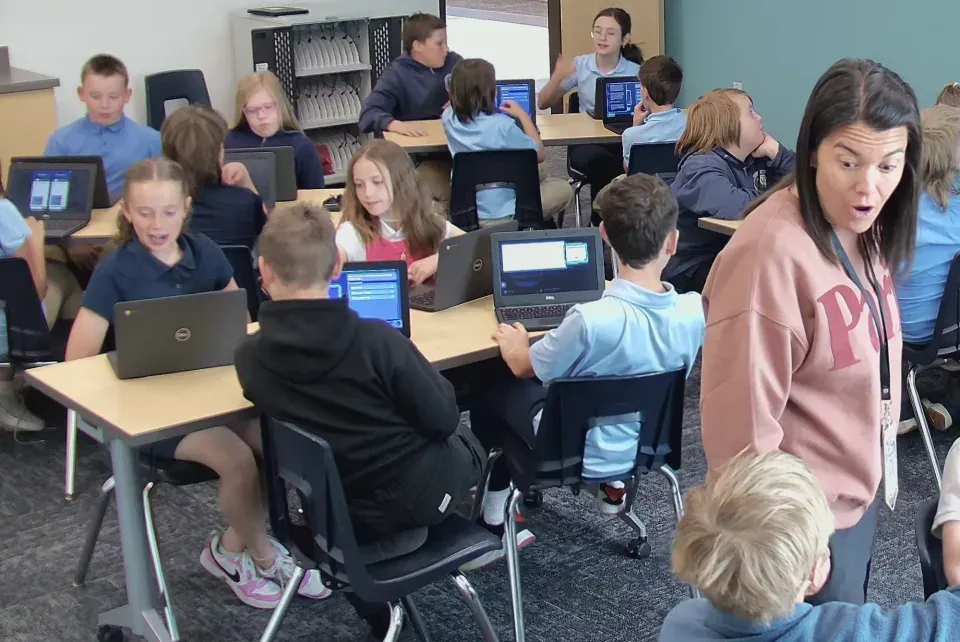
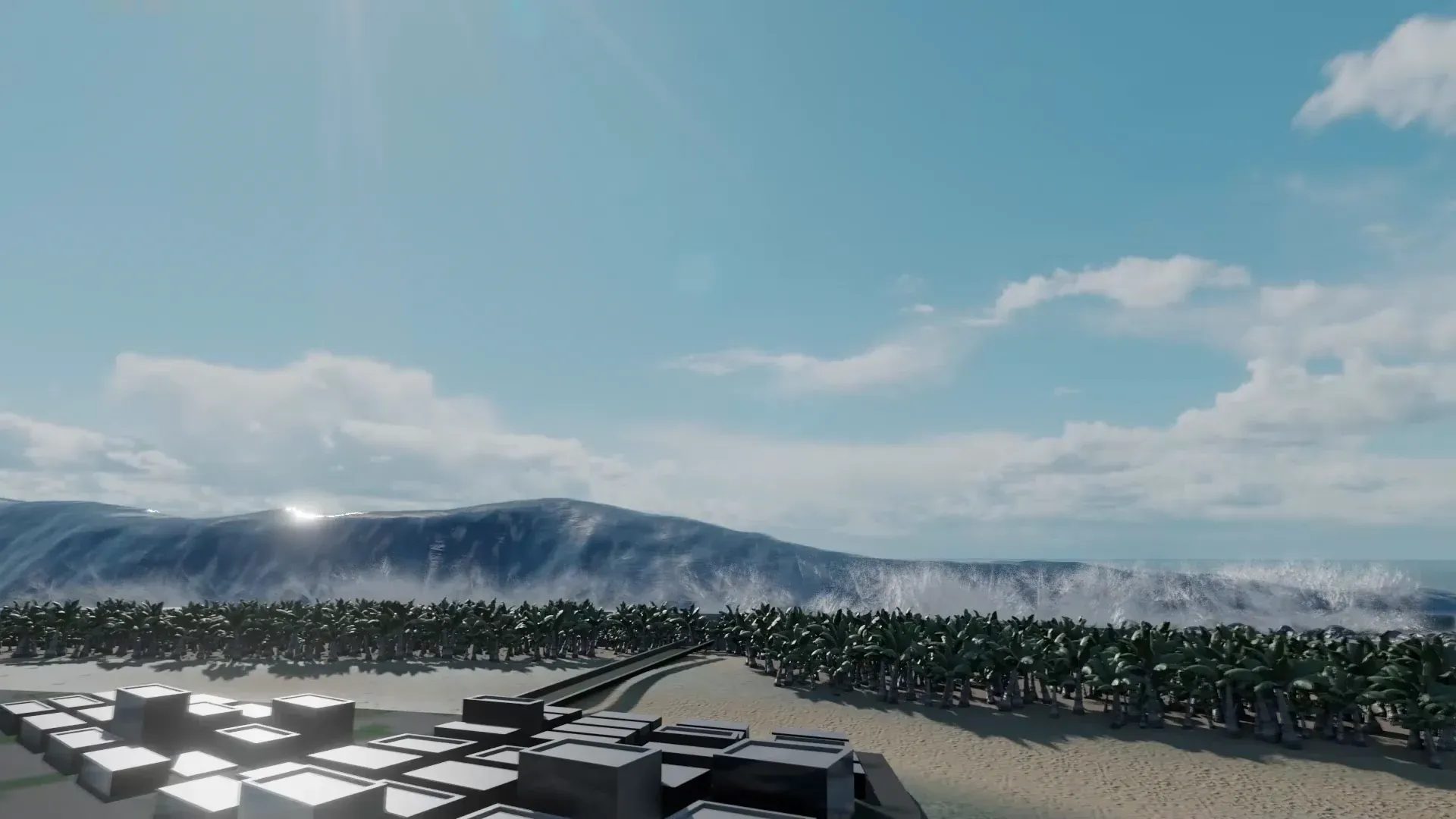
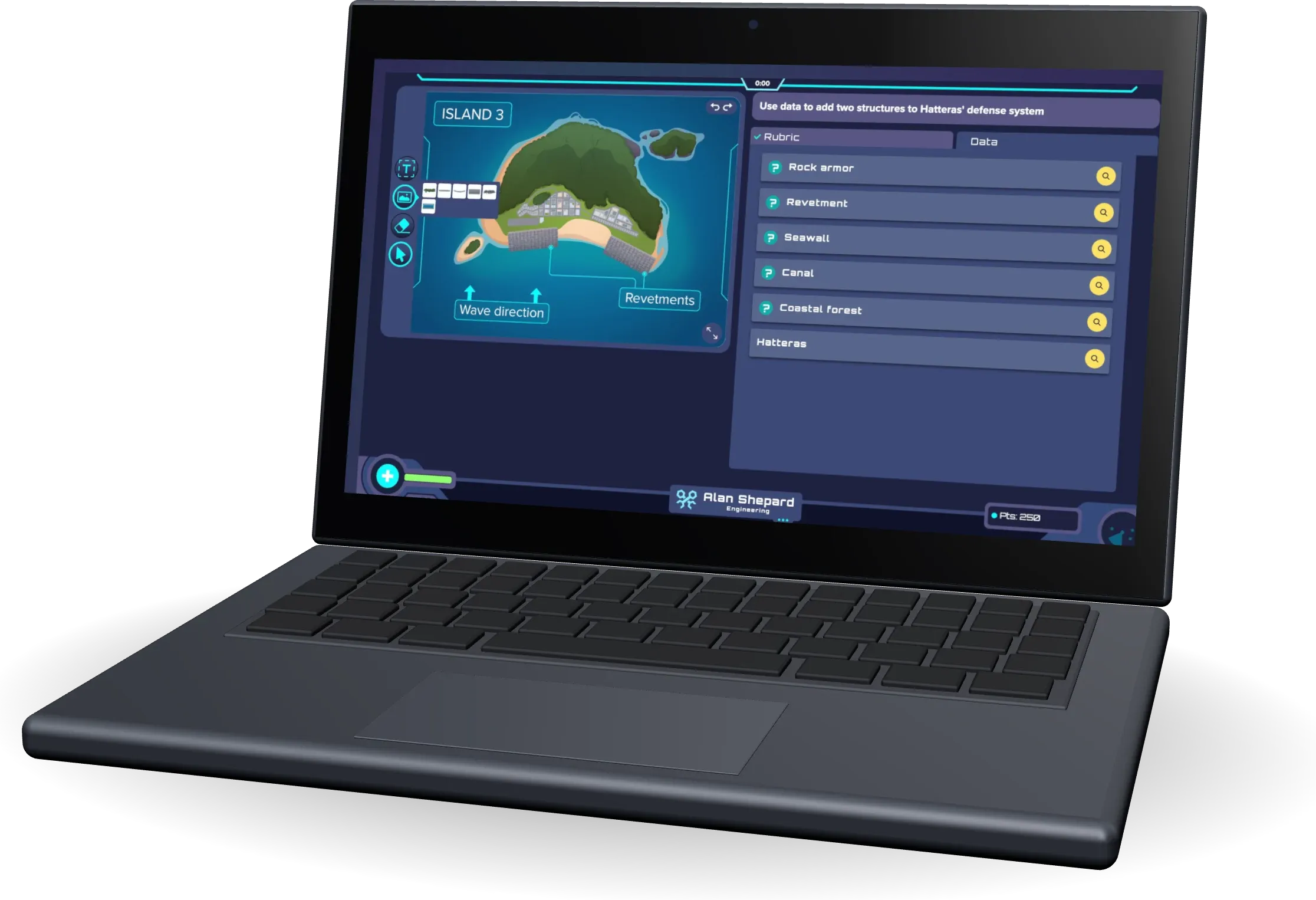
Every Mission puts the class inside a standards-aligned scenario where students analyze data, make decisions, and work together to solve a real problem. How it runs
- Every student is assigned to a team, and each team’s work is themed to it, from its own information and challenge to the same problem the rest of the crew is solving.
- The Mission connects every station and moves the story forward.
- The teacher leads the discussion and pushes for evidence. The teacher stays at the helm.
- One device per student and a projector for that period, 30 to 45 minutes a Mission, 5 minutes of prep.
- Any teacher can run one free; districts bring us in when they want it in every science classroom, with district-level reporting across all of them.
What the report shows
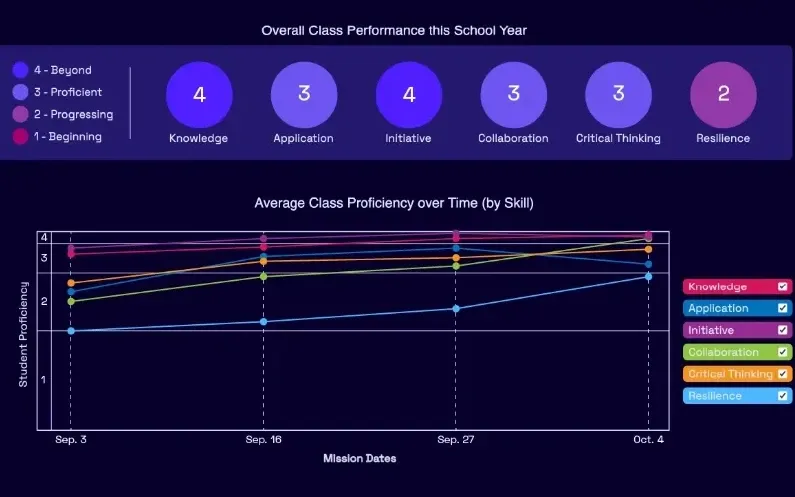
A class report from a real Mission: the class score in each of six skills, then each skill across the year. Every student gets a report on how well they did, built from what they did across the whole Mission: what they knew, whether they could apply it, and the human skills that Mission captured. The test shows what they know. The report shows the rest.
The evidence
+0.94percentage points of content knowledge for each Mission a class runs (p < .001)
Content-knowledge gain, percentage points Bar chart of content knowledge rising with the number of Missions run, from one Mission to twenty, a roughly 17.9-percentage-point separation.Students who ran about 20 Missions scored roughly 17.9 percentage points higher than students who ran one.
The more Missions a class runs, the more students grow. In Instructure’s 2025-26 study of more than a thousand fifth graders across 53 classrooms, funded by the U.S. Department of Education’s Institute of Education Sciences, students who ran Missions scored higher on content knowledge (g = 0.335, p < .001), rising about 0.94 percentage points with each Mission (p < .001), and on writing (g = 0.269, p = .015), rising about 0.035 rubric points with each Mission (p = .049). Mission.io meets ESSA Level II standards, as validated by Instructure.
Bautista et al. (2026), Instructure · content knowledge g = 0.335, p < .001; +0.94 pp per Mission, p < .001 · writing g = 0.269, p = .015; +0.035 rubric points per Mission, p = .049
Teaching a state edition or Fast Track?
Some districts teach a state edition of Twig (California, Indiana, Oklahoma, or New Mexico), the shorter Fast Track course, or the middle school modules in their own order. Bring us your modules and we’ll work out together where a Mission fits in each one.
Questions leaders ask about Twig Science
- Is Twig Science aligned to NGSS?
It’s designed for NGSS, and EdReports hasn’t reviewed it at any grade. The public checks: California adopted it for K-6 in 2018, New Mexico adopted all nine K-8 titles in 2024 (Physical Science 6-8 with reservations, at 88%), and one middle school module holds an NGSS Design Badge (2023).
- How much does Twig Science cost?
Imagine Learning publishes no prices; licenses, print, kits, and training are by quote. One Kansas district budgeted $560,437 over seven years for K-8, training and materials included (March 2025), which is roughly $400,000 over five years at that rate. The worked example above shows the math.
- Is there research on Twig Science?
One rated study. Evidence for ESSA rates Twig Science Promising (Tier 3), from a 2024-25 study by Imagine Learning researchers in one Iowa middle school: 382 students, effect size +0.15, p = .022, on a benchmark Imagine Learning owns. A second publisher brief, on California 5th grade science scores, is correlational (d = 0.17).
- How does Twig Science compare to Amplify?
Amplify meets EdReports’ expectations at K-5 and 6-8, and Twig has no EdReports review. Both are per-student licenses with kits, but Amplify’s contract prices are public and Twig’s are by quote. Twig leads with video phenomena and holds a rated middle school study. The head-to-head above has the rest.
- What do districts add to Twig Science?
A device and bandwidth plan, training past the launch, one pacing plan across schools, and, where a Driving Question closes, a Mission where the whole class has to use what the module built on a scenario it hasn’t seen. The pairing map lists the fit question by question.
How we reviewed this
We read EdReports’ report list and under-review page, California’s 2018 adoption list, New Mexico’s 2024 review forms for grades 3 to 8 (not the K-2 forms) and the Secretary’s authorization, Texas’s Proclamation 2024 list, Imagine Learning’s product pages, brochures, state flyers, NGSS correlations, and kit lists, the Learning List post (2024), the Evidence for ESSA entry (2025) and the Le Mars study behind it, Imagine Learning’s California research brief (2023), a Great Bend Tribune report on a Kansas board meeting, district board records from Illinois and California, and r/ScienceTeachers and r/elementaryteaching comments mentioning Twig from 2018 to October 2026, read through an archive, from which we quote only comments we could date and link, as posted, with spelling and punctuation tidied where a typo would distract and nothing else changed; the link shows the original. We left the publisher’s testimonials out of the teacher quotes. Prices are as of the dates shown and will drift; tell us if one has. We make Missions, districts pair them with Twig Science, and we said so at the top. Mission.io is not affiliated with or endorsed by Twig Science, Twig Education, or Imagine Learning. Everything is linked in Sources.
Sources
EdReports and state reviews
- EdReports, the under-review list (Oct 2026)
- EdReports sitemap (Oct 2026)
- Amplify Science K-5 (2022 edition; May 2023)
- Amplify Science 6-8 (2018 edition; 2019 review)
- FOSS Next Generation 6-8 (Dec 2019)
- OpenSciEd grades 6-8 (Feb 2023)
- HMH Into Science K-5 (2022 edition; May 2024)
- STEMscopes NGSS 3D 6-8 (Apr 2020)
- California State Board of Education, 2018 science adoptions
- New Mexico PED, Secretary's science authorization (Jul 2024)
- New Mexico PED, Twig Science Grade 3 review (2024)
- New Mexico PED, Twig Science Grade 4 review (2024)
- New Mexico PED, Twig Science Grade 5 review (2024)
- New Mexico PED, Twig Earth and Space Science 6-8 review (2024)
- New Mexico PED, Twig Life Science 6-8 review (2024)
- New Mexico PED, Twig Physical Science 6-8 review (2024)
- Texas Proclamation 2024 adopted materials (Nov 2023)
- NextGenScience, Volcano Hunters NGSS Design Badge (Aug 2023)
- Learning List, Twig Science Next Gen review post (May 2024)
Imagine Learning and the districts
- Imagine Learning, Twig Science (Sep 2026)
- Business Wire, Weld North Education acquires Twig Education (Jul 2021)
- Twig Science Elementary brochure (Sep 2023)
- Twig Science Middle School brochure (Mar 2025)
- Twig Science Next Gen NGSS correlation, Grade 5 (Mar 2023)
- Hands-On Lab Kits, Grade 5 (Aug 2023)
- Hands-On Lab Kits, Integrated, Grades 6 to 8 (Aug 2023)
- Twig Science Oklahoma flyer (Jun 2026)
- Twig Science New Mexico flyer (Oct 2024)
- Twig Science in Pennsylvania vs. Amplify flyer (Feb 2025)
- Imagine Learning print store, Twig Science (Oct 2026)
- West Contra Costa USD, Twig Science (Oct 2026)
- Great Bend Tribune, teachers recommend Twig Science (Mar 2025)
- Antioch CCSD 34 board packet, pilot budget (Jun 2025)
- Livermore Valley JUSD, Imagine Learning quote (May 2022)
Evidence reviews and studies
Reddit and other teacher forums
- r/ScienceTeachers, Amplify middle school science thread (Aug 2022)
- r/ScienceTeachers, opinions from actual science teachers (May 2024)
- r/ScienceTeachers, middle school science curriculums thread (Apr 2025)
- r/ScienceTeachers, where are the holes in Twig Science? (Oct 2025)
(And yes, we scoured the deepest, darkest corners of Reddit and the teacher forums, and luckily came out alive, to see what teachers were actually saying.)
Other programs and research
Teacher comments are linked where they are quoted; read through the Arctic Shift archive of Reddit, linked to their reddit.com permalinks.
Choosing Twig or running it? Check the record yourself
Going through an adoption? We're always glad to talk through your choices and show you how a Mission makes whichever one you pick go further. Already running Twig Science? Same conversation, about the year ahead.