
OpenSciEd Review (2026)
OpenSciEd is a free, openly licensed K-12 science curriculum built on NGSS storylines, developed by a nonprofit with ten partner states, and rated Meets at every EdReports gateway for grades 6-8 and for high school biology, chemistry, and physics. Part of our Best NGSS science curriculum (2026) guide, eleven programs on one rubric.
Who we are. Mission.io makes Missions, not a curriculum: teacher-led, whole-class simulations built to the same NGSS standards these programs teach. Districts bring us in to get more out of the science curriculum they already own, which is why we know this shelf.
For OpenSciEd we read the EdReports gateways, the state reviews, the contract price lists, and the teacher forums. No publisher funds us or gains from a verdict. Our one interest: helping you get more out of whichever program you choose, which is what we already do for districts across the country.
On this page
Is OpenSciEd a good curriculum? The verdict
OpenSciEd · reviewed October 2026 · Mission.io
Free to download and expensive to run badly.
Best for
Districts with a facilitation-heavy teaching culture, coaching to sustain it, and a real budget constraint: the only free NGSS program with a full EdReports review, all-green for 6-8 and for all three high school courses, paid for in kits and training instead of a license.
Not for
Districts that need a dashboard, predictable pacing across many campuses, or built-in scaffolding for students below grade level and multilingual students, or that plan to hand teachers the materials without training.
Key facts, as of October 2026
| Fact | OpenSciEd | Source and date |
|---|---|---|
| Publisher | OpenSciEd, an independent nonprofit (California public benefit corporation since 2025); developed with BSCS and ten partner states; certified print and kit versions from Activate Learning, Carolina, Kendall Hunt, PASCO, PocketLab, and Ward’s | openscied.org; Wikipedia, accessed Oct 2026 |
| Grades | K-12. Middle school (18 units) complete; high school biology, chemistry, physics complete (2023 edition); elementary (24 units) completed February 2026 | OpenSciEd release, Mar 2026; Education Week, Oct 2026 |
| License | Middle school CC BY 4.0 (you may print and copy the student materials); elementary and high school CC BY-NC with a commercial-use license. The download is free | openscied.org attribution page |
| State reviews | Louisiana Tier 1 (6-8, two certified versions; high school biology Tier 1); Massachusetts CURATE: Meets on scope and instruction, Partially Meets on accessibility for students and usability for teachers; New Jersey names it in the 9-12 model framework. Check your own state’s instructional materials list; the ten original partner states were CA, IA, LA, MA, MI, NJ, NM, OK, RI, and WA | doe.louisiana.gov; curriculumdashboard.mass.gov; nj.gov, May 2026 |
| Time as written | Grade 6 about 161 days, grade 7 about 196 days; Louisiana’s reviewers say it must be condensed to fit a year. | Louisiana review of OpenSciEd 6-8, 2022-23 |
| Digital | Free materials are Google Docs, Slides, and PDF with no gradebook or dashboard. Partner platforms add delivery and reporting: Kiddom OpenSciEd (all-green at EdReports, Oct 2026; price by quote), Activate Learning’s platform, Carolina Science Online, PASCO Portal ($200 per school per year) | kiddom.co; businesswire, Apr 2026; PASCO 2025 price list |
| Materials | Self-source from the free materials lists, or buy certified kits. A middle school classroom kit covers one teacher’s non-consumables for 30 students and consumables for 180 students, per unit | Louisiana instructional materials reviews; Activate Learning price list, May 2026 |
| Professional learning | Recommended by the program and the state reviews; a free six-hour “Starting Strong” self-guided course; paid launches from NSTA and regional providers (prices below) | nj.gov, Sep 2026; nsta.org |
| Scale | About 50,000 teachers on the middle school materials by 2023; 40,000 registered for the elementary materials by October 2026 | OpenSciEd, Feb 2023; Education Week, Oct 2026 |
What EdReports says about OpenSciEd, by gateway
| Review | Designed for NGSS | Coherence and scope | Usability | Report |
|---|---|---|---|---|
| OpenSciEd grades 6-8 (2022 edition) | Meets, 88% | Meets, 98% | Meets, 88% | EdReports, Feb 2023 |
| High school biology (2023 edition) | Meets, 97% | Meets, 96% | Meets, 100% | EdReports, Jul 2025 |
| High school chemistry | Meets, 94% | Meets, 96% | Meets, 100% | EdReports, Jul 2025 |
| High school physics | Meets, 97% | Meets, 96% | Meets, 100% | EdReports, Jul 2025 |
| Elementary K-5 | Submitted; no report yet | Education Week, Oct 2026 |
The six certified versions (Kendall Hunt, Activate Learning, Carolina, Kiddom, PASCO, PocketLab; 2024 to 2026) are the same curriculum in six wrappers and each is also all-green (Kendall Hunt, Activate Learning, Carolina, Kiddom, PASCO, PocketLab).
What do teachers say about OpenSciEd?
No program we’ve reviewed divides teachers more sharply, and the split tracks context: coaching, prep time, and who is in the room. The praise and the criticism below are real, dated, and linked; we’ve kept the harshest ones because a buyer will find them anyway.
Where teachers see value
The sequencing. Teachers who like it say the storyline logic is the point: lessons build on each other, students can see why today’s investigation follows yesterday’s, and the scope and sequence documents are detailed enough to justify choices to an administrator. The materials are inexpensive and the investigations fit the lesson. And it’s free to download, which changes the conversation with a business office.
“What makes OSE great for me is the sequencing of units and lessons. Everything builds so intuitively and logically that students are truly capable of solving difficult problems themselves.”
“I’m a teacher who uses OSE, and I love it. It definitely needs to get chopped up, edited, and personalized for your classroom, but the sequence and approach is fantastic.”
“I’d say OpenSciEd is an excellent skeleton ... very in-depth standards breakdowns and thorough scope/sequence documents to show your bosses ... Cons: looooong units ... teacher materials are heavily scripted, down to the minute.”
“OpenSciEd is DIFFICULT to teach the first time through with no training beforehand. Highly recommend joining the support FB groups.”
Common concerns
The prep load and the scripting come up in every thread. Teacher guides run long (one teacher counts “40 plus pages for teacher to read” per lesson), the pacing guides are written to the minute, and the units run longer than a school year holds as written. Teachers also report thin scaffolding for students below grade level and for multilingual students, and several say they rewrite assessments for clarity and length. The first year without training is the hardest.
“It’s a scripted curriculum that pretends to be student led.”
“It assumes every student is at or above grade level in everything and offers no support whatsoever for students who aren’t. Its a very flashy curriculum, and its free, but it assumes that there are never absences, every student is always engaged and bought in, and teachers have unlimited time/ money to set up, troubleshoot, and implement labs.”
“OpenSciEd is not feasible for time or holding interest level if taught exactly as scripted. I reword some of the assessments for clarity, and modify for IEPs/504s. I’ve added in my own formative assessments. There are way too many turn and talks and they get stale rather quickly.”
“OpenSciEd does one thing well, and that’s helping students develop a conceptual understanding of a phenomenon before introducing the formal vocabulary. Beyond that, it needs a lot of work and for districts to actually provide proper training for teachers.”
Thread titles tell the rest.
- “Openscied is a bad curriculum”
- “OpenSciEd Chemistry is making me want to quit midyear”
- “Open SciEd ruined high school science”
- “I feel like OpenSciEd is sapping the joy out of...”
- “Not boring Open Sci Ed unit”
Read them before you adopt; your teachers will.
OpenSciEd pros and cons, with the evidence
Pros
- The only free NGSS program with a full EdReports review, and it’s all-green: 88/98/88 at 6-8 and 94% to 100% at every high school gateway, plus Louisiana Tier 1. [EdReports; LDOE]
- No license fee, and at 6-8 a license (CC BY 4.0) that lets you print the student materials yourself. [openscied.org]
- A storyline structure that teachers who like it name as the reason it works, with scope and sequence documentation detailed enough to defend to a board (EdReports Coherence and Scope: 98%). [the quotes above; EdReports]
- Scale and support: 50,000 teachers on the middle school materials by 2023, 40,000 registered for elementary by October 2026, certified kits from six vendors, free and paid training. [OpenSciEd, Feb 2023; Education Week, Oct 2026]
Cons
- Prep and scripting. Lesson guides are long and timed to the minute, and the units run longer than a school year as written (grade 7 about 196 days). [Louisiana review; the forum quotes]
- Scaffolding. Massachusetts’ CURATE review rates accessibility for students and usability for teachers Partially Meets, and teachers report thin support for students below grade level and multilingual students. [curriculumdashboard.mass.gov; the quotes]
- Outcome evidence is thin: strong on quality reviews, not yet proven on outcomes. Two dissertations (Iowa 2023; Missouri 2023) report positive results with no effect sizes; Digital Promise’s 2024 synthesis names an efficacy study as a gap; the federally funded independent evaluation (BSCS, AIR, Southern University, East Baton Rouge) reports around 2029. [nj.gov outcomes page; Digital Promise; BSCS]
- No dashboard in the free version. Assessment is embedded and teacher-managed; district-level reporting needs a partner platform. [openscied.org assessment system; Kiddom]
- “Free” is the license, not the program. Kits, print, and training are real money, and the common failure is a district that didn’t budget kits because the curriculum was free. [Louisiana price list; r/ScienceTeachers, Sep 2024, “My new district thought they didn’t have to order lab kits”]
How it teaches
Instructional model
Each unit opens on an anchoring phenomenon, builds a Driving Question Board, and returns to the phenomenon over weeks as students revise models with new evidence. Lessons run on structured discourse (turn and talks, consensus discussions, scientist circles) rather than daily routines. That’s the strength and the lift in one design: it rewards teachers who can hold an inquiry together across weeks and gives a first-year teacher no routine to fall back on.
Assessment and reporting
The assessment system is embedded: pre-assessments (initial models, entrance tickets), formative checks in every lesson (models, exit tickets, progress trackers), self and peer assessment, and summative transfer tasks and written explanations at the end of lesson sets and units. Louisiana adds its own item sets per unit. What the free version does not have is a gradebook or a district dashboard; Kiddom, Activate Learning, Carolina, and PASCO sell platforms that add one. No reviewer has faulted the assessments’ quality; what teachers in the forums report is rewriting them for length and clarity.
Materials
Two ways to run it: self-source from the free materials lists, or buy certified kits (non-consumables for 30 plus consumables for 180 students, per unit) from Activate Learning, Carolina, Kendall Hunt, PASCO, PocketLab, or Ward’s. Districts that self-source take on the logistics of a kit program without the kit.
Implementation lift
Moderate to high. The program, the state reviews, and the teachers who like it all say the same thing: train first. The free self-guided course is the floor; the four-day launch most districts run costs about $1,050 per teacher at NSTA, less through regional providers.
How much does OpenSciEd cost?
The curriculum is free to download; running it costs roughly $800 to $1,500 per middle school unit for a classroom kit on Louisiana’s state contract (the full range is $176 to $2,831, updated May 2026), $34 to $1,081 per unit for consumable refills, $17.99 per teacher edition and $6.87 per student lab book (or print your own under CC BY), and $750 to $1,050 per teacher for a two- or four-day launch workshop at NSTA (2025-26), with regional launches from $20 to $200. Elementary non-consumable kits run $475 to $2,600 per unit. Partner platforms are extra (PASCO Portal $200 per school per year; Kiddom by quote). One small New Hampshire district estimated about $22,000 for its first year of grades 6-8 (Henniker, April 2025); scale that to your enrollment before you quote it.
A worked example, from the numbers above: one middle school, 300 students per grade, six science teachers, three years
- Classroom kits, year oneabout $41,0003 grades x 6 units x 2 kits = 36 kits, at about $1,150 each in the middle of the range
- Consumable refills, years two and threeabout $22,000about $300 per kit, about $11,000 a year
- Teacher editionsunder $700six teachers across six units
- Student lab booksprinted$6.87 each would be about $37,000 a year for 900 students; printing them under the CC BY license is why most districts don't buy them
- Trainingabout $6,300six teachers through NSTA's four-day launch
Three-year total, before a platformroughly $70,000
The honest range is $55,000 to $100,000, depending on which vendor’s kits you get and whether consumables are per cohort or per year.
Budget it like a program, not a PDF.
Prices as of October 2026. Prices drift; tell us if one has.
OpenSciEd against five NGSS programs, on one chart
| Program | EdReports, 6-8 | Instructional model | Lesson architecture | Hands-on intensity | Assessment and reporting | Implementation lift | Cost structure |
|---|---|---|---|---|---|---|---|
| OpenSciEd | Meets, all gateways (2022 edition; 2023 report) | Phenomenon storylines, open license | Extended storylines with scripted pacing | High | Embedded, teacher-managed; dashboard via partner platform | Moderate to high; train first | No license; kits, print, training |
| Amplify Science | K-5 Meets, every grade (2022 edition; 2023 report)6-8 Meets, all gateways (2018 edition; 2019 review) | Literacy and modeling routines; simulations plus investigations | Repeatable daily routines | Moderate | Embedded unit assessments; class reports in 6-8 | Moderate; routines scaffold year one | Per-student license plus kits: $13 K-5 (NYC), $25 6-8 (Louisiana) |
| FOSS Next Generation | K-5 not reviewed6-8 Does Not Meet, Gateway 1 (30%; 2019 edition, 2019 report) | Investigation-centered kit labs | Investigations in 45-minute parts | Very high (kits) | Embedded checks and I-Checks; FOSSmap reports in grades 3-8 | Moderate; materials management and refills | Kits with five-year digital seats, plus refills |
| HMH Into Science | K-5 Partially Meets, every grade (2022 edition; 2024)6-8 not reviewed | Platform with centralized pacing | Centralized pacing | Moderate | Class and student reports by standard on HMH Ed | Low to moderate; platform and kit reorders | Per-student six-year packages, kits in the higher tiers; K-5 digital $49.20 per student (Yonkers, NGSS edition, 2023 to 2028) |
| Inspire Science | K-5 not reviewed6-8 Does Not Meet, Gateway 1 (11%; 2020 edition, 2020 report) | Structured 5E, print plus digital | 5E lessons; 30- or 45-minute K-5 tracks | Moderate | Formative probes and lesson and module assessments; a teacher dashboard | Low to moderate; platform setup and kit refills | Per-student bundles plus classroom kits and yearly refills (grade 3 to 5 student bundle $157.68 for six years; grades 3 to 5 classroom kit $2,608 to $5,129; 6-8 up to $6,139) |
| Savvas Experience Science | K-5 under review, no report6-8 not reviewed | 5E, print or digital, on Realize | 5E Experiences inside Topics; K-5 stations | Moderate | Teacher performance views and custom tests (Realize) | Low on the platform; kits add work | Texas edition, Texas contract (Oct 2026): six-year digital $12.42 per student per year K-5, $14.25 for 6-8; print packages $19.25 to $21.50; kits extra; no national price |
OpenSciEd head to head: Amplify, FOSS, HMH, Inspire, Savvas
OpenSciEd vs Amplify Science
The comparison most districts face: OpenSciEd has no license fee, Amplify Science does, and everything else follows (Amplify’s license pricing is on its review). Both are all-green at EdReports for 6-8 (Amplify’s 2018 edition in EdReports’ first science review, 2019; OpenSciEd’s 2022 edition in 2023), so alignment doesn’t separate them. Lift does. OpenSciEd’s storylines ask teachers to hold weeks of inquiry together with scripted lessons and no daily routine to fall back on; Amplify’s repeatable routines scaffold delivery, especially in year one, and veteran teachers call them predictable once students learn the pattern. For a district with facilitation culture and a budget constraint, OpenSciEd deserves the evaluation. For a district that needs consistent pacing across campuses from day one, Amplify is the lower-risk adoption.
OpenSciEd vs FOSS
Both are hands-on; they build knowledge differently. FOSS builds it through physical investigation in well-stocked kits with 30 years of adoption history, particularly in California, and its 6-8 edition did not meet EdReports’ Gateway 1 (30%, 2019). OpenSciEd builds it through model revision and argument from evidence, and is all-green. Districts evaluating both usually already know which outcome they’re buying. One FOSS constraint worth knowing: its assessments are written tightly to specific lab activities, and teachers report that if you supplement or skip, students can’t access the test questions even when they understand the concept.
OpenSciEd vs HMH Into Science
These land on the same shortlist because districts are weighing open-license print against a platform. HMH Into Science offers pacing infrastructure, dashboards, a familiar lesson shape, and district-scale support that is hard to match; its 6-8 edition has no EdReports review (the K-5 edition Partially Meets Gateway 1, 2024). OpenSciEd is the stronger alignment record and the lighter infrastructure. The real question is readiness: maximum rollout support and predictable logistics, or instructional flexibility and open-license independence with a stronger professional learning culture to carry it.
OpenSciEd vs Inspire Science
Inspire Science runs a structured 5E model most teachers already know, with publisher-managed assessment, centralized reporting, and, for districts with high multilingual enrollment, Spanish-language K-5 materials and strong formative probes. Its 6-8 edition did not meet EdReports’ Gateway 1 (11%, 2020). OpenSciEd’s advantages are alignment and cost; Inspire’s are rollout and language support. Different districts will weigh those differently, and both are legitimate.
OpenSciEd vs Savvas Experience Science
Savvas Experience Science launched March 2025, on the Realize platform, so independent classroom reviews are still thin and its EdReports review is pending (K-5 under review, October 2026). What exists is Savvas’s platform track record: virtual labs, simulations, and reporting in one environment. OpenSciEd has the longer classroom history and the published quality reviews, which matters when you have to justify an adoption to a board. Savvas offers integration and logistics; OpenSciEd offers flexibility and asks more of the teacher.
When OpenSciEd fits, and when to think twice
Often a strong fit when a district:
- Prioritizes phenomenon-driven inquiry and student discourse
- Has coaching systems and a facilitation-heavy teaching culture
- Values the open license and can budget kits and training in its place
- Can support extended storylines without compressing them past what Louisiana’s reviewers already ask
- Has the professional learning capacity to sustain it past year one
Think twice when a district:
- Requires centralized dashboards or system-wide assessment visibility (or budget for a partner platform)
- Prefers predictable daily routines across many campuses
- Has limited coaching capacity or many first-year teachers
- Needs turnkey logistics
- Serves many students who need built-in scaffolding and language support
Most districts that adopt it budget for three or four things alongside it. The next section lists them.
What districts pair with OpenSciEd
OpenSciEd is the curriculum and nothing else, by design. Most of what districts put beside it is the infrastructure a publisher would have bundled: a reporting platform, assessment items, training that outlasts the launch. One addition on this list is instructional, and it’s ours. Read that entry knowing who wrote it.
- A partner platform for reporting. Kiddom OpenSciEd, Activate Learning’s platform, Carolina Science Online, or PASCO Portal, for digital delivery, notebooks, and the dashboard the free version lacks.
- State item sets and assessment supplements. Louisiana’s per-unit formative item sets are free and written to the units.
- Training that lasts past the launch. The free “Starting Strong” course, then a launch with NSTA or a regional provider, then coaching; the forums are unanimous that year one without it is the failure mode.
Our entry · We make Missions
A Mission, mid-storyline
Wherever the storyline is headed, a Mission gives the unit somewhere to go: one class period where students land in a scenario they haven’t seen and use what the storyline built to work through it together, with a report on every student when it’s over.
Four rows from the 5th grade map, one where no Mission fits: placements from OpenSciEd’s public unit storylines Unit Mission (code; minutes) Where it sits 5.1 Ecosystems & Matter Cycling Finding Balance (5-LS2-1; 42 min) After Lesson 14, before the summative 5.2 Matter Properties Matter Matters (5-PS1-2; 47 min) After Lesson 9 5.3 Earth Systems Hydro Heist (5-ESS2-2; 34 min) After Lesson 9 5.4 Sun, Moon, & Star Patterns, Lessons 1 to 8 No Mission fits Sun and Moon patterns The OpenSciEd 5th grade pairing map. OpenSciEd’s four 5th grade units, lesson set by lesson set: the Mission that fits, the lessons it follows, and the lessons where no Mission fits. One page, free, emailed now.
It’s on its way.
Check your inbox for the pairing map.
That didn’t send. Try again, or write to info@mission.io and we’ll send the map.
Email me the 5th grade map. It comes as a PDF, ready to print. Unsubscribe anytime.
What it adds
- The moment the storyline gets used. OpenSciEd builds the model over weeks. A Mission fits after students have enough understanding to reason with and before the unit’s transfer task, so the transfer happens out loud, together, first.
- The skills every unit leans on. Every district plan promises collaboration, critical thinking, initiative, and resilience, and the curriculum’s assessments don’t report on them. A Mission’s report does, for every student, on the skills that Mission captured.
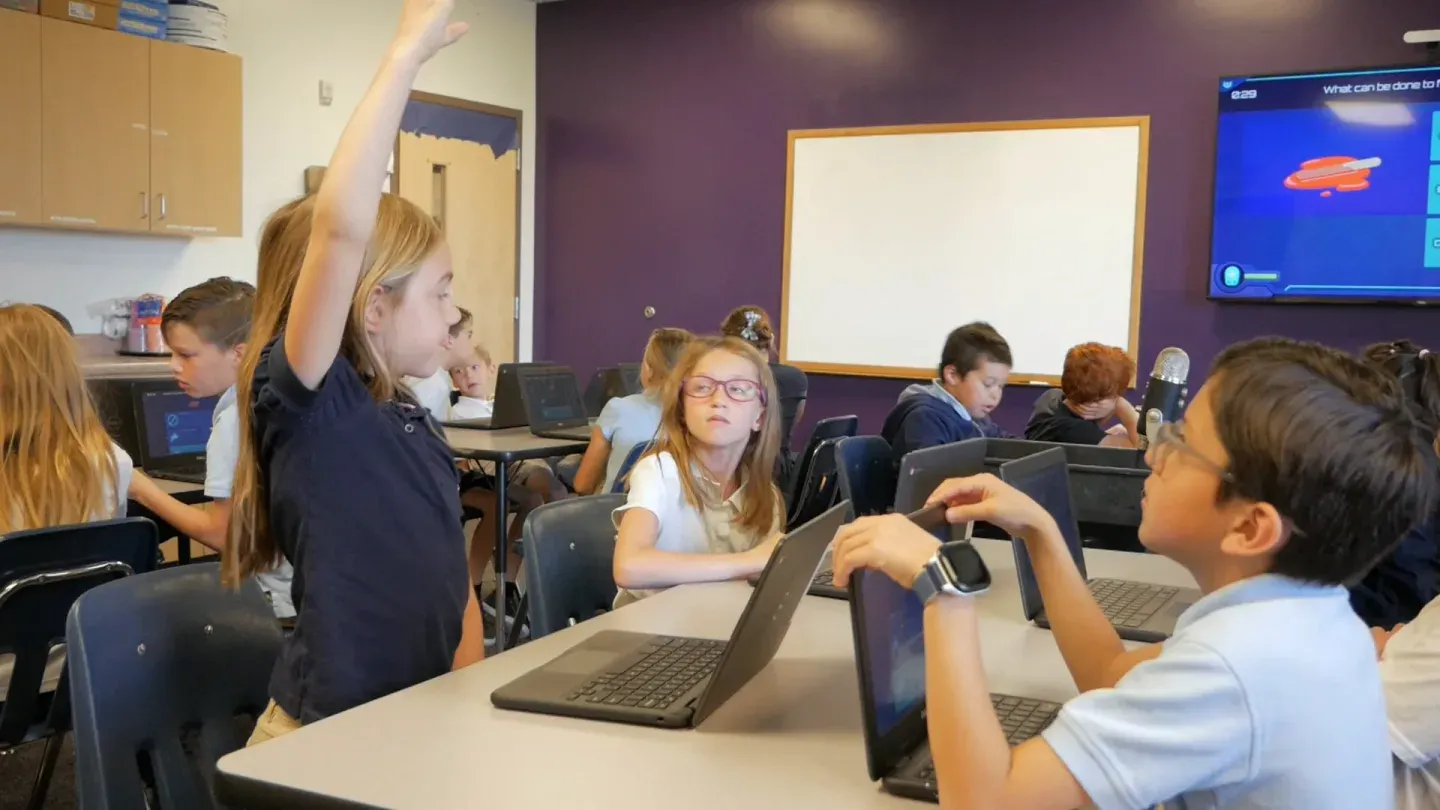
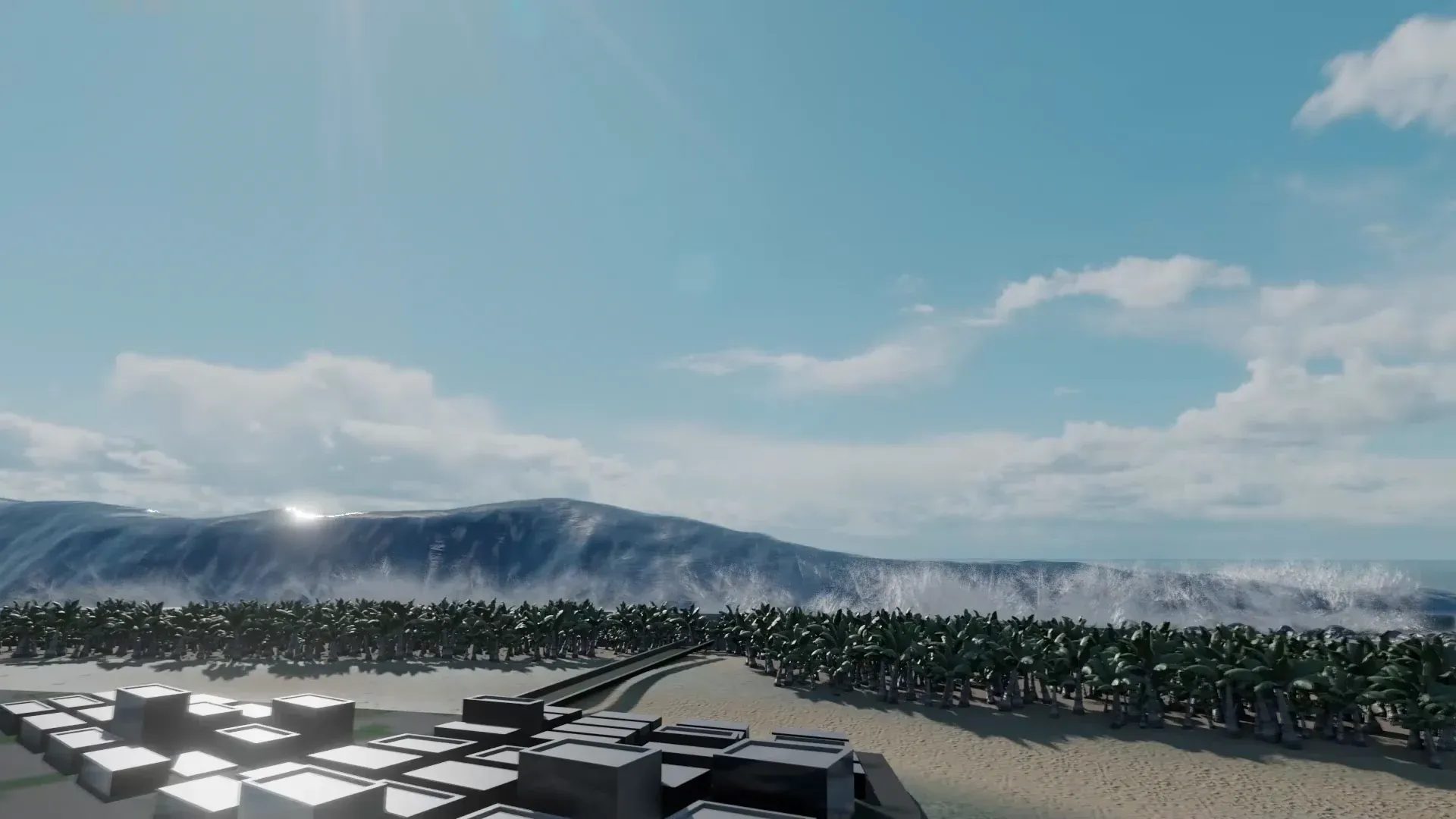
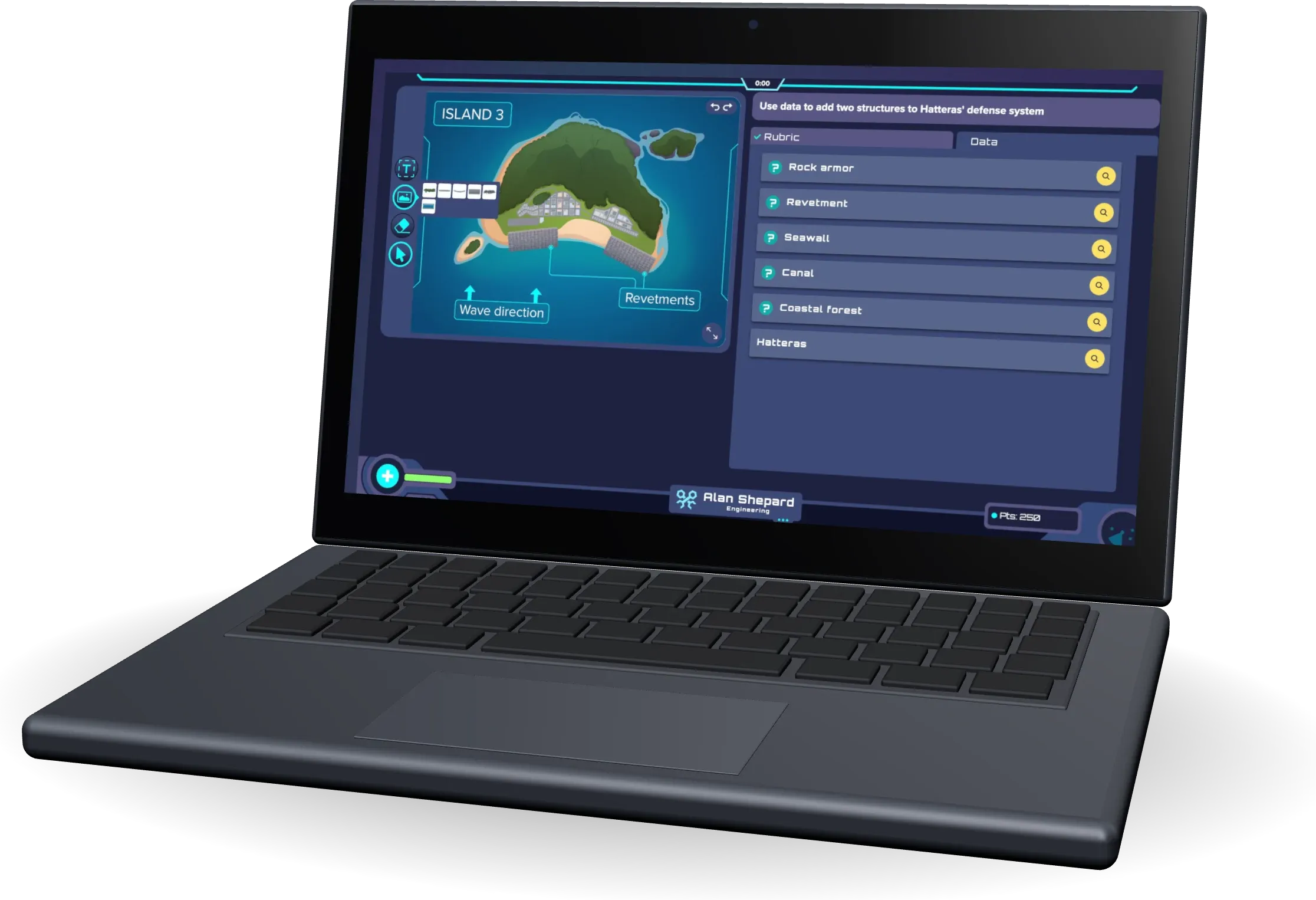
Every Mission puts the class inside a standards-aligned scenario where students analyze data, make decisions, and work together to solve a real problem. How it runs
- Every student is assigned to a team, and each team’s work is themed to it, from its own information and challenge to the same problem the rest of the crew is solving.
- The Mission connects every station and moves the story forward.
- The teacher leads the discussion and pushes for evidence. The teacher stays at the helm.
- One device per student and a projector, 30 to 45 minutes a Mission, 5 minutes of prep.
- Any teacher can run one free; districts bring us in when they want it in every science classroom, with district-level reporting across all of them.
What the report shows
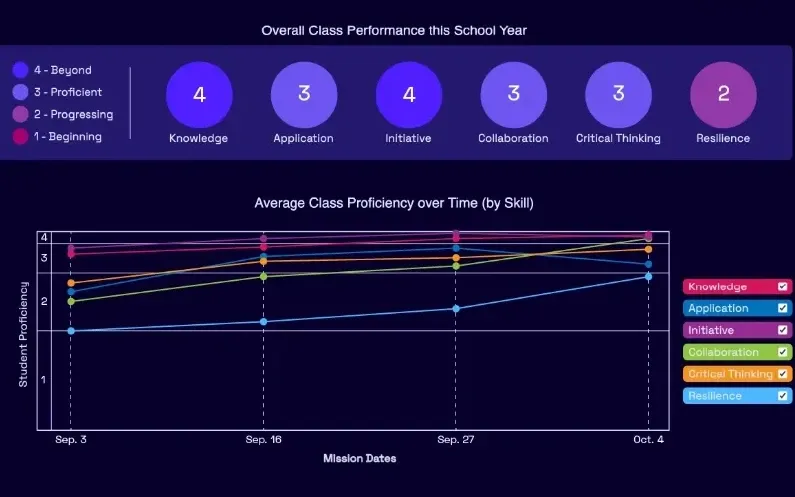
A class report from a real Mission: the class score in each of six skills, then each skill across the year. Every student gets a report on how well they did, built from what they did across the whole Mission: what they knew, whether they could apply it, and the human skills that Mission captured. The test shows what they know. The report shows the rest.
The evidence
+0.94percentage points of content knowledge for each Mission a class runs (p < .001)
Content-knowledge gain, percentage points Bar chart of content knowledge rising with the number of Missions run, from one Mission to twenty, a roughly 17.9-percentage-point separation.Students who ran about 20 Missions scored roughly 17.9 percentage points higher than students who ran one.
The more Missions a class runs, the more students grow. In Instructure’s 2025-26 study of more than a thousand fifth graders across 53 classrooms, funded by the U.S. Department of Education’s Institute of Education Sciences, students who ran Missions scored higher on content knowledge (g = 0.335, p < .001), rising about 0.94 percentage points with each Mission (p < .001), and on writing (g = 0.269, p = .015), rising about 0.035 rubric points with each Mission (p = .049). Mission.io meets ESSA Level II standards, as validated by Instructure.
Bautista et al. (2026), Instructure · content knowledge g = 0.335, p < .001; +0.94 pp per Mission, p < .001 · writing g = 0.269, p = .015; +0.035 rubric points per Mission, p = .049
Teaching your own sequence?
Some districts move OpenSciEd units between grades or align them to state standards. Bring us your units and we’ll work out together where a Mission fits in each one.
Questions leaders ask about OpenSciEd
- Is OpenSciEd aligned to NGSS?
Yes, by the public measure districts use: EdReports rates it Meets at all three gateways for grades 6-8 (2023) and for high school biology, chemistry, and physics (2025). The elementary materials are submitted and not yet rated.
- Is OpenSciEd really free?
The download is. Kits (roughly $800 to $1,500 per middle school unit per classroom kit on the Louisiana contract, May 2026), consumable refills, print, and training are not; the worked example above lands one middle school at roughly $70,000 over three years before a platform. Budget it like a program, not a PDF.
- How much training does it need?
More than most. The free six-hour “Starting Strong” course is the floor; the four-day launches run about $1,050 per teacher at NSTA and less regionally; the state reviews and most teachers in the forums say year one without training is where it fails.
- How does OpenSciEd compare to Amplify?
Both are all-green at EdReports for 6-8. OpenSciEd has no license fee and a heavier lift; Amplify has a license and repeatable routines that make year one more predictable. The head-to-head above has the rest.
- What do districts add to OpenSciEd?
Reporting (a partner platform), assessment (state item sets), training that outlasts the launch, and, in the middle of the storyline, a Mission where the whole class has to use what the unit built on a scenario it hasn’t seen. The pairing map lists the fit unit by unit.
How we reviewed this
We read the EdReports reports by gateway (6-8, the three high school courses, and the six certified versions), the Louisiana and Massachusetts state reviews, OpenSciEd’s release and knowledge-base pages, the Activate Learning price list on the Louisiana state contract, NSTA’s training prices, the New Jersey outcomes page and the two dissertations it cites, Digital Promise’s 2024 research synthesis, and about 900 r/ScienceTeachers comments mentioning OpenSciEd from April 2023 to October 2026, read through an archive, from which we quote only comments we could date and link, as posted, with spelling and punctuation tidied where a typo would distract and nothing else changed; the link shows the original. Prices are as of the dates shown and will drift; tell us if one has. We make Missions, districts pair them with OpenSciEd, and we said so at the top. Everything is linked in Sources.
Sources
EdReports
- OpenSciEd grades 6-8 (Feb 2023)
- OpenSciEd Biology (Jul 2025)
- OpenSciEd Chemistry (Jul 2025)
- OpenSciEd Physics (Jul 2025)
- Amplify Science 6-8 (2018 edition; 2019 review)
- FOSS Next Generation 6-8 (Dec 2019)
- HMH Science Dimensions 6-8 (Feb 2019)
- HMH Into Science K-5 (May 2024)
- Inspire Science 6-8 (Nov 2020)
- The under-review list
OpenSciEd and the states
- OpenSciEd press release on the middle school rating (Feb 2023)
- OpenSciEd K-5 completion release (Mar 2026)
- OpenSciEd assessment system
- Louisiana instructional materials reviews
- Activate Learning OpenSciEd price list, Louisiana contract (May 2026)
- Massachusetts CURATE, OpenSciEd (2022)
- New Jersey DOE, OpenSciEd student outcomes
- New Jersey DOE, Starting Strong broadcast (Sep 2026)
- NSTA OpenSciEd workshops 2025-26
- Henniker School District board adoption (Apr 2025)
Reddit and other teacher forums
- "Openscied is a bad curriculum" (May 2025)
- "Open SciEd ruined high school science" (Dec 2025)
- "I feel like OpenSciEd is sapping the joy out of..." (Oct 2026)
- "Not boring Open Sci Ed unit" (Sep 2026)
- "My new district thought they didn't have to order lab kits" (Sep 2024)
(And yes, we scoured the deepest, darkest corners of Reddit and the teacher forums, and luckily came out alive, to see what teachers were actually saying.)
Teacher comments are linked where they are quoted; read through the Arctic Shift archive of r/ScienceTeachers, linked to their reddit.com permalinks.
Walk into the adoption meeting with the facts
Going through an adoption? We're always glad to talk through your choices and show you how a Mission makes whichever one you pick go further.