8th grade problem solving activities

The locker problem rebuilt so the claim has to survive lockers nobody checked, five more classics fixed, a free sheet, and the Mission we’d run with 8th graders.

Who we are. Mission.io makes Missions: teacher-led, whole-class simulations where students use what they’re learning to work through a real scenario together.

Everything on this page works without us. The Mission we’d run with 8th graders is at the end, free. (No lockers there. Just a brand-new element too corrosive for anyone to contain.)

On this page

What problem solving looks like in 8th grade

Eighth grade problem solving activities ask thirteen- and fourteen-year-olds for more than an answer: a claim about a pattern, and a reason it has to hold. This page rebuilds a classic built for that, the locker problem, so the claim gets tested on lockers nobody checked.

Thirteen-year-olds are reluctant to take risks, argue in groups, and hold strong opinions. A year later they respond well to academic challenge, enjoy big ideas, and are more willing to make mistakes and learn from them. The locker problem is a big idea hiding in a hallway, and a safe one, because the first twenty lockers can be checked by hand before anyone commits to a claim about a thousand. It’s also the age where trying first has its best evidence, so the problem comes before any lesson on factors or squares (Sinha and Kapur, 2021).

The standards here are mostly practices, and that’s honest. Look for and express regularity in repeated reasoning (Mathematical Practice 8): the students who touch a locker are its factors. Make sense of the problem and persevere, starting with 20 lockers instead of 1,000 (Mathematical Practice 1). The content tie is real but thin: evaluating square roots of small perfect squares (CCSS 8.EE.A.2), because the lockers left open are the perfect squares.

Six things that make an activity build problem solving

Using what you know on a problem that looks new is hard at any age. Gick and Holyoak showed it with a story: people who had just read one containing the solution used it on a new problem far more often when someone hinted the story might help, and far fewer made the connection unprompted (Gick and Holyoak, 1980). Eighth graders can find a pattern. Testing it on a case they haven’t seen is where the transfer happens. Below, the six at the 8th grade level; the K to 8 guide holds the full set of studies.

  1. 1. A real problem with stakes the class can feel.

    Nobody needs to know which lockers stand open. A custodian who has to tape a notice on each one, and won’t walk the hallway a thousand times to find them, does.

  2. 2. Apply, don't recall.

    Finding the pattern is half; explaining it is the rest: a locker ends up open when it’s touched an odd number of times, and only perfect squares have an odd number of factors. No rule they’ve memorized gets them there.

  3. 3. Group goals with individual accountability.

    One marker per group helps, but it won’t tell you who found what. A block of lockers per student, reported out loud, will.

  4. 4. The teacher leads the thinking.

    Ask about the lockers that break their claim. Thirteen-year-olds who won’t risk a wrong answer will happily poke holes in someone else’s.

  5. 5. A debrief where the class argues it out.

    Give the debrief to the locker that broke someone’s first claim. Fourteen-year-olds enjoy big ideas, and why the squares stay open is a big one.

  6. 6. A way to see who did what.

    Two grids, a factor table, and a proof line with three test lockers on it. By the bell, every student’s piece of the argument is on paper.

Twenty lockers by hand. A thousand by proof.

The locker problem already gets apply right. What it’s missing as usually run is nearly everything that tells you who did it. The sheet puts that back, grids and proof frames ready →

The locker problem, rebuilt to hit all six

You know it. A hallway of closed lockers and as many students. Student 1 opens every locker, student 2 changes every second one, student 3 every third, and so on down the line. Which lockers are open at the end, and how do you know? It’s been a middle school favorite long enough to have a 1982 teachers’ monograph about it. As usually run, it has a great surprise and no record of who found what.

Watch a group work it and whoever holds the marker finds the pattern while the others watch. Splitting the lockers and rotating the marker changes that.

Time
55 minutes: 5 for the scene, 10 tracking by hand, 10 finding factors and a first claim, 10 proving on the test lockers, 10 for the 1,000-locker list, 10 to debrief. In 45, cut proving to 8 and turn the 1,000-locker round into a 2-minute written exit claim (how many, and why): 5, 10, 10, 8, 2, and 10.
Groups
Fours at a whiteboard, one marker each. Twenty-nine students means six fours and a five; the fifth owns lockers 21 to 30, where the pattern starts to show.
Supplies
Whiteboards or windows, one marker per group, the locker grids. Printing only.
Standards
Mathematical Practices 8 and 1, with CCSS 8.EE.A.2 as the content tie.
  1. The problemStakes

    Here’s the story. The custodian resets every locker in the building each June by exactly this procedure, and needs to know before starting which of the 1,000 lockers will end up open, so a notice can go on each one. Nobody is walking that hallway a thousand times. The class hands over the list and the reason, and the notices go where the class says.

  2. Apply, don't recallApply

    Start with 20 lockers by hand, not 1,000. The group has to find which lockers stay open, then say why: what do the students who touch a given locker have in common? That’s Mathematical Practice 8, and nobody gets there by remembering a rule.

  3. Lockers with individual accountabilityAccountability

    Four jobs, each owning a stretch of the hallway or a piece of the argument. The marker rotates on your signal every five minutes, so the Prover isn’t the only writer.

    • Tracker

      Lockers 1 to 10. Runs the first ten students by hand and reports what's open.

    • Second Tracker

      Lockers 11 to 20, run and reported the same way.

    • Factor Finder

      Lists who touched each open locker and says what those numbers share.

    • Prover

      Writes the claim for any locker, then tests it on 36, 50, and 64.

  4. You lead the thinkingTeacher leads

    At the boards: Which lockers are open so far, and who touched locker 12? Why does locker 16 end up different from locker 12? What’s your claim about locker 1,000, and what did you test it on? Pick the test lockers yourself; that’s how you know the claim wasn’t built to fit them.

  5. Two roundsApply

    Round one is the claim with its proof. Round two is the list for the custodian: which of the 1,000 stay open, and how the group knows the count without listing every touch. Groups that finish early get one more: which lockers were touched exactly twice, and why?

  6. The debriefDebrief

    10 minutes, whole class. Which locker broke someone’s first claim? What do the open lockers have in common, and why does that follow from who touches them? What do we give the custodian, and are we sure enough to let the notices go up?

  7. See who did whatSee who did what

    Tally four things per student: ran or checked a case accurately, stated a pattern in words, tested a claim on an unchecked locker, revised a claim with a reason. Plan on seeing half the class or so, since the Trackers report aloud and the rotating marker puts a new hand on the board every five minutes.

(For you, not them: 31 of the 1,000 stay open, and every one is a perfect square.)

Somebody’s first claim will break on a test locker, and that’s the moment the proof starts to matter to a room full of thirteen-year-olds.

The locker problem, free

Emailed now, ready to copy: the teacher page, four job cards, the custodian’s request, two locker grids (lockers 1 to 10 and 11 to 20, students 1 to 20 down the side), the Factor Finder’s table with the Prover’s claim-and-test frame, the 1,000-locker list frame with its how-we-know line, an answer key, and the four-behavior tally.

It’s on its way.

Check your inbox for the locker problem.

Email me the sheet. It comes as a PDF, ready to print. Unsubscribe anytime.

Five more 8th grade classics, and the fix each needs

Eighth grade is where the big problems show up and the same two students solve all of them. These five are worth running with a couple of changes that spread the thinking across the whole table. Here’s how each one usually runs, and what to change.

Five more for 8th grade

1. Fermi problems (7 to 8)

Needs a question nobody can look up, paper, calculators. Small groups.

Students break a question nobody can look up into stated assumptions, then multiply their way to an estimate. Every link in the chain is math put to use. As usually run, though, nobody needs the answer, and nothing shows whose assumptions they were.

The fix

  1. Ask a question the school will act on, and have every assumption signed by the student who made it.
  2. Once the chain is signed, the group names the single assumption that would change the school’s decision.

See Fermi problems rebuilt for 7th grade →

2. Barbie bungee

Needs rubber bands, a doll, a tape measure, a stairwell. Small groups. Two days.

Groups measure how far each added rubber band drops the doll, fit the line, and predict the stairwell drop. The cheer at the final drop is real, and so is the math. As usually run, though, nobody answers for the prediction when the doll goes over.

The fix

  1. Whoever fit the line signs the prediction for the final drop.
  2. The group defends that prediction to you before the doll goes over.

See Barbie bungee rebuilt for 8th grade math →

3. Catapults and egg drops (K to 8)

Needs the supply closet. Groups of three or four.

Groups build a catapult or an egg drop, launch it or drop it, and crown a winner. The test gives it stakes. As usually run, though, there’s little math or science in the build, and the egg survives or it doesn’t without anyone asking why.

The fix

  1. Write a spec before the build, with a target the group has to hit.
  2. Run a second round after the first failure.
  3. Debrief why it failed before anyone is crowned.

See 8th grade STEM activities →

4. Classroom escape room (3 to 8)

Needs a lockable box and four locks per group, or envelopes for the lockless version. Groups of four. 60 minutes.

Groups race the clock through a locked box, puzzle by puzzle, and the clock gives it stakes. As usually run, though, that’s all it has, since most locks guard review questions and the fast kid opens every one.

The fix

  1. Give each student one lock, and only its owner turns it.
  2. Release the final code only for a claim the group proves on a case you choose, the way the lockers get tested on 36, 50, and 64.

See the full escape room rebuild in the K to 8 guide →

5. Problem of the week

Needs one hard problem, a week to solve it. Solo.

A hard problem goes up, students get a week to solve it, and a solution gets posted at the end. It’s real math put to use. As usually run, though, it’s a quiet challenge for the same few students, and nobody hears how anyone solved it.

The fix

  1. Have students work it in pairs.
  2. Each pair fills in a strategy card that both partners sign.
  3. Close the week with five minutes of whole-class debrief on the methods, with the answer saved for last.

No page; the signed strategy card is the whole fix.

  • Our part · We make Missions

    Or let a Mission carry everything but the thinking

    Plenty of 8th grade teachers run the lockers by hand, and it holds up. A Mission is our teacher-led, whole-class simulation, and it carries all six inside one period while handling the scenario, the prep, and the measuring. Leading the argument is still your job.

    You're at the helm, not on the hook.

    The State of Things: the Mission we'd run with 8th graders

    The State of Things · Grades 6 to 8 · About 40 minutes · One device per student, plus your projector · Free with a teacher account

    A student in a sparkly black sweater laughs with her hands up mid high five, laptops open on the desk beside her.
    What you'll see: a crew that just got something right, and a high five that tells you which table it was.

    Dr. Zyla’s team on Prometheus station has discovered a new element, vitrolium. It’s highly corrosive, and the team can’t contain it in its current state. The crew has to investigate how it reacts to thermal energy and propose a plan for handling it safely. The crew works from seven stations: Command, Engineering, Medical, Security, Science, I.T., Operations.

    Every student is assigned to a team, and each team’s work is themed to it, from its own information and challenge to the same problem the rest of the crew is solving. The team gives a student a role in the story and people to lean on while you move between teams. You’re there for the follow-up: what happens to the particles when they cool it?

    Against the six:

    • Stakes. A new element too corrosive to contain, and a station waiting on the crew’s plan.
    • Apply. Students investigate how thermal energy changes the element’s particles and state (NGSS MS-PS1-4), then propose how to handle it.
    • Accountability. Every student is assigned to a team, and each team’s work is themed to it.
    • Teacher leads. Teacher Preview, then Start, then ask: What happens to the particles when you cool it? What would make it safer to handle? What does your plan risk?
    • Debrief. The Mission Guide lists two debriefing activities, starting with Phase Guess Who.
    • See who did what. Every student gets a report on how well they did, shaped by what this Mission asked of them.


    “Even my quiet or reluctant students participate because the missions are structured in a way where everyone’s voice matters.”

    Adriana Lopez, Junior high teacher, Clint Jr. High School

    Will it work in my room?

    Students join with a class code: no student accounts, no student email, no passwords. Chromebooks, laptops, or tablets, plus your projector. Free for teachers, no credit card. Student data is covered by COPPA and FERPA, and we signed the Student Privacy Pledge. No projector or devices? The locker problem needs neither, and the sheet still works.

    START FREE →

    Communication first, then this one

    This is one Mission. There are more than 100 built the same way, from fossils to fractions, each one somewhere for a unit to go, with a report on every student each time. Every lesson finally has somewhere to go.

    What the report shows

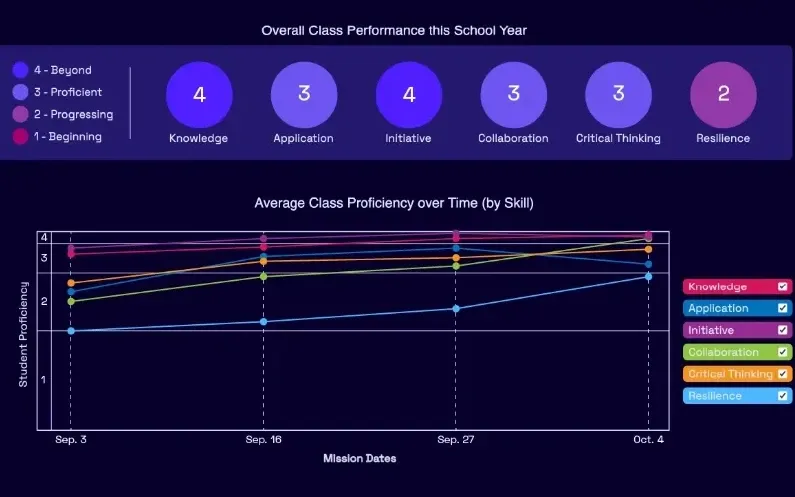
    A Mission.io class report: the class score in each of six skills, from knowledge and application to collaboration, critical thinking, and resilience, with the class chart across the year below.
    A class report from a real Mission: the class score in each of six skills, then each skill across the year.

    Every Mission produces a report for every student, built from what that student did across the whole Mission, on the skills the Mission captured. The six it can capture are Knowledge, Application, Initiative, Collaboration, Critical Thinking, and Resilience. The first two are what a test already sees. The other four are the human skills every school promises. There’s no row called problem solving, and we won’t pretend there is. It lives in the rows around it: whether a student could apply what they knew, think it through, and keep going when the first try failed. The test shows what they know. The report shows the rest. This is where problem solving gets practiced, and the only place the skills under it get measured. SEE THE EVIDENCE →

    You taught it. Now find out who can use it.

    Who's behind it

    Mission.io is a research and design organization with one job: make collaborative, active learning something a teacher can run every unit instead of once a semester, and put a report in your hands when it’s over. Over a million students have run a Mission. The research behind them is funded by the National Science Foundation and the U.S. Department of Education’s Institute of Education Sciences, and Mission.io meets ESSA Level II standards, as validated by Instructure.

    “Observe a mission in another classroom. It will change the way you think about them.”

    Danica Puente, Teacher, Holbrook Elementary, UT
    START FREEMISSION BRIEF →

    Free teacher account, no card. Begin with the Communication Mission, marked Start here in your library, and then The State of Things, each after its own 5-minute Teacher Preview.

Questions 8th grade teachers ask

My 8th graders won't commit to a claim. What makes one feel safe to risk?

Make the first claim cheap. Twenty lockers checked by hand is a safe place to be wrong, and the claim only gets expensive once the group has evidence behind it. Thirteen-year-olds avoid risks, so give them a test they can pass before they bet on a thousand.

Should I teach factors and square roots first?

Teach factors first if they’re shaky, and save the squares. The point is for them to discover that the open lockers are perfect squares and argue why. Try-first has its strongest evidence with students 12 to 18, so 8th grade is a good place to let the problem lead and make the connection right after.

How much proof should I expect from an 8th grader?

A claim in words and a reason that follows from who touches each locker. “Squares stay open” is a pattern. “Squares have an odd number of factors, so they get changed an odd number of times” is a proof an 8th grader can write. Test it on 36, 50, and 64 and you’ll know which one the group has.

Is the locker problem too easy for my strongest students?

Not with round two. Getting the count for 1,000 without listing every touch, then the touched-exactly-twice question, will stretch anyone who finished round one early. And the Prover’s job is hard at any level, because it asks why the pattern holds.