7th grade problem solving activities

Fermi problems rebuilt so every assumption has a 7th grader’s signature on it, five other classics with fixes, the free chain sheet, and the Mission we’d pick for 7th graders.

Who we are. Mission.io makes Missions: teacher-led, whole-class simulations where students use what they’re learning to work through a real scenario together.

Everything on this page works without us. The Mission we’d run with 7th graders is at the end, free. (No soap in that one. Just lasers, and a crystal someone named Moodoo stole.)

On this page

What problem solving looks like in 7th grade

Seventh grade problem solving activities hand twelve-year-olds a question nobody can look up, then make them build the answer out of assumptions they have to defend, one link at a time. This page rebuilds the classic version, the Fermi problem, so every assumption has an owner.

Twelve-year-olds are increasingly able to plan, organize, and set short-term goals, and they can see both sides of an issue but like to argue one point. Peer opinions now outweigh adult ones. A Fermi problem runs on exactly those habits: a plan built from stated assumptions, each one argued for. What it needs is the argument on paper, with a name next to it.

The standards: use proportional relationships to solve multistep ratio and percent problems (CCSS 7.RP.A.3), and model with mathematics, making assumptions and approximations to simplify a complicated situation while knowing they may need revising (Mathematical Practice 4). If the soap bottle gets measured as a prism, volume comes along too (7.G.B.6).

Six things that make an activity build problem solving

For students 12 to 15, one review speaks straight to group goals. Across 148 studies and more than 17,000 young adolescents in 11 countries, working toward a shared goal beat working alone or competing, on achievement and on peer relationships (Roseth, Johnson, and Johnson, 2008). A shared goal only pays off when every student owns a piece of it. Below, the six in a room of twelve-year-olds; the K to 8 guide gathers the problem solving studies.

  1. 1. A real problem with stakes the class can feel.

    Nobody needs the piano tuner count. A custodian who wants to order hand soap once a year instead of every month needs your number, and 7th graders know the difference.

  2. 2. Apply, don't recall.

    The method is the content: a chain of ratios from students per day to bottles per year, with units canceling on the page before anyone multiplies (7.RP.A.3).

  3. 3. Group goals with individual accountability.

    The default is one kid building the whole chain while three nod. Give each student two links to own and a signature to put on them, and the chain can’t be built by one person.

  4. 4. The teacher leads the thinking.

    Ask which assumption they trust least and what happens if it doubles. Twelve-year-olds will defend their numbers hard; your job is pointing them at the weakest one.

  5. 5. A debrief where the class argues it out.

    Spend it on the assumptions. When the class sees which one moved the answer most, that’s the lesson, and the custodian gets a range instead of a guess.

  6. 6. A way to see who did what.

    Every link carries a name, the poll has a tally strip, and the sensitivity check is written down. You know who reasoned what without relying on memory.

Nobody can look it up. Everybody signs it.

Fermi problems get apply right without any help. Building in the other five takes a custodian and some signatures. The sheet has the chain, the cards, and the poll strip ready →

Fermi problems, rebuilt to hit all six

You know them. How many piano tuners are in Chicago? How many balloons would fill the gym? No lookup, no answer key: students break the question into parts, state assumptions, and multiply. Illustrative Mathematics’ 7th grade course gives them a lesson of their own. As usually run, one student builds the chain, the group nods, and nobody actually needs the answer.

Watch a group do one and the assumptions are the part nobody writes down. A signature on every link changes that.

Time
55 minutes: 5 for the scene, 20 building the chain with the poll and the measurement, 5 to post, 10 to swap and check, 5 for the range, 10 to debrief. In 45: measure the pump once at the front for the whole room, build the chain in 15, and change one assumption inside the group instead of swapping (5 minutes). That’s 5, 15, 5, 5, 5, and 10.
Groups
Fours. Twenty-seven students split into six fours and a three, where the Measurer also keeps the chain.
Supplies
One soap pump bottle, a measuring cup, chain sheets. Under five dollars.
Standards
CCSS 7.RP.A.3 and Mathematical Practice 4, with 7.G.B.6 if the bottle is measured as a prism.
  1. The problemStakes

    The custodian wants to know how many bottles of hand soap the school uses in a year, so the order can go in once instead of every month, and the estimate has to come with its assumptions written out. Nobody can count it; the class has to reason it. Check with your custodian first. A real person waiting on the number is the stakes.

  2. Apply, don't recallApply

    The chain has six links: students, school days, washes per student per day, pumps per wash, milliliters per pump, milliliters per bottle. Each link is a ratio, and the units have to cancel on the sheet before anyone reaches for the multiplication. That’s 7.RP.A.3 doing actual work.

  3. Links with individual accountabilityAccountability

    Four jobs, each owning two links, and no link counts until its owner signs it.

    • Counter

      Students and school days. Two assumptions, each with a source or a reason.

    • Behavior Analyst

      Washes per day and pumps per wash. Polls ten classmates to back one.

    • Measurer

      Milliliters per pump and per bottle. Pumps a real bottle into a measuring cup.

    • Chain Keeper

      Writes the full chain with units canceling and collects every signature.

  4. You lead the thinkingTeacher leads

    At the tables: Which assumption are you least sure of, and by how much? What happens to the total if that one doubles? Which link did you actually measure? If the answer to the last one is “we guessed,” send the Measurer back to the bottle.

  5. Two roundsApply

    After totals are posted, groups swap chains, change the one assumption they think is weakest, recompute, and report how far the answer moved. That sensitivity check is MP4’s may need revising, and it’s the problem solving: finding out which guess matters.

  6. The debriefDebrief

    10 minutes, whole class. Which assumption moved the total most across the class? Which measurement surprised you? What do we tell the custodian, as a range, not a number? The first question is the one they’ll carry into 8th grade.

  7. See who did whatSee who did what

    Four behaviors go on the tally: stated an assumption with a reason, measured or polled for a link, canceled units correctly in the chain, revised an assumption and reported the effect. One period gets you about half the class, because the poll is loud and every student signs two links; the signed chain records the rest.

(The Behavior Analyst will learn more about classmates’ handwashing than anyone wanted to know.)

The custodian gets a range with every link signed, and the twelve-year-olds who signed them will defend each one like it’s personal.

The hand soap Fermi problem, free

Emailed now, ready to copy: the teacher page, four job cards, the custodian’s request with the six-link chain sheet (units and a signature on every link), the poll tally strip with the Measurer’s log, the assumption card (my number, my reason or source, how sure), the sensitivity slip (we changed, the total moved from, to), a sample chain for you, and the four-behavior tally.

It’s on its way.

Check your inbox for the hand soap Fermi problem.

Email me the sheet. It comes as a PDF, ready to print. Unsubscribe anytime.

Five more classics for 7th grade, each with its fix

Seventh grade math rooms are full of good problems that one student solves for everybody. These five are the usual suspects, and each gets fixed the way the soap chain does: an owner for every piece.

Five more for 7th grade

1. Open Middle (6 to 8)

Needs a problem on the board, or digit cards. Solo, as a warmup.

Using the digits 1 to 9 once each, students fill boxes to make the closest result. Testing candidates against each other is real apply. As usually run, though, it’s a solo warmup, and nobody sees how anyone got there.

The fix

  1. Pick one built on the ratio or integer standards you’re teaching.
  2. Make the group prove nothing beats its answer before it turns it in.

See Open Middle rebuilt for 6th grade →

2. The locker problem (6 to 8)

Needs whiteboards, one marker per group, a locker grid. Groups of four. 55 minutes.

Lockers, students, toggles, and the surprise that only some stay open. Working out why puts number sense to use. As usually run, though, one student spots the pattern, and nothing records who did.

The fix

  1. Give every student a block of lockers to own.
  2. The group writes a claim about locker 1,000, then tests it.

See the locker problem rebuilt for 8th grade →

3. Barbie bungee

Needs a doll, rubber bands, a tape measure, somewhere high to drop from. Small groups. Two days.

Groups add rubber bands to a doll’s bungee cord, measure each drop, fit a line, and predict the drop from as high as you dare. The final drop is real stakes, and the line of best fit is real math. As usually run, though, a couple of students take all the measurements, and nobody can say whose data the line came from.

The fix

  1. Give each student a set of trials to own.
  2. Each student signs their data before the group fits the line.

See Barbie bungee on the 8th grade math page →

4. Scale drawings

Needs grid paper, a cartoon, a scale factor. Solo or pairs.

Students enlarge a cartoon by a scale factor on grid paper, square by square. It puts proportional reasoning to work. As usually run, though, it’s solo art and math, and nobody checks anyone’s squares or talks about them after.

The fix

  1. Make it a mural the school actually wants.
  2. Give each student one grid square, so every square has an owner.
  3. Check each square against the original before it goes up.

No page; one square per student is the fix, and the mural is the record.

5. Classroom escape room (3 to 8)

Needs a lockable box and four locks per group, or envelopes for the lockless version. Groups of four. 60 minutes.

Groups race the clock through a locked box, puzzle by puzzle, and the clock gives it stakes. As usually run, though, the locks guard review questions, and the fast kid opens all of them.

The fix

  1. Give each student one lock, and only its owner turns it.
  2. Make the last lock a Fermi estimate the group defends to you as a range before you hand over the code.

See the escape room rebuilt, step by step, in the K to 8 guide →

  • Our part · We make Missions

    Or let a Mission carry everything but the thinking

    The soap chain works by hand, unit after unit. Each Mission is a teacher-led, whole-class simulation that fits the same six into one period and takes the scenario, prep, and measuring off your plate. The pushing, the questions, and the follow-ups stay yours.

    You're at the helm, not on the hook.

    Laser Labyrinth: the Mission we'd run with 7th graders

    Laser Labyrinth · Grades 5 to 8 · About 32 minutes · One device per student, plus your projector · Free with a teacher account

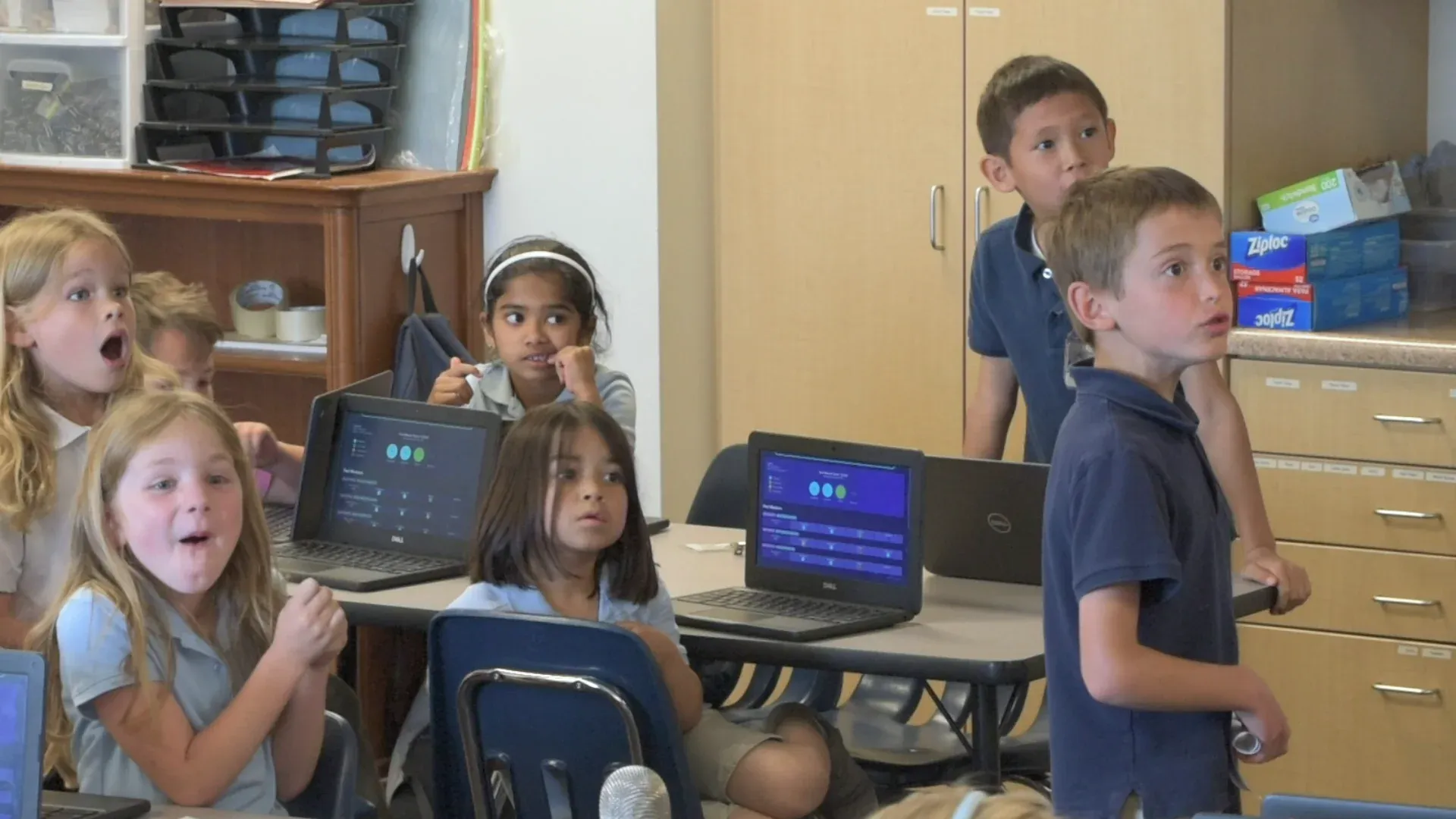
    Young students at laptops react to the front of the room, two girls open-mouthed in surprise, while two boys stand behind the table staring up at the screen.
    What you'll see: the moment the whole room finds out whether the plan worked, every face pointed the same way.

    Moodoo has stolen the crystal that powered the planet Tellenor and hidden it in his stronghold behind a laser maze. Getting through means working out the right combination of force, acceleration, and mass to deactivate the lasers. The work runs across seven stations: Command, Engineering, Medical, Security, Science, I.T., Operations.

    Every student is assigned to a team, and each team’s work is themed to it, from its own information and challenge to the same problem the rest of the crew is solving. The team gives a student a role in the story and people to lean on while you move between teams. You’re at a station asking what more mass does to the result.

    Against the six:

    • Stakes. A planet’s power source behind a maze, and only the right combination gets through.
    • Apply. Students show that a change in an object’s motion depends on the sum of the forces on it and its mass (NGSS MS-PS2-2), because that’s what turns each laser off.
    • Accountability. Every student is assigned to a team, and each team’s work is themed to it.
    • Teacher leads. Preview it (5 minutes), start it, and work the room: What forces act on it? How does mass change the result? What combination gets through?
    • Debrief. Four debriefing activities sit in the Mission Guide, untitled in the library record, so look them over before you run it.
    • See who did what. Every student gets a report on how well they did, shaped by what this Mission asked of them.

    “It’s been a while since students left my period saying that was the best class ever.”

    Will Crowther, Middle school teacher, Canyon View Middle School, UT

    Will it work in my room?

    Students join with a class code: no student accounts, no student email, no passwords. Chromebooks, laptops, or tablets, plus your projector. Free for teachers, no credit card. Student data is covered by COPPA and FERPA, and we signed the Student Privacy Pledge. No projector or devices? Fermi problems need neither, and the sheet still works.

    START FREE →

    Communication first, then this one

    This is one Mission. There are more than 100 built the same way, from fossils to fractions, each one somewhere for a unit to go, with a report on every student each time. Every lesson finally has somewhere to go.

    What the report shows

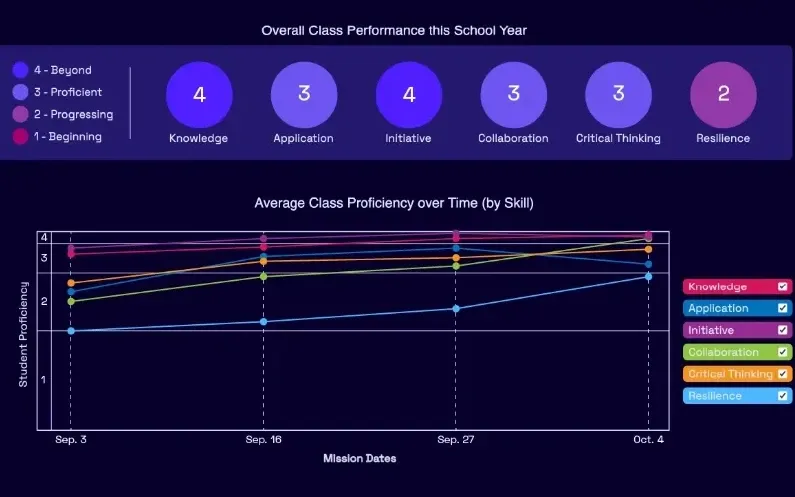
    A Mission.io class report: the class score in each of six skills, from knowledge and application to collaboration, critical thinking, and resilience, with the class chart across the year below.
    A class report from a real Mission: the class score in each of six skills, then each skill across the year.

    Every Mission produces a report for every student, built from what that student did across the whole Mission, on the skills the Mission captured. The six it can capture are Knowledge, Application, Initiative, Collaboration, Critical Thinking, and Resilience. The first two are what a test already sees. The other four are the human skills every school promises. There’s no row called problem solving, and we won’t pretend there is. It lives in the rows around it: whether a student could apply what they knew, think it through, and keep going when the first try failed. The test shows what they know. The report shows the rest. This is where problem solving gets practiced, and the only place the skills under it get measured. SEE THE EVIDENCE →

    You taught it. Now find out who can use it.

    Who's behind it

    Mission.io is a research and design organization with one job: make collaborative, active learning something a teacher can run every unit instead of once a semester, and put a report in your hands when it’s over. Over a million students have run a Mission. The research behind them is funded by the National Science Foundation and the U.S. Department of Education’s Institute of Education Sciences, and Mission.io meets ESSA Level II standards, as validated by Instructure.

    “Unlike other tech programs in the district that often have students working in isolation or in pairs, Mission.io emphasizes true collaboration.”

    Lorilee Johnson, District specialist, Alpine School District, UT
    START FREEMISSION BRIEF →

    Free teacher account, no card. First the Communication Mission, marked Start here in your library, then Laser Labyrinth; watch each one’s 5-minute Teacher Preview before you press Start.

Questions 7th grade teachers ask

My 7th graders want the "real" answer. What do I tell them?

No answer key exists, and that’s the job. A Fermi estimate is only as good as its weakest assumption, which is why the debrief asks which one moved the total most. Twelve-year-olds like to argue one point, so tell them the custodian needs a range and let them argue about how wide.

How do I keep one kid from building the whole chain?

Split the chain before anyone starts. Each student owns two links and signs them, the Chain Keeper can’t write a link that isn’t signed, and the poll and the measurement each belong to one person. If the chain is finished and someone’s links are blank, the sheet shows it.

Is a Fermi problem math or science?

Math, in this version: proportional reasoning across a chain of ratios (7.RP.A.3) and modeling with mathematics. The measuring borrows the science room’s habits, and the poll borrows a little statistics. For the science side of the year, see 7th grade STEM activities.

What if two groups get wildly different totals?

Good. Line the two chains up and find the link where they split. Finding it is the best ten minutes of the period, and at twelve a classmate’s number is more convincing than yours, so let the groups question each other before you say a word.