6th grade problem solving activities

Open Middle rebuilt so every student brings a candidate and the group proves its best, five more fixed, a free sheet, and the Mission we’d run with 6th graders.

Who we are. Mission.io makes Missions: teacher-led, whole-class simulations where students use what they’re learning to work through a real scenario together.

Everything on this page works without us. The Mission we’d run with 6th graders is at the end, free. (An abandoned asteroid mine is en route to the town’s power plant, and the crew has to find the best course of action on a coordinate plane.)

On this page

What problem solving looks like in 6th grade

Sixth grade problem solving activities hand eleven-year-olds a problem with many ways in and one best answer, and make every student bring an attempt before the group compares. This page rebuilds the one middle school math rooms reach for most, so the group has to prove its answer instead of announcing it.

Eleven-year-olds enjoy brain teasers and challenge rules and adult assumptions. They’re more adept at abstract thinking than a year ago, and they need time to talk with peers. An Open Middle problem is a brain teaser whose rules are the whole point, and the best answer is an assumption they get to beat. Sixth grade is also where trying a problem before the lesson starts to pay off, so here the algorithm waits until after.

The standards ask for two things at once. Fluently add, subtract, multiply, and divide multi-digit decimals with the standard algorithm (CCSS 6.NS.B.3). And make sense of problems and keep at them while looking for and using structure, like which place to fill first to land closest to a target (Mathematical Practices 1 and 7). One set of digit cards gets both.

Six things that make an activity build problem solving

One review should change the order of your 6th grade lesson. Across 53 studies and 166 comparisons, students who tried a problem before being taught the method outperformed students who were taught first (Sinha and Kapur, 2021). Most were 12 to 18, and the approach worked less well for younger students without enough background, so sixth grade sits at the edge: try first, as long as they know enough to make a real attempt. Below are the six as an eleven-year-old meets them; the rest of the research lives in the K to 8 guide.

  1. 1. A real problem with stakes the class can feel.

    Digits in boxes are a puzzle. A science room that needs exactly 10.00 grams, and waits a day if you’re wrong, is a problem with someone on the other end of it.

  2. 2. Apply, don't recall.

    The structure is the content: which place to fill first, ones before tenths before hundredths, and why. Remembering the algorithm won’t find the closest total; reasoning about place value will.

  3. 3. Group goals with individual accountability.

    Every student writes a candidate alone, with a name on it, before the group meets. After that, four job cards split the work so the fastest kid can’t carry the proof by herself.

  4. 4. The teacher leads the thinking.

    Your questions do the leading: which place did you fill first, what swap made it worse, how do you know nothing is closer. Then you hold back the algorithm until they’ve earned it.

  5. 5. A debrief where the class argues it out.

    Eleven-year-olds will argue about whose candidate was closest. Spend the debrief on why it was closest, and show the standard algorithm only after, as the fast way to check.

  6. 6. A way to see who did what.

    Four candidates on a whiteboard, each with a name, and one proof claim per group. Half your record is written before you pick up a pencil.

Close enough has to be proven.

Open Middle already brings apply, a teacher’s questions, and a debrief if you hold one. Here’s the version that adds the other three. The sheet has the digit boxes, slips, and proof frames ready →

Open Middle, rebuilt to hit all six

You know it, or you’ve seen it on a colleague’s board. Robert Kaplinsky’s Open Middle problems have a closed beginning, a closed end, and an open middle: using the digits 1 to 9 at most once each, fill the boxes to make the biggest, smallest, or closest result. Many paths, one best answer. As usually run it’s a warmup with hands up, the debrief is “who got closest?”, and nobody has to say why.

Watch a class do one and the same three hands go up every time. A candidate from every student, before anyone talks, changes who’s in the room.

Time
40 minutes: 3 for the scene, 4 alone, 12 in groups, 5 to report, 8 for round two, 8 to debrief. In a 45-minute block that leaves 5 minutes for the standard algorithm, shown after the problem.
Groups
Fours. For a class of 30, run six fours and two threes; in a three, the Improver also proves.
Supplies
Digit cards 1 to 9 for each group (print and cut, or write them on scrap paper), whiteboards, markers. Printing only.
Standards
CCSS 6.NS.B.3, with Mathematical Practices 1 and 7.
  1. The problemStakes

    The science teacher needs 10.00 grams of a reagent measured out of three containers, and the scale reads to two decimal places. The only weights the class can set come from the digit cards 1 to 9, each used once, as three amounts like 1.23. The class sends the science room its closest total, with proof that nothing is closer. If a closer one exists and nobody found it, the lab waits a day.

  2. Alone firstApply

    Four minutes, no talking: every student writes one candidate and its total on a slip with their name. That’s the try-first move from the research, and it tells you who can add decimals before a group can cover for anyone.

  3. Jobs with individual accountabilityAccountability

    Four jobs, each speaking once by rule, written on the sheet. No candidate gets dropped until its owner has checked its total.

    • Collector

      Puts all four candidates on the whiteboard. Each owner checks their own total.

    • Structure Finder

      Says which places matter most and why: the ones first, then the tenths.

    • Improver

      Takes the best candidate, swaps two digits, and reports whether it got closer.

    • Prover

      Writes why no closer total exists, or what the group couldn't rule out.

  4. You lead the thinkingTeacher leads

    At the whiteboards, three questions: Which place did you fill first, and why? What swap made it worse, and what does that tell you? How do you know there isn’t a closer one? They’ll want you to answer the third. Don’t.

  5. Two roundsApply

    Round two changes the target: closest to 5.00, as one amount minus another. Subtraction changes which digits belong where, so the group has to argue the structure again instead of copying round one. Rotate the jobs between rounds.

  6. The debriefDebrief

    8 minutes, whole class. Which candidate did your group start from, and whose was it? What was the swap that mattered? Did any group prove nothing is closer, and how? Then, and only then, show the standard algorithm as the fast way to check a total. (For you, not them: every possible total is a multiple of 0.09, and 10.00 isn’t one. The best is 9.99. In round two, 5.00 can’t be hit either; the closest are 4.98 and 5.02.)

  7. See who did whatSee who did what

    On the sheet, tally four moves per student: brought a candidate with a total, named a place-value reason, tried a swap and reported it, made or checked a proof claim. Roughly half the class shows up in one period, since every candidate sits on the board with a name and every job speaks once.

(Someone will ask for a zero card. There isn’t one, and that’s the point.)

By the time you show the standard algorithm, they’ll want it, because they’ve spent the period adding decimals the slow way.

The reagent Open Middle problem, free

Emailed now, ready to copy: the teacher page, four job cards, the reagent scene with round one’s digit boxes and proof frame, round two with its own, the candidate slip (my digits, my total), digit cards 1 to 9, an answer key, and the four-behavior tally.

It’s on its way.

Check your inbox for the reagent Open Middle problem.

Email me the sheet. It comes as a PDF, ready to print. Unsubscribe anytime.

Five more 6th grade classics, and the fix each needs

Sixth grade is where the warmup problems get good and the group work goes quiet: one kid solves, three nod. These five are the ones middle school math teachers reach for, and each needs a couple of changes to spread the thinking around. Here’s how each one usually runs, and what to change.

Five more for 6th grade

1. Fermi problems (7 to 8)

Needs Paper, a calculator, one question nobody can look up. Groups of four. A period.

How many piano tuners in Chicago? Students break the question into parts, state assumptions, and multiply. It’s a 7th grade classic, and it’s fine to run early in 6th, where rates and ratios put it to work. As usually run, though, nobody needs the answer, and one kid builds the chain for everyone.

The fix

  1. Ask a question the school will actually use, like how many paper towels the 6th grade restrooms go through in a week.
  2. Write the chain one assumption per line, and the student who made each one signs it.

See Fermi problems rebuilt for 7th grade →

2. The locker problem (6 to 8)

Needs whiteboards, one marker per group, a locker grid. Groups of four. 55 minutes.

A hallway of lockers, a student for each, and each student toggles every locker that’s a multiple of their number. The surprise about which ones end up open is earned by working the pattern. As usually run, though, one student spots the pattern, and nothing records who saw it.

The fix

  1. Use 100 lockers instead of 1,000.
  2. Give each student a block of lockers to track.
  3. The group writes its claim down before anyone says the word squares.

See the locker problem rebuilt for 8th grade →

3. Classroom escape room (3 to 8)

Needs a lockable box and four locks per group, or envelopes for the lockless version. Groups of four. 60 minutes.

Groups race a clock to open a locked box, puzzle by puzzle, and the clock gives it stakes. As usually run, though, the puzzles are review questions, and the fast kid opens every lock.

The fix

  1. Give each student one lock, and only its owner turns it.
  2. Make one lock a closest-answer problem the group has to prove before you give the code.

See how the K to 8 guide rebuilds the escape room →

4. Estimation 180

Needs a photo on the projector, scrap paper. Whole class. A bell-ringer.

A photo goes up, students estimate what it shows, and then comes the reveal. It puts number sense to use, and you lead the thinking. As usually run, though, it’s a bell-ringer of guesses, and nobody explains how they got theirs.

The fix

  1. Each group writes down a strategy before anyone says a number.
  2. After the reveal, the class compares the strategies side by side and leaves the guesses out of it.

No page; it’s a bell-ringer, and the strategy rule is the whole fix.

5. Digital escape rooms

Needs a device per student, a form with locked sections. Solo or pairs.

The same story and clock as a classroom escape room, with a Google Form where the padlock used to be. Students like the clock, and it’s easy to set up. As usually run, though, each section is a worksheet with a form lock, and there’s no record of who solved what.

The fix

  1. Give each student one section of the form to own.
  2. Hold back the last code, and give it out yourself after the group explains its answer out loud.

No page; the escape room fix in the K to 8 guide covers it.

  • Our part · We make Missions

    Or let a Mission carry everything but the thinking

    Open Middle by hand works, and it’s free. Ours is a Mission: a teacher-led, whole-class simulation built from what your class is learning. It packs all six into one period and covers the storyline, the prep, and the measuring, while the questions stay yours.

    You're at the helm, not on the hook.

    Brace for Impact: the Mission we'd run with 6th graders

    Brace for Impact · Grades 6 to 8 · About 30 minutes · One device per student, plus your projector · Free with a teacher account · Run it when your class is graphing in four quadrants.

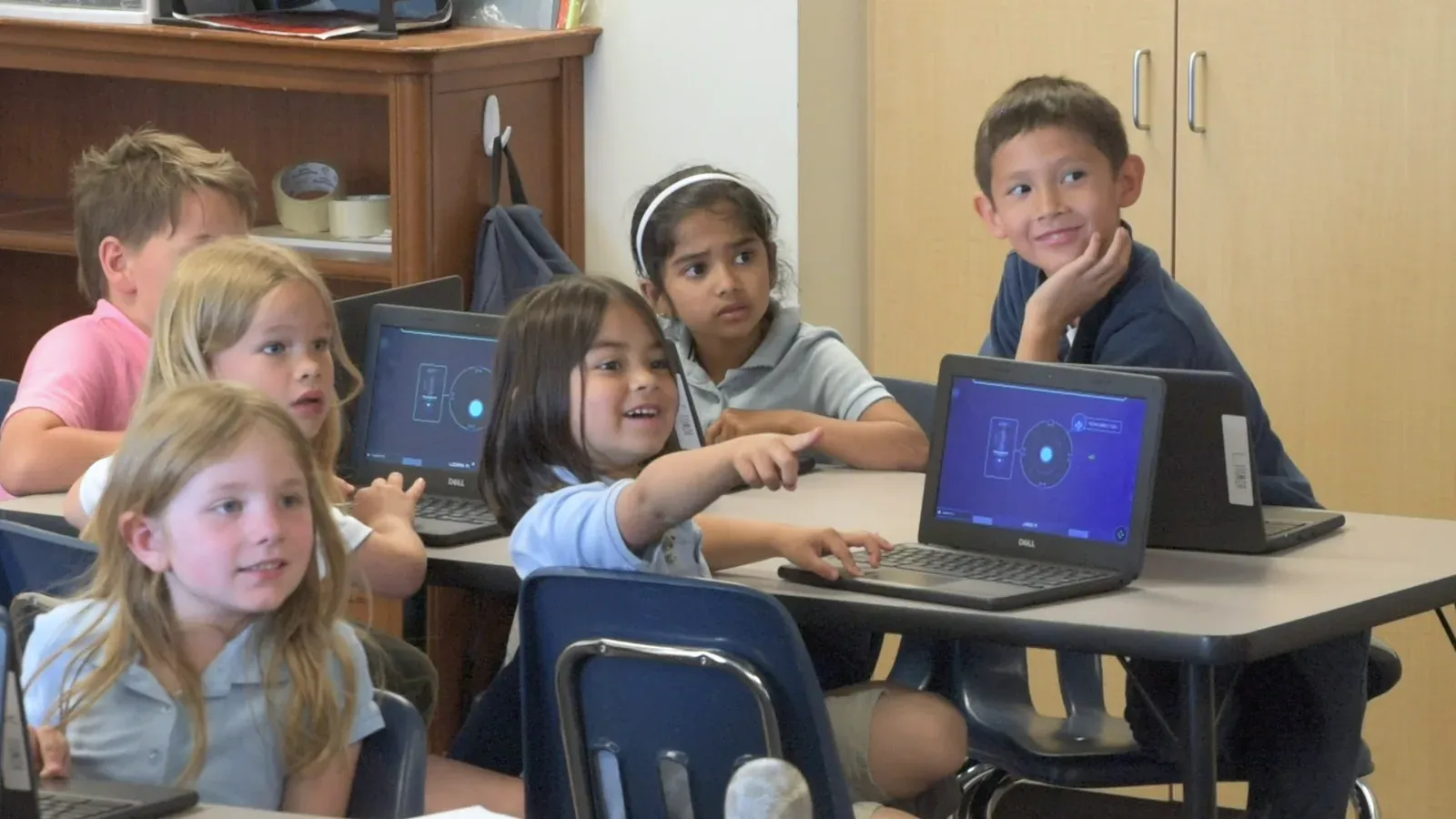
    Young students at a table of laptops look toward the front of the room; one girl points across the table and grins, and a boy beside her rests his chin on his hand, smiling.
    What you'll see: a table looking up from the same screen, one kid pointing at the answer she's sure of, and you close enough to ask her why.

    An abandoned asteroid mine is headed for the town’s power plant, and left alone it means mass power outages. The crew has to find the best course of action using coordinate planes. Seven stations split the work: Command, Engineering, Medical, Security, Science, I.T., Operations.

    Every student is assigned to a team, and each team’s work is themed to it, from its own information and challenge to the same problem the rest of the crew is solving. The team gives a student a role in the story and people to lean on while you move between teams. You’re at a station asking how far the mine is from the plant.

    Against the six:

    • Stakes. A mine on course for the plant, and the crew’s plan decides whether the lights stay on.
    • Apply. Students use coordinate planes to choose the best course of action (CCSS 6.NS.C.8). The library says they should arrive able to graph ordered pairs, negatives included, and find the distance between two points.
    • Accountability. Every student is assigned to a team, and each team’s work is themed to it.
    • Teacher leads. Teacher Preview, then Start, then the room: Where is the mine now? How far is it from the plant? What’s the best course of action, and why?
    • Debrief. The Mission Guide lists three debriefing activities, starting with Coordinate Plane Word Problems.
    • See who did what. Every student gets a report on how well they did, shaped by what this Mission asked of them.

    “At the end of the year last year, every group in my classroom listed Mission IO in the ‘Top 10 Things about Sixth Grade.’”

    Sharla York, 6th grade teacher, Heritage Elementary School

    Will it work in my room?

    Students join with a class code: no student accounts, no student email, no passwords. Chromebooks, laptops, or tablets, plus your projector. Free for teachers, no credit card. Student data is covered by COPPA and FERPA, and we signed the Student Privacy Pledge. No projector or devices? Open Middle needs neither, and the sheet still works.

    START FREE →

    Communication first, then this one

    This is one Mission. There are more than 100 built the same way, from fossils to fractions, each one somewhere for a unit to go, with a report on every student each time. Every lesson finally has somewhere to go.

    What the report shows

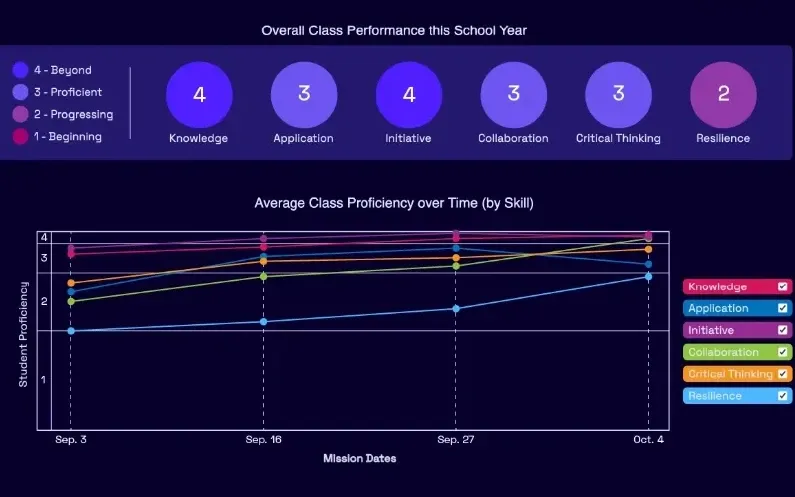
    A Mission.io class report: the class score in each of six skills, from knowledge and application to collaboration, critical thinking, and resilience, with the class chart across the year below.
    A class report from a real Mission: the class score in each of six skills, then each skill across the year.

    Every Mission produces a report for every student, built from what that student did across the whole Mission, on the skills the Mission captured. The six it can capture are Knowledge, Application, Initiative, Collaboration, Critical Thinking, and Resilience. The first two are what a test already sees. The other four are the human skills every school promises. There’s no row called problem solving, and we won’t pretend there is. It lives in the rows around it: whether a student could apply what they knew, think it through, and keep going when the first try failed. The test shows what they know. The report shows the rest. This is where problem solving gets practiced, and the only place the skills under it get measured. SEE THE EVIDENCE →

    You taught it. Now find out who can use it.

    Who's behind it

    Mission.io is a research and design organization with one job: make collaborative, active learning something a teacher can run every unit instead of once a semester, and put a report in your hands when it’s over. Over a million students have run a Mission. The research behind them is funded by the National Science Foundation and the U.S. Department of Education’s Institute of Education Sciences, and Mission.io meets ESSA Level II standards, as validated by Instructure.

    “This is the only thing I’ve used in 24 years of teaching that I love just as much as my students do.”

    Evelyn Fowles, 6th grade teacher
    START FREEMISSION BRIEF →

    Free teacher account, no card. The Communication Mission, marked Start here in your library, goes first, then Brace for Impact, and each starts with a 5-minute Teacher Preview.

Questions 6th grade teachers ask

Should I teach the algorithm before or after the problem?

After, in 6th grade, as long as they can already add decimals the long way. The try-first research is mostly students 12 to 18, and it worked less well where the background was missing, so a class that can’t yet line up decimal points needs that first. Once they can, let the problem lead and bring the algorithm in as the fast check.

My 6th graders say "that's close enough." How do I get them to prove it?

Make close enough cost something. In the rebuild the lab waits a day if a closer total exists, and the Prover has to write why nothing beats theirs or admit what they couldn’t rule out. Eleven-year-olds love catching an adult assumption. Let them catch their own group’s.

What if one student finds the best answer in two minutes?

Then that student just got the hardest job in the room, because the best answer isn’t finished until someone proves nothing is closer. Make them the Prover in round two, and give the Improver one job: beat them.

Is Open Middle only for my strongest math students?

No, and the four minutes alone are why. Every student writes one candidate with a total, and a weak candidate is useful: it’s the one the Improver starts swapping. Every candidate is on the board, and the group works from all of them.