5th grade problem solving activities

The party budget rebuilt with real money and a Checker on every line, five more classics fixed, the budget sheet free, and the Mission built for 5th grade.

Who we are. Mission.io makes Missions: teacher-led, whole-class simulations where students use what they’re learning to work through a real scenario together.

Everything on this page works without us. The Mission we’d run with 5th graders is at the end, free. (In it, the Gal-Delilahs have already stolen the ship’s water. Nobody kept the receipt.)

On this page

What problem solving looks like in 5th grade

Fifth grade problem solving activities give ten-year-olds a problem with real limits, like a fixed amount of money and too many things to buy, and make each student answerable for one piece of the solution. This page takes the most common one in 5th grade and rebuilds it so the math, and the thinking, belongs to everyone at the table.

Ten-year-olds are a gift here. They are cooperative and do well with cooperative learning, like rules and logic, can appreciate other people’s perspectives, and can concentrate for long periods. That’s why a budget lands at this age: one hard limit, a rule for every line, and three teammates who want something different on the menu.

The standard asks them to add, subtract, multiply, and divide decimals to hundredths with strategies based on place value, then connect the strategy to a written method and explain the reasoning (CCSS 5.NBT.B.7). The practice standards add modeling with mathematics: make assumptions to simplify a messy situation and interpret the result in context (MP4). A grocery budget does both, as long as somebody has to show the work.

Six things that make an activity build problem solving

Fifth grade is a good year to be doing this in groups. A review of face-to-face cooperative learning found it beat traditional whole-class teaching on achievement with a medium effect (0.54), stronger in math and science than in languages, and stronger for primary students than secondary ones (Kyndt et al., 2013). That holds only when the activity is built for it. Below, the six as they play out with ten-year-olds; the K to 8 guide carries the problem solving studies.

  1. 1. A real problem with stakes the class can feel.

    Pretend money buys a pretend party, and ten-year-olds can tell. Sixty real dollars from the fundraiser, spent on food they’ll actually eat, puts a cost on every slipped decimal.

  2. 2. Apply, don't recall.

    The content is the decimals standard itself: a price like 2.99 times a whole number of packages, worked by hand, with a sentence on how you know it’s right (5.NBT.B.7).

  3. 3. Group goals with individual accountability.

    Hand four kids one budget and the calculator goes to one of them while the other three choose balloon colors. Give each student a line to own and a Checker who initials it, and every number on the sheet has a name beside it.

  4. 4. The teacher leads the thinking.

    Ask at the table, not from the front: how many packages, and show me that multiplication. Ten-year-olds like rules, so make them say the rule they used out loud.

  5. 5. A debrief where the class argues it out.

    Hold the vote until the class has heard whose hand check caught an error and what it was. The menu argument is the hook; the caught mistake is the lesson.

  6. 6. A way to see who did what.

    If the poster is all you collect, you’ll never know who did the multiplication. The Checker’s initials put a written record on every line before you’ve tallied a thing.

Sixty dollars, four lines, one Checker.

The party budget gets apply right on its own, and the other five slip. Here it is with all six built in. Grab the budget sheet, hand-check frames and all →

The party budget, rebuilt to hit all six

You know it. Groups get pretend money and a stack of grocery flyers and plan a party for a set number of guests without going over. It’s the 5th grade decimals project, and it’s a good one, because the math has to work. As it usually runs, though, the money is imaginary, one kid works the calculator, two decorate, and the poster is the ending.

Watch a class run it and the group that finishes first has a gorgeous poster and a total nobody checked. Real money and a Checker change that.

Time
55 minutes: 5 for the scene and rules, 25 planning with hand checks, 5 posting, 5 for the price change, 5 to vote, 10 to debrief. In a 45-minute block, give every group the same one-page price list instead of flyers (flyers are where the time goes), cut planning to 18 minutes, and hold the vote the next day: that’s 43. Keep the debrief whole.
Groups
Fours. A class of 29 is six fours plus a five, and the fifth student owns a Dessert line.
Supplies
A one-page price list you write from a local store’s current prices, dated the day you write it, plus budget sheets and pencils. The calculators stay in the drawer until the end. The buying trip or online order comes later.
Standards
CCSS 5.NBT.B.7 (decimal operations, reasoning explained) and MP4 (model with mathematics).
  1. The problemStakes

    Use your class’s real numbers. Say there’s 60 dollars from the fundraiser and 24 people at the end-of-unit celebration, the class plus two guests. Whatever the class votes for gets bought, with real receipts. A plan that goes over by a cent is out, and a plan that leaves money on the table loses to one that doesn’t.

  2. Apply, don't recallApply

    Every line is a decimal times a whole number: the price of a package, how many packages for 24, the total. That’s 5.NBT.B.7, and the clause doing the work is the last one, explain the reasoning used. The sheet has a hand-check frame built for exactly that multiplication.

  3. Lines with individual accountabilityAccountability

    Four jobs, each owning one line of the budget, written on the sheet. The Checker picks nothing. The Checker checks every teammate’s line by hand, initials it, and only then gets the calculator, once, for the final total.

    • Food line

      Main item, price per package, packages for 24, line total.

    • Drink line

      The same four boxes, for drinks.

    • Supplies line

      Plates, cups, napkins, and the math for each.

    • Checker

      Picks nothing. Hand-checks and initials every line, then runs the calculator once.

  4. You lead the thinkingTeacher leads

    Three questions at the tables: How many packages, and how did you decide? What does your line cost? Show me the multiplication without the calculator. What would you cut if the juice went up 50 cents? However slow the hand check looks, don’t do it for them.

  5. Two roundsApply

    Once plans are posted, announce a price change: the store is out of the 2.99 juice, and the 3.49 one is in stock. Groups get five minutes to revise and re-check. That’s MP4’s interpret the result in context, and it’s where the plan that landed exactly on budget suddenly doesn’t.

  6. The debrief, then the voteDebrief

    10 minutes, whole class, before anyone votes. Which line surprised your group most? Whose hand check caught an error, and what was it? Then the vote: which plan do we buy, and how much is left over? Spend the most time on the hand check.

  7. See who did whatSee who did what

    Tally four behaviors per student on the sheet: computed a line and showed the method, checked a teammate’s line, explained a decision with a reason, revised a plan when a price changed. Expect to see about half the class in one period. The Checker’s initials cover the rest on paper, because every line carries a name and a check.

(The Supplies line is the one every group forgets. Plates cost money too.)

Somebody’s hand check will catch a decimal point in the wrong place, and the whole class will know whose initials saved the party.

The class party budget, free

Emailed now, ready to copy: the teacher page, four line cards, a blank price list for you to fill in, the scene and rules with the budget sheet (an owned line and a Checker’s initial box on each), the hand-check frame for a decimal price times a whole number, the price-change card, the vote ballot, and the four-behavior tally.

It’s on its way.

Check your inbox for the class party budget.

Email me the sheet. It comes as a PDF, ready to print. Unsubscribe anytime.

Five more classics for 5th grade, and each one's fix

If you’ve ever graded a budget poster and wondered who did the multiplication, these five will feel familiar. Each one is good at something, and each one needs a couple of changes before it builds problem solving. Here’s how each one usually runs, and what to change.

Five more for 5th grade

1. The handshake problem (4 to 6)

Needs bodies and a whiteboard. Whole class or small groups.

Everyone shakes hands with everyone else once; how many handshakes? Students have to find the pattern, which puts the math to use. As usually run, though, nobody needs the number, one kid finds it, and nothing records who did.

The fix

  1. Give each student a case to own, from three people up to six.
  2. The group says the rule in words before anyone is allowed to write 435.

See the handshake problem rebuilt for 4th grade →

2. Open Middle (6 to 8)

Needs digit cards or a problem on the projector. Solo, as a warmup.

Nine digit cards, none used twice, boxes to fill, and the biggest or closest result wins. Students keep testing candidates against each other, which is real apply. It belongs to 6th grade, and a 5th grade room can take it on early. As usually run, though, it’s a solo warmup, and nobody sees how anyone got their answer.

The fix

  1. Every student writes a candidate alone first.
  2. Then the group compares candidates and agrees on its best.

See Open Middle rebuilt for 6th grade →

3. Classroom escape room (3 to 8)

Needs a lockable box and four locks per group, or envelopes for the lockless version. Groups of four. 60 minutes.

Groups crack a chain of puzzles to open a locked box before the clock runs out, and the clock gives it real stakes. As usually run, though, most locks guard review questions, and the fast kid opens all of them. Nobody leads the thinking, and nobody talks about it after.

The fix

  1. Give each student one lock, and only its owner turns it.
  2. Make one lock open only on a spending decision, like which of two snack orders fits the budget, that the group defends to you.

See the escape room rebuilt in the K to 8 guide →

4. Math scavenger hunt (1 to 5)

Needs task cards taped around the room, a clipboard per pair. Pairs.

Problem cards go up on the walls, and pairs hunt them down and solve them. The cards put the unit to use. As usually run, though, it’s a worksheet that learned to walk, and one partner usually does the solving.

The fix

  1. Give each pair one pencil.
  2. Nothing gets written until both partners agree.

No page for this one; with the one-pencil rule it makes a fine warmup.

5. Design a dream playground

Needs grid paper and a cost per square. Small groups.

Groups draw a playground on grid paper with a cost per square, so every slide and sandbox has a price in area. It puts area and perimeter to work. As usually run, though, it’s a drawing project where one student does the math, and the designs go up without anyone questioning them.

The fix

  1. Give every student a section of the playground to own.
  2. Bring in a client, like someone from the PTA, with questions the group has to answer.

No page for this one; add the budget’s Checker, who initials every section’s cost.

  • Our part · We make Missions

    Or let a Mission carry everything but the thinking

    Run the budget by hand and it works; plenty of 5th grade teachers do it twice a year. Missions are teacher-led, whole-class simulations that hit the same six in one class period and handle the scenario, the setup, and the measuring. The thinking stays with you.

    You're at the helm, not on the hook.

    Hydro Heist: a Mission built for 5th grade

    Hydro Heist · Grade 5 · About 34 minutes · One device per student, plus your projector · Free with a teacher account

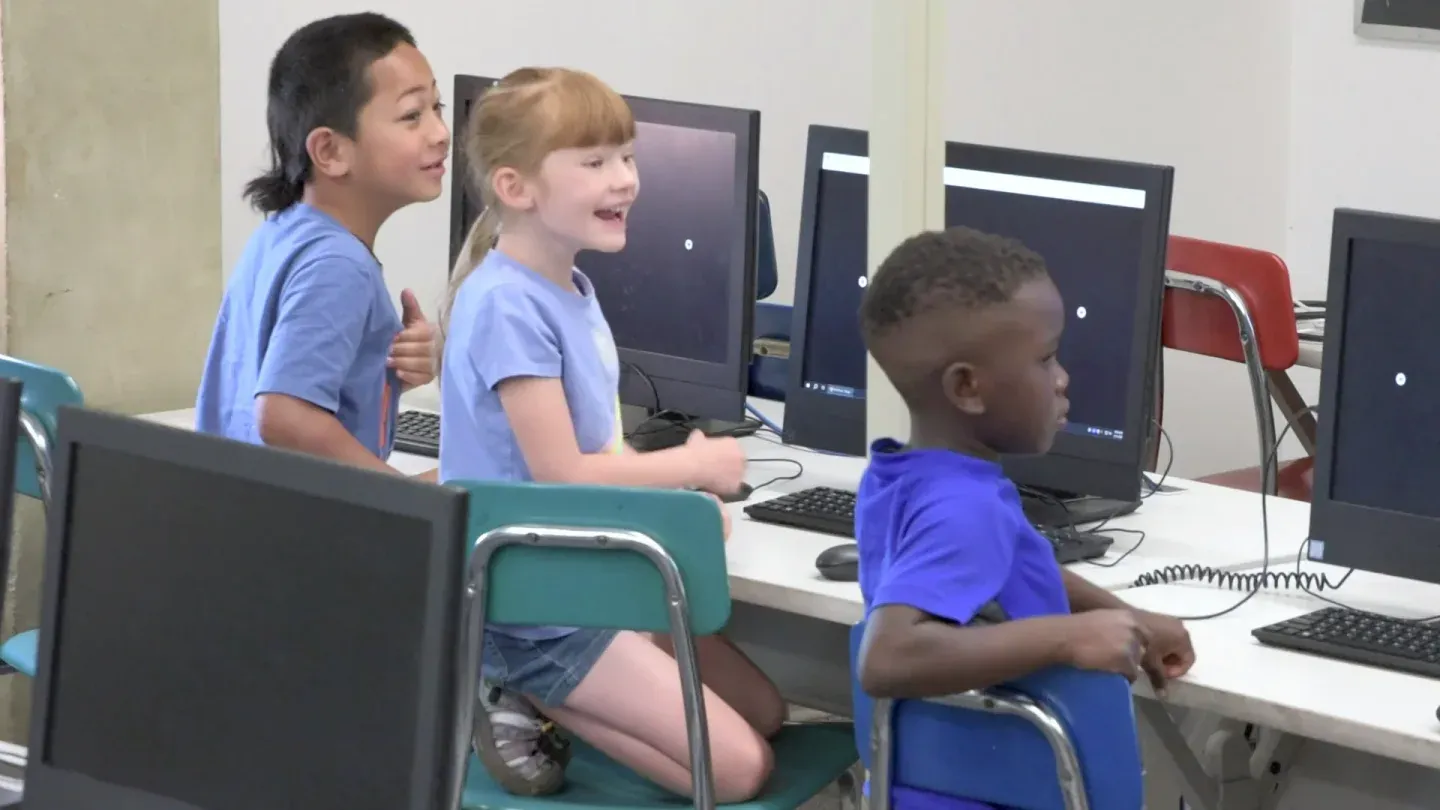
    Two students at a row of desktop computers grin and turn toward the room, one with a thumb up, while the boy at the next screen keeps his eyes on his monitor.
    What you'll see: a crew at their screens, one station calling out what its data says, and a decision about water still to make.

    The Gal-Delilahs just attacked the ship, wrecked the power system, and stole the water supply. Without water the hydroflux pumps quit, without the pumps nobody can steer, and space debris is about 30 minutes ahead. The crew has to analyze the water on the next planet and pick where to take fresh water from.

    Seven stations carry the work: Command, Engineering, Medical, Security, Science, I.T., Operations.

    Every student is assigned to a team, and each team’s work is themed to it, from its own information and challenge to the same problem the rest of the crew is solving. The team gives a student a role in the story and people to lean on while you move between teams. You’re at the table asking where the fresh water is.

    Against the six:

    • Stakes. About 30 minutes to the debris, and a ship that can’t steer without water.
    • Apply. Students analyze the planet’s water distribution to choose where to take fresh water from (NGSS 5-ESS2-2). The library says they should arrive able to calculate equivalent fractions.
    • Accountability. Every student is assigned to a team, and each team’s work is themed to it.
    • Teacher leads. After the 5-minute Teacher Preview, press Start and ask: What does the pump need? Where is that water? What do you do first with 30 minutes?
    • Debrief. The Mission Guide lists four debriefing activities, starting with Earth Water Distribution and Water Consumption.
    • See who did what. Every student gets a report on how well they did, shaped by what this Mission asked of them.

    “The missions are so engaging and entertaining my students don’t realize I am giving them an assessment.”

    Savannah Watson, Teacher, Orchard Elementary, UT

    Will it work in my room?

    Students join with a class code: no student accounts, no student email, no passwords. Chromebooks, laptops, or tablets, plus your projector. Free for teachers, no credit card. Student data is covered by COPPA and FERPA, and we signed the Student Privacy Pledge. No projector or devices? The party budget needs neither, and the sheet still works.

    START FREE →

    Communication first, then this one

    This is one Mission. There are more than 100 built the same way, from fossils to fractions, each one somewhere for a unit to go, with a report on every student each time. Every lesson finally has somewhere to go.

    What the report shows

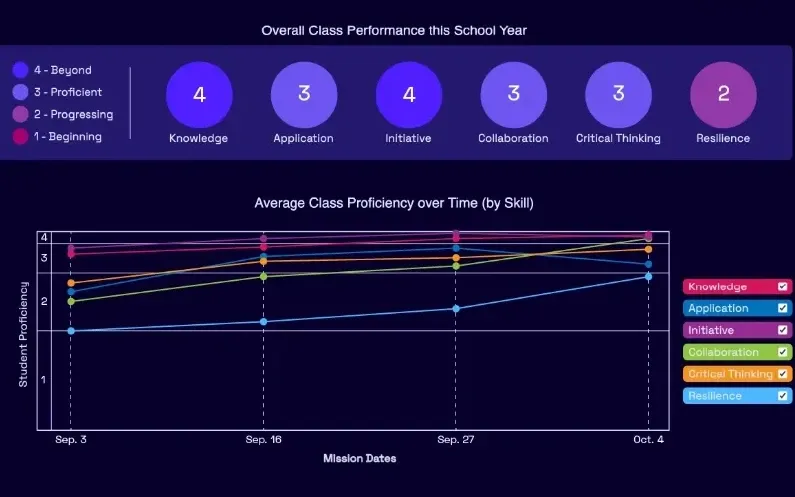
    A Mission.io class report: the class score in each of six skills, from knowledge and application to collaboration, critical thinking, and resilience, with the class chart across the year below.
    A class report from a real Mission: the class score in each of six skills, then each skill across the year.

    Every Mission produces a report for every student, built from what that student did across the whole Mission, on the skills the Mission captured. The six it can capture are Knowledge, Application, Initiative, Collaboration, Critical Thinking, and Resilience. The first two are what a test already sees. The other four are the human skills every school promises. There’s no row called problem solving, and we won’t pretend there is. It lives in the rows around it: whether a student could apply what they knew, think it through, and keep going when the first try failed. The test shows what they know. The report shows the rest. This is where problem solving gets practiced, and the only place the skills under it get measured. SEE THE EVIDENCE →

    You taught it. Now find out who can use it.

    Who's behind it

    Mission.io is a research and design organization with one job: make collaborative, active learning something a teacher can run every unit instead of once a semester, and put a report in your hands when it’s over. Over a million students have run a Mission. The research behind them is funded by the National Science Foundation and the U.S. Department of Education’s Institute of Education Sciences, and Mission.io meets ESSA Level II standards, as validated by Instructure.

    “I even sent an email to my whole building encouraging everyone to try it.”

    Jen, Veteran teacher, OH
    START FREEMISSION BRIEF →

    Free teacher account, no card. Start with the Communication Mission, marked Start here in your library, then Hydro Heist; each opens with its 5-minute Teacher Preview.

Questions 5th grade teachers ask

My 5th graders grab the calculator first. Should I ban it?

Cap it instead. The standard asks for strategies based on place value and a written explanation of the reasoning, and a calculator skips both. So it comes out once, at the end, after the Checker has checked every line by hand. They still get their button press; they just earn it.

What do I do when a group goes over budget?

Let it happen, then make them find the cent. Going over is the most useful thing a 5th grade group can do here, because it sends them back to the exact line where the decimal slipped. The price-change round exists partly to tip a tight plan over, so plan on at least one group meeting that moment.

Should the jobs rotate?

Next activity, yes, and the Checker most of all. Ten-year-olds like rules, and the Checker is the rule-keeper: initials on every line or the calculator stays put. Across a few activities, every student should take a turn checking someone else’s math by hand.

Is this a financial literacy lesson or a math lesson?

Math first. The budget is what makes the decimals matter: 5.NBT.B.7 on every line, and modeling with mathematics when the juice price changes. If it also teaches them that napkins cost money, nobody will complain. A grade up, 6th grade problem solving activities take the same decimals into a problem with one best answer.