5th grade critical thinking activities

The classroom debate rebuilt so every 5th grader argues from evidence, five more classics fixed, a free judges’ scorecard, and Matter Matters, the whole-class Mission built for 5th grade.

Who we are. Mission.io makes Missions: teacher-led, whole-class simulations where students use what they’re learning to work through a real scenario together.

Everything on this page works without us. The Mission built for 5th grade is at the end, free. (The deal comes from Rocco Jax of Arcon Industries. The math behind it is, in the library’s own word, questionable.)

On this page

What critical thinking looks like in 5th grade

In 5th grade, a critical thinking activity is one where ten-year-olds reach a judgment from evidence and then defend it to classmates who see it another way. This page takes the one most 5th grade rooms already run, the classroom debate, and rebuilds it so the whole class does that thinking, including the kids who never get picked to speak.

Ten is a good year for it. Ten-year-olds like rules and logic, can appreciate others’ perspectives, and can concentrate for long periods. A debate is rules and logic with the other side built in, and fifth grade is the first year most of a class can hold an opponent’s argument in mind long enough to answer it.

Three sets of standards want this habit. Science wants 3rd to 5th graders to compare and refine arguments based on an evaluation of the evidence presented (NGSS practice 7). Speaking and listening wants 5th graders to review the key ideas and draw conclusions in light of what the discussion taught them (CCSS SL.5.1d). Math calls it constructing viable arguments and critiquing the reasoning of others (CCSS MP3). The debate below gives all of it a reason to happen.

Six things that make 5th graders think critically

Critical thinking can be taught, and a 341-study review of how is specific about it. Teaching it worked across those studies (g = 0.30 overall), and it worked best (g = 0.57) when talk, real problems, and an adult’s coaching ran together (Abrami et al., 2015). That review reports no separate number for elementary grades, so read it as the shape of a good activity, and leave the promise about ten-year-olds to your own room. The six at 5th grade follow, and the studies live in our K to 8 guide.

  1. 1. A real problem with stakes the class can feel.

    A resolution with a winner and no consequence is a performance. A recommendation the facilities director will actually read is a decision, and ten-year-olds prepare differently for a letter that gets sent.

  2. 2. Apply, don't recall.

    The evidence comes from the unit: how a community protects a resource, read off real sources on water use and rainfall (NGSS 5-ESS3-1). Thinking runs on what students know about the thing in front of them (Willingham, 2007), so the science has to be in the argument.

  3. 3. Group goals with individual accountability.

    The one the debate misses. Three speakers per team carry the whole case while everyone else becomes the audience, so here every student holds a job nobody else on the team can do.

  4. 4. The teacher leads the thinking.

    Take your questions to each team’s table during prep and between speeches. Teacher questioning moved critical thinking on its own in the same review (g = 0.38).

  5. 5. A debrief where the class argues it out.

    “Who won?” closes the period without teaching anything. Ten minutes on which evidence was hardest to answer and which concession was honest is where 5th graders learn what made a case strong.

  6. 6. A way to see who did what.

    Speakers are easy to see. The judges’ scorecard shows you everyone else, and it keeps you from grading whoever was loudest.

Volume isn’t evidence.

The classics most 5th grade rooms run cover two, maybe three, of the six. Here’s the debate rebuilt to land all six. The judges’ scorecard comes on the free sheet →

The classroom debate, rebuilt to hit all six

You know it. Two teams, a resolution, an opening, a rebuttal, a closing, and a judge. It’s one of the best things a 5th grade room can do with a period. As usually run, it also leaves most of the class out: three speakers per team do the thinking, the rest wait to hear who won, and the winning idea goes nowhere afterward.

The rebuild makes three changes. The class debates a decision it will actually send somewhere, every student gets a job, and the judges score evidence instead of volume.

Time
Two periods: 55 minutes to prepare with the sources, then 55 to debate two rounds and debrief. In a 45-minute block on debate day, take 5 to set up, run one 20-minute round, swap the second round for a 10-minute written side switch, and keep the 10-minute debrief whole.
Groups
Teams of six, two teams debating at a time. With 30 students, twelve debate and eighteen judge, and you rotate over the week so everyone debates once. Judging is a job here, with a scorecard.
Supplies
A set of four source cards per team (two to a page, cut apart), job cards, a scorecard for every judge, a timer. Printing only.
Standards
NGSS 5-ESS3-1 and practice 7 (compare and refine arguments from evidence), CCSS SL.5.1d (draw conclusions in light of the discussion).
  1. The problemStakes

    The school is replacing the field’s old sprinkler system and has two bids. A rain-sensor system costs more now. A timer system costs less now and uses more water. The class recommends one to the facilities director, and the winning case goes out in a real letter. Tell them that before anyone opens a source card: whatever they decide, an adult is going to read it.

  2. Apply, don't recallApply

    Each side gets four source cards on water use, cost, and local rainfall. That’s 5-ESS3-1 in the room: obtain and combine information about how a community protects a resource. Every claim points at a card, so an opinion with no card behind it never gets said out loud.

  3. Six jobs, one eachAccountability

    Every student on a team holds one job and only that one. A citation without its card is struck, which makes the Evidence Keeper as important as the Opener.

    • Opener

      Makes a two-minute case with two pieces of evidence.

    • Evidence Keeper

      Holds the source cards and hands any speaker the exact line they cite.

    • Cross-Examiner

      Asks the other team two questions, and nothing else.

    • Rebutter

      Answers the other team's two strongest points, by name.

    • Closer

      Gets one minute for the decision and why.

    • Scorer

      Sits with the judges and tallies the other team's claims against evidence.

  4. You lead the thinkingTeacher leads

    During prep and between speeches, three questions at the team’s table: What’s your evidence for that, and where is it? What’s their best point, and what’s your answer? What would you concede? The third matters most when a team thinks it’s ahead.

  5. Two rounds, sides switchedApply

    After round one, the teams switch sides with five minutes to prepare. Now each team has to use what it just heard from the other side, which is SL.5.1d’s “draw conclusions in light of information” happening out loud.

  6. The debriefDebrief

    Ten minutes, whole class. Three questions in order: Which piece of evidence was hardest to argue against? Which concession was honest, and did it hurt the team? What does the class recommend, and what evidence settled it? Whatever they say to that final question goes in the letter.

  7. See who did whatSee who did what

    The judges’ scorecard counts three things: claims with evidence, questions answered directly, and a point conceded honestly. Your own tally counts four moves per student: made a claim with evidence, asked a question that got a direct answer, answered the other side’s point by name, conceded or revised with a reason. The scorecards catch every speaker, your tally catches the judges during the debrief, and over the week’s rotation you’ve caught the whole room.

(The concession box on the judges’ scorecard looks like a trap to a ten-year-old. It’s worth a point, and the first team to notice will use it well.)

A week later, ask a 5th grader which sprinkler bid won. She’ll quote you the source card that settled it.

The sprinkler debate, free

Emailed now, ready to copy: the teacher page, six job cards, the sprinkler decision with its resolution, four source cards (the two bids, last year’s water use, the town’s rainfall, the groundskeeper’s notes), the judge’s scorecard, the side-switch sheet, and the four-behavior tally.

It’s on its way.

Check your inbox for the sprinkler debate.

Email me the sheet. It comes as a PDF, ready to print. Unsubscribe anytime.

Five more classics for 5th grade, each with its fix

If your debates end with three exhausted speakers and a room of kids who never said a word, blame the format. Each classic below gets fixed with the same six.

Five more for 5th grade

1. Four corners (3 to 8)

Needs four corner signs and a statement. Whole class. About 45 minutes run well.

You read a statement, students walk to one of four corners, and anyone persuaded may move. When the statement matters, say a choice the class will really make, it has stakes. As usually run, though, the loudest kid in each corner speaks for everyone standing there, and nothing gets written down.

The fix

  1. Hand out cards, and have every student write a reason before anyone walks.
  2. Anyone who switches corners has to name the fact that moved them.

Four corners, rebuilt on the 3rd grade page →

2. Guess My Rule (3 to 5)

Needs a secret rule and an in/out chart on the board. Whole class. 10 minutes.

The class feeds a machine numbers and tries to name what it does to them, like 2 in and 7 out, 4 in and 11 out. It’s good practice with two-step rules, and you run the machine. As usually run, though, one quick kid names the rule while the rest are still working, and nobody has to show how they knew.

The fix

  1. Limit each group to three tests.
  2. Before each test, the group says what that number will tell them.
  3. Give one student the job of trying every guessed rule on every pair before the group commits.

Guess My Rule, rebuilt on the 4th grade page →

3. Philosophical chairs (6 to 8)

Needs a statement, two sides of the room. Whole class. A full period.

A statement goes up, the room splits into two sides, and nobody adds a point until they’ve summarized the last speaker’s. It’s a middle school classic and safe to run a year early, and its switch-sides rule builds in more accountability than anything else on this list. As usually run, though, the statement is a values question with nothing riding on it, and the students who never speak leave no trace.

The fix

  1. Make the statement a policy the principal could actually sign, like a change to the lunch schedule.
  2. Hand out a short source packet the day before.
  3. Every point has to come with a line from the packet behind it.

Philosophical chairs, rebuilt on the 8th grade page →

4. Mock trial

Needs a case, witness and lawyer roles, a jury. Whole class. Often two weeks.

Students try a case as lawyers, witnesses, and a jury, usually as a two-week project with costumes. With a role for every student, it has stakes, applying, and accountability built in. As usually run, though, nothing shows who reasoned from the evidence and who read a script, and the logistics often pull you away from asking the questions.

The fix

  1. Give every juror a scorecard with a point for each piece of evidence a lawyer uses.
  2. Take the judge’s bench yourself, and ask three questions during the trial.

No separate page; the debate’s scorecard carries straight over.

5. Fact-check the ad

Needs a commercial on video and a worksheet. Usually solo.

Students watch a commercial and pick apart its claims on a worksheet. It puts the claims to work against what students know. As usually run, though, it’s a solo worksheet with a video, so nothing rides on the answers, nobody answers to a team, and nobody talks it over afterward.

The fix

  1. Tie the ad to a decision someone else is waiting on, like whether the school newsletter should recommend the product.
  2. Put students in teams of three, and give each a job: who’s behind the ad, what’s the evidence for its claim, or what other sources say.

See the source-checking version rebuilt for 6th grade →

  • Our part · We make Missions

    Or let a Mission carry everything but the argument

    Plenty of teachers run a debate like this every unit, and it works. Matter Matters fits all six into about 47 minutes. We bring the story, the stations, and the report, and the arguing stays with your class and your questions.

    You're at the helm, not on the hook.

    Matter Matters: a whole-class Mission built for 5th grade

    Matter Matters · Grade 5 · About 47 minutes · One device per student, plus your projector · Free with a teacher account

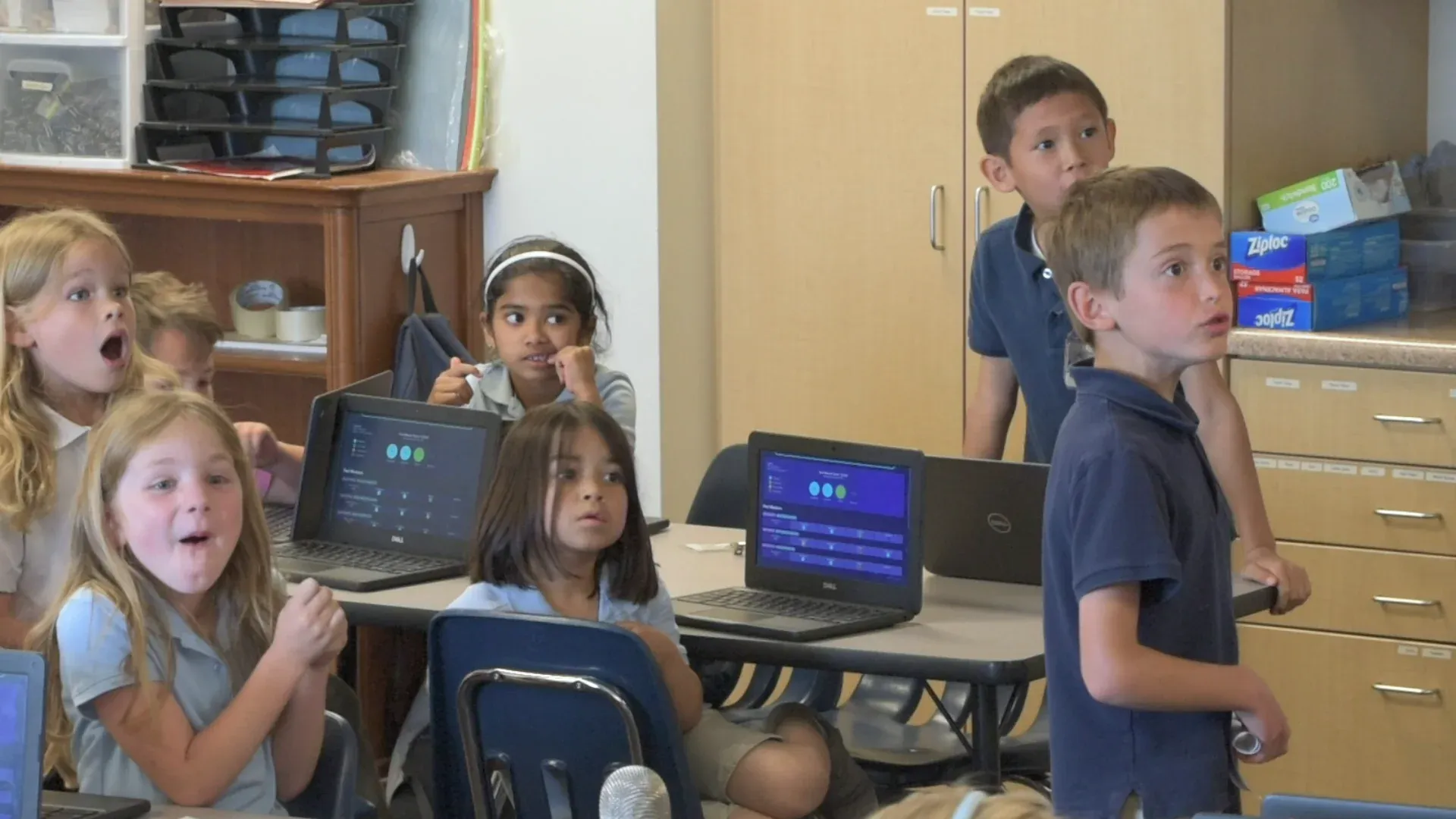
    Students at a table of laptops gasp and stare toward the front of the room, two boys standing behind them to see better.
    What you'll see: a crew gasping at the same screen, two kids on their feet to get a better look, then an argument about whose number is right, and you at the table asking how they know.

    Rocco Jax of Arcon Industries wants to alter a deal with Calix California, who represents an ice delivery company from Korè, using questionable calculations. Your class is the crew sent to mediate. The story plays on the projector. The work happens at seven stations (Command, Engineering, Medical, Security, Science, I.T., Operations) and in the arguments between them.

    Every student is assigned to a team, and each team’s work is themed to it, from its own information and challenge to the same problem the rest of the crew is solving. The team gives a student a role in the story and people to lean on while you move between teams.

    The crew also writes Calix a recommendation for how to proceed (CCSS W.5.1, opinion writing supported by reasons).

    Against the six:

    • Stakes. Calix is waiting on the crew’s recommendation.
    • Apply. The crew uses conservation of matter to find where the deal goes wrong (NGSS 5-PS1-2: the total weight of matter is conserved through heating, cooling, or mixing).
    • Accountability. Every student is assigned to a team, and each team’s work is themed to it.
    • Teacher leads. The Teacher Preview takes 5 minutes. After it, press Start and work the room: What does the weight have to be after the change? Where does the deal’s math go wrong? What do you tell Calix?
    • Debrief. Four follow-up activities come in the Mission Guide; the first is a conservation of matter experiment.
    • See who did what. Every student gets a report on how well they did, shaped by what this Mission asked of them.

    “Observe a mission in another classroom. It will change the way you think about them.”

    Danica Puente, Teacher, Holbrook Elementary, UT

    Will it work in my room?

    Students join with a class code: no student accounts, no student email, no passwords. Chromebooks, laptops, or tablets, plus your projector. Free for teachers, no credit card. Student data is covered by COPPA and FERPA, and we signed the Student Privacy Pledge. No projector or devices? The debate needs neither, and the sheet still works.

    START FREE →

    Communication first, then this one

    This is one Mission. Count more than 100 built the same way, from fossils to fractions, each closing on a report for every student. Every lesson finally has somewhere to go.

    What the report shows

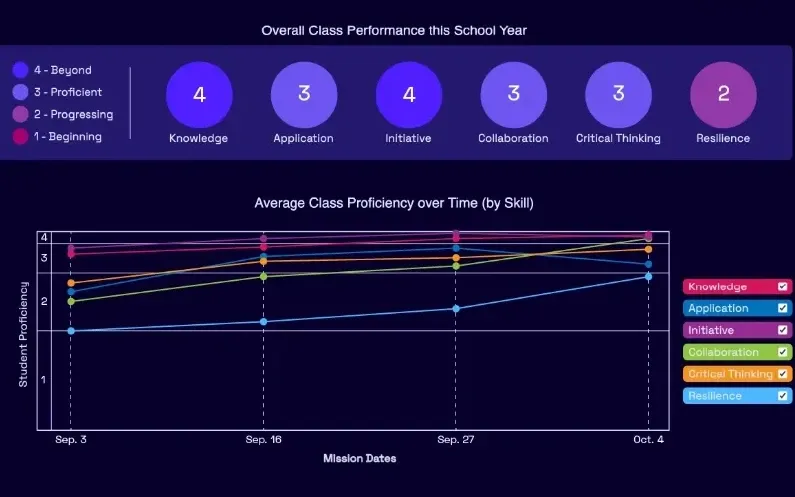
    A Mission.io class report: the class score in each of six skills, from knowledge and application to collaboration, critical thinking, and resilience, with the class chart across the year below.
    A class report from a real Mission: the class score in each of six skills, then each skill across the year.

    Every Mission produces a report for every student, built from what that student did across the whole Mission, on the skills the Mission captured. The six it can capture are Knowledge, Application, Initiative, Collaboration, Critical Thinking, and Resilience. The first two are what a test already sees. The other four are the human skills every school promises. The test shows what they know. The report shows the rest. This is where critical thinking gets practiced, and the only place it gets measured. SEE THE EVIDENCE →

    You taught it. Now find out who can use it.

    Who's behind it

    Mission.io is a research and design organization with one job: make collaborative, active learning something a teacher can run every unit instead of once a semester, and put a report in your hands when it’s over. Over a million students have run a Mission. The research behind them is funded by the National Science Foundation and the U.S. Department of Education’s Institute of Education Sciences, and Mission.io meets ESSA Level II standards, as validated by Instructure.

    “I even sent an email to my whole building encouraging everyone to try it.”

    Jen, Veteran teacher, OH
    START FREEMISSION BRIEF →

    Free teacher account, no card. Start with the Communication Mission, marked Start here in your library, then Matter Matters; watch the 5-minute Teacher Preview before each one.

Questions 5th grade teachers ask

My 5th graders just want to win. Does that ruin the debate?

It powers it. Ten-year-olds like rules and logic, so change the rule for winning. The judges’ scorecard only counts claims with evidence, direct answers, and honest concessions, which means the team that wants to win has to out-evidence the other one.

How do I grade a debate when only some students speak?

Every student has a job, and every job leaves a record: the Evidence Keeper’s cards, the Scorer’s tally, the judges’ scorecards. Rotate teams across the week and every student debates once and judges the rest of the time, so by week’s end you have a row on everyone.

What if a student has to argue a side they disagree with?

That’s the exercise. Arguing an assigned side means building the other point of view from evidence, and the side switch after round one makes every team do it anyway. Ten-year-olds can appreciate others’ perspectives; this gives them a reason to.

Does a debate count as science time?

This one does. The sprinkler question is NGSS 5-ESS3-1, obtaining and combining information about how a community protects a resource, and the argument has to come from the source cards. Run the prep period inside your Earth and human activity unit and the debate becomes the unit’s last day.

A debate you can finally grade

Start this week either way: the sprinkler debate by hand with the scorecard, or Matter Matters once you've watched its 5-minute Teacher Preview.