6th grade STEM activities

The straw rocket rebuilt so 6th graders redesign from their own test data, five more build challenges fixed, a free printable, and every 6th grade Mission by subject.

Who we are. Mission.io makes Missions: teacher-led, whole-class simulations where students use what they’re learning to work through a real scenario together. We build every one on the six things in our STEM activities for students, K-8 guide, and every student gets a report on how well they did.

You don’t need us to use this page: the straw rocket, the five challenges, and the sheet all work on their own. Every 6th grade Mission is at the end, by subject, free. (The one after the straw rocket trades the hallway for a coral reef. Nobody gets to launch anything at it.)

On this page

What 6th grade STEM looks like

6th grade STEM activities are challenges in which a team designs, builds, and tests something against criteria the standards name, redesigns from what the data showed, and leaves each student answerable for a part. This page rebuilds the straw rocket to the middle school engineering standard (MS-ETS1-1 to 4: define criteria and constraints with precision, evaluate competing solutions systematically, analyze test data to combine the best features, and build a model that generates data for iterative testing), fixes five more build challenges, and lists every 6th grade Mission by subject. The year’s content (middle school science is a 6 to 8 band, and many districts teach Earth and space science in 6th grade; ratios and the four-quadrant coordinate plane; digital citizenship) lives on the four subject pages.

Most of what gets called a STEM challenge is a contest, or a craft project with a STEM sticker on it. Kids cut, roll, tape, and we call it engineering. The straw rocket stands in for all of it, and most years it goes the same way: a sheet of paper, a straw, a long hallway, and the farthest flight wins.

Keep the launches. Sixth graders will argue over ten centimeters if you hand them a meter stick and a rival team. Ask one question about it afterward: were they solving a real problem, or following directions really well? Those feel the same in the moment, because the hallway is loud and everyone is measuring. The contest is what’s left when nobody said what the rocket had to do before it was built, and nobody can say afterward which change made it land where it did. The challenges on this page put both of those back, with the same paper in the same period.

Six things that turn a build contest into engineering

We’ve run this check with STEM teams in the districts we work with, and the craft project skips the same three every time: a real problem, criteria for success, and any pressure to iterate. If the finished product is all the activity asks for, the learning is optional. The fix is a small step before the build and a small step after it, and nothing on the table changes. One number is worth carrying down: when a group shared a goal and each student answered for a part, 84% of studies found a positive effect; without both, 17% (Slavin, 1991).

  1. 1. A real problem with stakes the class can feel.

    “Whose rocket flies farthest?” is a contest. “The outpost needs three supply drops in a row, and short means the supplies are lost” is a problem.

  2. 2. Apply, don't recall.

    A first round of launches whose data changes the design. If a team can build the whole rocket without the idea you taught that morning, the idea wasn’t needed.

  3. 3. Group goals with individual accountability.

    The one most build challenges miss: one kid builds, one kid blows, two kids watch. Four roles, one job each, and a box each student signs.

  4. 4. The teacher leads the thinking.

    The questions are yours, asked at the launch line while the next team sets up. The launch isn’t yours: the Launcher launches, and you listen for which team can say what its data told it.

  5. 5. A debrief where the class argues it out.

    Every team’s two ranges on the board, and the question is which change tightened the spread.

  6. 6. A way to see who did what.

    If you can’t tell which student called the change and which one taped what they were handed, you can’t teach the practice. You can only hope for it.

One lucky launch proves nothing.

The free printable at the end of the next section puts all six at the launch line, ready to copy. Get the sheet →

The straw rocket, rebuilt for 6th grade

The straw rocket is the one rocket that fits in a hallway and takes no chemicals: a paper tube slid over a straw and launched by breath, with fins and nose cones changed to chase distance. The way it usually runs is a free build, a launch, and “how far did it go?” Here’s the version that hits all six.

Needs
For eight teams: 16 sheets of paper, 8 straws (wider than the rocket tubes; tubes rolled on a pencil work), tape, 8 meter sticks or one marked hallway, and a protractor card per team, folded from scrap paper (the sheet shows how). Under $5.
Time
55 minutes. 45 with the rocket templates pre-printed, so the first build takes 5 minutes.
Groups
Fours. With 30 students, seven groups of four and one of two, where the Launcher also measures.
Standards
MS-ETS1-4 (a model that generates data for iterative testing and redesign) and MS-ETS1-3 (analyze test data across designs to combine the best features). The forces content it brushes is MS-PS2-2 (a change in motion depends on the forces and the mass).
  1. Teach first, 10 minutesApply

    Launch a bare paper tube three times, then the same tube with fins three times, and plot all six distances on the board. Ask what the fins did to the spread, not only the average. Then name the three variables (fin size and count, nose cone shape, rocket length) and the rule for a fair test: one change at a time, the same breath, the same angle.

  2. The problem, 2 minutesStakes

    A supply rocket has to reach a research outpost on the far side of a crevasse. The outpost is a taped zone starting 4 meters out, and short means the supplies are lost. The team gets three launches to prove the design is consistent, because an outpost can’t bet on one lucky shot. Each team copies the criteria and constraints into the box before touching the paper.

    • Criteria: three of three launches land in the zone.
    • Constraints: two sheets of paper, one straw, 20 cm of tape, 10 minutes per build.
  3. Four roles, one job eachAccountability

    On the sheet, and everyone signs their role’s box.

    • Builder

      The only hands on the rocket.

    • Launcher

      Same angle, same breath: lines up on the protractor card and says "45" every time.

    • Measurer

      Reads each distance to the nearest 10 cm and calls it out.

    • Data Lead

      Records every launch, works out the range of the three, and names the one variable the team changes next.

  4. Round one, 10 minutes, then three launchesApply

    Build, then three launches from the line. The Data Lead logs all three and writes the range (farthest minus shortest) before anyone touches the rocket again. A wide range is worth writing down; it’s what round two tries to shrink.

  5. Change one variable, 3 minutesApply

    Pick one: fins, nose cone, or length. The Data Lead writes which one and what the team predicts it does to the spread.

  6. Round two, three more launchesTeacher leads

    The Launcher and the Measurer swap, so the data isn’t one kid’s breath. You stand at the launch line and ask three questions (Which variable are you changing, and what do you predict it does to the spread? What did your three launches tell you that one launch couldn’t? What are you keeping identical?) and then you listen. If a team asks you which fins are best, point at the board.

  7. The debrief, 10 minutesDebrief

    Every team’s two ranges on the board. Which change tightened the spread across the room, and which change only moved the average? If you combined the best feature from two teams, what rocket would you build? (That’s MS-ETS1-3 in one question.) Who on your team called a change before the data showed it? Give the last question time.

  8. See who did whatSee who did what

    The observation sheet, four behaviors per student: proposed a change with a prediction, read or recorded data accurately, disagreed with a reason, changed their mind when the data said to. One hallway lane means teams wait their turn, and the wait is when you walk the line with the tally. You’ll catch about half the room in one period; the signed role boxes and the Data Lead’s log catch the rest, at a glance, before you grade anything.

  9. Once a week, or four sections in a row

    The two-visit version, for a short block or a once-a-week lab: the demo, the problem, the build, and round one on visit one, with the rocket sketched and signed; the change, round two, and the debrief on visit two. Each team’s rocket and log keep in a labeled envelope between visits. Four sections in a row: tape the launch line and the zone once in the morning and leave them, and give each Launcher their own straw, so swapping roles never means sharing one. Ask before you take over the hallway; the class next door will hear the countdown either way.

(One team will build the farthest rocket in the room and miss the zone twice. That’s the team the debrief is for.)

Keep the launches. Put the criteria in front of them and the range after them, and the contest becomes a design.

The straw rocket, free

Emailed now, ready to copy: the teacher page, four role cards, the team page (the criteria box with the rocket sketch, the six-launch log, and the two range boxes), the protractor cards, and the four-behavior tally.

It’s on its way.

Check your inbox for the straw rocket.

Email me the sheet. It comes as a PDF, ready to print. Unsubscribe anytime.

Five more 6th grade STEM challenges, fixed

Five more that every 6th grade list carries: what each one is, how it usually runs, and the couple of changes that fix it.

Five more for 6th grade

2. The paper skyscraper

Needs paper and tape, a box fan for the test. Groups of four.

Teams build the tallest freestanding tower they can from paper and tape, racing the clock. 6th graders compete hard, and the build moves fast. As usually run, though, height is the only goal, one or two students do the building, and nobody records why a tower leaned or fell.

The fix

  1. Make a wind test the criterion: the tower has to stand through 10 seconds of the box fan on low.
  2. Use the four roles from the straw rocket, with a Tester in place of the Launcher: Builder, Tester, Measurer, and Data Lead.
  3. Log where each tower gave out in the wind.

No page for this one; the fix above is the whole of it.
3. The strongest craft stick bridge

Needs craft sticks, glue, books or weights to load. Groups of four. The glue dries overnight.

Teams glue craft sticks into a bridge, let the glue dry overnight, and load it with books or weights until it breaks. If you taught trusses first, it’s a real problem that puts the idea to work. As usually run, though, it’s a load contest: the strongest bridge wins, one student does most of the gluing, and nobody looks closely at where the others broke.

The fix

  1. Give each team four roles, the straw rocket’s four with a Loader in the Launcher’s spot: Builder, Loader, Measurer, and Data Lead.
  2. Keep a load log, and have the team predict before every add.
  3. Debrief on where each bridge failed.

No page for this one; the straw rocket’s four roles carry over.

4. The Rube Goldberg machine

Needs whatever is in the bin: dominoes, ramps, cups, string, marbles. Groups of four. Several sessions.

Teams build a chain reaction from dominoes, ramps, cups, string, and marbles that does one simple task the long way. Every link takes some physics to get right. As usually run, though, it’s a multi-day project where the design ends up belonging to the loudest voice, and you watch the final run without knowing who understands which step.

The fix

  1. Give each student one step of the chain to own, and have them sign for it.
  2. Before the full run, each student explains out loud what makes their step trigger the next one.

No page for this one; it’s a unit, not a period.

5. The rubber band paper plane launcher

Needs rubber bands, craft sticks or cardboard, paper, tape. Groups of four.

Teams build a rubber band launcher from craft sticks or cardboard, then tune it to send a paper plane for distance or accuracy. Tuning a launcher is real engineering, with a reason to change one thing and try again. As usually run, though, one student tests while the others watch, and each setting gets one shot, so nobody knows whether a change did anything.

The fix

  1. Run three trials per setting, the straw rocket’s method on a new machine.
  2. Make one student the Data Lead, who fills in a range box for each set of three.
  3. Aim at a target zone on the floor instead of chasing distance.

No page for this one; the straw rocket’s launch log works as is.

6. The earthquake shake tray

Needs a tray, building materials, a pair of hands to shake it. The whole class.

Students build structures on a tray, and the tray gets shaken until something falls. It shows what an earthquake does to a building in a way 6th graders remember. As usually run, though, it’s a demo: the teacher shakes, the class watches, and nobody owns a structure or a result.

The fix

  1. Build a real shake table in place of the tray.
  2. Set two criteria: a load each structure carries, and a shake level it has to survive.
  3. Give each student a role that owns one floor of the structure.

See it rebuilt for 6th grade →

  • Our part · We make Missions

    Then the standard has somewhere to go

    Plenty of teachers rebuild these by hand every unit, and it works. A Mission is a teacher-led, whole-class simulation on the standard the unit was teaching: your class becomes the crew, the scenario is built from the unit you just taught, and the only way through is using it together. Run the straw rocket first, then the Mission on the same standard, and the engineering unit has a day two.

    You're at the helm, not on the hook.

    Spine-Backed Globster: the rocket's standard, as a Mission

    Spine-Backed Globster · Grades 6 to 12 · About 36 minutes · One device per student, plus your projector · Free with a teacher account

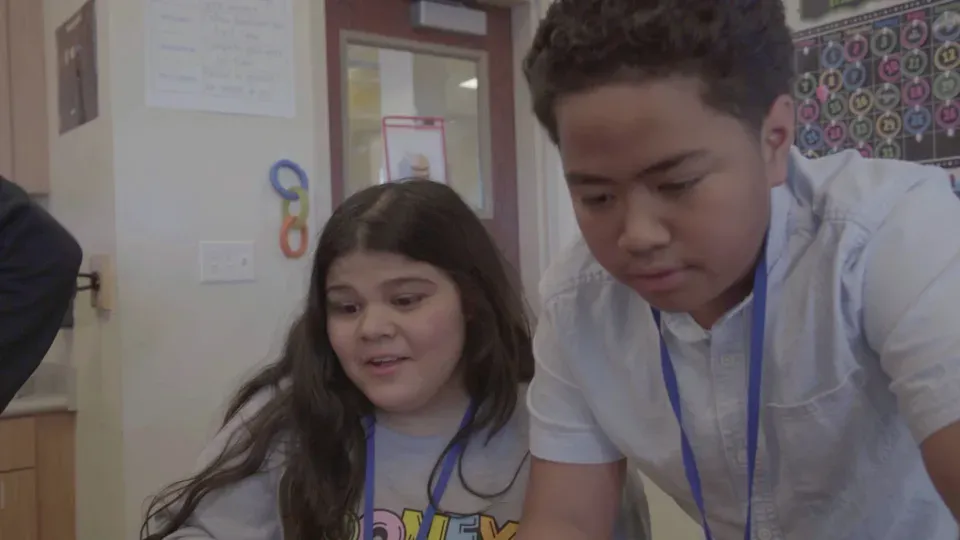
    Two students wearing blue lanyards lean in close over the same screen, the girl starting to say something as the boy beside her reads.
    What you'll see: two students bent over one screen, and you asking what the reef data says before either one writes the proposal.

    An invasive alien creature is wrecking a coral reef ecosystem off the coast of Taipan. The crew first works together to analyze data and figure out why the creature is causing so much damage, then writes a proposal for a solution to end the infestation (MS-ETS1-1, MS-ETS1-2, MS-ETS1-3, with the ecosystem codes MS-LS2-4 and MS-LS2-5). The story plays on the projector. The work happens at seven stations (Command, Engineering, Medical, Security, Science, I.T., Operations) and in the arguments between them.

    Every student is assigned to a team, and each team’s work is themed to it, from its own information and challenge to the same problem the rest of the crew is solving. The team gives a student a role in the story and people to lean on while you move between teams. You’re at the helm, asking what the data says the problem actually is and what the proposal has to fix.

    Run the straw rocket first, and tell the class why: three launches taught them to trust data over one lucky shot, and the reef is a data problem before it’s a design problem. The lesson prepares them. The Mission is what they’re preparing for.

    “At the end of the year last year, every group in my classroom listed Mission IO in the ‘Top 10 Things about Sixth Grade.’”

    Sharla York, 6th grade teacher, Heritage Elementary School

    Will it work in my room?

    Students join with a class code: no student accounts, no student email, no passwords. Chromebooks, laptops, or tablets, plus your projector. Free for teachers, no credit card. Student data is covered by COPPA and FERPA, and we signed the Student Privacy Pledge. See every class once a week in a lab? Then the lab is where the Mission runs and the classroom is where the unit runs: ask the 6th grade team what they just finished, pick that row below, and run it the week after.

    START FREE →

    Communication first, then the rocket's two

    What the report shows

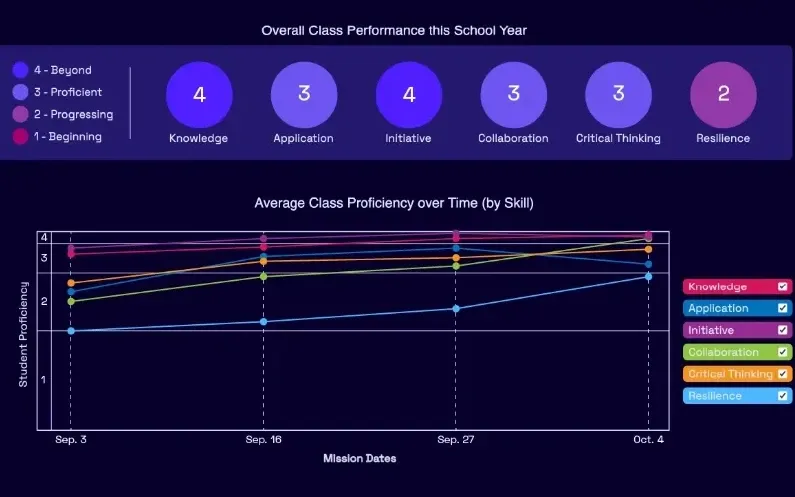
    A Mission.io class report: the class score in each of six skills, from knowledge and application to collaboration, critical thinking, and resilience, with the class chart across the year below.
    A class report from a real Mission: the class score in each of six skills, then each skill across the year.

    Every Mission produces a report for every student, built from what that student did across the whole Mission, on the skills the Mission captured. The six it can capture are Knowledge, Application, Initiative, Collaboration, Critical Thinking, and Resilience. The first two are what a test already sees. The other four are the human skills every school promises. The test shows what they know. The report shows the rest. SEE THE EVIDENCE →

    You taught it. Now find out who can use it.

    Who's behind it

    Mission.io is a research and design organization with one job: make collaborative, active learning something a teacher can run every unit instead of once a semester, and put a report in your hands when it’s over. Over a million students have run a Mission. The research behind them is funded by the National Science Foundation and the U.S. Department of Education’s Institute of Education Sciences, and Mission.io meets ESSA Level II standards, as validated by Instructure.

    “This is the only thing I’ve used in 24 years of teaching that I love just as much as my students do.”

    Evelyn Fowles, 6th grade teacher

    Every 6th grade Mission, by subject

    Spine-Backed Globster is one. There are 21 STEM Missions at 6th grade, numbered 7 to 27 below, and each one is where a unit can end: the engineering unit ends at Spine-Backed Globster, states of matter ends at The State of Things, ratios end at Lab Beneath the Waves. Every lesson finally has somewhere to go. Cart once this week and no unit in mind? Storm Front is 16 minutes.

    Engineering

    Four on the engineering design standards, two of them on the rocket’s MS-ETS1-3; two about the job rather than the standard. The 6th grade engineering activities page rebuilds the shake-table tower. For every grade, K to 8, see Engineering activities for students.

    Engineering Missions at 6th grade: four on the NGSS engineering design standards, two career and technical.
    NumberMissionTopic (code)Minutes
    7Spine-Backed GlobsterDefine the problem, compare solutions, and combine the best of them to protect an ecosystem (MS-ETS1-1, MS-ETS1-2, MS-ETS1-3, MS-LS2-4, MS-LS2-5; grades 6 to 12)36
    8TsunamiDesign and compare ways to protect islands from a natural hazard (3-5-ETS1-1, 3-5-ETS1-2, MS-ETS1-2, MS-ETS1-3; grades 5 to 8)33
    9InfectionUse the area of polygons to plan how to remove infected tissue (6.G.A.1, MS-ETS1-2; grades 6 to 9)34
    10Reactor RevampTest and improve a prototype (3-5-ETS1-3; grades 3 to 6)45
    11Unstoppable ForceEngineering and problem solving (career and technical; no NGSS code)34
    12Mission to MarsSpace engineering (career and technical; no NGSS code)45

    Science

    Eleven, and the Earth and space shelf is the deepest, which suits the districts that teach it in 6th grade. The 6th grade science activities page rebuilds the water cycle in a bag as a fair test. The last two carry elementary codes and work as review. For every grade, K to 8, see Science activities for the classroom.

    Science Missions at 6th grade, by NGSS code; the last two carry 5th grade and earlier codes.
    NumberMissionTopic (code)Minutes
    13Escape RouteAtoms and molecules (MS-PS1-1)34
    14The State of ThingsWhat adding or removing heat does to particles and states of matter (MS-PS1-4)40
    15Laser LabyrinthForce, mass, and motion (MS-PS2-2; grades 5 to 8)32
    16System ShutdownCells, tissues, organs, and body systems (MS-LS1-3; grades 5 to 8)34
    17Ecosystem PatternsPatterns of interaction in ecosystems (MS-LS2-2)39
    18Show of ForceGravity’s role in the solar system (MS-ESS1-2)40
    19Encrypted EscapeProperties of objects in the solar system (MS-ESS1-3)30
    20Mount KatastrofiHow geological events change the surface (MS-ESS2-2; grades 5 to 8)24
    21Storm FrontWarm fronts, cold fronts, and where the storm goes (MS-ESS2-5)16
    22CliffhangerEarth’s spheres interact (5-ESS2-1; grades 5 to 6)19
    23Era of the UnknownFossils and rock layers (3-LS4-1, 4-ESS1-1; grades 3 to 6)44

    Math

    Two, on ratios and the four-quadrant plane, both 30 minutes or under. The 6th grade math activities page rebuilds the lemonade ratio classic. For every grade, K to 8, see Math activities for students.

    Math Missions at 6th grade, by CCSS code.
    NumberMissionTopic (code)Minutes
    24Lab Beneath the WavesRatios, rates, and unit rates (6.RP.A.1, 6.RP.A.2, 6.RP.A.3)25
    25Brace for ImpactGraph points in all four quadrants and find distances between them (6.NS.C.8)30

    Technology

    One at this grade; if the unit is digital citizenship, this is the week it points to. The 6th grade technology activities page rebuilds the Caesar cipher, no lab needed. For every grade, K to 8, see Technology activities for students.

    The technology Mission at 6th grade.
    NumberMissionTopic (code)Minutes
    26Cyber Defense ForceSpot a phishing scam before it gets in: digital citizenship (grades 4 to 12)37

    Careers

    One that doesn’t belong to a unit: a veterinary case, read from body system data.

    The career Mission at 6th grade.
    NumberMissionTopic (code)Minutes
    27Do No HarmVeterinary science: respond to a health emergency from body system data (career and technical; grades 5 to 12)28
    START FREEMISSION BRIEF →

    Free teacher account, no card. Start with the Communication Mission, marked Start here in your library, then Spine-Backed Globster, each after its 5-minute Teacher Preview.

    Also at this grade

    The Communication Mission (30 minutes; run it first) and the Collaboration and Critical Thinking Missions for 4th grade and up (24 minutes each) live on the 6th grade collaboration activities and 6th grade critical thinking activities pages. Then the reading and writing Missions: At Odds, Dawn of the Scarecrow, On the Edge of Tomorrow (MS), Strokes of Genius (MS), and Showstopper, a costume design Mission for 3rd grade and up.

Questions 6th grade teachers ask

I teach 6th grade science in short periods. What fits?

The straw rocket fits a 45-minute period with the templates pre-printed, or two visits with round two and the debrief on the second. Five Missions on this page run under 30 minutes: Storm Front, 16; Cliffhanger, 19; Mount Katastrofi, 24; Lab Beneath the Waves, 25; and Do No Harm, 28.

Is the straw rocket physics or engineering?

Engineering, by the standards: a model that generates data for testing and redesign (MS-ETS1-4) and test data analyzed across designs (MS-ETS1-3). It brushes forces and motion (MS-PS2-2) without teaching it; if forces is the unit, Laser Labyrinth is the Mission on that code.

How do I keep it from turning into a breath contest?

Make the criterion three of three in the zone, not distance, so the strongest lungs don’t win on their own. The Launcher lines up on the protractor card and says “45” every time, the Launcher and Measurer swap between rounds, and the range goes on the board next to the average. A consistent rocket beats a long one, and the criteria box says so.

Which 6th grade Mission goes with which unit?

Atoms: Escape Route. States of matter: The State of Things. Body systems: System Shutdown. Ecosystems: Ecosystem Patterns. The solar system: Show of Force and Encrypted Escape. Weather: Storm Front. Ratios: Lab Beneath the Waves. The coordinate plane: Brace for Impact. Every row in the tables names its unit in the topic.