6th grade science activities

The water cycle bag rebuilt as a fair test, five more investigations by NGSS standard, a free printable, and every 6th grade science Mission by standard.

Who we are. Mission.io makes Missions: teacher-led, whole-class simulations where students use what they’re learning to work through a real scenario together.

Everything on this page works without us. Every 6th grade science Mission is at the end, by standard, free. (In the one we’d start with, the crew rebuilds a whole solar system from planetary data. Taping a bag to a window is the easy week.)

On this page

What 6th grade science looks like

Sixth grade science activities are investigations in which the class gathers evidence about something the standards name, has to argue from that evidence, and leaves each student answerable for a piece. NGSS writes middle school as one band, MS-PS1 to MS-ETS1, and each state decides which year teaches what, so this page maps the standards most 6th grade sequences reach for, with an investigation and a Mission for each where one exists. The 6th grade STEM activities page carries the build challenges.

In most sequences, 6th grade is the Earth and space year: what Earth is made of and how its surface changes (ESS2.A, ESS2.B), the roles of water (ESS2.C), weather and climate (ESS2.D), the Earth, sun, and moon and the solar system they sit in (ESS1.A, ESS1.B), and resources, hazards, and what people do to the planet (ESS3). Alongside it, the 6th grade Missions reach into atoms and states of matter, force and mass, body systems, ecosystems, and engineering design.

The activity that usually stands in for the water cycle is a zip bag with blue water and a sun drawn on it, taped to a window. It fogs, it drips, and the diagram on the bag was labeled before anyone looked. That’s a poster that sweats. Science is what happens when two bags disagree and the class has to explain why.

Six things that turn a demo into an investigation

Inquiry-based science teaching outperformed traditional instruction across 37 studies, and the surprise inside the finding is who leads it: teacher-led inquiry beat student-led by a clear margin (Furtak, Seidel, Iverson, and Briggs, 2012). Hands-on helped most when students also had to think and talk about what they saw (Minner, Levy, and Century, 2010). The uncomfortable part is two grades up: in 2024, 31% of 8th graders scored at or above Proficient in science and 38% scored below Basic, both worse than 2019 (NAEP 2024). Sixth grade is where that stretch starts, so the periods have to be investigations.

  1. 1. A real problem with stakes the class can feel.

    “Watch the water cycle” is a poster. “Tell a desert town which solar still to build 500 of” is a problem.

  2. 2. Apply, don't recall.

    A second round that only works with the data from the first. If the activity can be finished without the science, it isn’t a science activity.

  3. 3. Group goals with individual accountability.

    The one most science classics miss: one bag, one kid with the tape, three kids watching it drip. When the group shared a goal and each student answered for a part, 84% of studies found a positive effect; without both, 17% (Slavin, 1991).

  4. 4. The teacher leads the thinking.

    The inquiry finding above settles it. Three questions at the window, on the day the numbers come in, do more than a packet of twenty.

  5. 5. A debrief where the class argues it out.

    The week of data is the setup. The argument afterward, about which variable moved the most water, is the practice the standards name: engaging in argument from evidence.

  6. 6. A way to see who did what.

    If you can’t tell which student named the variable and which one copied it off the bag, you can’t teach the practice. You can only hope for it.

One bag is a poster. Two bags are a test.

The sheet at the end of the next section has the bags ready to run at the window: the role cards, the two-bag setup check, the six-day grid, the recommendation to the engineer, and the tally. Get the sheet →

Water cycle in a bag, rebuilt for 6th grade (MS-ESS2-4)

A zip bag with water and blue food coloring, a sun and a cloud drawn on it, taped to a sunny window and watched for evaporation and condensation. Sixth grade teachers reach for it because the water cycle model standard, MS-ESS2-4, arrives in sixth in most sequences, and the way it usually runs is one bag, one taper, and a cycle drawn on the plastic before anyone has seen it happen. Here’s the version that hits all six: two bags per team, one difference between them, and a week of numbers.

Time
A 45-minute setup, then 5 minutes a day for six school days, then a 20-minute debrief. The setup takes a full 45-minute period.
Groups
Fours. With 30 students, seven groups of four and one pair, where the Variable Lead also measures.
Supplies for eight teams
16 quart zip bags, food coloring, a sheet of black paper per team, masking tape, 8 droppers, a south-facing window, and a shaded wall. Under $6.
Standards
MS-ESS2-4 (a model of water cycling through Earth’s systems, driven by the sun’s energy and the force of gravity), run as a controlled comparison.
  1. Teach first, 10 minutesApply

    Show two identical bags after a day, one from the sunny window and one from the north wall, and ask what the sun did. Name the idea once: the sun’s energy moves water from liquid to vapor, cooling turns it back, and gravity brings it down. Then name the question for the week: which condition moves the most water through the cycle?

  2. The problemStakes

    A desert town wants to collect drinking water with simple solar stills, and its engineer needs to know what matters most: more sunlight, more heat, more water surface, or a darker base. The town will build 500 stills on the class’s recommendation. Say the stakes out loud: a wrong call is 500 stills that make a teaspoon a day.

  3. Four roles, one job eachAccountability

    On the sheet, and everyone signs their role’s box. Measurer and Recorder swap between rounds.

    • Builder

      Sets up the two bags identically except for one variable. The only hands on the tape.

    • Variable Lead

      Chooses and announces the one difference, and writes it on both bags.

    • Measurer

      Each day, counts droplets on the cloud side or measures the water with a dropper, and says the number.

    • Recorder

      Fills the daily grid, plus the difference between the two bags.

  4. You lead the thinkingTeacher leads

    Three questions, asked at the window: What’s the one difference between your two bags? What is the energy source doing in each bag, in your words? What do three days of data tell you that one day didn’t? Save the third for day three, when there’s data to answer it.

  5. Two rounds, so the first week countsApply

    Round one is three days on the team’s own variable. A short debrief after it picks a second variable, and round two runs that one for three more days, with teams swapped so every variable has two teams. Two teams on the same variable means two sets of numbers that have to agree.

  6. The debrief, after round twoDebrief

    Every pair’s difference on the board. Which variable moved the most water, and was that true for both teams that ran it? Where does gravity show up in your bag, and where does the sun’s energy? What would you tell the engineer, and what’s the one thing you’d want to test before you were sure? The first question is the fair test: if two teams on the same variable disagree, it isn’t evidence yet.

  7. See who did whatSee who did what

    The observation sheet, four behaviors per student: named the one variable correctly, recorded daily and honestly, explained a change in energy words, changed their mind when the data said to. Across the week the tally catches most of the room; the setup day alone catches about half.

(Every team wants the bag that drips. The other one, the bag that barely changes, is the one that makes the drips mean anything.)

Label both bags with the team and the variable before they go up. It’s the Variable Lead’s first job, and it’s what keeps sixteen identical bags from becoming one mystery.

The water cycle bag fair test, free

Emailed now, ready to copy: the teacher page, four role cards (Builder, Variable Lead, Measurer, Recorder), the two-bag setup check for each round, the team’s six-day record grid with a daily difference column, the recommendation to the engineer, and the four-behavior tally.

It’s on its way.

Check your inbox for the water cycle bag fair test.

Email me the sheet. It comes as a PDF, ready to print. Unsubscribe anytime.

Five more 6th grade investigations, by standard

Five more on every 6th grade list: what each one is, how it usually runs, and the fix, in the order the standards run.

Earth and space

2. Moon phases with a lamp and a ball (MS-ESS1-1)

Needs a lamp, a ball per pair, the eight-position sheet. Pairs: a Modeler and a Sketcher.

With a lamp as the sun and their own head as Earth, students hold a ball out at arm’s length and turn in a circle, watching the lit part of the ball change. It’s the right model for the standard, and the teacher usually leads it well. As usually run, though, it’s a whole-class demo: everyone turns at once, and nobody has to draw or explain what they saw.

The fix

  1. Pair students up: a Modeler holds the ball and turns, and a Sketcher draws the lit part at each of the eight positions on the sheet.
  2. Swap jobs halfway around, so both partners have drawings.
  3. Have each student defend one drawing: where the ball was, and how much of its lit half faced the Modeler.

No Mission on this standard at 6th grade; Show of Force is next door, on gravity and orbits (MS-ESS1-2).
3. Crystal growing, by cooling rate (MS-ESS2-1)

Needs borax or alum, hot water, a jar per pair, a ruler. Pairs, one cooling rate each.

Borax or alum dissolved in hot water grows crystals overnight, one jar cooled fast and one cooled slowly. The science is there: slow cooling grows bigger crystals, the same reason granite’s crystals are bigger than basalt’s. As usually run, though, it’s an overnight surprise, with nobody owning a jar and crystal size settled by eye.

The fix

  1. Give each pair one jar and one cooling rate, fast or slow, with the same solution in every jar.
  2. The next morning, each pair measures its biggest crystals with a ruler.
  3. Put every pair’s measurement on one table, fast next to slow, so crystal size is a measurement the class can compare.

No Mission on this standard at 6th grade.

4. Graham cracker tectonics (MS-ESS2-2)

Needs graham crackers, whipped topping. Whole class, as the hook before the lesson.

Graham crackers sit on a layer of whipped topping, and students push them together, pull them apart, and slide them past each other to model plate boundaries. It’s a picture of what plates do that sixth graders remember. As usually run, though, it’s an edible demo, and the snack is gone before anyone talks it through, which is fine for a hook before the lesson.

The fix

  1. Run it in the first few minutes, as the hook before the plate boundaries lesson.
  2. End on a question the lesson answers, like what the crackers can’t show about how slowly real plates move.

Mount Katastrofi is the Mission on this standard.

5. Convection currents in a tank (MS-ESS2-6)

Needs two clear tanks per team, hot colored water, cold water, a thermometer, a timer. Teams, each with a Timer.

Hot colored water released under cold water rises and spreads in a clear tank, and the class watches a convection current form. The class applies the idea to what drives currents in the ocean and the air. As usually run, though, it’s one tank and one swirl, with nobody answerable for a number.

The fix

  1. Give each team two tanks, with a different gap between the hot and cold water in each, checked with the thermometer.
  2. A Timer times how long the color takes to reach the top in each tank.
  3. Put every team’s times next to its temperature gaps, so the class compares speeds across the room.

No Mission on this standard at 6th grade.

6. Shake-table structures (MS-ESS3-2)

Needs straws, index cards, or craft sticks; a tray on marbles or rubber bands.

Teams build a tower of straws, index cards, or craft sticks on a base, then shake it on a tray riding on marbles or rubber bands until it fails. The shake is a fair stand-in for an earthquake, and sixth graders love the test. As usually run, though, there’s no real criteria box, so the tallest tower wins and nobody says what the tower was supposed to survive.

The fix

  1. Write the criteria box before anyone builds: how tall, what sits on top, and how many shakes it has to survive.
  2. Add the constraints too: a set number of straws, a length of tape, and a time limit.
  3. Test every tower on the same shake and judge it against the box, so height alone can’t win.

See the shake table rebuilt for 6th grade →

  • Our part · We make Missions

    Then the unit has somewhere to go

    Plenty of teachers rebuild these by hand every unit, and it works. A Mission is a teacher-led, whole-class simulation on a middle school standard: your class becomes the crew, the scenario is built from a unit you teach, and the only way through is using it together. The bags belong to the water and weather unit, and Show of Force belongs to the solar system unit. No Mission is built on the bags’ own standard, MS-ESS2-4. The nearest is Storm Front, on air masses and fronts, in the Earth and space table below.

    You're at the helm, not on the hook.

    Show of Force: the solar system unit, as a Mission

    Show of Force · 6th grade · About 40 minutes · One device per student, plus your projector · Free with a teacher account

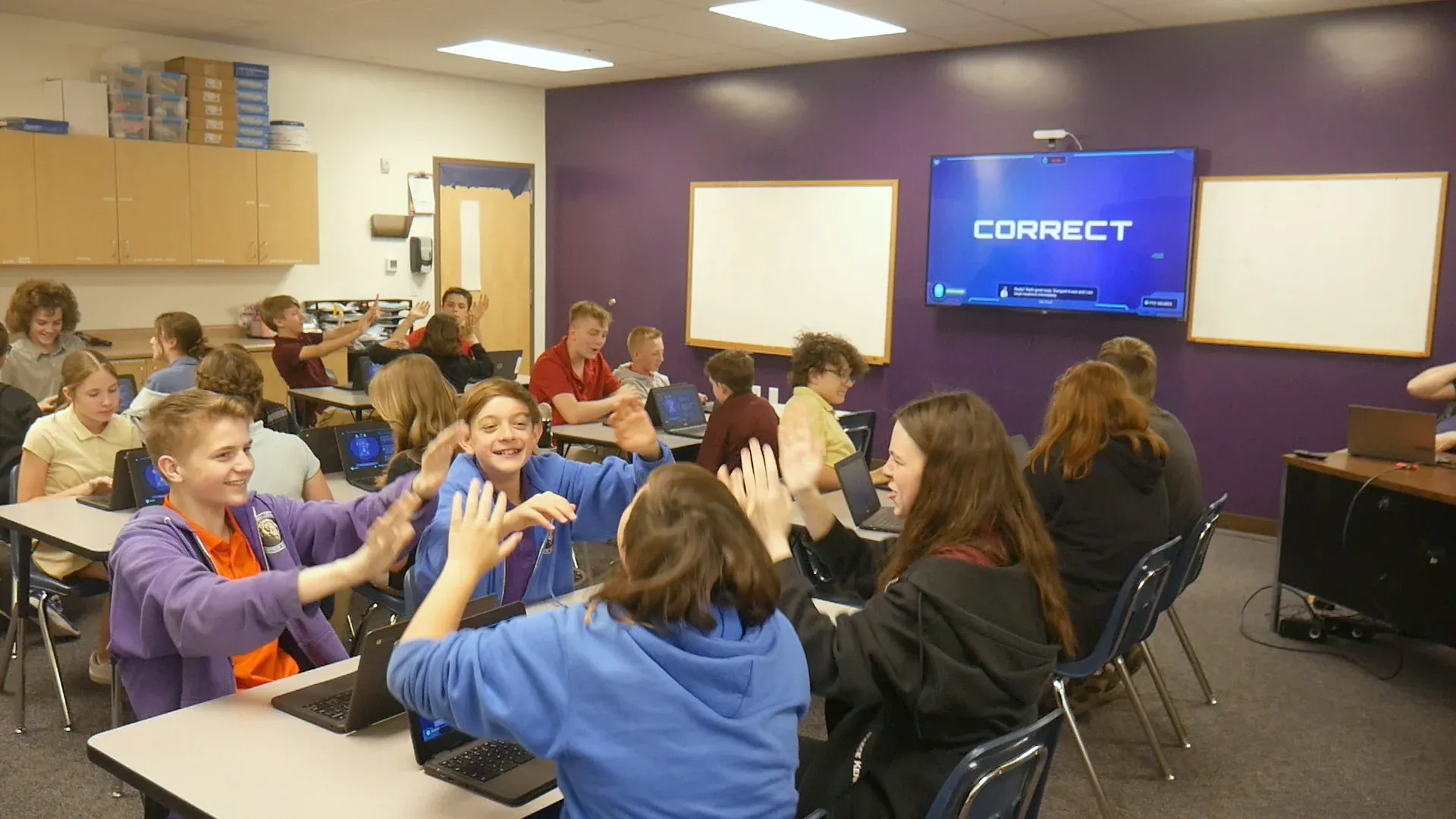
    Students high-five across a table of Chromebooks while the screen at the front of the room reads CORRECT.
    High-fives across one table, Chromebooks open, while the screen at the front of the room reads CORRECT.

    The Crooked Snakes have been spotted near the planet Terranova, and the crew is on its way to catch them when the ship’s navigation system is hacked. To keep going, the crew has to use planetary data to re-create a map of Terranova’s solar system. The story plays on the projector. The work happens at seven stations (Command, Engineering, Medical, Security, Science, I.T., Operations).

    Every student is assigned to a team, and each team’s work is themed to it, from its own information and challenge to the same problem the rest of the crew is solving. The team gives a student a role in the story and people to lean on while you move between teams. You’re at the helm, asking what keeps this planet in orbit and where the data puts it.

    It’s built to MS-ESS1-2, gravity’s role in the solar system, so it belongs at the end of the space unit. Show of Force is built for 6th grade alone, and its word list (orbital period, orbital velocity, inertia, density) is worth a pass before the class starts.

    “At the end of the year last year, every group in my classroom listed Mission IO in the ‘Top 10 Things about Sixth Grade.’”

    Sharla York, 6th grade teacher, Heritage Elementary School

    Will it work in my room?

    Students join with a class code: no student accounts, no student email, no passwords. Chromebooks, laptops, or tablets, plus your projector. Free for teachers, no credit card. Student data is covered by COPPA and FERPA, and we signed the Student Privacy Pledge. On a shared cart it’s the day you have the cart, and that’s fine, as long as the class knows all unit long that the cart day is where the unit is headed. At about 40 minutes, Show of Force fits inside a 45-minute period with about five minutes to spare.

    START FREE →

    Communication first, then space, then water and weather

    What the report shows

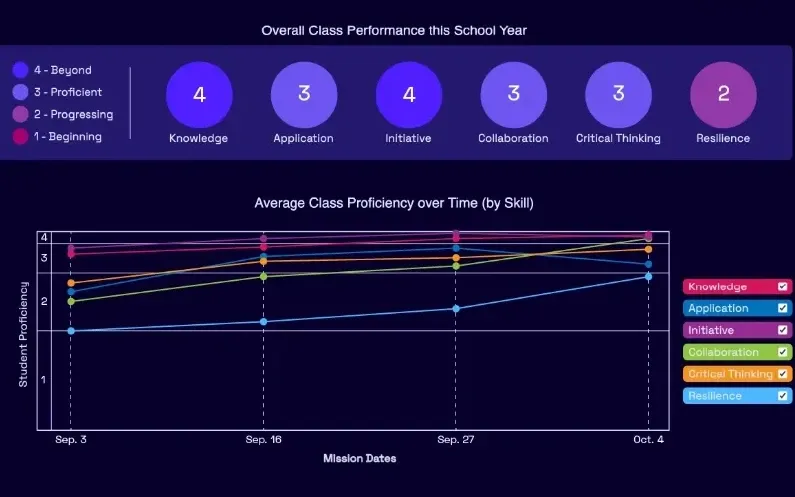
    A Mission.io class report: the class score in each of six skills, from knowledge and application to collaboration, critical thinking, and resilience, with the class chart across the year below.
    A class report from a real Mission: the class score in each of six skills, then each skill across the year.

    Every Mission produces a report for every student, built from what that student did across the whole Mission, on the skills the Mission captured. The six it can capture are Knowledge, Application, Initiative, Collaboration, Critical Thinking, and Resilience. The first two are what a test already sees. The other four are the human skills every school promises. The test shows what they know. The report shows the rest. SEE THE EVIDENCE →

    You taught it. Now find out who can use it.

    Who's behind it

    Mission.io is a research and design organization with one job: make collaborative, active learning something a teacher can run every unit instead of once a semester, and put a report in your hands when it’s over. Over a million students have run a Mission. The research behind them is funded by the National Science Foundation and the U.S. Department of Education’s Institute of Education Sciences, and Mission.io meets ESSA Level II standards, as validated by Instructure.

    6th grade science Missions by NGSS standard

    Show of Force is one. There are 15 science and engineering Missions at 6th grade, numbered 7 to 21 below, and each one is where a unit can end: atoms end at Escape Route, plate tectonics end at Mount Katastrofi, weather ends at Storm Front. NGSS sets 6 to 8 as one band that each state orders its own way, so the tables group the Missions that run at 6th grade by their middle school code. Each code links to its standard on nextgenscience.org.

    Matter and its interactions (MS-PS1)

    Two Missions, one on what matter is made of and one on how it changes state.

    Matter Missions at 6th grade, by NGSS code.
    NumberThe standardMissionMinutes
    7MS-PS1-1 Models of atoms, simple molecules, and extended structures (grades 6 to 8)Escape Route34
    8MS-PS1-4 Adding or removing thermal energy changes particle motion, temperature, and state (grades 6 to 8)The State of Things40

    Motion and stability (MS-PS2)

    One Mission, and it runs from 5th grade up.

    The forces Mission at 6th grade, by NGSS code.
    NumberThe standardMissionMinutes
    9MS-PS2-2 How an object’s motion changes depends on the forces on it and its mass (grades 5 to 8)Laser Labyrinth32

    Organisms and ecosystems (MS-LS1, MS-LS2)

    Body systems and ecosystems, one Mission each.

    Life science Missions at 6th grade, by NGSS code.
    NumberThe standardMissionMinutes
    10MS-LS1-3 Body systems: cells, tissues, and organs working together (grades 5 to 8)System Shutdown34
    11MS-LS2-2 Patterns in how organisms interact across ecosystems (grades 3 and 6 to 8)Ecosystem Patterns39

    Earth and space (MS-ESS1, MS-ESS2, MS-ESS3)

    The deepest shelf, and the one 6th grade usually teaches. Storm Front at 16 minutes is the shortest Mission on the page. Five standards here have no Mission, and an investigation on this page teaches each one.

    Earth and space Missions at 6th grade, by NGSS code, with the five standards that have no Mission.
    NumberThe standardMissionMinutes
    12MS-ESS1-2 Gravity’s role in the motions of the solar system and galaxies (6th grade)Show of Force40
    13MS-ESS1-3 Scale properties of objects in the solar system (grades 6 to 8)Encrypted Escape30
    14MS-ESS2-2 How geological processes have changed Earth’s surface over time (grades 5 to 8). On this page: 4. Graham cracker tectonics.Mount Katastrofi24
    15MS-ESS2-5 Air masses and fronts change the weather (grades 6 to 8)Storm Front16
    MS-ESS1-1 The Earth, sun, and moon as a system that explains the moon’s phases, eclipses, and seasons. On this page: 2. Moon phases.No Mission
    MS-ESS2-1 The cycling of Earth’s materials, and the energy that drives it. On this page: 3. Crystal growing.No Mission
    MS-ESS2-4 Water cycling through Earth’s systems, driven by the sun’s energy and gravity. On this page: 1. Water cycle in a bag.No Mission
    MS-ESS2-6 How uneven heating and Earth’s rotation drive the circulation of the atmosphere and oceans. On this page: 5. Convection currents.No Mission
    MS-ESS3-2 Using data on natural hazards to forecast future events and design ways to lessen their effects. On this page: 6. Shake-table structures.No Mission

    Engineering design (MS-ETS1)

    Three Missions on the design standards; none carries MS-ETS1-4, the model-and-test one. The 6th grade engineering activities page maps these standards with the design challenges that teach them.

    Engineering Missions at 6th grade, by NGSS code.
    NumberThe standardMissionMinutes
    16MS-ETS1-2 Use area to map infected tissue and plan how to remove it without harming healthy cells (grades 6 to 9)Infection34
    17MS-ETS1-3, MS-ETS1-2, 3-5-ETS1-1, 3-5-ETS1-2 Design solutions that protect populated islands from a tsunami (the grades 5 to 8 build)Tsunami33
    18MS-ETS1-1, MS-ETS1-2, MS-ETS1-3, MS-LS2-4, MS-LS2-5 Control an invasive species to restore biodiversity in a marine ecosystem (grades 6 to 12)Spine-Backed Globster36

    Also at 6th grade, on elementary standards

    Three more that run at 6th grade on elementary codes. Cliffhanger runs 19 minutes.

    Science Missions that run at 6th grade on elementary standards.
    NumberThe standardMissionMinutes
    195-ESS2-1 Earth’s spheres (geosphere, biosphere, hydrosphere, atmosphere) interact (grades 5 and 6)Cliffhanger19
    203-LS4-1, 4-ESS1-1 Fossils and rock layers (grades 3 to 6)Era of the Unknown44
    213-5-ETS1-3 Test and improve a prototype (grades 3 to 6)Reactor Revamp45
    START FREEMISSION BRIEF →

    Free teacher account, no card. Start with the Communication Mission, marked Start here in your library, then the Mission for your unit, each after its 5-minute Teacher Preview.

    Also at this grade

    The 6th grade STEM activities page lists the math, technology, and career Missions; the 6th grade engineering activities page rebuilds the shake table; and the Collaboration and Critical Thinking Missions live on the 6th grade collaboration activities and 6th grade critical thinking activities pages.

Questions 6th grade science teachers ask

I only have 20 minutes this week. What still fits?

The bags, once they’re up: 5 minutes a day after the 45-minute setup. Most Missions here run 30 to 45 minutes, and two fit inside 20: Storm Front at 16 minutes and Cliffhanger at 19. Mount Katastrofi runs 24.

Which middle school NGSS standards does this page map?

Every code with a Mission that runs at 6th grade, plus the codes the investigations here teach: matter (MS-PS1), forces (MS-PS2), body systems and ecosystems (MS-LS1, MS-LS2), space, Earth’s systems, and hazards (MS-ESS1, MS-ESS2, MS-ESS3), and engineering design (MS-ETS1), plus three Missions on elementary codes. The tables map each code to its Mission. Five of the standards the investigations teach have no Mission: MS-ESS1-1, MS-ESS2-1, MS-ESS2-4, MS-ESS2-6, and MS-ESS3-2.

My state teaches Earth science in 7th grade. Is this page still for me?

Yes. NGSS sets 6 to 8 as one band and each state orders it, so the investigations work in whichever year your state puts them. Eleven of the 15 Missions here also run in 7th and 8th grade. Show of Force is the exception: it’s built for 6th grade only.

How do I grade an investigation that runs all week?

Grade the recommendation and the behaviors. The sentence to the engineer (which variable, what the data showed, what you’d still test) is one grade; the four-behavior tally across the week is the other, and over six days it catches most of the room. A recommendation the other team on that variable can’t back up shows up as a weak claim, and now you can say why.

Is Show of Force on the water cycle's standard?

No. The bags are MS-ESS2-4, and no Mission carries it. Show of Force is MS-ESS1-2, gravity in the solar system, which makes it the space unit’s Mission. The nearest Mission to the bags is Storm Front, on air masses and fronts.