5th grade science activities

Mystery powders rebuilt so 5th graders identify matter by its properties, five more investigations by NGSS standard, a free printable, and every 5th grade science Mission by standard.

Who we are. Mission.io makes Missions: teacher-led, whole-class simulations where students use what they’re learning to work through a real scenario together.

Everything on this page works without us. Every 5th grade science Mission is at the end, by standard, free. (The one after the powders has four unknown substances on an asteroid. Nobody has to taste those either.)

On this page

What 5th grade science looks like

Fifth grade science activities are investigations in which the class gathers evidence about something the standards name, has to argue from that evidence, and leaves each student answerable for a piece. This page covers the 5th grade performance expectations, 5-PS1-1 to 5-ESS3-1, with an investigation and a Mission for each where one exists. The 5th grade STEM activities page carries the build challenges.

The year is the one where matter stops being a word and starts being a thing you can test: particles too small to see (5-PS1-1), mass that doesn’t vanish when sugar does (5-PS1-2), materials you can identify by their properties (5-PS1-3), and mixtures that sometimes make something new (5-PS1-4). Then gravity (5-PS2-1), where plants get their stuff (5-LS1-1), food webs (5-LS2-1), the sun and the stars (5-ESS1-1, 5-ESS1-2), Earth’s spheres and water (5-ESS2-1, 5-ESS2-2), and protecting what’s left (5-ESS3-1).

You know the activity that usually stands in for all of that. Baking soda, vinegar, a cheer, and twenty-eight kids who watched one kid pour. That’s a demo, and a demo is a fine thirty seconds. Science is what happens after, when the class has to decide what the fizz means and prove it.

Six things that turn a demo into an investigation

Inquiry-based science teaching outperformed traditional instruction across 37 studies, and the surprise inside the finding is who leads it: teacher-led inquiry beat student-led by a clear margin (Furtak, Seidel, Iverson, and Briggs, 2012). Hands-on helped most when students also had to think and talk about what they saw (Minner, Levy, and Century, 2010). The uncomfortable part is the clock: grades 3 to 5 average about 23 minutes a day on science, against 85 on reading (2018 NSSME+). That’s a master schedule, not a choice, and it means the 23 minutes have to be an investigation.

  1. 1. A real problem with stakes the class can feel.

    “Identify the unknown” is a puzzle. “Name the powder before it goes in the muffins” is a problem.

  2. 2. Apply, don't recall.

    A second round that only works with the data from the first. If the activity can be finished without the science, it isn’t a science activity.

  3. 3. Group goals with individual accountability.

    The one most science classics miss: one kid with the dropper, three kids with their chins on the table. When the group shared a goal and each student answered for a part, 84% of studies found a positive effect; without both, 17% (Slavin, 1991).

  4. 4. The teacher leads the thinking.

    The inquiry finding above settles it. Three questions at the tray beat a worksheet of twenty at the desk.

  5. 5. A debrief where the class argues it out.

    The investigation is the setup. The argument afterward is the practice the standards name: engaging in argument from evidence.

  6. 6. A way to see who did what.

    If you can’t tell which student described a property and which one copied the name, you can’t teach the practice. You can only hope for it.

A demo is a show. An investigation is a claim with evidence.

The sheet at the end of the next section has the powders ready to run on the tray: the role cards, the safety strip, the team’s fingerprint grid and claim box, and the tally. Get the sheet →

Mystery powders, rebuilt for 5th grade (5-PS1-3)

You know this one, or you know its cousin. Five white powders (salt, sugar, baking soda, cornstarch, flour), three tests (water, vinegar, iodine), then an unknown to identify from its properties. It’s the investigation 5-PS1-3 names in its own clarification, and the way it usually runs is one kid with the dropper, a grid nobody argues about, and an unknown that gets named by the first kid to say “baking soda.” Here’s the version that hits all six.

Time
55 minutes with cleanup. The 45-minute cut: pre-portion the powders the night before and test four knowns (drop flour, keep cornstarch). The two-day version for a 23-minute block: the idea and the five knowns on day one, with the grid signed before the bell; the unknown, the claim, and the debrief on day two.
Groups
Fours. With 28 students, seven groups of four; with 27, one group of three where the Observer also records.
Supplies for seven teams
Salt, sugar, baking soda, cornstarch, flour, white vinegar, tincture of iodine (about $5), droppers, an egg carton per team as the test tray, goggles for the Dropper, paper towels. About $12 all in. The no-iodine version works too: water and vinegar alone pick out baking soda (the only fizz) and split the powders that dissolve from the ones that don’t.
Standards
5-PS1-3 (identify materials by their properties); the vinegar round also serves 5-PS1-4 (does mixing make something new). Writing the claim serves W.5.1.
  1. Teach first, 10 minutesApply

    Show two white powders and ask how you could tell them apart without tasting. Someone will ask why the cook can’t just taste it; the health department says no tasting from open bins, and neither do we. Chart the tests the class invents and keep three: water (dissolves or not), vinegar (fizzes or not), iodine (turns blue-black or not). Name the idea once: a material’s properties are its fingerprint.

  2. The problemStakes

    The cafeteria’s labels came off five identical bins, and the cook needs them back by lunch. One of the bins is baking soda, and the muffins are ruined if it goes in as flour. Each team builds a fingerprint chart from labeled samples, then gets one unlabeled sample from the bin marked “?” and has to name it with evidence. Say the stakes out loud: a wrong name is a tray of muffins in the trash.

  3. Four roles, one job eachAccountability

    On the sheet, and everyone signs their role’s box. Dropper and Observer swap between rounds.

    • Dropper

      The only hands on the water, vinegar, and iodine.

    • Observer

      Describes what happened, and never says the powder's name.

    • Recorder

      Fills the five-by-three grid, then the unknown row.

    • Safety Lead

      Goggles on the Dropper, no tasting, calls the cleanup.

  4. You lead the thinkingTeacher leads

    Three questions, asked at the tray: Which test separates these two powders that look the same? What did the vinegar do, and is that a new substance or the same stuff? What’s your unknown, and which two tests prove it? The hardest part is not saying “baking soda.” Let them.

  5. Two rounds, so the chart has to be usedApply

    The five knowns, then the unknown. The unknown round only works with the chart from the known round; a team that skipped a test in round one finds out in round two. Tell the class up front that two of the five are built to look alike, so eyes don’t count as a test. If a team names it fast, hand them a second unknown.

  6. The debrief, 10 minutesDebrief

    The class chart on the board. Which single test told you the most, and which was useless for some pairs? Did any team name the unknown wrong, and which test would have caught it? Who in your group insisted on checking a second test before naming it? The second question is the lesson: one property is a guess, two are evidence.

  7. See who did whatSee who did what

    The observation sheet, four behaviors per student: described a property without naming the powder, used two pieces of evidence for a claim, disagreed with a reason, changed their mind with a reason. Tally while you walk the seven trays; you’ll catch about half the room in one period. The roles keep the other six trays busy, and the Recorder’s grid is what you check when you get there.

(Iodine on cornstarch goes blue-black and looks alarming on a paper towel. Say before the first drop that it’s the test working.)

Never taste anything. That rule is on the sheet’s safety strip, and it’s also the first thing the class will ask about.

The mystery powders, free

Emailed now, ready to copy: the teacher page, four role cards (Dropper, Observer, Recorder, Safety Lead), the safety strip, the team’s fingerprint grid with the unknown row, the claim box “It is ___ because test ___ and test ___,” an answer key, and the four-behavior tally.

It’s on its way.

Check your inbox for the mystery powders.

Email me the sheet. It comes as a PDF, ready to print. Unsubscribe anytime.

Five more 5th grade investigations, by standard

Five more on every 5th grade list: what each one is, how it usually runs, and the fix, in the order the standards run.

Matter, life, Earth and space

2. Dissolving and the missing mass (5-PS1-2)

Needs salt, water, a scale, cups. Groups of four. 30 minutes. Mess: low.

Students weigh salt and a cup of water separately, stir the salt in until it disappears, and weigh the mix again. It’s a good puzzle for fifth graders, since the salt looks gone and the standard says its mass isn’t. As usually run, though, it happens on the one scale at the front, and the class takes the teacher’s word for the number.

The fix

  1. Set out one scale for every two teams, so every team weighs its own.
  2. A Weigher reads each number aloud: the water, then the salt.
  3. Before the mix, a Predictor writes down the number the scale will show, and the Weigher reads the real one after.

No page for this one; the Predictor’s number is the fix.
3. The plant in a sealed bag (5-LS1-1)

Needs a plant, a bag, a windowsill. Pairs. Five minutes a day for a week. Mess: none.

A potted plant goes in a clear bag on the windowsill, the inside of the bag fogs up, and the question is where the water came from. It puts a real puzzle about plants and water on the sill. As usually run, though, it’s a demo with no control, so the fog proves nothing, and nobody is responsible for watching it.

The fix

  1. Next to it, seal a second bag over a pot of the same soil, watered the same, with no plant in it.
  2. Rotate a daily Observer in each pair, who writes one sentence about both bags.
  3. At the end of the week, each pair writes a claim about where the water came from that names the evidence.

No Mission on this standard; this one is the answer this year.

4. Shadow tracking across the day (5-ESS1-2)

Needs a stick, chalk, a sunny patch. Teams of four. Three 5-minute checks in one day. Mess: none.

A stick stands in a sunny patch, and the class traces its shadow in chalk at three times in one day to compare length and direction. It puts the standard right on the blacktop, and the teacher leads the talk. As usually run, though, it’s a sidewalk activity where everyone watches one stick, and nobody has to commit to what the next shadow will do.

The fix

  1. Give each team its own stick, standing in the same spot all day.
  2. Rotate the Tracer at each check: morning, right after lunch, and the last ten minutes of the day, which is the schedule most rooms can keep.
  3. Before each check, every team writes down where it predicts the shadow will fall, so the pattern has to be argued from the predictions.

No page for this one; the predictions are the fix.

5. The moon phase journal

Needs a notebook. Individual, then teams. A month of nightly sketches. Mess: none.

Each student sketches the moon every night for a month in a notebook. It asks fifth graders to find a pattern in real observations, which is the right job. As usually run, though, it’s homework that gets collected at the end, so nobody finds the pattern until it’s graded, and nobody argues about it along the way.

The fix

  1. Once a week, pool everyone’s sketches on one class chart, night by night.
  2. Argue the pattern as it shows up on the chart, before the month is over.
  3. Let students who can’t see the sky at night use the class chart as their data, and say why it’s trustworthy.

No page for this one; the pooled chart is the fix. Moon phases sit in middle school’s standards (MS-ESS1-1), so run it as enrichment beside the shadow work.

6. The water filter (5-ESS3-1, 3-5-ETS1-2)

Needs gravel, sand, cloth, a bottle, dirty water. Groups of four. 45 minutes. Mess: high.

Groups layer gravel, sand, and cloth in a cut bottle and pour muddy water through to see whose comes out cleanest. The problem is real, and the dirty water makes it easy to care about. As usually run, though, it’s a build with a winner: a team can finish without using any science, and you can’t see who did what.

The fix

  1. Before anyone builds, write the criteria and constraints: how much clearer the water has to come out, how fast, and with which materials.
  2. Test every filter the same way, with the same pour checked against the same clarity card.
  3. Run two rounds, so each team rebuilds from what its first test showed.

See the water filter rebuilt for 5th grade →

  • Our part · We make Missions

    Then the unit has somewhere to go

    Plenty of teachers rebuild these by hand every unit, and it works. A Mission is a teacher-led, whole-class simulation on the same standard: your class becomes the crew, the scenario is built from the unit you just taught, and the only way through is using it together. Run the powders first, then the Mission, and the unit has a day two.

    You're at the helm, not on the hook.

    Into the Asteroid: the matter unit, as a Mission

    Into the Asteroid · 5th grade · About 41 minutes · One device per student, plus your projector · Free with a teacher account

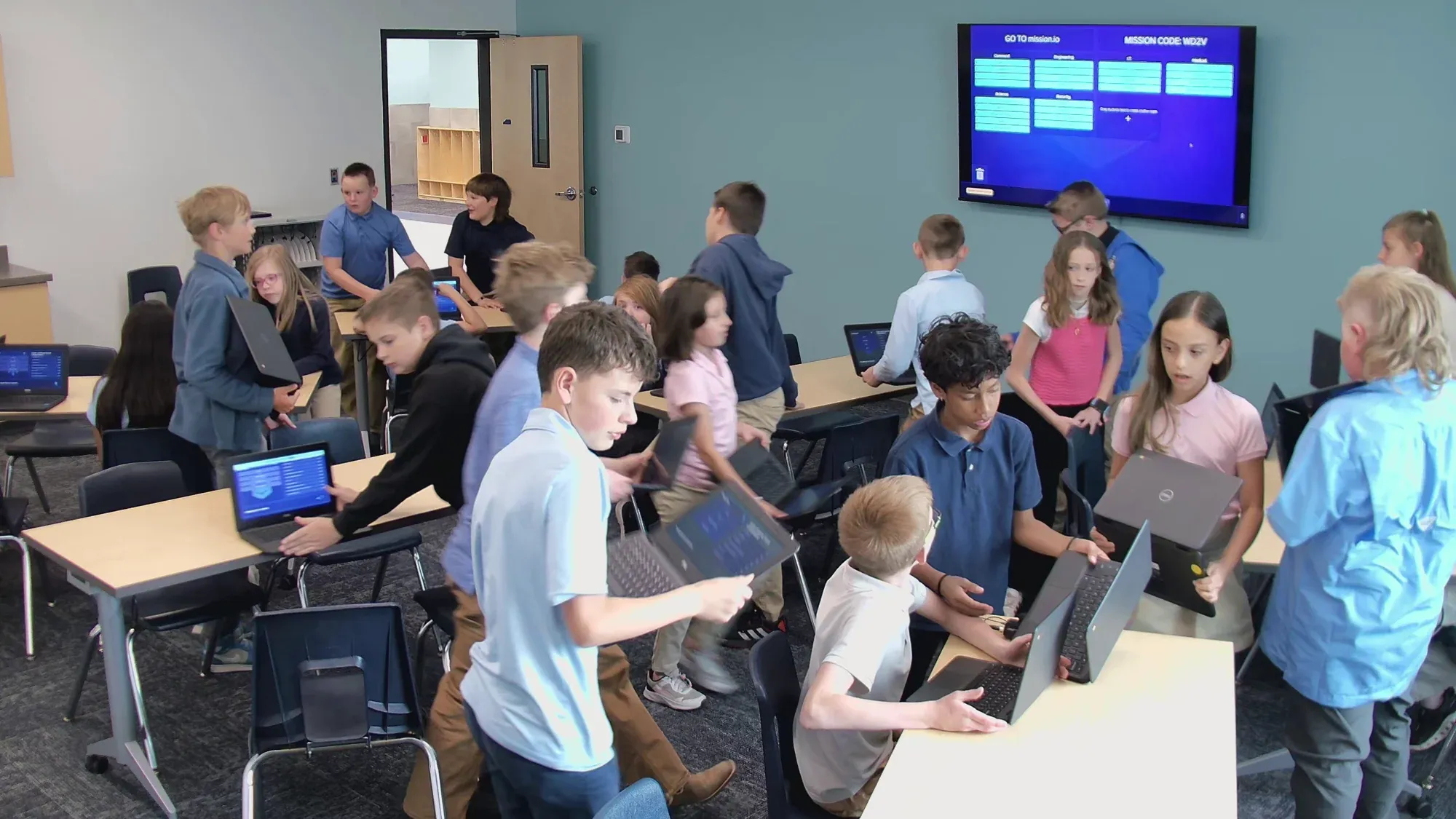
    An upper-elementary class moves into crews with their Chromebooks while the screen at the front lists the stations.
    What you'll see: the class moving into crews, then the Science station telling Engineering what the fizz means before Engineering commits to a plan.

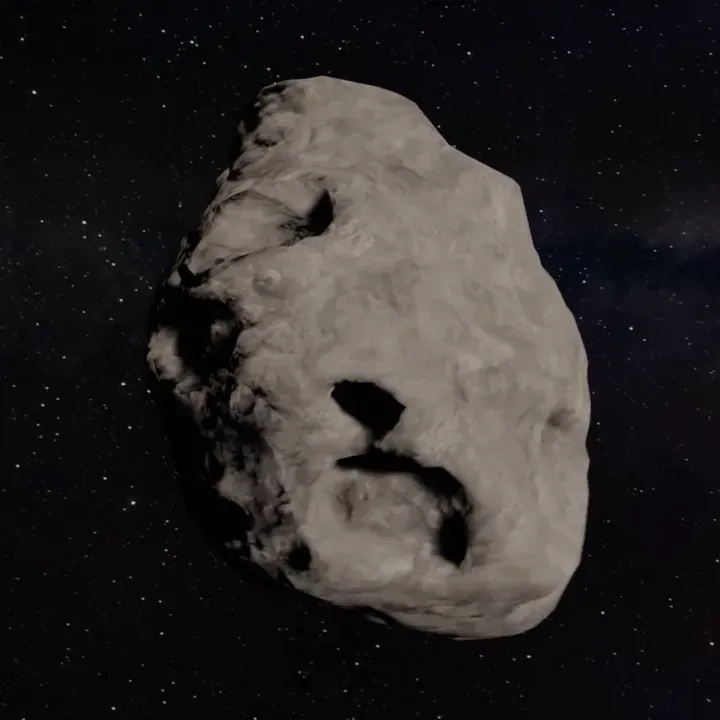
    An asteroid is on course to collide with a planet in the Industrial Sector, and lives are at stake. When the crew lands on it, they have to identify four mysterious substances by their properties, then work together to analyze how they interact and find the best way to move the asteroid out of harm’s way. The story plays on the projector. The work happens at seven stations (Command, Engineering, Medical, Security, Science, I.T., Operations) and in the arguments between them.

    Every student is assigned to a team, and each team’s work is themed to it, from its own information and challenge to the same problem the rest of the crew is solving. The team gives a student a role in the story and people to lean on while you move between teams. You’re at the helm, asking which property tells them what this is.

    It’s built to the same two standards as the powders (5-PS1-3 and 5-PS1-4), with reading and writing codes alongside (RI.5.3, RI.5.7, W.5.2, W.5.4). Run the powders first, and tell the class why: they’re going to need the fingerprint chart when the asteroid shows up. The lesson prepares them. The Mission is what they’re preparing for.

    “My students ask every time they walk in the door, ‘IS IT A MISSION DAY?’”

    Kate Fallon, Teacher, St. Amelia School, NY

    Will it work in my room?

    Students join with a class code: no student accounts, no student email, no passwords. Chromebooks, laptops, or tablets, plus your projector. Free for teachers, no credit card. Student data is covered by COPPA and FERPA, and we signed the Student Privacy Pledge. On a shared cart it’s the day you have the cart, and for a lot of rooms that’s Friday; that’s fine, as long as the class knows all week that Friday is where the unit is headed.

    START FREE →

    Communication first, then the matter unit's two

    What the report shows

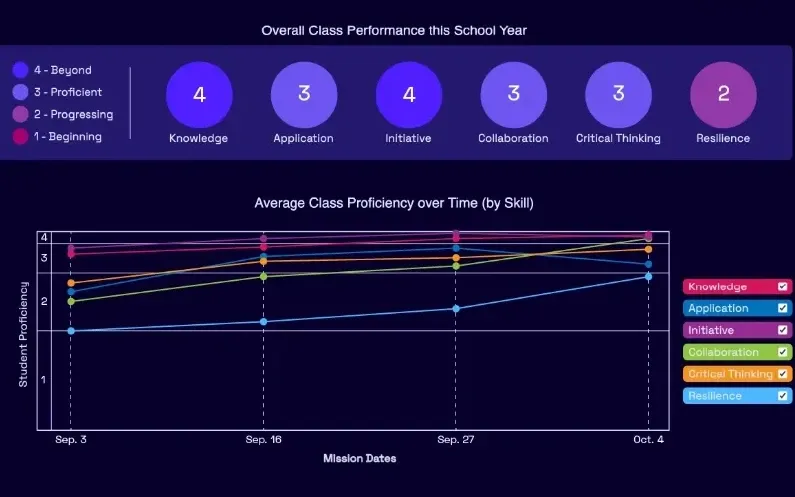
    A Mission.io class report: the class score in each of six skills, from knowledge and application to collaboration, critical thinking, and resilience, with the class chart across the year below.
    A class report from a real Mission: the class score in each of six skills, then each skill across the year.

    Every Mission produces a report for every student, built from what that student did across the whole Mission, on the skills the Mission captured. The six it can capture are Knowledge, Application, Initiative, Collaboration, Critical Thinking, and Resilience. The first two are what a test already sees. The other four are the human skills every school promises. The test shows what they know. The report shows the rest. SEE THE EVIDENCE →

    You taught it. Now find out who can use it.

    Who's behind it

    Mission.io is a research and design organization with one job: make collaborative, active learning something a teacher can run every unit instead of once a semester, and put a report in your hands when it’s over. Over a million students have run a Mission. The research behind them is funded by the National Science Foundation and the U.S. Department of Education’s Institute of Education Sciences, and Mission.io meets ESSA Level II standards, as validated by Instructure.

    5th grade science Missions by NGSS standard

    Into the Asteroid is one. There are 18 science and engineering Missions at 5th grade, numbered 7 to 24 below, and each one is where a unit can end: matter ends at the asteroid, food webs end at Finding Balance, Earth’s water ends at Hydro Heist. Every lesson finally has somewhere to go. Each code links to its standard on nextgenscience.org.

    Matter and its interactions (5-PS1)

    Three Missions, one for each place the matter unit can end.

    Matter Missions for 5th grade, by NGSS code.
    NumberThe standardMissionMinutes
    75-PS1-1 Particles too small to seeDivide and Conquer40
    85-PS1-2 Total mass is conserved when matter changes. On this page: 2. Dissolving.Matter Matters47
    95-PS1-3, 5-PS1-4 Identify materials by their properties; does mixing make a new substance. On this page: 1. Mystery powders.Into the Asteroid41

    Motion and stability (5-PS2)

    One standard, one Mission, and at 25 minutes it runs just past a 23-minute block.

    The forces Mission for 5th grade, by NGSS code.
    NumberThe standardMissionMinutes
    105-PS2-1 Why down is down: gravity pulls toward Earth’s centerDefying Gravity25

    Ecosystems, energy, and organisms (5-LS1, 5-LS2, 5-PS3)

    Food webs end at Finding Balance. Two standards have no Mission, and the bagged plant above is the answer for one of them this year.

    Life science Missions for 5th grade, by NGSS code, with the two standards that have no Mission.
    NumberThe standardMissionMinutes
    115-LS2-1 Food webs: how matter moves among plants, animals, decomposers, and the environmentFinding Balance42
    5-LS1-1 Where plants get their matter (mostly air and water). A Mission for this standard is in development. On this page: 3. The plant in a sealed bag.No Mission
    5-PS3-1 The energy in food came from the sun. A Mission for this standard is in development.No Mission

    Earth and space (5-ESS1, 5-ESS2, 5-ESS3)

    The deepest shelf. Cliffhanger at 19 minutes fits inside a 23-minute block.

    Earth and space Missions for 5th grade, by NGSS code.
    NumberThe standardMissionMinutes
    125-ESS1-1, 5-ESS1-2 The sun is a star, closer than the rest; shadows, day length, and the stars change with the seasons. On this page: 4. Shadow tracking.Operation Starfall40
    135-ESS2-1 Earth’s spheres (geosphere, biosphere, hydrosphere, atmosphere) interactCliffhanger19
    145-ESS2-2 Where the water is: how much is ocean, ice, lakes, and groundwaterHydro Heist34
    155-ESS3-1 How communities use science to protect Earth’s resources. On this page: 6. The water filter.On the Move45

    Engineering design (3-5-ETS1)

    Built to the 3-5 engineering standard: they run from 3rd to 5th grade, and Tsunami runs through 8th. Engineering Solutions at 17 minutes is the shortest Mission on the page. The 5th grade engineering activities page maps these standards with the design challenges that teach them.

    Engineering Missions for grades 3 to 5, by NGSS code.
    NumberThe standardMissionMinutes
    163-5-ETS1-3 Test and improve a prototypeReactor Revamp45
    173-5-ETS1-1, 3-5-ETS1-2, MS-ETS1-2, MS-ETS1-3 Define a problem with criteria and constraints; compare solutions (the grades 5 to 8 build)Tsunami33
    184-ESS3-2, 3-ESS3-1, 3-5-ETS1-1, 3-5-ETS1-2, MS-ETS1-2 Define and compare solutions that reduce the damage from natural hazardsEngineering Solutions17

    Also at 5th grade, on other grades' standards

    Six more that run at 5th grade on another grade’s code; the last three carry middle school codes and run through 8th grade.

    Science Missions that run at 5th grade on another grade's standards.
    NumberThe standardMissionMinutes
    194-ESS2-1 Weathering and erosion (grades 4 and 5)Landslide38
    203-LS4-1, 4-ESS1-1 Fossils and rock layers (grades 3 to 6)Era of the Unknown44
    21Forces and motion (grades 4 and 5; no NGSS code listed)Off the Rails30
    22MS-LS1-3 Body systems (grades 5 to 8)System Shutdown34
    23MS-PS2-2 Force, mass, and motion (grades 5 to 8)Laser Labyrinth32
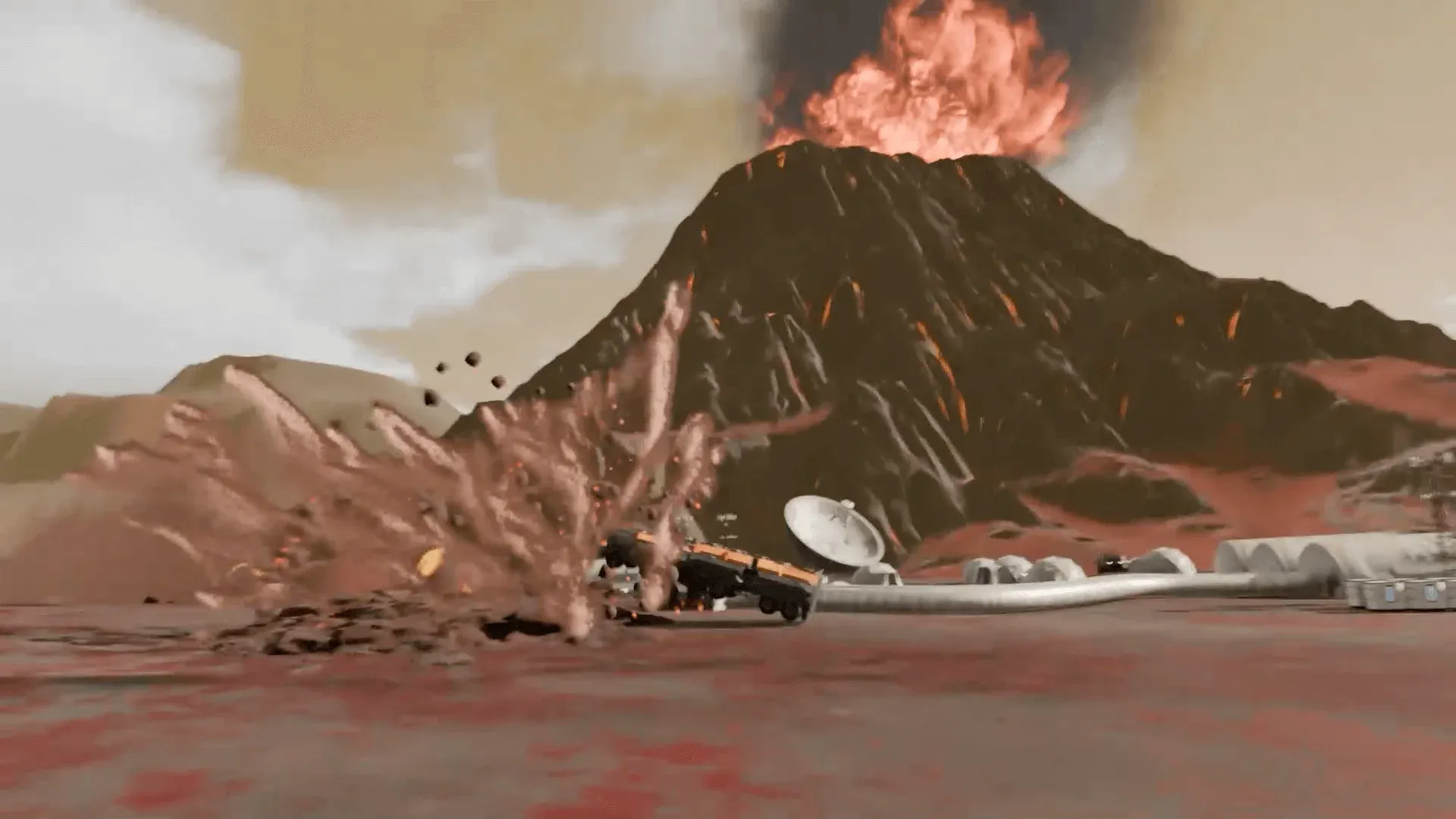
    24MS-ESS2-2 How geological events change the surface (grades 5 to 8)Mount Katastrofi24
    START FREEMISSION BRIEF →

    Free teacher account, no card. Start with the Communication Mission, marked Start here in your library, then the Mission for your unit, each after its 5-minute Teacher Preview.

    Also at this grade

    The Abyss, a deep-sea science story built for informative writing (RI.5.2, W.5.2); the 5th grade STEM activities page lists the math, technology, and career Missions; and the Collaboration and Critical Thinking Missions live on the 5th grade collaboration activities and 5th grade critical thinking activities pages.

Questions 5th grade science teachers ask

I get 23 minutes for science. Which of these fits?

The shadow checks and the bagged plant are five minutes a day. The powders need the 45-minute cut, or the two-day split: knowns on day one, the unknown and the debrief on day two. Most Missions are one 40-minute block, and two on this page fit inside yours: Engineering Solutions (17 minutes) and Cliffhanger (19). Defying Gravity, at 25, runs just past it.

Which 5th grade NGSS standards does this page map?

It maps the 5th grade performance expectations across matter (5-PS1), forces (5-PS2), life science (5-LS1, 5-LS2, 5-PS3), Earth and space (5-ESS1, 5-ESS2, 5-ESS3), and the 3-5 engineering standards. The tables map each code to its Mission and to the investigation on this page that teaches it; 5-LS1-1 and 5-PS3-1 have no Mission.

How do I grade a science investigation fairly?

Grade the claim and the behaviors; the fizz was never the point. The claim box (“It is ___ because test ___ and test ___”) is one grade; the four-behavior tally over two or three investigations is the other. A team that named the unknown right with one test shows up as a weak claim, and now you can say why.

My students aren't reading at grade level. Can they do this?

The powders are observation and talk; the reading is a three-column grid. For the Mission, the story is narrated aloud and shown as text on the main screen, and the text on each student’s own screen can be read aloud to them.

Is this aligned to my state's standards, not just NGSS?

Each Mission page lists its NGSS codes and the state sets it maps to. Into the Asteroid carries NGSS 5-PS1-3 and 5-PS1-4 and maps to 31 sets in all: 27 state science sets (Texas’s TEKS among them), Common Core, and two state ELA sets.