3rd grade problem solving activities

One classic rebuilt so 3rd graders decide what they need to know, five more fixed, a free sheet, and the whole-class Mission built for 3rd grade.

Who we are. Mission.io makes Missions: teacher-led, whole-class simulations where students use what they’re learning to work through a real scenario together.

Everything on this page works without us. The Mission built for 3rd grade waits at the end, free. (Its crystal sits behind a laser maze. The juice boxes are not involved.)

On this page

What problem solving looks like in 3rd grade

Third grade problem solving activities ask eight-year-olds to look at a situation, decide what they’d need to know to answer it, go get exactly that, and check whether the answer makes sense. Choosing which numbers matter is harder than the multiplication. This page rebuilds the task structure most elementary math teachers already reach for when they want that.

Eight-year-olds are industrious and full of ideas, they enjoy group activities, and they have a growing sense of fairness. A three-act task is built for the ideas: ask an eight-year-old what she wonders and you’ll get ten answers. The fairness shows up in Act 2, when the group argues about which piece of information is fair to ask for. Abstract thinking is still limited at eight, so the problem stays about something they can see.

The standard asks them to use multiplication and division within 100 to solve word problems about equal groups, arrays, and measurement, with drawings and equations that use a symbol for the unknown (CCSS 3.OA.A.3). The practice standard asks them to model with mathematics: pick out the quantities that matter, connect them, and check the result against the situation (CCSS Mathematical Practice 4). The activity below runs on juice boxes.

Six things that make a task more than a word problem

Open-ended isn’t enough on its own. In Hattie’s 2017 synthesis, teaching students how to solve problems lands at d = 0.68, more than double problem-based learning at d = 0.26 (Hattie, 2017). The difference is the teaching around the problem, which is good news for a 3rd grade teacher who plans to stay in the room. Here’s each of the six in 3rd grade; the K to 8 problem solving guide has the studies.

  1. 1. A real problem with stakes the class can feel.

    A clip of something interesting buys curiosity. A photo of your class’s field day cart, and the question of whether anyone goes without, gets eight-year-olds arguing.

  2. 2. Apply, don't recall.

    Third graders apply when they decide what to compute, and the three-act structure makes them decide. Multiplication within 100 is the tool; choosing when to use it is the skill.

  3. 3. Group goals with individual accountability.

    In most three-act lessons, Act 2 belongs to the four kids with their hands up. Give each group one Information Officer and three asks, and every ask has to win an argument first.

  4. 4. The teacher leads the thinking.

    The structure is teacher-led, so keep it that way at the tables. Ask what they need to know and why that, then walk away before you tell them.

  5. 5. A debrief where the class argues it out.

    Act 3 is a built-in debrief that usually shrinks to “who was closest?” Spend ten minutes on the information they didn’t need, the reason behind the best estimate, and the decision.

  6. 6. A way to see who did what.

    If you can’t tell which child chose the information and which one copied the equation, you’re grading the group. Job cards and a tally let you grade the child.

Three asks. Spend them well.

Three-act tasks already hit three or four of the six. Here’s the rebuild that adds the missing two, accountability and a record. The sheet at the end has every log the groups need →

The three-act math task, rebuilt to hit all six

You know it, from Dan Meyer’s structure and Graham Fletcher’s free K to 5 library. Act 1 is a short video or photo that raises a question with no numbers given. In Act 2, students decide what they need to know and get it. Act 3 is the reveal. It’s the rich task elementary math teachers reach for first. As usually run, a few voices carry Act 2, nobody answers for a part, and the debrief is “who was closest?”

Give Act 1 a consequence and give every group a budget of three asks, and the whole table has to think.

Time
45 minutes: 5 for Act 1 and wonders, 5 for estimates, 15 for Act 2 with three asks, 5 for Act 3, 5 for the changed quantity, 10 for the debrief. It fits a 45-minute block as written, with no slack.
Groups
Fours. With 26 students, make five fours and two threes; in a three, the Checker also models.
Supplies
A photo of the field day cart you take yourself (or any free Fletcher task with equal groups), whiteboards, and the estimate strip and three-ask log from the sheet. Printing only.
Standards
CCSS 3.OA.A.3 (multiplication and division word problems within 100), CCSS Mathematical Practice 4 (model with mathematics).
  1. The problemStakes

    Act 1 is a photo of packs of juice boxes stacked on a cart for your class’s field day. The office needs to know, before the truck comes at 10, whether the packs on the cart are enough for every student to get two boxes. If you’re wrong by a pack, somebody goes without.

  2. Estimate before you knowApply

    Before any information, the Estimator writes the group’s too-low, too-high, and best estimate, each with a reason. With packs of 6, two boxes each, and a class of 24, the real numbers stay inside 100, right where 3.OA.A.3 lives.

  3. Four jobs, three asksAccountability

    One job each, and the group gets exactly three asks for information. Only the Information Officer may ask you for a number, so every ask has to be argued for inside the group first.

    • Estimator

      Writes the too-low, too-high, and best estimate before any information arrives.

    • Information Officer

      The only one who asks you for a number, three times total.

    • Modeler

      Draws the equal groups or the array and writes the equation with a box.

    • Checker

      Checks the model against the estimate, and says whether the answer is reasonable before the group commits.

  4. You lead the thinkingTeacher leads

    Three questions at the tables: What do you need to know, and why that? What does your drawing show, and where is the unknown? Is your answer between your too-low and too-high?

  5. Change one numberApply

    After Act 3, the truck brings packs of 4 instead of 6. Groups get five minutes to re-model, with jobs rotated. That’s modeling with the situation changed under them, the part of MP4 most tasks skip.

  6. The debriefDebrief

    Ten minutes, whole class. Which piece of information did you ask for that you didn’t need? Whose estimate was closest, and what was the reason behind it? Do we have enough, and what do we tell the office?

  7. See who did whatSee who did what

    Four marks per student: made an estimate with a reason, asked for information with a reason, drew a model that matched the story, checked an answer against an estimate. The Estimator talks first and the Information Officer argues every ask out loud, so you’ll catch about half the room; rotating jobs on the changed quantity catches more.

(The Information Officer will try to spend all three asks in the first minute. Let it happen once.)

Third graders will start asking “do we even need that number?” in the next word problem, and that question is the lesson.

The field day juice box task, free

Emailed now, ready to copy: the teacher page, four job cards, the Act 1 wonder card and the estimate strip, the group sheet (the three-ask log, the model frame with the box and the Checker’s line, and the packs-of-4 round), an answer key, and the four-behavior tally.

It’s on its way.

Check your inbox for the field day juice box task.

Email me the sheet. It comes as a PDF, ready to print. Unsubscribe anytime.

Five more classics, and the fix each needs

Third grade is where rich tasks start showing up on every list, and where most of them get run with one kid doing the thinking. Here are five more, each with its fix.

Five more for 3rd grade

1. Numberless word problems (2 to 3)

Needs the board, and a word problem with its numbers hidden. Whole class.

A word problem goes up with its numbers taken out, and the numbers come back one at a time before the question. By 3rd grade it’s a familiar routine, and it still makes students understand the story before they compute, with you leading. As usually run, though, a few hands answer each reveal, and nothing records who predicted what.

The fix

  1. Make it a two-step problem with a multiplication in it, like tables of eight at the class picnic.
  2. Keep a prediction strip on every desk, and every student writes on it before each reveal.

See the 2nd grade rebuild, with a prediction on every desk →

2. The handshake problem (4 to 6)

Needs the class's own hands and the board. Whole class or groups.

Every person in the room shakes every other hand once. How many handshakes is that? Most collections put it in grades 4 to 6, and 3rd graders can take it on early, acting out small cases until a pattern shows. As usually run, though, nobody needs the number, one kid finds it, and nothing records who did.

The fix

  1. Give the number a job somebody is waiting on, like the office asking whether there’s time for it at the assembly.
  2. Give each group member a case to own: one works out three people, one four, one five, one six.

See the handshake problem at a 4th grade assembly →

3. Math scavenger hunt (1 to 5)

Needs task cards around the room, a clipboard per pair. Pairs.

Task cards go up around the room, and pairs hunt them down with a clipboard. It gets students out of their seats, and the cards can come from the unit. As usually run, though, it’s still a worksheet, with no record of which partner solved which card.

The fix

  1. Pairs share one pencil.
  2. A card only counts once both partners have initialed it.

No page for this one; with shared initials it makes a good review day.

4. "How many ways" problems

Needs a poster or a worksheet. Pairs.

“How many ways can you make 24 with equal groups?” Pairs list arrays and groupings on a worksheet or a poster. It’s all apply, right on 3rd grade multiplication. As usually run, though, the list grows with no record of whose ways they were.

The fix

  1. Give each pair one recorder, the only one holding the pencil.
  2. Every way needs a drawing and the name of the partner who found it before it goes on the list.

No page for this one; the fix is the whole lesson plan.

5. Classroom escape room (3 to 8)

Needs one locked box per group, or envelopes if you skip the locks. Groups of four. 60 minutes.

A story, a locked box, a chain of puzzles, and a clock that’s real stakes. Groups race to crack the codes, and 3rd graders love the race. As usually run, though, the puzzles are review questions with one right answer, and the fast kid opens every lock while the rest watch.

The fix

  1. Give every student a lock to own, and only its owner turns it.
  2. Make one puzzle a decision the group argues to you before it gets the number.

See the escape room fixed in the problem solving guide →

  • Our part · We make Missions

    Or let a Mission set the scene. You lead the thinking.

    Plenty of 3rd grade teachers run three-act tasks by hand all year, and they work. A Mission is a teacher-led, whole-class simulation: we connect every student, run the story on your projector, and move it forward, which leaves you the part an eight-year-old needs most, a grown-up asking why that number.

    You're at the helm, not on the hook.

    Polar Opposites (3rd): a Mission built for 3rd grade

    Polar Opposites (3rd) · Built for 3rd grade · About 21 minutes · One device per student, plus your projector · Free with a teacher account

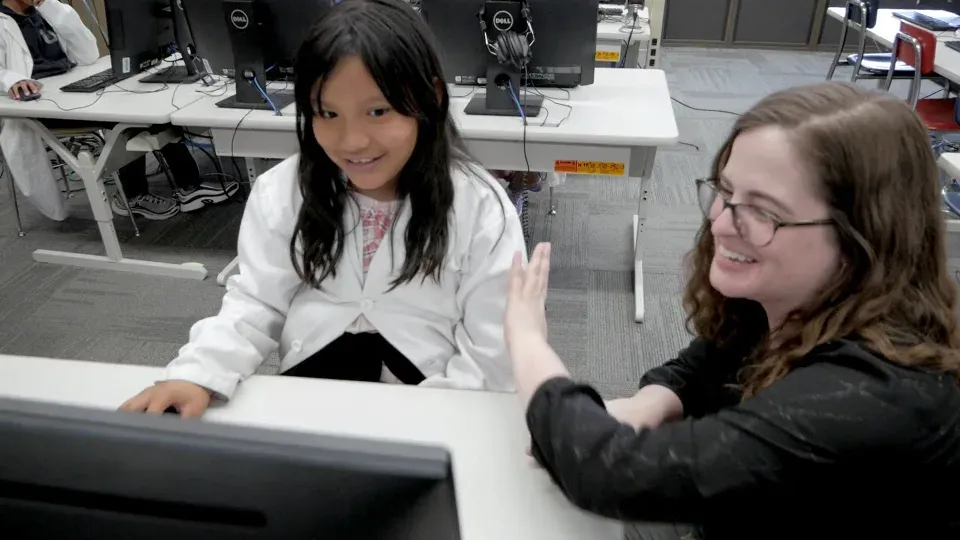
    A smiling teacher sits beside a student in a lab coat at her computer, raising a hand toward her for a high five.
    What you'll see: a teacher at one student's screen, both of them grinning, while the rest of the room works the same problem.

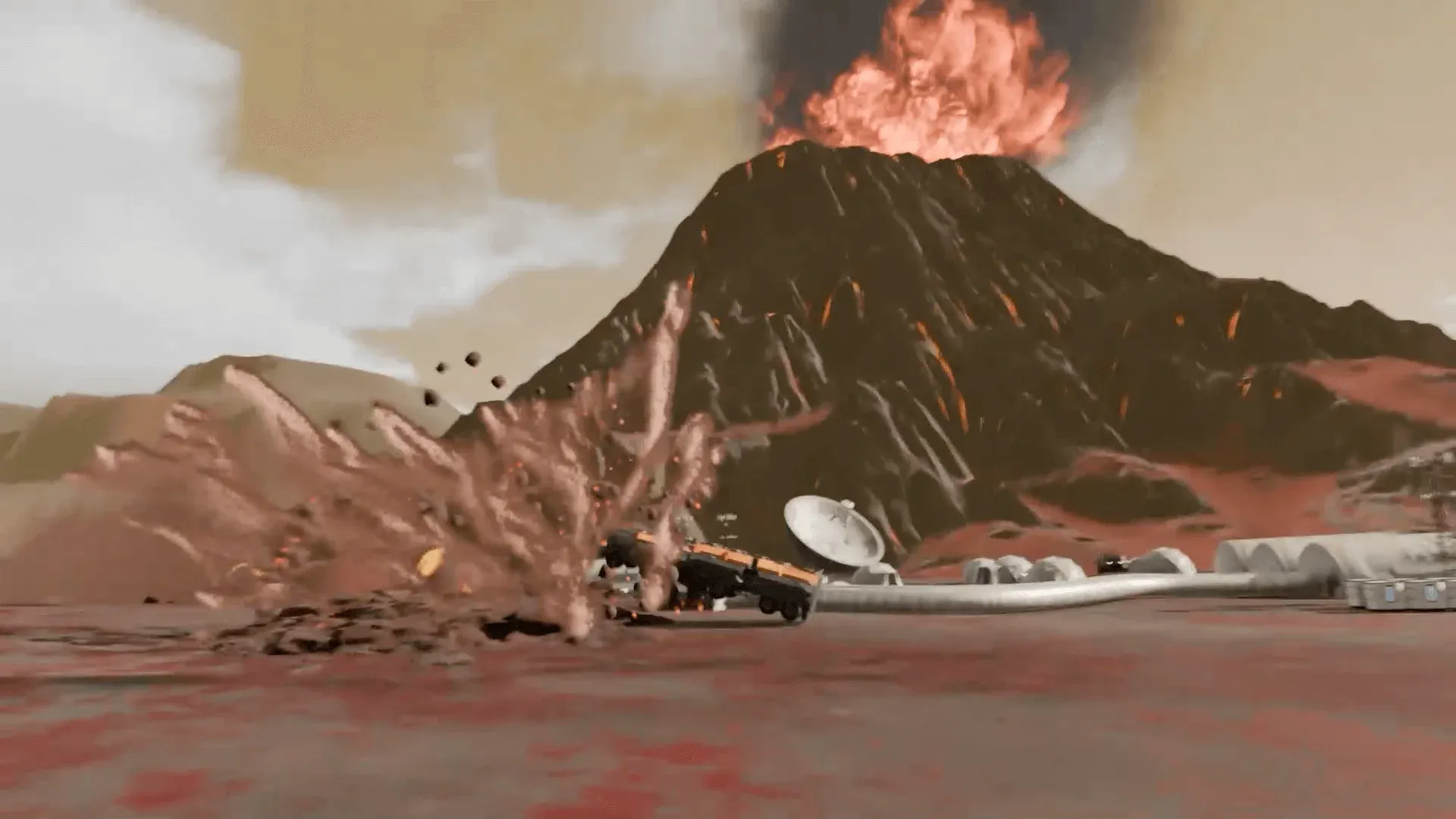
    Moodoo has stolen a rare crystal that powered the planet Tellenor and locked it in his stronghold behind a laser maze. To get it back, your class has to work out the arrangement of magnets and static electricity that shuts the lasers down. The heist plays out on your projector, and each student works the maze on their own screen.

    This is a solo Mission, one student per screen, so there are no stations or crew teams. The story goes the way most of the class chooses, and each child’s own choices and answers go into their report. You’re beside them, asking what happens if they flip one magnet.

    Against the six:

    • Stakes. A stolen crystal, a planet without its power, and a laser maze in the way.
    • Apply. Students work out the arrangement of magnets and static electricity that deactivates the lasers, a simple design problem solved with magnet science (NGSS 3-PS2-4).
    • Accountability. Each 3rd grader works the maze for themselves.
    • Teacher leads. Watch the 5-minute Teacher Preview, press Start, and work the room with three questions: Which way do these two magnets push? What arrangement gets us through? What happens if you flip one?
    • Debrief. The library’s Mission Guide lists four debrief activities, starting with writing prompts.
    • See who did what. Every child gets a report on how well they did, built from their own choices and answers across the Mission.

    “Even my quiet or reluctant students participate because the missions are structured in a way where everyone’s voice matters.”

    Adriana Lopez, Junior high teacher, Clint Jr. High School

    Will it work in my room?

    Students join with a class code: no student accounts, no student email, no passwords. Chromebooks, laptops, or tablets, plus your projector. Free for teachers, no credit card. Student data is covered by COPPA and FERPA, and we signed the Student Privacy Pledge. No projector or devices? The juice box task needs neither, and the sheet still works.

    START FREE →

    Communication first, then this one

    This is one Mission. More than 100 others are built the same way, from fossils to fractions, and every one ends with a report on each student.

    What the report shows

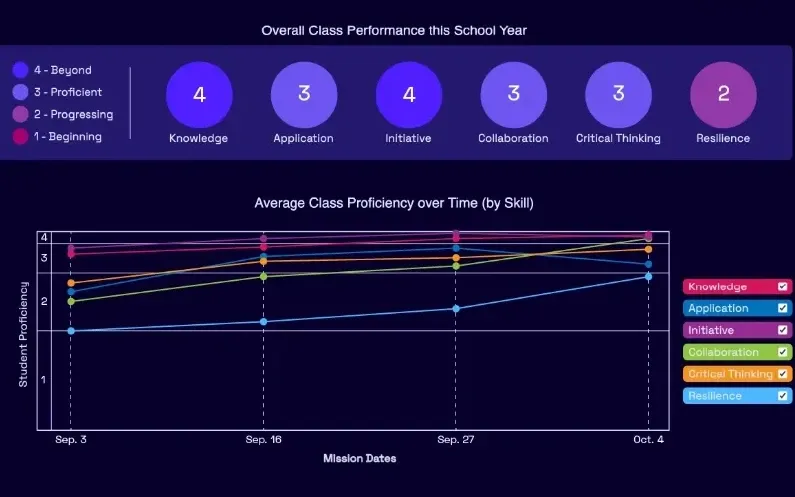
    A Mission.io class report: the class score in each of six skills, from knowledge and application to collaboration, critical thinking, and resilience, with the class chart across the year below.
    A class report from a real Mission: the class score in each of six skills, then each skill across the year.

    Every Mission produces a report for every student, built from what that student did across the whole Mission, on the skills the Mission captured. The six it can capture are Knowledge, Application, Initiative, Collaboration, Critical Thinking, and Resilience. The first two are what a test already sees. The other four are the human skills every school promises. There’s no row called problem solving, and we won’t pretend there is. It lives in the rows around it: whether a student could apply what they knew, think it through, and keep going when the first try failed. The test shows what they know. The report shows the rest. This is where problem solving gets practiced, and the only place the skills under it get measured. SEE THE EVIDENCE →

    You taught it. Now find out who can use it.

    Who's behind it

    Mission.io is a research and design organization with one job: make collaborative, active learning something a teacher can run every unit instead of once a semester, and put a report in your hands when it’s over. Over a million students have run a Mission. The research behind them is funded by the National Science Foundation and the U.S. Department of Education’s Institute of Education Sciences, and Mission.io meets ESSA Level II standards, as validated by Instructure.

    “What I love most is that it’s low-prep but high-impact.”

    Ginger Marsh, Middle school teacher, Cedar Middle School
    START FREEMISSION BRIEF →

    Free teacher account, no card. Start with the Communication Mission, marked Start here in your library, then Polar Opposites (3rd), each after its 5-minute Teacher Preview.

Questions 3rd grade teachers ask

My 3rd graders have ten wonders each. How do I pick the one we solve?

Collect them fast, then point at the one the photo was taken to raise, and say so. Eight-year-olds are full of ideas, and that’s a gift; you just don’t have to chase all ten today. Keep the list on the wall, and the best leftover wonder becomes tomorrow’s warmup.

What if a group spends an ask on information it doesn't need?

Let it happen. A wasted ask is the most useful mistake in the lesson, because the debrief opens with which information you didn’t need. A group that spent an ask on the color of the cart won’t make that trade twice.

How is a three-act task different from a word problem?

A word problem hands over the numbers and asks the question. A three-act task shows the situation and makes students decide what the question is and which numbers they need. That decision is the problem solving; the multiplication is the tool they use once they’ve made it.

My math block is 45 minutes. Will this fit?

Exactly, with no slack: 5 minutes for Act 1, 5 for estimates, 15 for Act 2, 5 for the reveal, 5 for the changed quantity, and 10 for the debrief. If Act 2 runs long, turn the changed quantity into one question during the debrief, and keep the debrief whole.