3rd grade collaboration activities

Literature circles rebuilt so the roles serve a verdict, five more 3rd grade classics fixed, the circle sheet, and the whole-class Mission we’d run with 3rd graders.

Who we are. Mission.io makes Missions: teacher-led, whole-class simulations where students use what they’re learning to work through a real scenario together.

Everything on this page works without us. The Mission we’d run with 3rd graders is at the end, free. (Its crew invents new traits for creatures struggling on Viper I. Budget a minute for the kid who wants to give everything wings.)

On this page

What collaboration looks like in 3rd grade

Third grade collaboration activities ask a circle of four or five eight-year-olds for one decision, and give each student a role the decision can’t be made without. This page rebuilds the first named-roles structure most 3rd grade teachers run with a book, so the roles feed a decision the whole circle has to reach.

Eight-year-olds enjoy group activities but may prefer certain classmates. Their sense of fairness is growing, they’re “industrious and full of ideas,” and they “may not remember instructions.” That’s why literature circles suit eight: the role sheet remembers the instructions for them, and their fairness instinct polices the rotation. It’s also why you make the circles, not them. And the payoff is real at this age: in one large review, cooperative learning paid off more in primary classrooms than in secondary ones (Kyndt et al., 2013).

The standard asks 3rd graders to arrive at discussions prepared, having read the material, and to draw on that preparation; to follow agreed-upon rules; to ask questions, stay on topic, and tie their comments to what a classmate just said; and to explain their own ideas in light of the discussion (CCSS ELA SL.3.1). A circle that has to agree on advice does all of it.

Six things that make literature circles collaborative

The case for active learning starts with a blunt number from college: in 225 studies of STEM courses, students in lecture classes failed 55% more often than those in active-learning classrooms (Freeman et al., 2014). In schools, England’s Education Endowment Foundation puts collaborative learning at about five months of extra progress for very low cost, on limited evidence (EEF Toolkit). Both depend on what the group task actually asks. Below, the six at age eight; the full research list lives in the K to 8 guide.

  1. 1. A real problem with stakes the class can feel.

    A chapter to discuss is a topic. A character who has to choose by the end of the chapter, and a class vote on whose advice she should take, is a problem eight-year-olds will fight about.

  2. 2. Apply, don't recall.

    The Summarizer recalls; an advisor has to use the text. Two lines that back the advice is reading comprehension with a job attached.

  3. 3. Group goals with individual accountability.

    Role sheets already give every member a part. What’s missing is a reason for the parts to meet, so the circle reads five sheets aloud and stops. Slavin’s synthesis is the reason to fix that: a shared goal plus individual accountability produced positive effects in 84% of studies, and 17% without the pair (Slavin, 1991).

  4. 4. The teacher leads the thinking.

    Circulating checks role sheets. Pulling a chair up to one circle for three minutes, and asking whose line supports the advice, teaches the discussion.

  5. 5. A debrief where the class argues it out.

    Most circles end when the Discussion Director runs out of questions. End yours with the whole class weighing which circle’s evidence was strongest.

  6. 6. A way to see who did what.

    A filled-in role sheet proves a student prepared. It doesn’t show who talked, who listened, or who changed their mind, and that’s the half you’re trying to teach.

A chapter is a topic. A choice is a problem.

Literature circles already give every student a role. Here’s the structure with a verdict added and all six in place. Get the circle sheet →

Literature circles, rebuilt to hit all six

You know the structure: small groups read the same book and meet with rotating roles (Discussion Director, Literary Luminary, Connector, Illustrator, Word Wizard), each role prepared on a sheet beforehand. It’s the right instinct for eight-year-olds, because every student has a job. As usually run, though, the meeting is a reading of five role sheets, nothing depends on the group agreeing, and the teacher circulates.

Give the circle a decision the book forces, sharpen the roles so they serve the decision, and end with the next page.

Time
50 minutes with the reading done beforehand: 5 to set the decision, 20 in circles, 10 to report, 5 for the reveal and revision, 10 for the whole-class talk. In a 45-minute block, give circles 15, have two circles report instead of all, and move the reveal to the next meeting; that’s 30 minutes plus the two reports. Keep the debrief whole.
Groups
Four roles per circle. With 25 students, run five circles of five; each circle’s fifth member keeps time and copies down the two lines. Or make four circles of four and three of three, where the Connector also illustrates.
Supplies
The book, four role sheets per circle, one advice card per circle. Printing only.
Standards
CCSS SL.3.1a (come prepared and draw on that preparation), SL.3.1c (link their comments to what others said), and SL.3.1d (explain their own ideas in light of the discussion).
  1. The problemStakes

    Pick a chapter that ends on a choice: stay or go, tell or hide. “Your circle is her advisors. Before she decides, you have to agree on what she should do and back it with two lines from the book. Then the class votes on whose advice she takes.”

  2. Apply, don't recallApply

    Before the meeting, every member fills in the “my advice and my line” box on their sheet: one sentence of advice, one line from the text that supports it. That box is SL.3.1a on paper, and it means nobody arrives empty-handed.

  3. Roles that serve a verdictAccountability

    Four roles, each sharpened so the circle can’t reach its advice without it. The Literary Luminary becomes the Evidence Finder, with a harder job. Rotate the roles every week, and expect the fairness police to check.

    • Director

      Runs the order and holds the circle to two lines of evidence.

    • Evidence Finder

      Brings three marked passages and gets the circle to pick two.

    • Connector

      Argues what a real person would do, tied to a passage.

    • Illustrator

      Draws the moment of decision and labels what each character wants.

  4. You lead the thinkingTeacher leads

    Pull a chair up to each circle for three minutes and ask: What’s the advice so far, and whose line supports it? Who disagrees, and with what line? What question would change your advice? Then move on, even mid-argument. Especially mid-argument.

  5. The revealStakes

    After each circle reports, read the next page aloud: what the character actually did. Give circles four minutes to revise their advice for her next decision. Now the advice had consequences, and the second round is better for it.

  6. The debriefDebrief

    Ten minutes with everyone together. Three questions: Which circle’s evidence was strongest, and why? Who in your circle changed the advice, and with what line? Which role was hardest this week? Spend the most time on the middle one.

  7. See who did whatSee who did what

    While you sit in, mark each student on the tally for four things: proposed an idea, built on a classmate’s idea, disagreed using a line from the text, changed their mind for a reason. Four circles at three minutes each reaches roughly half your students. The role sheets catch preparation for everyone, which is the half the tally misses.

(Eight-year-olds keep careful track of fairness, so they’ll notice if one circle gets four minutes of you and another gets two. Bring a timer.)

Eight-year-olds will argue about whether she should have told for as long as you let them. Now the argument comes with two lines of evidence and a vote.

The literature circle verdict, free

Emailed now, ready to copy: the teacher page, four role cards rewritten for a decision, the four role sheets (each with the “my advice and my line” box), the circle’s advice card with room for two lines of evidence, and the four-behavior tally.

It’s on its way.

Check your inbox for the literature circle verdict.

Email me the sheet. It comes as a PDF, ready to print. Unsubscribe anytime.

Five more classics, and the fix each needs

Third grade is where group work starts to feel possible, and where a lot of it turns into one hardworking kid and three spectators. Each classic below gets the changes that give every student a part worth tallying.

Five more for 3rd grade

1. Jigsaw reading (3 to 8)

Needs four short readings. Groups of four. About 60 minutes.

Students split into expert groups to learn one section of a reading each, then go back to their home groups to teach it. Every student holds a piece nobody else has, which is why jigsaw works. As usually run, though, it’s a rotation with summaries, where the home group has nothing to decide and nothing shows you which expert taught well.

The fix

  1. At eight, keep each expert’s reading to a page.
  2. Give the home group one question to answer with all four sections.
  3. Have every expert bring back one line the home group must use in its answer.

See jigsaw rebuilt for 5th grade →

2. Reader's theater

Needs a short script, one copy per reader. Groups of four or five. Rehearsal time across a week.

Groups of four or five rehearse a short script across the week, then perform it for the class. It gets eight-year-olds rereading the same lines until they know them cold. As usually run, though, parts get handed out by reading level, the performance is the end of it, and the group never has to decide anything together.

The fix

  1. Give each group one staging decision to make together, like where the character stands when she lies.
  2. After each performance, ask the audience what the choice showed.

No page for this one; the staging decision is the whole fix.

3. Save Fred (1 to 3)

Needs gummy worms, gummy rings, plastic cups, paper clips. Groups of four. 20 minutes.

Fred the gummy worm sits on an upturned cup, his life preserver trapped underneath, and the team rescues him with paper clips only. Even at eight it gets the whole table leaning in. As usually run, though, it’s a laugh, and the kid with the steadiest hands does the rescue while the others watch.

The fix

  1. Set a step limit before anyone picks up a clip, and count the moves out loud.
  2. Make the Recorder predict each move before it happens, and write the prediction down.

See Save Fred rebuilt for 1st grade →

4. Group poster on a chapter (K to 8)

Needs a poster, four markers. Groups of four. A period.

A group of four gets one poster and four markers to show a chapter the class has read. It puts the book to work. As usually run, though, it gets everything else wrong, and by minute six it’s one kid’s poster.

The fix

  1. Give the poster one question to answer about the chapter, like whether the main character made the right choice.
  2. Give each student one marker color and one role, so every color on the poster belongs to a name.
  3. Debrief at a gallery of the posters, where each circle defends its answer.

No page for this one; with a question and roles it becomes a literature circle with markers.

5. Marshmallow tower (3 to 5)

Needs spaghetti, tape, string, one marshmallow. Groups of four. 18 minutes.

Teams get spaghetti, tape, string, and one marshmallow, and the tallest freestanding tower in eighteen minutes wins. The clock and the falling towers give it stakes. As usually run, though, it’s a race with nothing to apply, nobody’s part to point at, and no talk once it falls.

The fix

  1. Give each team four roles, one job each.
  2. Stop for a test between the first build and the second.
  3. Hold the debrief at the base of the towers, standing or not.

See the marshmallow tower rebuilt for 4th grade →

  • Our part · We make Missions

    Or let a Mission set the scene. The verdict stays yours

    Rebuilt literature circles work by hand, week after week, with nothing but a book and a stack of sheets. A Mission is a teacher-led, whole-class simulation, 38 minutes here, with the six designed in; it narrates, sets up each station, and records what every student did. The questions you ask at the table are still the lesson.

    You're at the helm, not on the hook.

    Animal Architects: a whole-class Mission made for 3rd grade

    Animal Architects · Grade 3 · About 38 minutes · One device per student, plus your projector · Free with a teacher account

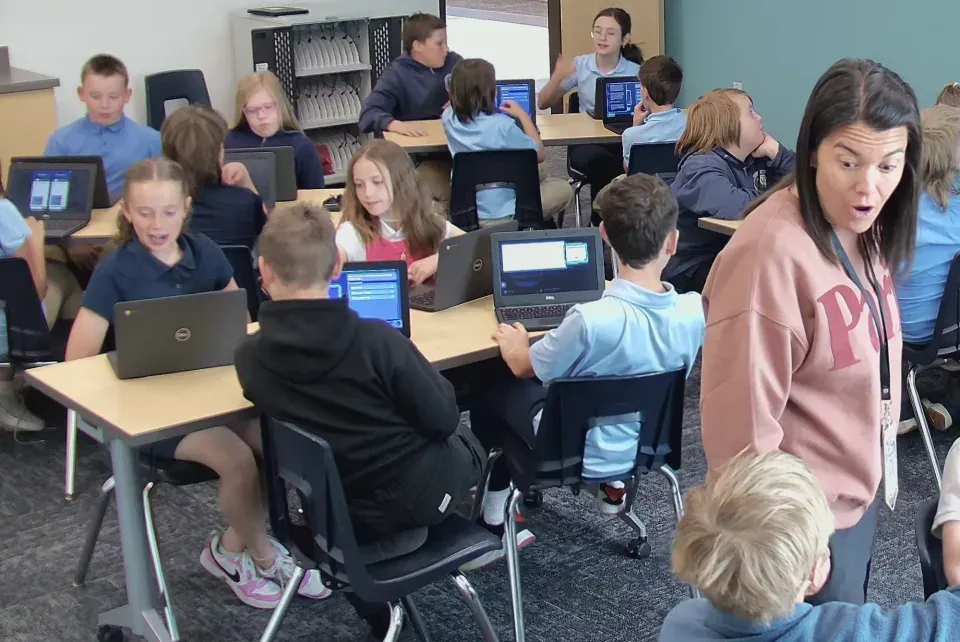
    A teacher stops mid-room with a look of surprise while the students around her work at Chromebooks and talk across their tables.
    What you'll see: tables of 3rd graders talking across their screens, one station telling another what it found, and you stopping mid-room because a team just said something worth hearing.

    Creatures on the planet Viper I are struggling to survive. The crew gets a quick review of inherited and environmental traits, then invents new traits together that could help the creatures thrive. The story plays on the projector. The work happens at seven stations (Command, Engineering, Medical, Security, IT, Operations, Science) and in the arguments between them.

    Every student is assigned to a team, and each team’s work is themed to it, from its own information and challenge to the same problem the rest of the crew is solving. The team gives a student a role in the story and people to lean on while you move between teams. You’re at the helm, asking why a new trait would actually help.

    Against the six:

    • Stakes. Viper I’s creatures are struggling, and the crew’s new traits are meant to help them thrive.
    • Apply. After the review, students use what they know about traits to invent new ones (NGSS 3-LS3-2: traits can be influenced by the environment).
    • Accountability. The crew invents the traits together.
    • Teacher leads. After the five-minute Teacher Preview, sit in with teams and ask: Which trait is inherited and which came from the environment? What trait would help here? Why?
    • Debrief. Borrow the circles’ ending: which team’s trait had the best evidence behind it?
    • See who did what. Every student gets a report on how well they did, shaped by what this Mission asked of them.

    “Even my quiet or reluctant students participate because the missions are structured in a way where everyone’s voice matters.”

    Adriana Lopez, Junior high teacher, Clint Jr. High School

    Will it work in my room?

    Students join with a class code: no student accounts, no student email, no passwords. Chromebooks, laptops, or tablets, plus your projector. Free for teachers, no credit card. Student data is covered by COPPA and FERPA, and we signed the Student Privacy Pledge. No projector or devices? Literature circles need neither, and the sheet still works.

    START FREE →

    Communication first, then this one

    This is one Mission. Traits, fossils, fractions: the library runs past 100 Missions designed like this one, so a unit always has an event to build toward, and each event closes with a report on every student. Every lesson finally has somewhere to go.

    What the report shows

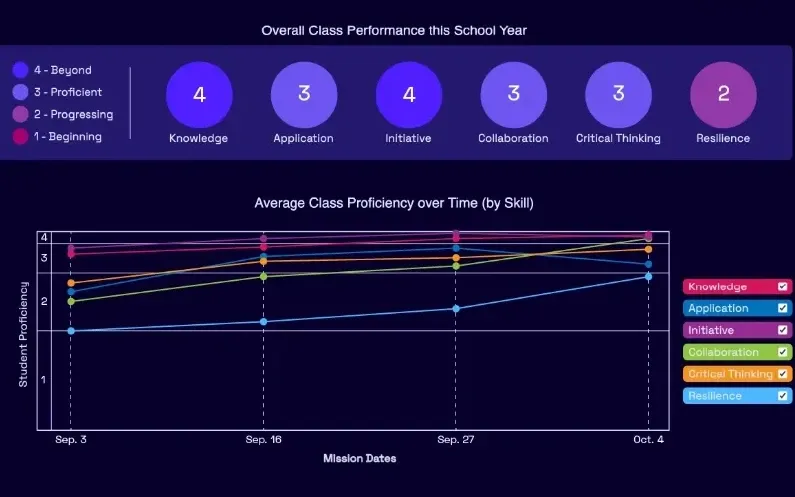
    A Mission.io class report: the class score in each of six skills, from knowledge and application to collaboration, critical thinking, and resilience, with the class chart across the year below.
    A class report from a real Mission: the class score in each of six skills, then each skill across the year.

    Every Mission produces a report for every student, built from what that student did across the whole Mission, on the skills the Mission captured. The six it can capture are Knowledge, Application, Initiative, Collaboration, Critical Thinking, and Resilience. The first two are what a test already sees. The other four are the human skills every school promises. The test shows what they know. The report shows the rest. This is where collaboration gets practiced, and the only place it gets measured. SEE THE EVIDENCE →

    You taught it. Now find out who can use it.

    Who's behind it

    Mission.io is a research and design organization with one job: make collaborative, active learning something a teacher can run every unit instead of once a semester, and put a report in your hands when it’s over. Over a million students have run a Mission. The research behind them is funded by the National Science Foundation and the U.S. Department of Education’s Institute of Education Sciences, and Mission.io meets ESSA Level II standards, as validated by Instructure.

    “Unlike other tech programs in the district that often have students working in isolation or in pairs, Mission.io emphasizes true collaboration.”

    Lorilee Johnson, District specialist, Alpine School District, UT
    START FREEMISSION BRIEF →

    Free teacher account, no card. Third graders run the Communication Mission first (marked Start here in your library; theirs is the grades 2 and 3 version) and Animal Architects next, and you watch a 5-minute Teacher Preview for each one.

Questions 3rd grade teachers ask

Are 3rd graders ready to run literature circles without me?

Mostly, with a decision to make and a sheet to hold the steps. Third grade is when students move from taking turns to real group problem-solving. What eight-year-olds can’t always do is remember the instructions, so the role sheet carries it and you sit in for three minutes.

My students read their role sheets aloud and stop. How do I get a real discussion?

Give the sheets somewhere to go. When the circle has to agree on one piece of advice and defend it with two lines in front of the class, reading your sheet aloud is only the start. The Director’s job is to hold the circle to the evidence, and your three questions do the rest.

Should I let 3rd graders pick their own circles?

Make the circles yourself. Eight-year-olds enjoy group work but may prefer certain classmates, and a circle of four best friends agrees too fast. Rotate the roles weekly and the circles every book. Their sense of fairness will make sure you do.

Which books work for this kind of literature circle?

Any book where a character has to make a real choice at the end of a chapter: stay or go, tell or hide, help or walk away. Picture books work for a first try, and chapter books work once the routine is set. The next page is the reveal, so choose a stopping point where she hasn’t decided yet.

Discussion you can finally see

Run your next literature circle as a verdict with the sheet, or try Animal Architects after you've watched its short Teacher Preview. All six, either way.