3rd grade STEM activities

The craft stick catapult rebuilt so 3rd graders run a fair test, five more build challenges fixed, a free printable, and every 3rd grade Mission by subject.

Who we are. Mission.io makes Missions: teacher-led, whole-class simulations where students use what they’re learning to work through a real scenario together. We build every one on the six things in our STEM activities for students, K-8 guide, and every student gets a report on how well they did.

You don’t need us to use this page: the catapult, the five challenges, and the sheet all work on their own. Every 3rd grade Mission is at the end, by subject, free. (The one after the catapult puts a train on a raised track and asks how far it will roll. Nobody has to fish a pom-pom out from behind the bookshelf.)

On this page

What 3rd grade STEM looks like

3rd grade STEM activities are challenges in which a team designs, builds, and tests something, changes one thing at a time, argues from what the tests showed, and leaves each student answerable for a part. This page rebuilds the craft stick catapult to the grade’s engineering standard (3-5-ETS1-3: plan and carry out fair tests in which variables are controlled and failure points are considered, to find what to improve), applying the forces the grade owns (3-PS2-1: balanced and unbalanced forces change motion). It also fixes five more build challenges and lists every 3rd grade Mission by subject. The year’s content (forces and magnets; life cycles, traits, and fossils; weather and climate; multiplication, fractions, and multi-step problems) lives on the subject pages.

Most of what gets called a STEM challenge is a contest, or a craft project with a STEM sticker on it. In 3rd grade the catapult stands in for all of it, and most years it goes the same way: a bag of craft sticks, a fistful of rubber bands, one kid building, one kid launching, and two kids chasing pom-poms across the floor.

The launch stays; third graders will cheer it either way. The question asked after it is the part to change. “Whose went farthest?” has a winner and no reason. “Which change landed it in the square three times?” has an answer the whole room can argue about, and the arguing is the lesson. The challenges on this page put that second question back, with the same sticks in the same period.

Six things that turn a build contest into engineering

We’ve run this check with STEM teams in the districts we work with, and the craft project skips the same three every time: a real problem, criteria for success, and any pressure to iterate. If the finished product is all the activity asks for, the learning is optional. The fix is a small step before the build and a small step after it, and nothing at the launch line changes. One number is worth carrying down: when a group shared a goal and each student answered for a part, 84% of studies found a positive effect; without both, 17% (Slavin, 1991).

  1. 1. A real problem with stakes the class can feel.

    “Launch it far” is a contest. “The supply crate has to land in the square, or it’s lost in the canyon” is a problem.

  2. 2. Apply, don't recall.

    A test that changes the design. If a team can build and launch all period without the idea you taught that morning (a bigger push, a bigger change in motion), the idea wasn’t needed.

  3. 3. Group goals with individual accountability.

    The one most build challenges miss: one builder, one launcher, two kids chasing pom-poms. Four roles, one job each, and a box each student signs.

  4. 4. The teacher leads the thinking.

    The questions are yours, asked at the launch line between sets. The launches aren’t: the Launcher pulls, the Measurer calls the landing, and you listen for which team can name its variable.

  5. 5. A debrief where the class argues it out.

    Catapults lined up on the floor, and the question is which variable mattered most across the room.

  6. 6. A way to see who did what.

    If you can’t tell which student held the pull steady on purpose and which one got lucky, you’re grading the catapult. The tally on the sheet grades the thinking.

Same pull, every time, or it isn’t a test.

The free printable at the end of the next section puts all six at the launch line, ready to copy. Get the sheet →

The craft stick catapult, rebuilt for 3rd grade

The craft stick catapult is the build challenge third grade runs as a forces lesson, because 3rd grade is the forces grade: craft sticks, rubber bands, and a spoon that launches a pom-pom for distance or at a target. The way it usually runs is a free build and “whose went farthest?” Here’s the version that hits all six.

Needs
Per team: 10 craft sticks, 5 rubber bands, a plastic spoon, and pom-poms. For the room: spares (about 100 sticks and 50 bands in all), masking tape for the squares and the launch line, meter sticks, and one rubber band for the demo. About $10 for seven catapults.
Time
55 minutes. 45 with a base catapult pre-built per team, so round one is adjust, not build, or two visits.
Groups
Fours. With 25 students, six fours and a three, where the Measurer also records.
Standards
3-5-ETS1-3 (fair tests, controlled variables, failure points), applying 3-PS2-1 (balanced and unbalanced forces change an object’s motion), the content code the grade owns here.
  1. Teach first, 10 minutesApply

    Pull a rubber band to two lengths and let go; ask which push was bigger and what that did to the motion. Name it once: a bigger unbalanced force, a bigger change in motion. Then name the three things a catapult builder can change: how far the arm is pulled, how long the arm is, and where the pivot sits.

  2. The problem, 2 minutesStakes

    A supply drop. A pom-pom supply crate has to land inside a taped square 2 meters from the launch line, three times in a row: a crate that lands short is lost in the canyon, and one that lands long is in the river. Each team writes the criteria and constraints in the box before touching a stick.

    • Criteria: the crate lands in the square three launches in a row.
    • Constraints: ten sticks, five rubber bands, one spoon, the clock.
  3. Four roles, one job eachAccountability

    On the sheet, and everyone signs their role’s box.

    • Builder

      The only hands on the sticks.

    • Launcher

      Pulls the arm back to the same mark every time and calls "same pull."

    • Measurer

      Reads each landing to the nearest 10 centimeters and says it out loud.

    • Recorder

      Writes the three landings for each design and circles the one variable that changed.

  4. Build, 8 minutes, then three launchesApply

    The Launcher calls “same pull” before every launch, and the Measurer calls every landing. Three launches, three numbers, before anyone touches the design.

  5. Change one variable, 2 minutesApply

    The pull, the arm, or the pivot. One, and the Recorder circles it. The Builder and the Launcher swap jobs, and the team launches three more.

  6. Your three questions, at the launch lineTeacher leads

    Between sets, not during them. What is your variable this round? What did the three landings tell you? What are you changing, and what are you keeping the same? A team that can’t answer the last one has changed two things.

  7. The debrief, 10 minutesDebrief

    Which teams got three in the square, and what did they change to get there? Which variable mattered most across the room? Who in your group called the change that worked? The whole-room question is the one third graders argue about. Let them, and ask each side for its landings.

  8. See who did whatSee who did what

    The observation sheet, four behaviors per student: proposed a change, kept a variable the same on purpose (and said so out loud), disagreed with a reason, changed their mind with a reason. Tape the squares along one wall so you can walk the line of launchers. You’ll catch about half the room in one period; the Recorder’s circled log and the signed box catch the rest, at a glance, before you grade anything.

  9. Once a week, or four sections in a row

    The two-visit version, for a short block or a once-a-week lab: teach first, the criteria, the build, and the first three launches on visit one, with each catapult in a labeled bag and the log signed; the change, the second set, and the debrief on visit two. Four sections in a row: one bag per team, counted out the day before, and the squares and the launch line taped once for the whole day. Pom-poms get counted back into the bag at the end of every period, and the ones behind the shelves are a gift to next year’s class.

(Somebody will want to change the pull, the arm, and the pivot all at once. That’s three experiments and no answer, and the Recorder’s circle is there to say so.)

Same sticks, same spoon. The square and the one circled variable are what turn the launch into a test.

The craft stick catapult, free

Emailed now, ready to copy: the teacher page, four role cards, the team page (the criteria box, the six-landing launch log, and the one-variable box), and the four-behavior tally.

It’s on its way.

Check your inbox for the craft stick catapult.

Email me the sheet. It comes as a PDF, ready to print. Unsubscribe anytime.

Five more 3rd grade STEM challenges, fixed

Five more that every 3rd grade list carries: what each one is, how it usually runs, and the couple of changes that fix it.

Five more for 3rd grade

2. The paper plate tower

Needs 20 paper plates per team, scissors, no tape. Groups of four.

Teams get 20 paper plates and a pair of scissors, with no tape, and build the tallest tower they can before time runs out. Cutting slots and stacking plates is real building, and 3rd graders go at it hard. As usually run, though, it’s a timed build where one student does most of the stacking and nobody can say why any plate went where it did.

The fix

  1. Hand each student five of the team’s 20 plates to own; only the owner places them.
  2. Before a plate goes on, its owner says a reason out loud: why there, and why that cut.

No page for this one; the fix fits on a sticky note.
3. The straw roller coaster for a ping-pong ball

Needs straws, tape, a ping-pong ball, a cup at the end. Groups of four.

Teams tape straws into a track and send a ping-pong ball from the top to a cup at the end. Getting the ball through every turn is a puzzle 3rd graders stick with. As usually run, though, there’s no target, so any run that reaches the cup counts, a couple of students do the building, and nobody writes down what happened.

The fix

  1. Set a time target before anyone builds (the ball has to take at least a set number of seconds to reach the cup), and write it on the board.
  2. Use four roles on the catapult’s pattern: a Builder, a Releaser, a Timer, and a Recorder.
  3. Have the Recorder log the time for every run.

No page for this one; the catapult’s log works with the columns renamed.

4. The newspaper tent the group can sit in

Needs newspaper, masking tape. Groups of four.

Teams roll and tape newspaper into a tent big enough for the whole group to sit inside. Everyone has to fit, so every student cares whether it stands. As usually run, though, it’s a big, messy build with no idea behind it: the tent sags, the team starts over, and nobody talks about why.

The fix

  1. Teach triangles first: show that a triangle of rolled newspaper holds its shape when you push on it.
  2. When something collapses, stop and debrief what fell and where before the team builds again.

No page for this one; the newspaper does most of the teaching.

5. The slow ramp

Needs a ramp (a board or a binder), a ping-pong ball, whatever's in the scrap bin. Groups of three.

Teams set up a ramp from a board or a binder and try to make a ping-pong ball roll down it as slowly as possible, using whatever’s in the scrap bin. Tell them why slow matters, and it becomes a real problem to solve. As usually run, though, it’s a free tinker: students change three things at once, nobody times the runs, and nobody can say which change slowed the ball.

The fix

  1. Make the Timer and the Recorder real jobs, held by two different students.
  2. Log a time for every run.
  3. Allow one change per run, so the log shows what each change did.

No page for this one; it’s the catapult’s fair test, rolling instead of flying.

6. The floating houseboat from index cards

Needs index cards, straws, tape, a tub of water, pennies. Groups of three.

Teams tape index cards and straws into a houseboat and set it in a tub of water. 3rd graders love watching their boat float on the first try. As usually run, though, floating is the whole test, so there’s nothing to use or compare, and nobody can say who built which part.

The fix

  1. Load the boat with pennies, one at a time, until it sinks.
  2. Record the count at each add, so every boat ends with a number.
  3. Debrief which shape held the most pennies.

No page for this one; a penny count on the board covers it.

  • Our part · We make Missions

    Then the standard has somewhere to go

    Plenty of teachers rebuild these by hand every unit, and it works. A Mission is a teacher-led, whole-class simulation on the standard the unit was teaching: the scenario is built from the unit you just taught, and the only way through is using it. Run the catapult first, then the Mission on the forces it applied (3-PS2-1), and the forces unit has a day two.

    You're at the helm, not on the hook.

    Off the Rails: the catapult's forces, as a Mission

    Off the Rails (2nd-3rd) · Grades 2 to 3 · About 23 minutes · One device per student, plus your projector · Free with a teacher account

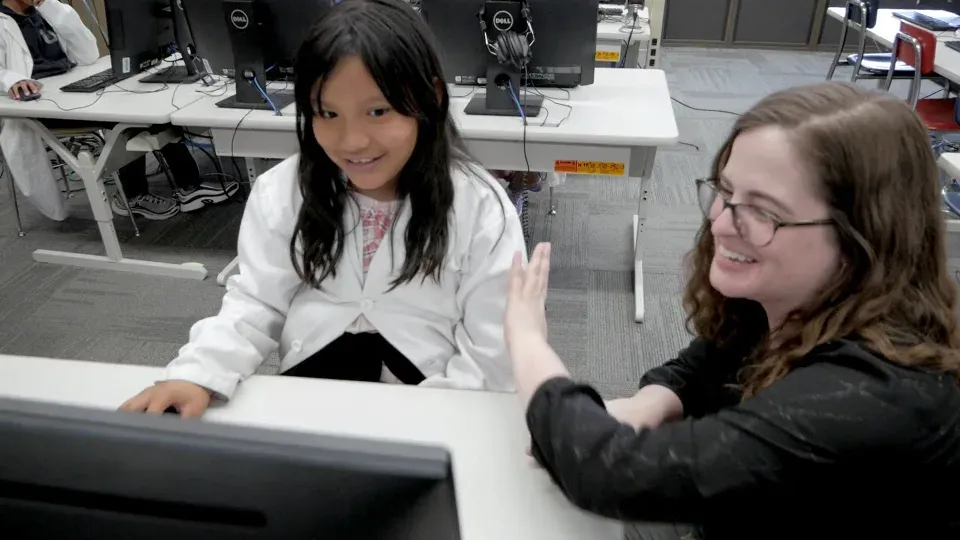
    A student in a white lab coat smiles at her screen while her teacher, laughing, reaches over for a high five.
    What you'll see: a student who just got one right, and you asking how she knew before the train moves.

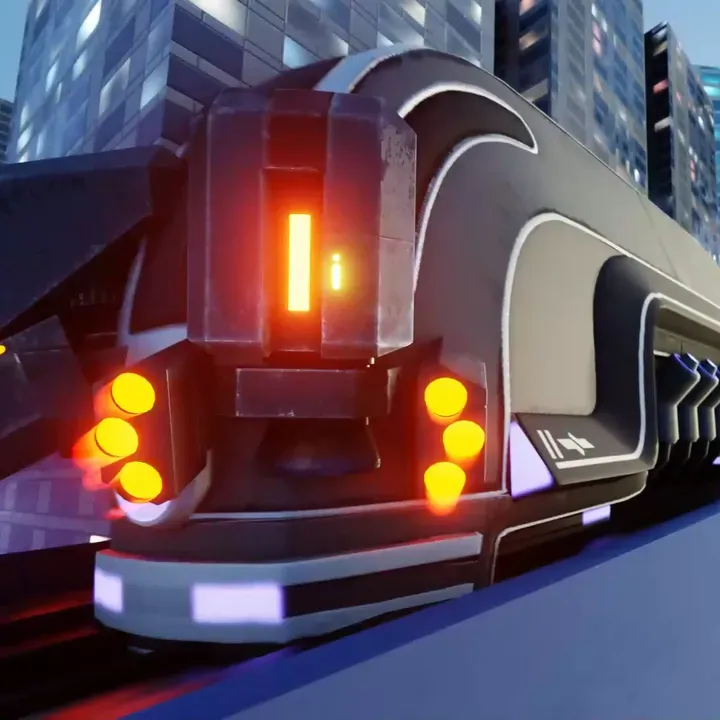
    The GAL-Delilahs are pulling up train tracks in Taipan. After RALF and his robot friends go head to head with a swarm of them, the class works out which of their side most needs backup by analyzing balanced and unbalanced forces in action (3-PS2-1). Then the GAL-Delilahs raise a track with a train on it, and students use patterns in data to figure out how far the train will go from a given height and decide where to put the protection (3-PS2-2). The story plays on the projector. Every student works on their own screen. The story goes the way most of the class chooses, and each child’s own choices and answers go into their report.

    The technology carries the story and collects every answer. You lead the thinking: Which side is winning? How far did it go from that height? So where does the barrier go?

    Run the catapult first, and tell the class why: the catapult is where they learned that a bigger push makes a bigger change in motion, and the train needs the same idea with more riding on it. The lesson prepares them. The Mission is what they’re preparing for. Off the Rails carries the catapult’s forces code, not its engineering one; Reactor Revamp carries 3-5-ETS1-3.

    “The missions are so engaging and entertaining my students don’t realize I am giving them an assessment.”

    Savannah Watson, Teacher, Orchard Elementary, UT

    Will it work in my room?

    Students join with a class code: no student accounts, no student email, no passwords. Chromebooks, laptops, or tablets, plus your projector. Free for teachers, no credit card. Student data is covered by COPPA and FERPA, and we signed the Student Privacy Pledge. See every class once a week in a lab? Then the lab is where the Mission runs and the classroom is where the unit runs: ask the 3rd grade team what they just finished, pick that row below, and run it the week after.

    START FREE →

    Communication first, then the catapult's two

    What the report shows

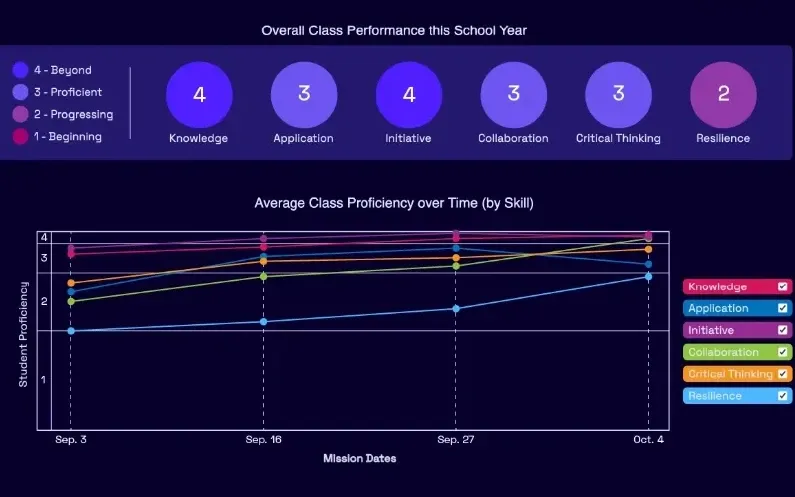
    A Mission.io class report: the class score in each of six skills, from knowledge and application to collaboration, critical thinking, and resilience, with the class chart across the year below.
    A class report from a real Mission: the class score in each of six skills, then each skill across the year.

    Every Mission produces a report for every student, built from what that student did across the whole Mission, on the skills the Mission captured. The six it can capture are Knowledge, Application, Initiative, Collaboration, Critical Thinking, and Resilience. The first two are what a test already sees. The other four are the human skills every school promises. The test shows what they know. The report shows the rest. SEE THE EVIDENCE →

    You taught it. Now find out who can use it.

    Who's behind it

    Mission.io is a research and design organization with one job: make collaborative, active learning something a teacher can run every unit instead of once a semester, and put a report in your hands when it’s over. Over a million students have run a Mission. The research behind them is funded by the National Science Foundation and the U.S. Department of Education’s Institute of Education Sciences, and Mission.io meets ESSA Level II standards, as validated by Instructure.

    “I even sent an email to my whole building encouraging everyone to try it.”

    Jen, Veteran teacher, OH

    Every 3rd grade Mission, by subject

    Off the Rails is one. There are 20 STEM Missions at 3rd grade, numbered 7 to 26 below, and each one is where a unit can end: the engineering unit ends at Reactor Revamp, forces end at Off the Rails, fractions end at Dug’s Great Big Garden. Every lesson finally has somewhere to go. Cart once this week and no unit in mind? Hot and Cold Changes and Engineering Solutions are 17 minutes each. No technology Mission is built for 3rd grade; the 3rd grade technology activities page carries activities a room can run without one, and Technology activities for students has every grade, K to 8.

    Engineering

    Three on the grade’s engineering design standard, from a 17-minute tsunami decision to a 45-minute prototype rebuild. The 3rd grade engineering activities page rebuilds a classic of its own. Engineering activities for students has every grade, K to 8.

    Engineering Missions at 3rd grade, all three on the NGSS 3-5 engineering design standard.
    NumberMissionTopic (code)Minutes
    7Reactor RevampTest and improve a prototype (3-5-ETS1-3; grades 3 to 6)45
    8Tsunami (3rd)Design defenses for islands in a tsunami’s path (3-5-ETS1-1, 3-5-ETS1-2, 3-ESS3-1)43
    9Engineering SolutionsChoose the solutions that reduce a tsunami’s damage, the short version (3-5-ETS1-1, 3-5-ETS1-2, 3-ESS3-1, 4-ESS3-2; grades 3 to 5)17

    Science

    Thirteen, from forces and magnets to fossils and the weather: the deepest shelf at the grade. The 3rd grade science activities page sets each one against the investigation that teaches it. The first nine are built for 3rd grade content, and two of them (The Abyss and On the Move) are written up as paragraphs, so they carry reading and writing codes too; the last four carry codes from other grades and run at 3rd too. Science activities for the classroom has every grade, K to 8.

    Science Missions at 3rd grade, by NGSS code; the last four carry codes from other grades.
    NumberMissionTopic (code)Minutes
    10Off the Rails (2nd-3rd)Balanced and unbalanced forces; predict a train’s motion from a pattern (3-PS2-1, 3-PS2-2; grades 2 to 3)23
    11Polar Opposites (3rd)Magnets and static electricity push and pull without touching (3-PS2-3, 3-PS2-4)21
    12ChrysalisLife cycles of plants and animals (3-LS1-1)31
    13Animal ArchitectsInherited and environmental traits; invent a trait for an animal that’s struggling (3-LS3-1, 3-LS3-2)38
    14The Abyss (3rd)The traits of deep-sea creatures, written up as informative paragraphs (3-LS3-2, 3-LS4-3)49
    15Era of the UnknownFossils and the environments they came from (3-LS4-1, 4-ESS1-1; grades 3 to 6)44
    16On the Move (3rd)Plan around animal migrations that block a construction project, written up as paragraphs (3-LS4-4)41
    17Melting PointWeather patterns and climates (3-ESS2-1, 3-ESS2-2; grades 3 to 4)41
    18Defying Gravity (3rd)Gravity pulls everything down (no NGSS code listed)19
    19Hot and Cold ChangesHeating and cooling change matter, and some changes can’t be undone (2-PS1-4; grades 2 to 3)17
    20Treasure HuntLandforms and bodies of water as map clues (2-ESS2-2; grades 1 to 3)22
    22Ecosystem PatternsPatterns in how organisms interact across ecosystems (MS-LS2-2; grades 3 and 6 to 8)39

    Math

    Three, on the three big units of 3rd grade math: multiplication, multi-step problems, and fractions. The 3rd grade math activities page rebuilds a classic of its own. Math activities for students has every grade, K to 8.

    Math Missions at 3rd grade, by CCSS code.
    NumberMissionTopic (code)Minutes
    23Collapse of Singularity CityMultiplication as equal groups, and word problems that use it (3.OA.A.1, 3.OA.A.3, 3.OA.A.4)18
    24The Crooked SnakesPictographs and multi-step word problems (3.MD.B.3, 3.OA.A.1, 3.OA.A.3, 3.OA.C.7, 3.OA.D.8, 3.NBT.A.2)24
    25Dug's Great Big GardenFractions as parts of a whole, and equivalent fractions (3.NF.A.1, 3.NF.A.3)28

    Careers and creativity

    One that doesn’t belong to a unit: a creativity Mission for K to 5.

    The creativity Mission at 3rd grade.
    NumberMissionTopic (code)Minutes
    26Sky's the LimitCreativity and imagination (no standards codes; grades K to 5)18
    START FREEMISSION BRIEF →

    Free teacher account, no card. Start with the Communication Mission, marked Start here in your library, then Off the Rails, each after its 5-minute Teacher Preview.

    Also at this grade

    The Collaboration and Critical Thinking Missions for 2nd and 3rd grade (15 minutes each; they live on the 3rd grade collaboration activities and 3rd grade critical thinking activities pages), the Communication Mission for 2nd and 3rd grade (19 minutes, the first one to run), and the reading, writing, and arts Missions: Strokes of Genius, Dawn of the Scarecrow, The Root of the Problem, and Showstopper, a costume design for RALF (no standards codes).

Questions 3rd grade teachers ask

I see my 3rd graders once a week for STEM. What fits?

The plate tower and the slow ramp are the short ones; the catapult fits a 45-minute special with a base catapult pre-built per team, or two visits with the second set of launches on the second. A Mission is one visit, and six on this page run under 20 minutes, the shortest at 17 (Hot and Cold Changes and Engineering Solutions) and 18 (Season Search, Collapse of Singularity City, Sky’s the Limit). Ask the classroom teacher what unit just ended and pick that row.

What makes a catapult challenge a fair test?

The same pull every time, one variable changed per round and circled on the log, and three launches per design so one lucky landing doesn’t count (3-5-ETS1-3). Change the pull and the pivot together and the team learns that something worked, never which thing.

Do 3rd graders need a forces unit before the catapult?

No. The ten-minute teach-first is the forces lesson: two rubber band pulls and one sentence (a bigger unbalanced force, a bigger change in motion). It’s also what Off the Rails expects them to walk in with, so the catapult can be the week before the Mission.

How do I grade a STEM challenge fairly?

Grade the circled variable and the behaviors, not the distance. The signed criteria box and the Recorder’s log are one grade; the four-behavior tally over two or three challenges is the other. A team that landed three in the square by changing everything at once shows up on the log, and the log is what lets you say so.