4th grade STEM activities

The toy parachute drop rebuilt so 4th graders compare designs against criteria, five more build challenges fixed, a free printable, and every 4th grade Mission by subject.

Who we are. Mission.io makes Missions: teacher-led, whole-class simulations where students use what they’re learning to work through a real scenario together. We build every one on the six things in our STEM activities for students, K-8 guide, and every student gets a report on how well they did.

You don’t need us to use this page: the parachute drop, the five challenges, and the sheet all work on their own. Every 4th grade Mission is at the end, by subject, free. (The one we’d run with 4th graders sends the class to a colony on Vespus that keeps losing buildings downhill, with the town meeting’s list of suspects to check. Nobody packed a parachute.)

On this page

What 4th grade STEM looks like

4th grade STEM activities are challenges in which a team designs, builds, and tests something against criteria the standards name, compares its designs by what the test showed, and leaves each student answerable for a part. This page rebuilds the toy parachute drop to the grade’s engineering standard (3-5-ETS1-1 to 3: define the problem with criteria and constraints, generate and compare several solutions against them, run fair tests and find the failure points), fixes five more build challenges, and lists every 4th grade Mission by subject. The year’s content (energy, waves and how information travels, the structures that keep living things alive, rock layers and Earth’s changing surface, and reducing the damage from natural hazards; place value, fractions, angles, and measurement; digital citizenship) lives on the four subject pages.

Most of what gets called a STEM challenge is a contest, or a craft project with a STEM sticker on it. Kids cut, tie, tape, and we call it engineering. The parachute drop stands in for all of it, and most years it goes the same way: a grocery bag, four strings, a washer, a stepstool, and the slowest chute wins.

Keep the drop. Fourth graders will count the seconds out loud whether you ask them to or not. Ask one question about it afterward: were they solving a real problem, or following directions really well? Those feel the same in the moment, because the room is busy and everyone is counting. The contest is what’s left when nobody said what the parachute had to do before it was built, and nobody can say afterward which change slowed it down. The challenges on this page put both of those back, with the same bags in the same period.

Six things that turn a build contest into engineering

We’ve run this check with STEM teams in the districts we work with, and the craft project skips the same three every time: a real problem, criteria for success, and any pressure to iterate. If the finished product is all the activity asks for, the learning is optional. The fix is a small step before the build and a small step after it, and nothing in the bag changes. One number is worth carrying down: when a group shared a goal and each student answered for a part, 84% of studies found a positive effect; without both, 17% (Slavin, 1991).

  1. 1. A real problem with stakes the class can feel.

    “Whose parachute is slowest?” is a contest. “The weather sensor breaks if it lands in under 3 seconds” is a problem.

  2. 2. Apply, don't recall.

    A first round of drops that changes the canopy. If a team can build the whole parachute without the idea you taught that morning, the idea wasn’t needed.

  3. 3. Group goals with individual accountability.

    The one most build challenges miss: one kid drops, one kid times, two kids watch. Four roles, one job each, and a box each student signs.

  4. 4. The teacher leads the thinking.

    The questions are yours, asked under the drop point while the next team waits. The drop isn’t yours: the Dropper drops, and you listen for which team can say why its time changed.

  5. 5. A debrief where the class argues it out.

    Every team’s six times on the board, and the question is what the 3-second canopies shared.

  6. 6. A way to see who did what.

    If you can’t tell which student picked the variable and which one held the bag they were handed, you can’t teach the practice. You can only hope for it.

Three seconds is a criterion.

The free printable at the end of the next section puts all six in the team’s hands, ready to copy. Get the sheet →

The parachute drop, rebuilt for 4th grade

The toy parachute drop is the build challenge every 4th grade list carries: a plastic bag or coffee filter canopy, string, and a small weight, dropped from a set height, slowest fall wins. Fourth grade is the sweet spot: old enough to time a drop, young enough that the drop is still thrilling. The way it usually runs is a free build, one drop, and “whose was slowest?” Here’s the version that hits all six.

Needs
For seven chutes: 14 plastic grocery bags, string, 7 metal washers or small toys, tape, a stopwatch or phone per group, and a stepstool, or the top of the stairs with a teacher up there. Under $5.
Time
55 minutes. 45 with the canopies pre-cut to two sizes, so the choice is a comparison instead of a scissors session.
Groups
Fours. With 27 students, six groups of four and one of three, where the Timer also records.
Standards
3-5-ETS1-2 (generate and compare several solutions against the criteria and constraints) and 3-5-ETS1-3 (fair tests that find the failure points). Air resistance is not a 4th grade core idea, so the page claims no physics code for it.
  1. Teach first, 8 minutesApply

    Drop a flat sheet of paper and a crumpled one from the same height and ask why the flat one takes longer. Name it once: air pushes back on a bigger surface. Then name the three things a parachute designer can change: canopy size, canopy shape, string length.

  2. The problem, 2 minutesStakes

    A weather sensor (the washer) has to reach a mountain station from a drone, and it breaks if it falls faster than 3 seconds from the drop height. Say it plainly: a fast landing is a broken sensor and a station with no weather data. Each team copies the criteria and constraints into the box before touching a bag.

    • Criteria: 3 seconds or more from the marked height; the sensor lands inside the taped landing zone.
    • Constraints: one plastic bag, four strings, the washer, the clock.
  3. Four roles, one job eachAccountability

    On the sheet, and everyone signs their role’s box.

    • Builder

      The only hands on the canopy.

    • Dropper

      Releases from the same mark every time, arm straight, and says "same height."

    • Timer

      Starts at release, stops at touch, and says the time aloud.

    • Recorder

      Sketches the canopy and writes each time, plus whether it landed in the zone.

  4. Round one, 8 minutes, then three dropsApply

    Build, then three drops from the mark, because one drop can be a fluke. The Recorder logs all three before anyone touches the canopy again.

  5. Change one variable, 2 minutesApply

    Pick one: size, shape, or string length. The Recorder writes which one and what the team expects it to do to the time.

  6. Round two, three more dropsTeacher leads

    The Dropper and the Timer swap, so the timing isn’t one kid’s property. You stand under the drop point and ask three questions (Which variable did you pick to change, and why that one? What did your three drops tell you? What will you keep exactly the same this round?) and then you listen. If a team asks you which size is best, answer with their own log.

  7. The debrief, 10 minutesDebrief

    Every team’s times on the board. Which canopies hit 3 seconds, and what did they share? Did any team’s change make the time worse, and why do you think so? Who in your group noticed the strings tangling before the drop? Give the third question time.

  8. See who did whatSee who did what

    The observation sheet, four behaviors per student: proposed a change, kept a variable the same on purpose, disagreed with a reason, changed their mind with a reason. One drop point means teams queue, and the queue is when you walk the line with the tally. You’ll catch about half the room in one period; the signed role boxes and the Recorder’s log catch the rest, at a glance, before you grade anything.

  9. Once a week, or four sections in a row

    The two-visit version, for a short block or a once-a-week lab: the demo, the problem, the build, and round one on visit one, with the canopy sketched and signed; the change, round two, and the debrief on visit two. Each team’s parachute waits in a labeled bag with its washer taped inside, and the log rides in the bag. Four sections in a row: pre-cut the canopies the night before, one stack per section, and tape the landing zone once in the morning. If the drop is from the stairs, an adult stands at the top every period; the Dropper’s arm goes over the rail, not the Dropper.

(If a canopy gets a hole poked in the top by accident and swings less, don’t fix it. That’s a variable, and somebody just found it.)

Keep the drop and the stopwatch. Put the criteria in front of the build and a second round after it, and the contest becomes a comparison.

The parachute drop, free

Emailed now, ready to copy: the teacher page, four role cards, the team page (the criteria box with the canopy sketch, the six-drop log, and the one-variable box), and the four-behavior tally.

It’s on its way.

Check your inbox for the parachute drop.

Email me the sheet. It comes as a PDF, ready to print. Unsubscribe anytime.

Five more 4th grade STEM challenges, fixed

Five more that every 4th grade list carries: what each one is, how it usually runs, and the couple of changes that fix it.

Five more for 4th grade

2. The craft stick bridge with binder clips

Needs craft sticks, binder clips, two desks or books to span, a book to load. Groups of four.

Teams clip craft sticks together with binder clips into a span between two desks, then set a book on it. The clips come apart easily, so a team can rebuild fast and try again. As usually run, though, it’s a strength test with no target: it held or it didn’t, one student does the clipping, and nobody writes down what gave out.

The fix

  1. Before building, the team writes down a load target: it has to hold the math book for 10 seconds.
  2. Use the four roles from the parachute drop, with a Loader in place of the Dropper: Builder, Loader, Timer, and Recorder.
  3. Have the Recorder log what failed first on every test.

No page for this one; the parachute’s roles carry over.
3. The windmill from a tube and paper

Needs a cardboard tube, paper, a pencil or skewer, tape, a fan. Groups of four.

Teams tape paper blades to a cardboard tube on a pencil or skewer, and a fan turns it. Seeing it spin is satisfying, and nearly every team gets there. As usually run, though, every windmill that turns counts as a success, so there’s nothing to measure, no reason to change a blade, and no way to tell who did what.

The fix

  1. Put a tape flag on one blade, and count the turns in 10 seconds in front of the fan.
  2. Give each student one blade to own and sign.
  3. When a student changes their blade, they say what the change did to the count.

No page for this one; the turn count fits on the board.

4. The index card tower, ten cards, freestanding

Needs ten index cards, no tape. Groups of three.

Teams fold ten index cards, with no tape, into the tallest freestanding tower they can before time runs out. Every student can fold, and it fits in a short block. As usually run, though, it’s a race with no idea behind the folds, and when towers fall the class moves straight on.

The fix

  1. Teach two folds first: the triangle tube and the accordion.
  2. After the build, debrief what fell: which fold held, and where did each tower give out?

No page for this one; it’s a warmup with a debrief.

5. The fan-proof building

Needs paper and tape, a box fan. Groups of four.

Teams build a paper building that has to stay standing in a box fan’s breeze. The wind is a real stake 4th graders can feel. As usually run, though, it’s pass or fail at one fan setting, nobody learns anything from the buildings that blow over, and there’s no record of who built what.

The fix

  1. Start the fan on low and step it up, one setting at a time.
  2. Log the highest setting each building survived.
  3. Before the team rebuilds, the Recorder names the part that failed first.

No page for this one; it pairs with the 4th grade natural hazards unit.

6. The newspaper chair a teammate can sit on

Needs newspaper, masking tape. Groups of four.

Teams roll and tape newspaper into a chair, and at the end one teammate sits on it. Somebody has to sit, so the whole team has a stake in it holding. As usually run, though, it’s a long, loud build that doesn’t use any idea from class, and nobody can say who built which leg.

The fix

  1. Teach rolled tubes and triangles first, so the build uses the idea: a tight tube holds weight end to end, and a triangle holds its shape.
  2. Log who designed each leg, one name per leg.

No page for this one; teaching the rolled tubes first is most of the fix.

  • Our part · We make Missions

    Then the unit has somewhere to go

    Plenty of teachers rebuild these by hand every unit, and it works. A Mission is a teacher-led, whole-class simulation on the standard the unit was teaching: your class becomes the crew, the scenario is built from the unit you just taught, and the only way through is using it together. The parachute drop belongs to your engineering design unit, and Landslide belongs to the weathering and erosion unit. The Missions on the parachute’s own standard open the engineering table below.

    You're at the helm, not on the hook.

    Landslide: the Mission we'd run in 4th grade

    Landslide · Grades 4 to 5 · About 38 minutes · One device per student, plus your projector · Free with a teacher account

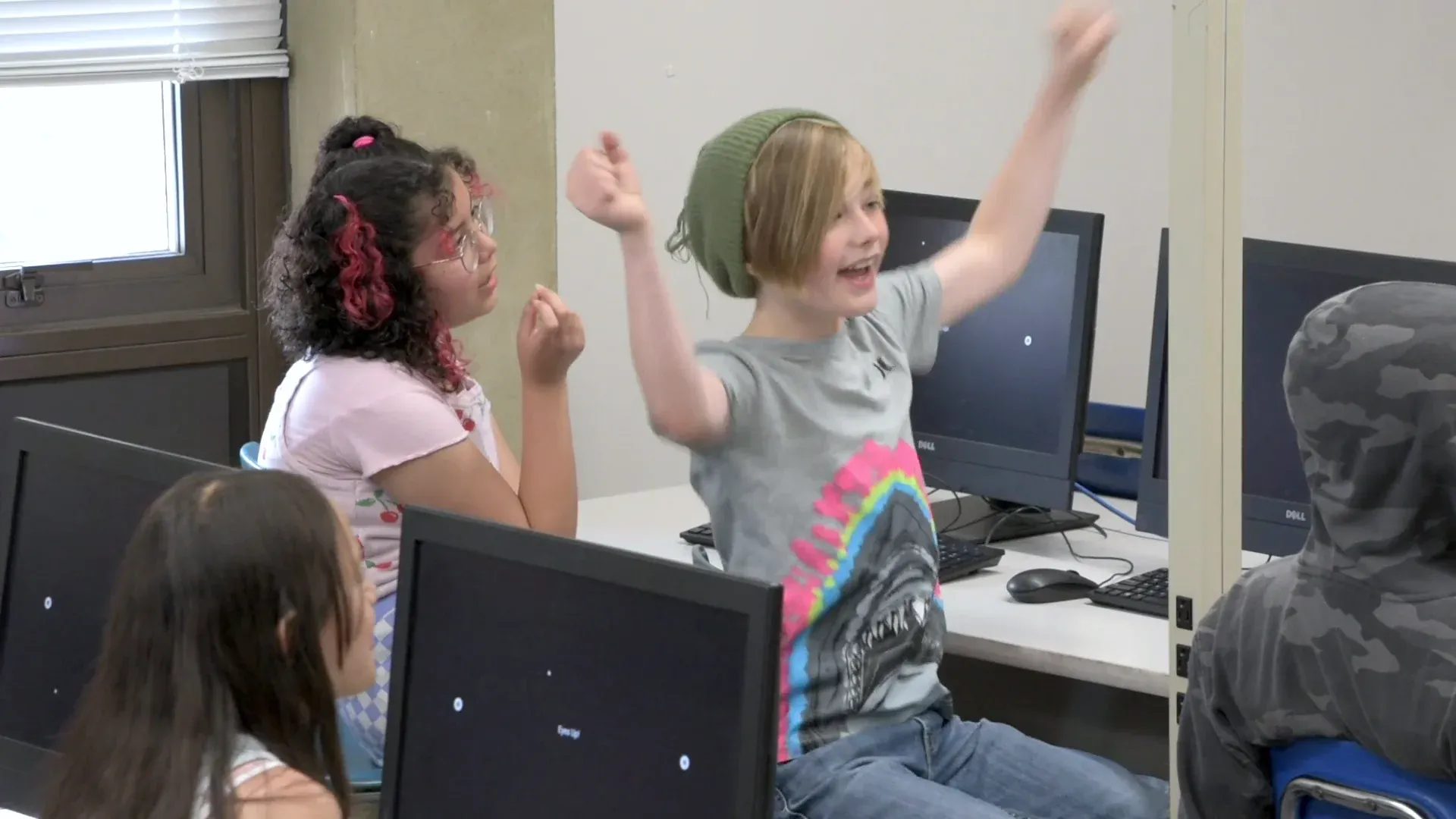
    A student in a green beanie throws both arms in the air at a lab computer while the classmate beside them grins.
    What you'll see: a crew that just got one right, and you asking which cause the evidence ruled out before they move on.

    A colony on Vespus is in a state of emergency: landslides have swept away many of its buildings, and they’re still coming. The town has held an emergency meeting and listed what might be causing them, and the crew has to investigate each one and bring back a solution before the whole city is lost (4-ESS2-1). The story plays on the projector. The work happens at seven stations (Command, Engineering, Medical, Security, Science, I.T., Operations) and in the arguments between them.

    Every student is assigned to a team, and each team’s work is themed to it, from its own information and challenge to the same problem the rest of the crew is solving. The team gives a student a role in the story and people to lean on while you move between teams. You’re at the helm, asking which cause the evidence supports and which one it rules out.

    The library asks that students can already name what freeze and thaw, wind, and rain do to the ground, so it fits the end of the weathering and erosion unit.

    “The missions are so engaging and entertaining my students don’t realize I am giving them an assessment.”

    Savannah Watson, Teacher, Orchard Elementary, UT

    Will it work in my room?

    Students join with a class code: no student accounts, no student email, no passwords. Chromebooks, laptops, or tablets, plus your projector. Free for teachers, no credit card. Student data is covered by COPPA and FERPA, and we signed the Student Privacy Pledge. See every class once a week in a lab? Then the lab is where the Mission runs and the classroom is where the unit runs: ask the 4th grade team what they just finished, pick that row below, and run it the week after.

    START FREE →

    Communication first, then two for 4th grade

    What the report shows

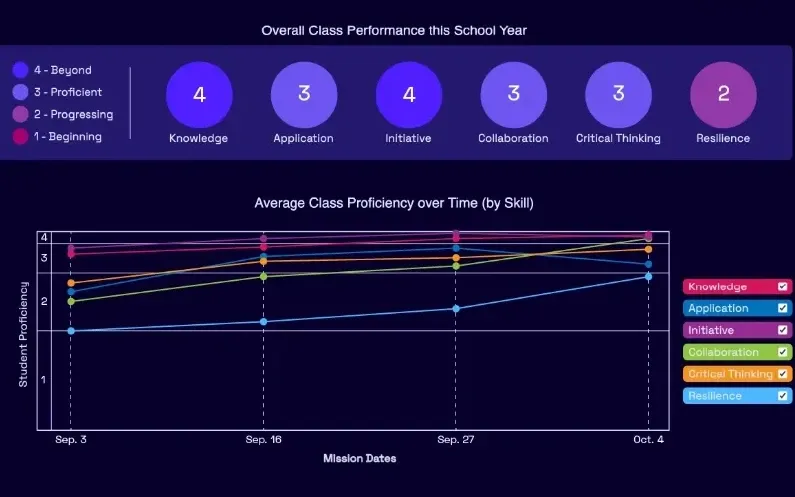
    A Mission.io class report: the class score in each of six skills, from knowledge and application to collaboration, critical thinking, and resilience, with the class chart across the year below.
    A class report from a real Mission: the class score in each of six skills, then each skill across the year.

    Every Mission produces a report for every student, built from what that student did across the whole Mission, on the skills the Mission captured. The six it can capture are Knowledge, Application, Initiative, Collaboration, Critical Thinking, and Resilience. The first two are what a test already sees. The other four are the human skills every school promises. The test shows what they know. The report shows the rest. SEE THE EVIDENCE →

    You taught it. Now find out who can use it.

    Who's behind it

    Mission.io is a research and design organization with one job: make collaborative, active learning something a teacher can run every unit instead of once a semester, and put a report in your hands when it’s over. Over a million students have run a Mission. The research behind them is funded by the National Science Foundation and the U.S. Department of Education’s Institute of Education Sciences, and Mission.io meets ESSA Level II standards, as validated by Instructure.

    “Unlike other tech programs in the district that often have students working in isolation or in pairs, Mission.io emphasizes true collaboration.”

    Lorilee Johnson, District specialist, Alpine School District, UT

    Every 4th grade Mission, by subject

    Landslide is one. There are 22 STEM Missions at 4th grade, numbered 7 to 28 below, and each one is where a unit can end: the engineering unit ends at Tsunami (4th), Earth’s surface ends at Landslide, fractions end at A Fraction of the Problem. Every lesson finally has somewhere to go. Cart once this week and no unit in mind? Engineering Solutions is 17 minutes.

    Engineering

    Three on the 3-5 engineering design standard, all three on the parachute’s codes; two about the job rather than the standard. The 4th grade engineering activities page rebuilds the stream tray erosion barrier. Engineering activities for students has every grade, K to 8.

    Engineering Missions at 4th grade: three on the NGSS engineering design standard, two career and technical.
    NumberMissionTopic (code)Minutes
    7Tsunami (4th)Design and compare ways to protect islands from a natural hazard (3-5-ETS1-1, 3-5-ETS1-2, 4-ESS3-2)43
    8Engineering SolutionsReduce the damage from natural hazards (3-5-ETS1-1, 3-5-ETS1-2, 3-ESS3-1, 4-ESS3-2, MS-ETS1-2)17
    9Reactor RevampTest and improve a prototype (3-5-ETS1-3; grades 3 to 6)45
    10Unstoppable ForceEngineering and problem solving (career and technical; no NGSS code)34
    11Mission to MarsSpace engineering (career and technical; no NGSS code)45

    Science

    Eleven, and the energy and waves unit gets three of them. The 4th grade science activities page sets each one against the investigation that teaches it. The Abyss (4th) is the longest on this page, a deep-sea story that ends in a written paragraph. The last three reach into 3rd or 5th grade codes and run across two grades or more. Science activities for the classroom has every grade, K to 8.

    Science Missions at 4th grade, by NGSS code; the last three carry 3rd or 5th grade codes.
    NumberMissionTopic (code)Minutes
    12Disaster Above VespusA faster object has more energy (4-PS3-1)26
    13Read Between the WavesWave patterns: amplitude and wavelength (4-PS4-1)27
    14ExtractionSend information with patterns (4-PS4-3)35
    15Relocation Round-UpThe inside and outside structures that keep living things alive (4-LS1-1)26
    16The Abyss (4th)How deep-sea creatures’ adaptations keep them alive, written up as a paragraph (4-LS1-1)50
    17LandslideWeathering and erosion (4-ESS2-1; grades 4 to 5)38
    18Polar Opposites (4th)Magnetic interactions (no NGSS code listed)28
    19Off the Rails (4th-5th)Forces and motion (grades 4 to 5; no NGSS code listed)30
    20Era of the UnknownFossils and rock layers (3-LS4-1, 4-ESS1-1; grades 3 to 6)44
    21Melting PointWeather and climate (3-ESS2-1, 3-ESS2-2; grades 3 to 4)41
    22Operation StarfallShadows, stars, and patterns in the sky (5-ESS1-1, 5-ESS1-2; grades 4 to 5)40

    Math

    Four, one for each of the units that take the most of 4th grade math: place value, fractions, measurement, and angles, all 40 minutes or under. The 4th grade math activities page rebuilds design-a-zoo for area and perimeter. Math activities for students has every grade, K to 8.

    Math Missions at 4th grade, by CCSS code.
    NumberMissionTopic (code)Minutes
    23Power StruggleRound, add, and subtract multi-digit numbers (4.NBT.A.3, 4.NBT.B.4)28
    24A Fraction of the ProblemCompare fractions with unlike denominators; add and subtract fractions (4.NF.A.2, 4.NF.B.3)30
    25RiptideConvert units and solve measurement word problems (4.MD.A.1, 4.MD.A.2)40
    26Sunken StarshipMeasure angles, and add and subtract them (4.MD.C.5, 4.G.A.1)28

    Technology

    One at this grade; if the unit is digital citizenship, this is the week it points to. The 4th grade technology activities page carries conditionals with cards, no lab needed. Technology activities for students has every grade, K to 8.

    The technology Mission at 4th grade.
    NumberMissionTopic (code)Minutes
    27Cyber Defense ForceSpot a phishing scam before it gets in: digital citizenship (grades 4 to 12)37

    Creativity

    One that doesn’t belong to a unit: a creativity Mission for K to 5, and the second shortest on this page.

    The creativity Mission at 4th grade.
    NumberMissionTopic (code)Minutes
    28Sky's the LimitCreativity and imagination (grades K to 5)18
    START FREEMISSION BRIEF →

    Free teacher account, no card. Start with the Communication Mission, marked Start here in your library, then Landslide, each after its 5-minute Teacher Preview.

    Also at this grade

    The Communication Mission (30 minutes; run it first) and the Collaboration and Critical Thinking Missions for 4th grade and up (24 minutes each) live on the 4th grade collaboration activities and 4th grade critical thinking activities pages. Then the reading and writing Missions: Strokes of Genius (4th), Dawn of the Scarecrow, On the Move (4th), The Root of the Problem (4th), and Showstopper.

Questions 4th grade teachers ask

I have a 30-minute STEM block. What fits?

The index card tower and the fan-proof building are the short ones; the parachute drop fits two visits, with round two and the debrief on the second. Eight Missions on this page run under 30 minutes, and these are the five shortest: Engineering Solutions, 17; Sky’s the Limit, 18; Disaster Above Vespus, 26; Relocation Round-Up, 26; and Read Between the Waves, 27.

Is the parachute drop a lesson on air resistance?

Not by the standards. Air resistance isn’t a 4th grade core idea, so the drop serves the engineering standard instead: compare several designs against the criteria (3-5-ETS1-2) and run fair tests that find the failure points (3-5-ETS1-3). The flat and crumpled paper demo is the one idea it needs, and it takes two minutes.

Everyone wants the stopwatch. How do I keep the timing fair?

Swap the Dropper and the Timer between rounds, have the Timer say each time aloud, and run three drops per round so one late thumb doesn’t decide the design. The log on the sheet has a row for every drop, so a strange time stays visible instead of getting argued away.

Which 4th grade Mission goes with which unit?

Energy: Disaster Above Vespus. Waves: Read Between the Waves. How information travels: Extraction. Structures and survival: Relocation Round-Up, or The Abyss (4th) if the unit ends in writing. Earth’s surface: Landslide. Natural hazards and the engineering unit: Tsunami (4th). Fractions: A Fraction of the Problem. Every row in the tables names its unit in the topic.