1st grade problem solving activities

One classic rebuilt so 1st graders have to talk their way to the answer, five more fixed, a free sheet, and the whole-class Mission we’d run with 1st graders.

Who we are. Mission.io makes Missions: teacher-led, whole-class simulations where students use what they’re learning to work through a real scenario together.

Everything on this page works without us. The Mission we’d run with 1st graders waits at the end, free. (Its river splits in two, and not one puzzle piece ends up under the radiator.)

On this page

What problem solving looks like in 1st grade

First grade problem solving activities hand six-year-olds a challenge that pushes back fairly: a shape that won’t fill, a gap that’s the wrong size, a plan that has to change halfway. The child tries, the piece doesn’t fit, and the child tries something else. This page takes the geometry puzzle most 1st grade classrooms already own and rebuilds it so two children have to solve it together.

Six-year-olds are competitive and enjoy group work, they may choose projects that are too hard, and they’re extremely sensitive to criticism. A tangram suits all three. They’ll pick the fox outline over the square every time, and when it doesn’t work, it’s the piece that doesn’t fit, not the child.

The standard asks 1st graders to compose two-dimensional shapes into a composite shape and make new shapes from it (CCSS 1.G.A.2), and to look for and use structure, like noticing that two small triangles make the square (CCSS Mathematical Practice 7). The activity below gives the puzzle a reason to get finished.

Six things that make a 1st grade puzzle a real problem

Thinking and knowing come tangled together: there’s no thinking skill a child can use on content they don’t know yet, and even three-year-olds can reason well about the things they do know (Willingham, 2007). For 1st graders, that means teaching a few composing facts before anyone touches a piece. Here’s each of the six in 1st grade; the K to 8 problem solving guide has the studies.

  1. 1. A real problem with stakes the class can feel.

    An outline on a card is a puzzle. The class pet’s house missing its roof before the rain is a problem, and six-year-olds will want that roof done right.

  2. 2. Apply, don't recall.

    Composing shapes is the whole task, so this one comes built in. The work is making sure each child composes, not just the one holding the pieces.

  3. 3. Group goals with individual accountability.

    In a center, one child does the puzzle and a partner hands over pieces. Split the seven pieces between them and neither one can finish alone, so both have to talk.

  4. 4. The teacher leads the thinking.

    Kneel at the pair, ask one question, and move on. A six-year-old stuck on a gap needs a question about its shape, not your finger on the right piece.

  5. 5. A debrief where the class argues it out.

    Six minutes back on the rug: which gap was hardest, and what shape was it? A 1st grader who explains a gap out loud has to understand it first.

  6. 6. A way to see who did what.

    If you can’t tell which partner found the square and which one waited for it, you can’t teach problem solving. Four tally marks per child settle it.

Seven pieces, one roof, two pairs of hands.

As usually run, tangrams hit one of the six. Here’s how to get them to all six in half an hour. Grab the roof sheet, fact cards and all →

Tangram puzzles, rebuilt to hit all six

You know them. Seven flat pieces (five triangles, a square, and a parallelogram) have to fill an outline exactly, with no gaps and no overlaps. They’re in nearly every 1st grade math closet, and they’re a great puzzle. As usually run, they’re also a solo center, or one child solving while a partner watches, with no debrief and no way to tell who did the thinking.

Splitting the pieces between two children fixes most of that by itself.

Time
30 minutes: 4 to set the problem and model the split, 8 for the first roof, 2 to swap, 8 for the second roof, 6 for the debrief, 2 to collect. It fits a math block as written.
Groups
Pairs. With 23 children, make one trio: the third child holds the parallelogram and the square, and takes the first turn as Fixer.
Supplies
One tangram set per pair, cut from the sheet (or a foam set that makes a 5-inch square), and the sheet’s two roof outlines, one of each per pair. A foam class set is inexpensive.
Standards
CCSS 1.G.A.2 (compose shapes into a composite shape), CCSS Mathematical Practice 7 (look for and make use of structure).
  1. The problemStakes

    The class pet’s house lost its roof. Put a tangram outline on the wall with the roof missing and tell the class there’s one set of seven tiles, the roof needs all seven with no gaps, or the rain gets in. Then hand each partner half the tiles and say the catch: neither of you has enough alone.

  2. Facts before piecesApply

    Before the pair starts, each child writes or draws one composing fact on the card: two small triangles make the ___. That’s the background knowledge the puzzle needs, and it’s the structure standard in one blank.

  3. Split pieces, two jobsAccountability

    One child holds the two big triangles and the square; the other holds the two small triangles, the medium triangle, and the parallelogram. You may place only your own pieces, but you may tell your partner where to put theirs. Jobs swap on the second roof.

    • Placer

      Goes first, and says each piece's name out loud as it goes down ("the big triangle goes here").

    • Fixer

      May move one piece of either child's, once, and has to say why.

  4. You lead the thinkingTeacher leads

    Kneel at each pair with one of three questions: Which two pieces make a square? What shape is the gap, and which of your pieces is that shape? What did your partner say that helped? Then stand up and move on before you’re tempted to place one.

  5. Two roofsApply

    The second outline is a roof for a different animal, with the jobs swapped and the pieces swapped. The child who held the big triangles now has to find a home for the parallelogram.

  6. The debriefDebrief

    Six minutes on the rug. Which gap was hardest to fill, and what shape was it? Did anyone’s Fixer move change everything? Which two pieces did you keep making a square out of?

  7. See who did whatSee who did what

    The tally, four marks per child: named a piece correctly, named a gap’s shape, told a partner where a piece goes with a reason, moved a piece with a reason. The Placer names every piece aloud, so you’ll catch about half the room on the first roof, and the swapped jobs on the second catch most of the rest.

(The parallelogram will cause the most trouble. Sometimes it only fits flipped over, and nobody believes that the first time.)

First graders will discover that the square they couldn’t make was in their partner’s hands the whole time.

The tangram roof puzzle, free

Emailed now, ready to copy: the teacher page, the Placer and Fixer cards, the composing fact card, a tangram set to cut out, the two roof outlines at the same size, and the four-behavior tally.

It’s on its way.

Check your inbox for the tangram roof puzzle.

Email me the sheet. It comes as a PDF, ready to print. Unsubscribe anytime.

Five more classics, and the fix each needs

If your 1st grade problem solving block is mostly centers and a timer, you’re in good company. Each classic below gets there with a couple of changes. Here’s how each one usually runs, and what to change.

Five more for 1st grade

1. Act-it-out story problems (K to 1)

Needs cubes or counters, or just bodies. Whole class. 25 minutes.

You tell a story with numbers in it, and children act it out with bodies or cubes before anyone writes the number sentence. The story gives them math to use, and you lead it. As usually run, though, a few children act while the rest watch, and nothing shows who did the thinking.

The fix

  1. Make the story about the class, like whether there are enough glue sticks for every table.
  2. Give every child a job in the story, from Counter to Checker, so nobody is only watching.
See act-it-out story problems rebuilt for kindergarten →

2. Numberless word problems (2 to 3)

Needs a word problem on the board or projector. Whole class.

The numbers in a word problem stay hidden until the class knows what the story is doing, then come out one at a time. It’s a 2nd and 3rd grade classic, and it’s fine to start in 1st, because it stops children from grabbing every number and adding. As usually run, though, it’s hands-up talk where a few children answer each reveal, and nothing rides on the story.

The fix

  1. Before each reveal, every child makes a prediction on a strip or a whiteboard.
  2. Nobody shares until every child has one.

See numberless word problems rebuilt for 2nd grade →

3. Math scavenger hunt (1 to 5)

Needs problem cards taped around the room. Pairs.

Problem cards are taped up around the room, and pairs find each one and solve it. Children get out of their seats, which 1st graders love. As usually run, though, it’s a worksheet on the walls, and one partner usually does the cards.

The fix

  1. Give each pair one pencil.
  2. Nobody writes until both partners agree on the answer.

No page for this one; with the one-pencil rule it’s a good warmup.

4. Pattern block puzzles

Needs pattern blocks, outline cards. Solo or pairs, at a center.

Children fill an outline card with pattern blocks at a center. It’s the same idea as tangrams with chunkier pieces, and it puts shapes to work. As usually run, though, it has the same misses: one child at a time, and no talk about why a piece fits.

The fix

  1. Run it as the warmup the day before the tangram roof.
  2. Split the blocks between partners from the start, so neither can fill the outline alone.

No page for this one; run it as the warmup before the tangram roof.

5. Paper bridges and the gingerbread man's boat

Needs the build bin. Small groups.

Groups build a paper bridge, or a boat for the gingerbread man, then test it: a build, a test, a winner. Children love the test day. As usually run, though, the boat floats or sinks and nobody learns why.

The fix

  1. Before anyone builds, write down what the boat has to do, like hold the gingerbread man and stay dry.
  2. Test it twice, with one change between the tests.

See the build challenges for 1st grade →

  • Our part · We make Missions

    Or hand the story to a Mission and keep the questions

    Plenty of 1st grade teachers run puzzles like this by hand every week, and they work. A Mission is a teacher-led, whole-class simulation: we put the story on your projector, connect every child’s screen, and move the scenario along, which frees you to kneel beside a child and ask the question that gets her unstuck.

    You're at the helm, not on the hook.

    Wind and Water: the Mission we'd run in 1st grade

    Wind and Water · Grades 1 to 2 · About 16 minutes · One device per student, plus your projector · Free with a teacher account

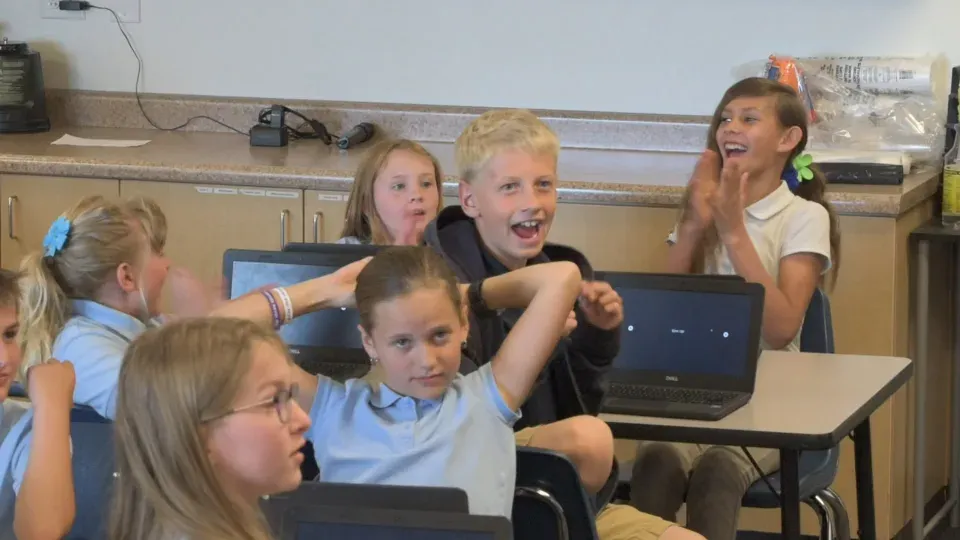
    Young students in school uniforms cheer and clap at their laptops, one girl with both hands on top of her head.
    What you'll see: first graders clapping at their laptops, somebody's hands on her head, and the whole room looking at the same story at once.

    A river has split in two, and the crew has to compare ways to divert the water. Then wind keeps knocking fruit off the orchard trees, and the crew has to find a way to protect them. The story plays on your projector; each child weighs the fixes on their own screen.

    Wind and Water runs one child to a screen, without stations or crew teams. The story goes the way most of the class chooses, and each child’s own choices and answers go into their report. You’re kneeling beside them, asking which fix diverts the water best.

    Against the six:

    • Stakes. A split river and an orchard losing its fruit, and both need a fix.
    • Apply. Children compare ways to divert the river, then protect the trees. The library lists it for grades 1 and 2 under the 2nd grade erosion standard (NGSS 2-ESS2-1), so in 1st grade it previews next year’s science.
    • Accountability. Each 1st grader answers for their own fixes.
    • Teacher leads. Watch the 5-minute Teacher Preview, press Start, and walk the room with three questions: Which fix diverts the water best? Why that one? What would protect the trees?
    • Debrief. The library’s Mission Guide lists four debrief activities, starting with “How can you stop a landslide?”
    • See who did what. Every child gets a report on how well they did, built from their own choices and answers across the Mission.

    “The missions are so engaging and entertaining my students don’t realize I am giving them an assessment.”

    Savannah Watson, Teacher, Orchard Elementary, UT

    Will it work in my room?

    Students join with a class code: no student accounts, no student email, no passwords. Chromebooks, laptops, or tablets, plus your projector. Free for teachers, no credit card. Student data is covered by COPPA and FERPA, and we signed the Student Privacy Pledge. No projector or devices? The roof needs neither, and the sheet still works.

    START FREE →

    Communication first, then this one

    This is one Mission. There are more than 100 like it, from fossils to fractions, each one a place for a unit to go and a report on every student when it’s over.

    What the report shows

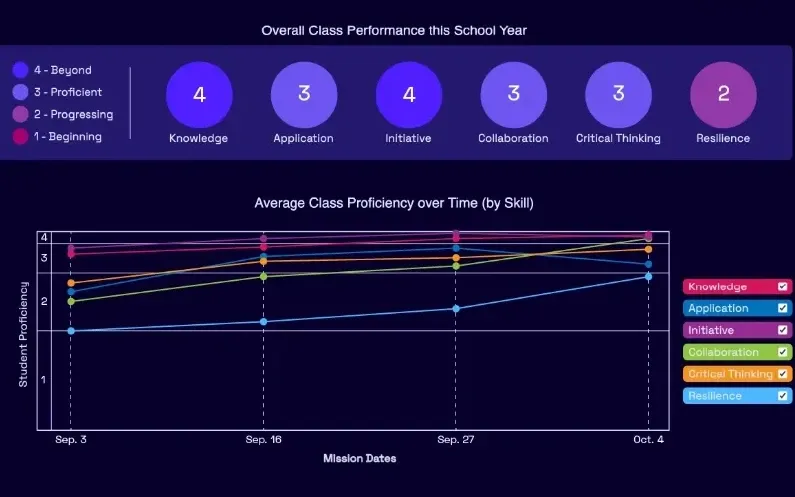
    A Mission.io class report: the class score in each of six skills, from knowledge and application to collaboration, critical thinking, and resilience, with the class chart across the year below.
    A class report from a real Mission: the class score in each of six skills, then each skill across the year.

    Every Mission produces a report for every student, built from what that student did across the whole Mission, on the skills the Mission captured. The six it can capture are Knowledge, Application, Initiative, Collaboration, Critical Thinking, and Resilience. The first two are what a test already sees. The other four are the human skills every school promises. There’s no row called problem solving, and we won’t pretend there is. It lives in the rows around it: whether a student could apply what they knew, think it through, and keep going when the first try failed. The test shows what they know. The report shows the rest. This is where problem solving gets practiced, and the only place the skills under it get measured. SEE THE EVIDENCE →

    You taught it. Now find out who can use it.

    Who's behind it

    Mission.io is a research and design organization with one job: make collaborative, active learning something a teacher can run every unit instead of once a semester, and put a report in your hands when it’s over. Over a million students have run a Mission. The research behind them is funded by the National Science Foundation and the U.S. Department of Education’s Institute of Education Sciences, and Mission.io meets ESSA Level II standards, as validated by Instructure.

    “I even sent an email to my whole building encouraging everyone to try it.”

    Jen, Veteran teacher, OH
    START FREEMISSION BRIEF →

    Free teacher account, no card. Start with the Communication Mission, marked Start here in your library, then Wind and Water, each after its 5-minute Teacher Preview.

Questions 1st grade teachers ask

My 1st graders melt down when a puzzle gets hard. What helps?

Make the puzzle the thing that’s wrong, not the child. Six-year-olds are extremely sensitive to criticism, and a tangram gives them a way out: the piece doesn’t fit, so try another piece. Splitting the set helps too, because a stuck child can ask a partner for a piece instead of wondering if they’re bad at this.

Wouldn't it be faster to give each child a full set?

Faster, yes, and quieter, which is the problem. With a full set, a 1st grader can finish without saying a word. With half a set each, the only way to the roof is out loud: which piece, where, and why. That talk is where you see the thinking.

Are tangrams real math or just a puzzle?

Real math, when they’re run this way. Composing shapes into a new shape is the 1st grade geometry standard (1.G.A.2), and noticing that two small triangles make the square is the structure practice (MP7). The composing fact card at the start is what turns the puzzle into the lesson.

How should I pair 1st graders for this?

Pair them yourself, and expect a little competition. Six-year-olds enjoy group work and like to win, so the split pieces make the pair a team against the roof instead of against each other. Change partners for the next puzzle so nobody gets the same half every time.