Kindergarten problem solving activities

One classic rebuilt so kindergartners solve a problem they can see and touch, five more fixed, a free sheet, and the whole-class Mission we’d run with kindergartners.

Who we are. Mission.io makes Missions: teacher-led, whole-class simulations where students use what they’re learning to work through a real scenario together.

Everything on this page works without us. The Mission we’d run with kindergartners waits at the end, free. (A fish in it is tangled in seaweed. Nobody has to carry a single chair.)

On this page

What problem solving looks like in kindergarten

Kindergarten problem solving activities give five-year-olds a story they have to understand before they can answer it, so they act it out, count it, and check it, usually with their own bodies or a handful of cubes. This page takes the one nearly every kindergarten teacher already runs and rebuilds it so every child on the rug does the thinking.

Five-year-olds think out loud before acting, and they tend to see one way to do things. Acting a story out is that thinking out loud, turned into something you can watch, and asking two children to act the same story two different ways is how a second way shows up. Their planning skills are still coming in, so the plan has to live outside their heads, in cubes and chairs they can see (Harvard’s Center on the Developing Child).

The standard asks kindergartners to solve addition and subtraction story problems within 10 by using objects or drawings to show the problem (CCSS K.OA.A.2), and to make sense of a problem before solving it, which at five means retelling the story first (CCSS Mathematical Practice 1). The activity below sets the story at your own snack table.

Six things that make a problem worth solving at five

Can five-year-olds really problem solve? Yes, with one honest caveat. A review of letting students try a problem before they’re taught (53 studies, 166 comparisons) found that trying first beat teaching first, but most of those students were 12 to 18, and it worked less well with younger kids who didn’t have the background yet (Sinha and Kapur, 2021). So in kindergarten the numbers get taught first, the struggle stays short, and the plan sits on the rug where a five-year-old can see it. Here’s each of the six in kindergarten; the K to 8 problem solving guide has the studies.

  1. 1. A real problem with stakes the class can feel.

    “Three birds flew away” asks nothing of anyone. “Do we have enough chairs for snack?” does, because if the answer is no, somebody has to go get one.

  2. 2. Apply, don't recall.

    At five, applying means showing the story with something you can touch. That’s the heart of K.OA.A.2: objects or drawings first, number sentences later.

  3. 3. Group goals with individual accountability.

    Three children act and twenty-one watch, and the watchers learn to watch. Give every child a job in the story and the rug stops being an audience.

  4. 4. The teacher leads the thinking.

    You tell the story and you ask the questions, sitting at their eye level. Kindergartners need a grown-up to say the thinking out loud before they can do it on their own.

  5. 5. A debrief where the class argues it out.

    Five minutes, still on the rug: which way of acting it made counting easiest, and did the Counters agree? Keep it short if you have to, but keep it.

  6. 6. A way to see who did what.

    If you can’t say which child retold the story and which one echoed the Counter, you’re guessing. A class list and a pencil end the guessing.

Count the chairs. Then carry them.

Most kindergarten story problems hit two or three of the six. Here’s the one you probably ran this month, rebuilt to hit all six. The snack table sheet has every card for the rug →

Act-it-out story problems, rebuilt to hit all six

You know it. You tell a story with numbers in it (“Eight birds were in the fountain. Three flew away.”), a few children act it out with their bodies or cubes, and the class works out how many are left before anyone writes a number sentence. It’s the right instinct; Illustrative Mathematics opens its kindergarten story problem lessons by asking how the class could act the story out. As usually run, though, three children act, everyone else watches, and the birds are fine either way.

Two changes fix it: make the story about something the class actually has to decide, and give every child a job in it.

Time
About 26 minutes on the rug: 3 to set up the chairs, 6 for each of three stories, 5 for the debrief. Short on time? Two stories and the debrief make 20.
Groups
The whole class. Story one has 13 jobs (9 Actors, 2 Counters, a Checker, a Recorder); rotate them across three stories so everyone acts and everyone counts.
Supplies
Chair cards, a tub of cubes, chart paper, and the real chairs at your snack table. Nothing to buy.
Standards
CCSS K.OA.A.2 (solve story problems within 10 with objects or drawings), CCSS Mathematical Practice 1.
  1. The problemStakes

    Set it at your own snack table: “We have 8 chairs at the snack table. 5 friends are sitting. The bus brought 4 more friends. Do we have enough chairs? If not, how many do we carry over from the reading corner, and who carries them?” Then say the stakes out loud: whatever the class decides, the class carries.

  2. Show it before you say itApply

    Nobody says a number until the story is on the rug. Children act it with their bodies first, then again with cubes, and the Recorder draws it as circles on the chart with your hand on the marker. Objects or drawings, then the answer: that’s the standard, word for word.

  3. A job for every childAccountability

    Four jobs, each with one thing only that child does. Swap them every story, so nobody spends the morning as the same chair.

    • Actor

      Sits down or stands up when the story says so.

    • Counter

      One of two. Counts the friends out loud, and both Counters have to agree.

    • Checker

      Holds the chair cards and says whether there are enough.

    • Recorder

      Draws the story on the chart as circles, with your help.

  4. You lead the thinkingTeacher leads

    Three questions, asked from the rug: What happened first in the story? How many now, and how do you know? Is that the same answer the Counters got? Ask the third one even when they agree.

  5. A second story that flips the questionApply

    Story two keeps the snack table and changes the question: now there are 10 friends and 8 chairs, so how many have to stand? The children who found story one easy have to show it a new way. Story three is a Take From card from the sheet, with the jobs rotated again.

  6. The debriefDebrief

    Five minutes, everyone still on the rug. Which way of acting it made counting easiest, bodies or cubes? Did the two Counters agree, and if not, what did they do? How many chairs do we carry? Then carry them.

  7. See who did whatSee who did what

    The tally is your class list with four columns: retold the story in order, showed it (bodies, cubes, or a drawing), counted and checked, explained a way to a friend. Mark as you go. The Counters and the Checker talk by design and the Actors are easy to spot, so you’ll catch about half the rug each story, and three stories catch nearly everyone.

(Have the 4 bus friends walk in from the doorway. A story problem lands harder when it arrives in person.)

Kindergartners will remember the morning they counted wrong and somebody had to stand. They’ll count twice next time.

The snack table story problems, free

Emailed now, ready to copy: the teacher page, four job cards, three story cards with blanks for your class’s own numbers (Add To, Compare, Take From), the chair cards, the circle chart, and the four-behavior tally.

It’s on its way.

Check your inbox for the snack table story problems.

Email me the sheet. It comes as a PDF, ready to print. Unsubscribe anytime.

Five more classics, and the fix each needs

Kindergarten is full of activities with problem solving in the name and a center timer at the end. Every one below gets better with the same six.

Five more for kindergarten

1. Pattern block and tangram puzzles

Needs pattern blocks or a tangram set, outline cards. Solo or pairs.

Children fill an outline card with pattern blocks or tangram pieces, turning each shape until it fits. Fitting shapes is real kindergarten geometry, and it puts what they know about sides and corners to use. As usually run, though, it’s a center for one child at a time, with nothing riding on it and nobody talking about it after.

The fix

  1. Split the blocks between two children, so neither can finish the outline alone.
  2. Each child places only their own blocks, so the outline needs both of them.

See tangrams rebuilt for 1st grade, with the pieces split between partners →

2. Shape scavenger hunt

Needs a clipboard and a pencil. Solo or pairs, around the room.

Children walk the room with a clipboard, hunting for the circles and squares hiding in clocks, windows, and rugs. It gets them looking hard at real shapes. As usually run, though, it’s a walk with a clipboard: each child checks boxes alone, and nobody asks how they knew it was a square.

The fix

  1. Give each pair one clipboard.
  2. No check mark goes down until both partners agree it’s a square and say why, like “four sides, all the same.”

No page for this one; with the agree-first rule it’s a fine warmup.

3. The gingerbread man's bridge

Needs a fairy tale and the build bin. Small groups.

A fairy tale sets up a build: get the gingerbread man across the river, or build the third pig a better house. The story gives five-year-olds stakes they care about, and the build puts what they know to use. As usually run, though, it’s a STEM day where a few hands do the building, and nothing records who did what.

The fix

  1. Give every pair of hands a named job, said out loud before the build starts.
  2. End with one question for the group: which change made it hold?

See the build challenges for kindergarten →

4. Counting collections

Needs a bag of objects per pair, a recording sheet. Pairs.

Each pair gets a bag of buttons or bears and counts it any way they like, by ones, in piles, or in rows. Counting is the math they’re learning, and when you sit down at the table you’re leading the thinking. As usually run, though, it’s a center where one partner does most of the counting, and the count disappears when the bag goes back.

The fix

  1. Partners draw how they counted, together, on one recording sheet.
  2. Then they compare with a pair that counted a different way.

See counting collections rebuilt for kindergarten math →

5. Jigsaw puzzles at a center

Needs a puzzle. Solo.

Children put a jigsaw puzzle together at a center, alone. It’s good for small hands and patience. As usually run, though, it’s practice: one right answer, the picture on the box, and nothing to decide or talk about after.

The fix

  1. Keep it as a center for small hands and patience.
  2. Stop calling it problem solving, and save that name for the activities above.

No page for this one; it’s already good at what it’s for.

  • Our part · We make Missions

    Or let a Mission carry the story while you ask

    Plenty of kindergarten teachers run story problems by hand all year, and they work. A Mission is a teacher-led, whole-class simulation: we connect every child’s screen, play the story, and keep it moving, so you can do the part kindergartners need a grown-up for, asking the next question and noticing who’s onto something.

    You're at the helm, not on the hook.

    Tools of the Trade: the Mission we'd run in kindergarten

    Tools of the Trade · Grades K to 2 · About 10 minutes · One device per student, plus your projector · Free with a teacher account

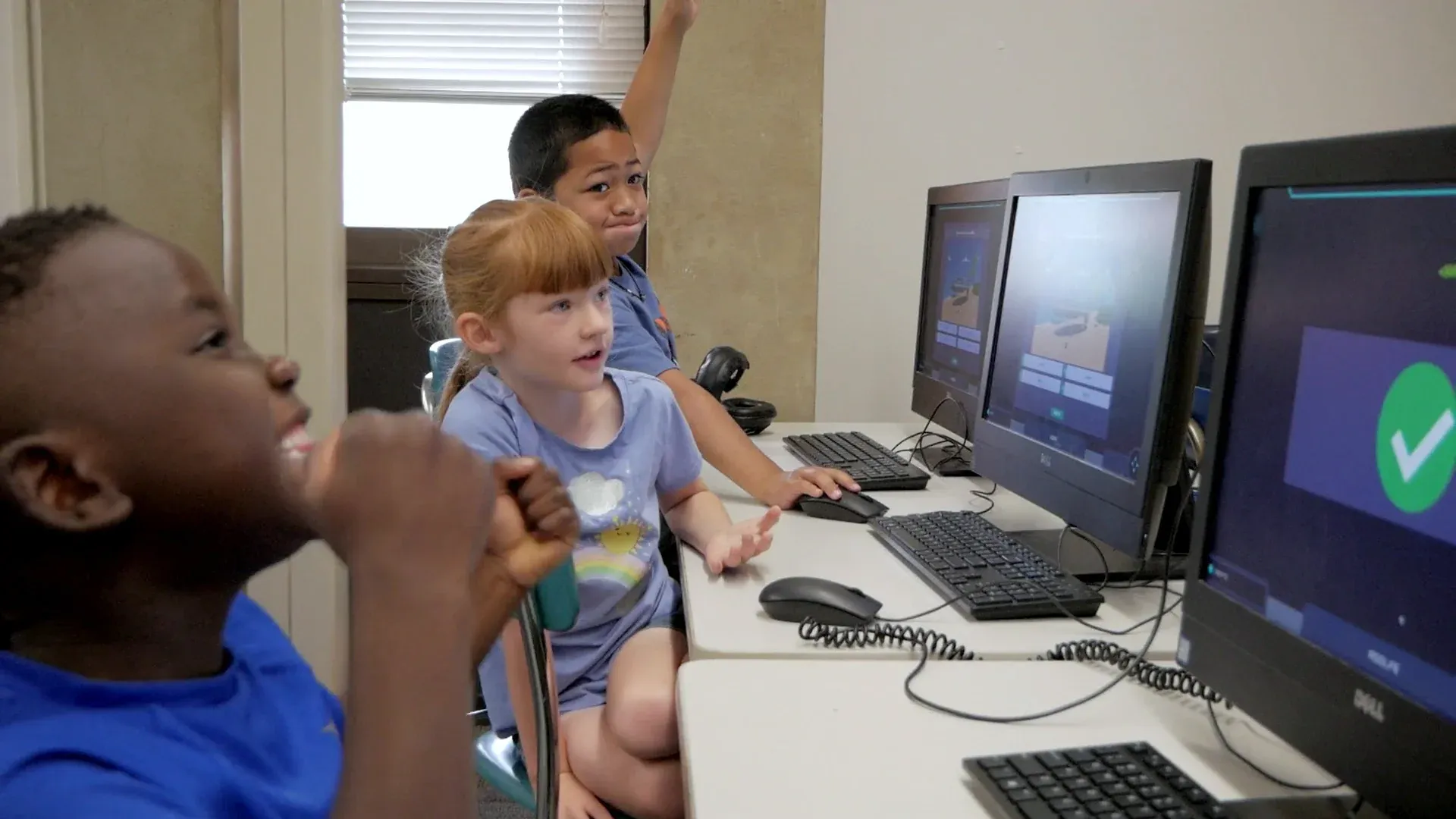
    Three young students at desktop computers, one boy grinning with his fists up and another with an arm raised high, while a green checkmark fills the nearest screen.
    What you'll see: a row of small faces at their screens, one hand shooting up, and somebody very pleased with a green checkmark.

    Ziggy, a fishy friend of the crew, is tangled in seaweed underwater, and your class has to find the best way to rescue him with the materials on hand. His story plays on your projector, and each child weighs the rescue ideas on their own screen.

    Every kindergartner gets a screen of their own; there are no stations or crew teams in this one. The story goes the way most of the class chooses, and each child’s own choices and answers go into their report. You’re down at their level, asking which idea works with what you have.

    Against the six:

    • Stakes. Ziggy is stuck, and the crew only has what’s on hand.
    • Apply. Children weigh different rescue ideas and pick the best one for the materials they have, the K to 2 engineering standard in miniature (NGSS K-2-ETS1-1).
    • Accountability. No child rides along: each one picks a rescue idea on their own screen.
    • Teacher leads. Watch the 5-minute Teacher Preview, press Start, and ask your three while the Mission carries the story: What is the problem, exactly? What do we have to work with? Which idea works best with what we have?
    • Debrief. The library’s Mission Guide lists two debrief activities, one of them Save Ziggy: Part 2.
    • See who did what. Every child gets a report on how well they did, built from their own choices and answers across the Mission.

    “Unprompted, the students all began to applaud like you see in the videos of NASA control rooms. It made my day.”

    Charity Perry, Kindergarten teacher, Pony Express Elementary, UT

    Will it work in my room?

    Students join with a class code: no student accounts, no student email, no passwords. Chromebooks, laptops, or tablets, plus your projector. Free for teachers, no credit card. Student data is covered by COPPA and FERPA, and we signed the Student Privacy Pledge. No projector or devices? The snack table needs neither, and the sheet still works.

    START FREE →

    Communication first, then this one

    This is one Mission. More than 100 are built the same way, from fossils to fractions, and each gives a unit somewhere to land, with a report on every student every time.

    What the report shows

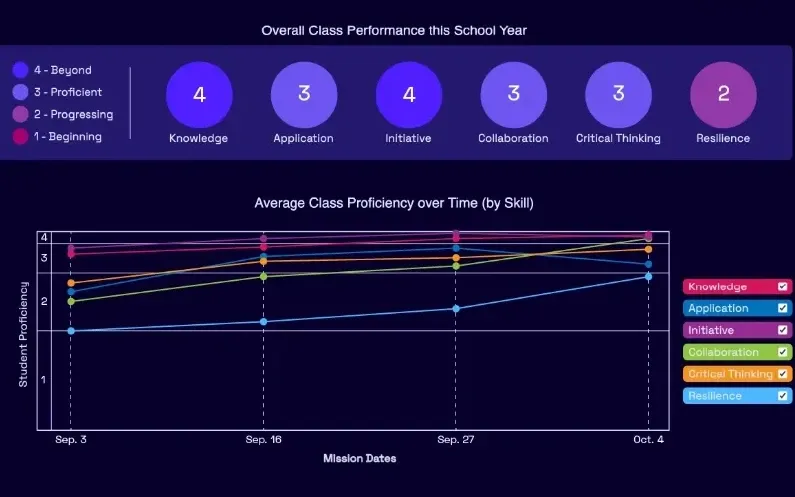
    A Mission.io class report: the class score in each of six skills, from knowledge and application to collaboration, critical thinking, and resilience, with the class chart across the year below.
    A class report from a real Mission: the class score in each of six skills, then each skill across the year.

    Every Mission produces a report for every student, built from what that student did across the whole Mission, on the skills the Mission captured. The six it can capture are Knowledge, Application, Initiative, Collaboration, Critical Thinking, and Resilience. The first two are what a test already sees. The other four are the human skills every school promises. There’s no row called problem solving, and we won’t pretend there is. It lives in the rows around it: whether a student could apply what they knew, think it through, and keep going when the first try failed. The test shows what they know. The report shows the rest. This is where problem solving gets practiced, and the only place the skills under it get measured. SEE THE EVIDENCE →

    You taught it. Now find out who can use it.

    Who's behind it

    Mission.io is a research and design organization with one job: make collaborative, active learning something a teacher can run every unit instead of once a semester, and put a report in your hands when it’s over. Over a million students have run a Mission. The research behind them is funded by the National Science Foundation and the U.S. Department of Education’s Institute of Education Sciences, and Mission.io meets ESSA Level II standards, as validated by Instructure.

    “Observe a mission in another classroom. It will change the way you think about them.”

    Danica Puente, Teacher, Holbrook Elementary, UT
    START FREEMISSION BRIEF →

    Free teacher account, no card. Start with the Communication Mission, marked Start here in your library, then Tools of the Trade, each after its 5-minute Teacher Preview.

Questions kindergarten teachers ask

Are kindergartners too young for real problem solving?

No, as long as the problem is one they can see. Even three-year-olds can reason about things they understand; what five-year-olds are short on is background knowledge and the ability to hold a plan in their heads (Willingham, 2007). So keep the struggle short, put the plan in their hands (cubes, chairs, their own bodies), and teach the numbers before you ask them to use the numbers.

How do I keep the whole rug involved when only a few children are acting?

Give the watchers jobs too. In the rebuilt version nobody just watches: the Counters count out loud, the Checker rules on the chairs, the Recorder draws, and the jobs rotate every story. A child with no job this round is a Counter’s backup and has to say whether they agree.

Should kindergartners write number sentences for story problems?

Not yet, unless they want to. The kindergarten standard asks them to solve story problems with objects or drawings (K.OA.A.2), and the equation can come later. The circle chart is the number sentence a five-year-old can actually read.

How do I know which kindergartners are actually problem solving?

Tally four things on your class list while you lead: retold the story in order, showed it with bodies, cubes, or a drawing, counted and checked, explained a way to a friend. Three stories gets a mark next to nearly every name, and a child with four empty boxes is the child to sit beside tomorrow.

A problem small enough to carry

Start this week: the snack table story by hand with the sheet, or Tools of the Trade after its 5-minute Teacher Preview.