Kindergarten STEM activities

The Three Little Pigs house rebuilt so kindergartners test it like engineers, five more build challenges fixed, a free printable, and every kindergarten Mission by subject.

Who we are. Mission.io makes Missions: teacher-led, whole-class simulations where students use what they’re learning to work through a real scenario together. We build every one on the six things in our STEM activities for students, K-8 guide, and every student gets a report on how well they did.

You don’t need us to use this page: the pigs’ house, the five challenges, and the sheet all work on their own. Every kindergarten Mission is at the end, by subject, free. (The one we’d run in kindergarten puts satellites back in orbit with a push or a pull. The wolf was not invited.)

On this page

What kindergarten STEM looks like

Kindergarten STEM activities are challenges in which a small team builds something to solve a problem, tests it the same way every time, and talks about what the test showed, with each child answerable for one part. This page rebuilds the Three Little Pigs house to the K to 2 engineering standard (K-2-ETS1-1 and K-2-ETS1-3: define a simple problem, then compare two tested solutions by how well each one held up), fixes five more build challenges, and lists every kindergarten Mission by subject. The year’s content (pushes and pulls, sunlight warming the ground, what plants and animals need, and the weather; counting and shapes) lives on the subject pages.

Most of what gets called a STEM challenge in kindergarten is a craft with a story stapled to it. Kids stack, tape, and squish, and we call it engineering. The pigs’ house stands in for all of it, and most years it goes the same way: a pile of straws and sticks, a fan, three huffs, and a shriek when the straw house goes over.

Keep the wolf. Kindergartners will build for a pig with a care they never bring to a worksheet. What goes missing is everything around him: nobody decided what the house had to survive before they built it, nobody tested every house the same way, and afterward nobody can say why the block house stood. The challenge below puts those back, with the same straws and the same fan, in one morning block.

Six things that turn a build contest into engineering

We’ve run this check with STEM teams in the districts we work with, and the craft project skips the same three every time: a real problem, criteria for success, and any pressure to iterate. If the finished product is all the activity asks for, the learning is optional. The fix is a small step before the build and a small step after it, and nothing on the tray changes. One number is worth carrying down: when a group shared a goal and each student answered for a part, 84% of studies found a positive effect; without both, 17% (Slavin, 1991).

  1. 1. A real problem with stakes the class can feel.

    “Whose house stood up?” is a contest. “The pig’s house has to keep the wolf out through three huffs” is a problem.

  2. 2. Apply, don't recall.

    A material chart the class makes before anyone builds. If a team can build the whole house without the idea you charted that morning, the idea wasn’t needed.

  3. 3. Group goals with individual accountability.

    The one most build challenges miss: one child builds and three watch. Three roles, one job each, and a role card with each child’s photo or name on it.

  4. 4. The teacher leads the thinking.

    The wolf is yours, and so are the questions: three at the base of each house while they build, then the same three huffs from the same spot for every house, counted out loud.

  5. 5. A debrief where the class argues it out.

    Houses on the rug in front of everyone, and the question is what the ones still standing had in common.

  6. 6. A way to see who did what.

    If you can’t tell which child chose the blocks and which one only held the plate, all you know is which house stood.

A house the wolf can’t blow down is a story. A house the team can explain is engineering.

The free printable at the end of the next section puts all six on the tray, ready to copy. Get the sheet →

The Three Little Pigs house, rebuilt for kindergarten

The Three Little Pigs house is the build challenge kindergarten teachers run in the first month, because the story is already in the room: a house for a pig from straws, craft sticks, or blocks, and a wolf (a small fan or a squeeze bottle) that tries to blow it down. The way it usually runs is a free build, the teacher on the fan, and “whose house stood up?” Here’s the version that hits all six.

Needs
For seven houses: 200 straws, 100 craft sticks, a tub of wooden blocks or LEGO, 7 small paper plates as bases, a roll of masking tape, Play-Doh, and a small fan or a squeeze bottle. Under $15 if the blocks are already in the room.
Time
About 50 minutes with the story read aloud. 45 if you read the story earlier in the day; keep the debrief whole.
Groups
Threes. With 20 children, six groups of three and one pair; in the pair, the Builder also checks.
Standards
K-2-ETS1-3 (compare two tested solutions) and K-2-ETS1-1 (define a simple problem). The air pushing on the house is a K-PS2-1 conversation too (pushes of different strengths), but the engineering codes are the honest ones.
  1. Teach first, 10 minutesApply

    Read the story. Then pass around three materials (a straw, a craft stick, a wooden block) and let every child feel each one. Ask one question and chart the answers: which of these would be hardest for the wolf to push over, and why? That chart is what they’ll use.

  2. The problem, 2 minutesStakes

    The pig’s house has to keep the wolf out through three huffs. Say the stakes out loud: a house that falls on huff two means the pig moves in with his brother, and the brother’s house is small. The problem box on the sheet says the three-huff rule in a few short words you read aloud, and the team draws its house under it.

    • Criteria: the house stands through all three huffs.
    • Constraints: only what comes off your tray, six minutes to build, and the wolf blows from the same spot for every house.
  3. Three roles, one job eachAccountability

    On the role cards, with each child’s name on theirs, or a photo taped on.

    • Builder

      The only hands on the house.

    • Material Picker

      Chooses what comes off the tray and has to tell the Builder why.

    • Checker

      Gives the house a gentle one-finger push before the wolf comes and tells the Builder what wobbled.

  4. Build, 6 minutes, with the Checker's pushApply

    The Checker pushes before the wolf does, so the team finds the wobble while there’s still time to fix it. A team that skips the push finds out on huff one.

  5. The first wolf testTeacher leads

    Three huffs from the fan at the same distance for every house, and you count them out loud. Before the fan comes out, crouch at the base of each house and ask three questions (What is the wolf going to push on first? What did the Checker’s push tell you? What would you change if you had one more minute?), then listen for the team that answers with a reason.

  6. Change one thing, 2 minutes, then the wolf againApply

    Kindergartners can change one thing; they can’t redesign a house, and nobody should ask them to. Then the second wolf test: same fan, same spot, same three huffs.

  7. The debrief, 8 minutes on the rugDebrief

    Houses in front of the class. Which houses stood up through all three huffs, and what did they have in common? What did your team change, and did it help? Who in your group had an idea the Builder used? That last one is the question that makes a five-year-old sit up.

  8. See who did whatSee who did what

    The observation sheet, four behaviors per child, tallied while you walk: tried an idea, used a teammate’s idea, said why (any reason, out loud), kept going after a wobble. You’ll catch about a third of the room in one period, because you’ll be managing tape. That’s enough to see who never touched the house, and the role cards with names on them show the rest, at a glance, before you grade anything.

  9. Once a week, or four sections in a row

    The two-visit version, for a short block or a once-a-week lab: the story, the material chart, the build, and the first wolf test on visit one, with each house on its plate in a labeled bin; the change, the second wolf test, and the debrief on visit two. Each team’s Play-Doh goes in a zip bag with their names on it, or it’s a pebble by next week. Four sections in a row: bags, not trays, packed the day before, and a tape mark on the floor so the wolf stands in the same spot all day.

(There’s usually one team that builds with straws anyway, knowing exactly how the story ends. Theirs is the house the debrief needs.)

Keep the wolf. Put the chart in front of him and the rug after him, and it’s engineering.

The Three Little Pigs house, free

Emailed now, ready to copy: the teacher page, three role cards, the team page (the three-huff rule with room to draw the house, and the wolf-test log), and the four-behavior tally.

It’s on its way.

Check your inbox for the Three Little Pigs house.

Email me the sheet. It comes as a PDF, ready to print. Unsubscribe anytime.

Five more kindergarten STEM challenges, fixed

Five more that every kindergarten list carries: what each one is, how it usually runs, and the couple of changes that fix it.

Five more for kindergarten

2. The tallest cup tower

Needs plastic cups, a small stuffed animal. Groups of three.

Teams stack plastic cups into the tallest tower they can, usually as a race or a free build, and the tallest one gets a cheer. Children love it, and the cups are already in the cupboard. As usually run, though, nothing has to sit on top, one child stacks while the others hand up cups, and nobody says afterward why the tall ones stayed up.

The fix

  1. Add a load: the tower has to hold a small stuffed animal on top, so a tall, wobbly tower doesn’t win.
  2. Give each child one job (one stacks, one hands up cups, one watches for a wobble), so every child has a part in the tower.
  3. Bring the towers to the rug and ask what the ones that held the animal had in common.

See the cup tower rebuilt on the 1st grade engineering page, stuffed animal included →
3. Sink or float

Needs a tub of water, a tray of small objects. Groups of three at the tub.

Children guess whether each object on the tray will sink or float, drop it in the tub, and check the guess on the class prediction chart. When you ask why after each drop, it has them using what they know, and you’re the one leading the thinking. As usually run, though, a couple of children do most of the dropping, the guesses come with no reason, and afterward you can’t tell who thought what.

The fix

  1. Give each child two objects from the tray to own; only the owner drops them.
  2. Before each drop, the owner says a reason out loud: “It will float because it’s light,” or “It will sink because it’s metal.”

No page for this one; the reason before the drop is the whole fix.

4. Paper airplane distance

Needs paper, a hallway or the gym floor. Groups of three.

Every child folds a paper plane and throws it down the hallway or across the gym floor, and the one that goes farthest wins. Nobody needs convincing to try it. As usually run, though, everyone folds a different way, nobody measures, and the contest ends with no one sure what made a plane fly farther.

The fix

  1. Teach one fold to the whole class first, step by step, so every team starts from the same plane.
  2. Make one child on each team the Recorder, who counts the floor tiles from the line to where each plane lands.
  3. On the rug, ask what the planes that flew farthest had in common.

See it rebuilt for 3rd grade →

5. Pumpkin or apple boats

Needs a small pumpkin or apple half per team, pennies or marbles, a tub of water. Groups of three.

Each team gets a pumpkin or apple half (a grown-up does the carving), floats it in the tub, and loads it with pennies or marbles until it tips. A boat that might sink is a problem kindergartners feel right away, and they’ll talk about it all day. As usually run, though, it’s a party-day activity where every hand is in the water at once and nobody keeps count, so it ends in wet sleeves.

The fix

  1. Give each boat three jobs, one child each: a Loader, whose hands are the only ones in the water, a Counter, and a Caller who calls out when the boat starts to tip.
  2. The Counter says the count out loud after every penny, so the whole team knows how many the boat held.

No page for this one; three jobs and a count said out loud cover it.

6. The ice cube melt race

Needs one ice cube per child, small cups. Individual, then the whole class.

The class guesses where in the room an ice cube will melt fastest, then sets out cups to find out. It’s a real question for kindergartners, and they’ll check on a cup all morning. As usually run, though, it’s one cup on a sunny windowsill that the whole class watches, so no child owns a spot or a result.

The fix

  1. Give each child one ice cube in a cup and one spot in the room to own: the windowsill, under a desk, by the door.
  2. Call a check every couple of minutes, and each child looks at their own cube and tells you how much is left.

See the ice cube get a shade structure on the kindergarten engineering page →

  • Our part · We make Missions

    Then the unit has somewhere to go

    Plenty of teachers rebuild these by hand every unit, and it works. A Mission is a teacher-led, whole-class simulation on the standard the unit was teaching: the story plays on your projector, every child has a part on their own screen, and the only way through is using what they just learned. The pigs’ house belongs to your engineering unit, and Pushing and Pulling belongs to the pushes and pulls unit. The Missions on the pigs’ own standard open the engineering table below.

    You're at the helm, not on the hook.

    Pushing and Pulling: the Mission we'd run in kindergarten

    Pushing and Pulling · Kindergarten · About 17 minutes · One device per student, plus your projector · Free with a teacher account

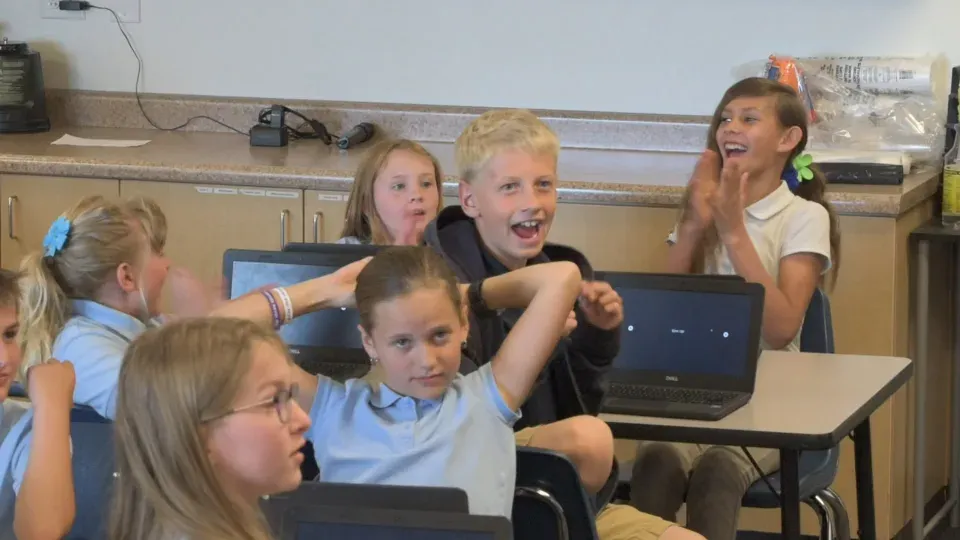
    Young students in light blue uniform shirts clap and cheer at their laptops, one boy grinning wide and a girl in front with both arms up behind her head.
    What you'll see: a table that just got one right, and you asking whether that satellite needed a push or a pull before anyone moves on.

    Dr. Marvin’s satellites have slipped out of their orbits, and the class has to put them back: decide whether a satellite needs a push or a pull, then watch footage of a second satellite being pushed into position, work out what went wrong, and correct it (K-PS2-1, K-PS2-2). The story plays on the projector, and every child makes the call on their own screen; there are no stations or crew teams in this one. The story goes the way most of the class chooses, and each child’s own choices and answers go into their report.

    We connect every screen and move the story forward. You get the part kindergartners need a grown-up for: down at their level, asking push or pull, and how they know.

    The air that knocks a straw house over is a push, so the wolf gives you the words for it.

    “Unprompted, the students all began to applaud like you see in the videos of NASA control rooms. It made my day.”

    Charity Perry, Kindergarten teacher, Pony Express Elementary, UT

    Will it work in my room?

    Students join with a class code: no student accounts, no student email, no passwords. Chromebooks, laptops, or tablets, plus your projector. Free for teachers, no credit card. Student data is covered by COPPA and FERPA, and we signed the Student Privacy Pledge. See every class once a week in a lab? Then the lab is where the Mission runs and the classroom is where the unit runs: ask the kindergarten team what they just finished, pick that row below, and run it the week after.

    START FREE →

    Communication first, then two for kindergarten

    What the report shows

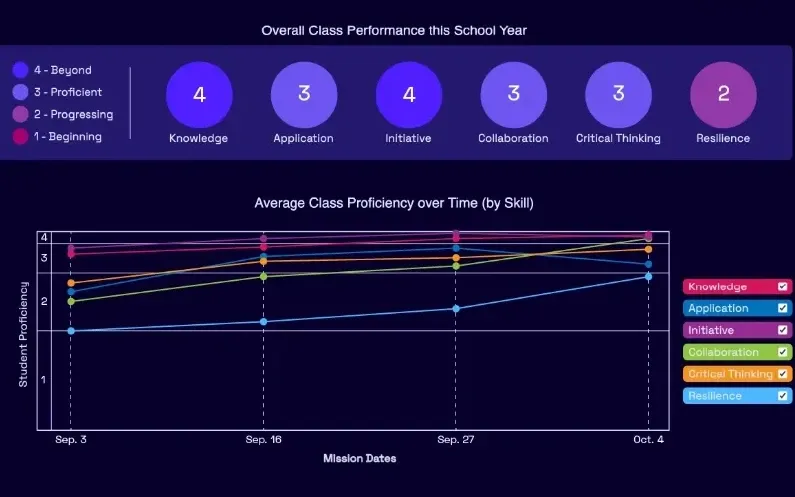
    A Mission.io class report: the class score in each of six skills, from knowledge and application to collaboration, critical thinking, and resilience, with the class chart across the year below.
    A class report from a real Mission: the class score in each of six skills, then each skill across the year.

    Every Mission produces a report for every student, built from what that student did across the whole Mission, on the skills the Mission captured. The six it can capture are Knowledge, Application, Initiative, Collaboration, Critical Thinking, and Resilience. The first two are what a test already sees. The other four are the human skills every school promises. The test shows what they know. The report shows the rest. SEE THE EVIDENCE →

    You taught it. Now find out who can use it.

    Who's behind it

    Mission.io is a research and design organization with one job: make collaborative, active learning something a teacher can run every unit instead of once a semester, and put a report in your hands when it’s over. Over a million students have run a Mission. The research behind them is funded by the National Science Foundation and the U.S. Department of Education’s Institute of Education Sciences, and Mission.io meets ESSA Level II standards, as validated by Instructure.

    “My students ask every time they walk in the door, ‘IS IT A MISSION DAY?’”

    Kate Fallon, Teacher, St. Amelia School, NY

    Every kindergarten Mission, by subject

    Pushing and Pulling is one. There are 17 STEM Missions at kindergarten, numbered 7 to 23 below, and each one is where a unit can end: the engineering week ends at Beach Frenzy, pushes and pulls end at Pushing and Pulling, counting ends at Finding Will. Every lesson finally has somewhere to go. No kindergarten Mission carries a technology code; the kindergarten technology activities page has unplugged ones, and Technology activities for students has every grade, K to 8. Devices out this week and no unit in mind? Tools of the Trade is 10 minutes.

    Engineering

    Two, both on the K to 2 engineering design standard the pigs’ house teaches, and both under 20 minutes. The kindergarten engineering activities page rebuilds a classic of its own. Engineering activities for students has every grade, K to 8.

    Engineering Missions at kindergarten, both on the NGSS K to 2 engineering design standard.
    NumberMissionTopic (code)Minutes
    7Beach FrenzyProtect a robot from the sun’s warming; compare tested designs (K-2-ETS1-1, K-2-ETS1-2, K-2-ETS1-3, K-PS3-1, K-PS3-2, 1-PS4-3; grades K to 2)15
    8Tools of the TradeWeigh rescue ideas and pick the one the materials allow (K-2-ETS1-1; grades K to 2)10

    Science

    Twelve, from pushes and pulls to the weather: the deepest shelf at the grade. The kindergarten science activities page sets each one against the investigation that teaches it. The last four carry 1st grade codes and are built for kindergarten and up. Science activities for the classroom has every grade, K to 8.

    Science Missions at kindergarten, by NGSS code; the last four carry 1st grade codes.
    NumberMissionTopic (code)Minutes
    9Pushing and PullingPushes and pulls: put satellites back in the right orbit (K-PS2-1, K-PS2-2)17
    10Thrive TogetherWhat struggling plants and animals need to thrive (K-LS1-1)14
    11Blossoming ClimatesWeather patterns (K-ESS2-1)17
    12Tackling ToxinsPolluted water, the living things it hurts, and a fix (K-ESS2-2; grades K to 1)21
    13Living ProofHow beavers, prairie dogs, and woodpeckers change their surroundings to meet their needs (K-ESS2-2)19
    14Finding an Ocean HomeFind a home that meets an animal’s needs (K-ESS3-1)12
    15Forecast FiascoWeather forecasts and getting ready for severe weather (K-ESS3-2; grades K to 2)22
    16No, No, DugHelp Dug see how careless choices damaged a neighborhood (K-ESS3-3)18
    17In the CardsSound and vibration (1-PS4-1; grades K to 1)17
    18Dug's Beach PartyTrack daylight patterns to place the beach umbrellas (1-ESS1-1; grades K to 1)21
    19Dark Side of the MoonMoon phases (1-ESS1-1; grades K to 2)27

    Math

    Two, on counting and shapes, both around 20 minutes. The kindergarten math activities page rebuilds a classic for counting. Math activities for students has every grade, K to 8.

    Math Missions at kindergarten, by CCSS code.
    NumberMissionTopic (code)Minutes
    21Finding WillCount to tell how many, and compare two groups (K.CC.B.4, K.CC.B.5, K.CC.C.6)22
    22Dug's Search and RescueName shapes and where they sit: above, below, beside (K.G.A.1, K.G.A.2)19

    Creativity

    One that doesn’t belong to a unit: a creativity Mission for K to 5 that gets RALF to the top of a skyscraper.

    The creativity Mission at kindergarten.
    NumberMissionTopic (code)Minutes
    23Sky's the LimitCreativity and imagination (grades K to 5; no codes listed)18
    START FREEMISSION BRIEF →

    Free teacher account, no card. Start with the Communication Mission, marked Start here in your library, then Pushing and Pulling, each after its 5-minute Teacher Preview.

    Also at this grade

    The Collaboration and Critical Thinking Missions for K to 1 (15 minutes each; the kindergarten collaboration activities and kindergarten critical thinking activities pages build both skills by hand), the Communication Mission from the first tile (19 minutes at this grade), and two outside STEM: Dawn of the Scarecrow (K-3), a listening Mission that ends with a scarecrow designed for RALF (SL.K.2, W.K.8), and Showstopper (K-2), which designs RALF a costume for the annual Robot Costume Contest.

Questions kindergarten teachers ask

I see my kindergartners once a week for STEM. What fits?

The sink or float tub and the cup tower are the short ones; the pigs’ house fits a 45-minute special with the story read in the classroom first, or two visits with the second wolf test on the second. A Mission is one visit, and most at this grade run under 20 minutes (Tools of the Trade, 10; Finding an Ocean Home, 12; Thrive Together, 14; Beach Frenzy, 15). Ask the classroom teacher what unit just ended and pick that row.

Can kindergartners really do engineering?

At kindergarten size, yes. The K to 2 standard asks them to define a simple problem and compare two things they tested (K-2-ETS1-1, K-2-ETS1-3), not to redesign from scratch. That’s why the pigs’ house allows one change between wolf tests: a five-year-old can change one thing and tell you whether it helped.

Most of my class can't read yet. Does the sheet still work?

Yes. You read the three-huff rule aloud from the problem box, and the team draws its house under it. Each role card is a few words, with the child’s name or photo on it. The wolf-test log is a check or an X for each huff, two rounds. The tally is yours to fill in, not theirs.

Should I grade a kindergarten STEM challenge?

Not the house. Watch for the four behaviors on the tally (tried an idea, used a teammate’s idea, said why, kept going after a wobble), and look across two or three challenges before you decide anything about a child. A house that stood without a Checker’s push is a lucky build, and the tally is what lets you see it.