1st grade engineering activities

The cup tower rebuilt so 1st graders test how a shape holds a load, five more design challenges, a free printable, and 1st grade’s 2 engineering Missions by standard.

Who we are. Mission.io makes Missions: teacher-led, whole-class simulations where students use what they’re learning to work through a real scenario together.

Everything on this page works without us. Every 1st grade engineering Mission is at the end, by standard, free. (Tools of the Trade is a fish rescue that takes ten minutes, which is about how long a 1st grader will wait for a tangled fish.)

On this page

What 1st grade engineering looks like

First grade engineering activities are design challenges where the class looks at a problem, builds something whose shape does a job, and tests two versions to see which one works better, with each child answerable for a piece. This page covers the K to 2 engineering design standards, K-2-ETS1-1 to K-2-ETS1-3, with a challenge and a Mission for each. The 1st grade science activities page carries the investigations.

First grade is the middle year of the K to 2 band, and the band asks for three moves. Define a simple problem from what you observe (K-2-ETS1-1). Sketch or build a model that shows how its shape helps it work (K-2-ETS1-2). Then compare two tested solutions to see what each one does well and badly (K-2-ETS1-3). First grade adds a design task of its own: solve a human problem by copying how plants and animals use their parts (1-LS1-1).

A sleeve of plastic cups, a 60-second timer, and the fastest hands in the room stacking while everyone else counts: you know the activity that usually stands in for all of that. Give the tower a job, with a stuffed animal riding on top, and the stacking turns into design.

Six things that turn a build into engineering

The standards set the bar on purpose: NGSS raised engineering design “to the same level as scientific inquiry,” and in K to 2 that means students use tools and materials, drawings, and physical models to solve simple problems and compare solutions (NGSS Appendix I). The catch is the clock. Engineering is written into the science standards, so it shares science’s time, and K to 2 classes average about 17 minutes a day on science (2018 NSSME+). A tower that takes two of those days had better be engineering.

  1. 1. A real problem with stakes the class can feel.

    “Tallest in 60 seconds” is a race. “The lookout has to see over the bookshelf” is a problem.

  2. 2. Apply, don't recall.

    A second round that only works with what the first test showed. If the tower can be finished without testing anything, it isn’t engineering.

  3. 3. Group goals with individual accountability.

    The one most build challenges miss: the fastest hands stack, and the rest of the table watches. When the group shared a goal and each student answered for a part, 84% of studies found a positive effect; without both, 17% (Slavin, 1991).

  4. 4. The teacher leads the thinking.

    The timer doesn’t ask questions. You do. Three at the tower (which shape, what happened when the lookout went on, the bottom or the top) do more teaching than the stopwatch ever did.

  5. 5. A debrief where the class argues it out.

    The build is the setup. The talk afterward, about which towers held the lookout and what their bottoms looked like, is the practice the standards name.

  6. 6. A way to see who did what.

    If you can’t tell which child called the shape and which one only stacked, you can’t teach the design process. You can only time it.

Tall takes cups. Holding something up takes a plan.

The printable at the end of the next section puts all six on the table, with every card and log the activity uses, ready to copy. Get the sheet →

The cup tower, rebuilt for 1st grade (K-2-ETS1-2)

Plastic cups stacked by hand into the tallest freestanding tower, here with a load: a stuffed animal has to sit on top. It’s on the 1st grade STEM lists, and the kindergarten, 2nd, and 4th grade ones too, because it needs nothing but a sleeve of cups, which is why 1st grade teachers reach for it on day one. The way it usually runs is a 60-second race, the fastest hands stacking, and the teacher holding the timer. Here’s the version that hits all six.

Time
35 minutes; this is a short one, and the debrief can run long. The 45-minute version is the full lesson with a drawing step added: draw your tower before you build (K-2-ETS1-2).
Groups
Threes. With 24 children, eight groups of three exactly; with 25, one group of four, where the fourth child is the Drawer.
Supplies for eight towers
160 plastic cups (a sleeve of 200 is about $10), 8 stuffed animals from home, and tape for the line on the wall.
Standards
K-2-ETS1-2 (a model that shows how its shape helps the structure do its job) with K-2-ETS1-3 (compare two tests).
  1. Teach first, 8 minutesApply

    Build a column one cup wide and a pyramid in front of the class, push each gently, and ask which held and why. Name it: a wide bottom holds up a tall top. Draw both shapes on the board; the shapes are what they apply.

  2. The problemStakes

    The stuffed animal is a lookout who has to see over the bookshelf (a height marked on the wall with tape) to watch for the recess bell, and a tower that falls drops the lookout. The criteria: the top of the tower reaches the tape line, and the lookout sits on top for a count of five. The constraints: 20 cups, no tape, 6 minutes.

  3. Three roles, one job eachAccountability

    Names on the role cards. Stacker and Tester swap between rounds.

    • Stacker

      The only hands on the cups.

    • Shape Caller

      Says which shape to build (pyramid, column, or a mix) and why, before the Stacker starts.

    • Tester

      Places the lookout on top and counts to five out loud, hands off.

  4. You lead the thinkingTeacher leads

    Three questions, asked next to the tower: Which shape did you pick, and why? What happened when the lookout went on? What will you change: the bottom or the top?

  5. Two rounds, so the test has to be usedApply

    6 minutes to build and test, 2 minutes to change one thing, then the second test. The change has to answer what the lookout did the first time.

  6. The debrief, 8 minutesDebrief

    Towers still standing, or not. Which towers held the lookout, and what did their bottoms look like? What did your team change, and did it help? Who in your group said something the Stacker used? First graders will name the kid who said “make the bottom bigger,” and that kid will remember it.

  7. See who did whatSee who did what

    The observation sheet, four behaviors per child: proposed a shape, used a teammate’s idea, gave a reason, tested fairly (hands off, counted to five). A tally catches about half the room; the build is fast, and the test is a pause you can use.

(A tower can look perfect right up until the lookout sits down, and then it’s a pile of cups and a very good debrief question.)

Leave the tape line on the wall afterward. Every first grader in the room will check whether they’re taller than it.

The lookout cup tower, free

Emailed now, ready to copy: the teacher page, three role cards, one group page (the tower drawing and the two tests), and the four-behavior tally.

It’s on its way.

Check your inbox for the lookout cup tower.

Email me the sheet. It comes as a PDF, ready to print. Unsubscribe anytime.

Five more 1st grade design challenges, by standard

Five more on every 1st grade list: what each one is, how it usually runs, and what it needs to be engineering, in the order the standards run.

Define, model, compare

2. The clothespin and craft stick bridge (K-2-ETS1-1)

Needs clothespins, craft sticks, two desks for the gap.

Teams clip clothespins onto craft sticks to span the gap between two desks. Clothespins are good practice for first grade fingers, and a bridge that finally reaches the other desk is a big moment. As usually run, though, it’s a free build: once it reaches, it’s done, nothing has to cross it, and there’s no telling who built which part.

The fix

  1. Add a toy car that has to roll from one desk to the other without falling through.
  2. Let teams test with the car as often as they like, and fix the spot where it tips or sags.
  3. End by rolling the car across every bridge and asking which ones it made it over, and why.

No page for this one; the toy car is the fix.
3. The index card structure that holds a book (K-2-ETS1-2)

Needs five index cards, no tape, one book.

Each team gets five index cards, no tape, and a book, and has to fold the cards into something that holds the book up. The supplies are nearly free, and first graders treat it like a puzzle. As usually run, though, teams fold at random until something works, and nobody draws what they tried, so no one can say why the winner held.

The fix

  1. Start with a two-minute lesson: a flat card flops, a folded card stands, because a fold makes a column.
  2. Give one child the Recorder’s job, drawing each attempt before the book goes on.
  3. Hold up the drawings of the ones that held, and ask what their folds had in common.

See it fixed on the 1st grade STEM page →

4. The newspaper tube tower (K-2-ETS1-2)

Needs rolled newspaper, tape.

Teams roll sheets of newspaper into tubes and tape them into the tallest tower they can. First graders love rolling the tubes, and height is easy to measure with a yardstick. As usually run, though, it’s a messy race with no idea behind the build, and at the end no one can say why the tall one stood or who did what.

The fix

  1. Before the build, teach the triangle: four taped tubes in a square squish flat when you push, and three in a triangle hold their shape.
  2. Have each team show you where its triangles will go before the tape comes out.
  3. At the end, each team points to one triangle and says what it’s holding up.

No page for this one; the triangle lesson is the fix.

5. The marshmallow and toothpick raft (K-2-ETS1-3)

Needs marshmallows, toothpicks, a tub of water.

Teams poke toothpicks into marshmallows to build a raft, then set it in a tub of water to see if it floats. It’s a fun first look at floating and sinking. As usually run, though, it’s a craft: the raft only has to float, nothing rides on it, and with no roles, one child often builds it while the rest watch.

The fix

  1. Swap the marshmallows for a square of foil, so the boat’s shape is what the team designs.
  2. Give it cargo: pennies, placed one at a time and spread out, until it sinks.
  3. Split three jobs: a Folder for the foil, a Loader for the pennies, and a Recorder who draws the hull and writes how many pennies it held.

See the foil boat rebuilt for 1st grade →

6. The animal part solution (1-LS1-1)

Needs building materials, a cup of beans for the test.

Students design a tool that works like an animal part, such as a bird’s beak or a crab’s claw. The science gets used, because the tool has to work the way the animal’s part does. As usually run, though, it stays a drawing, so it never gets tested, and there’s no way to see what each student came up with.

The fix

  1. Have each student build their tool from the building materials on the tray.
  2. Test it on a cup of beans: how many beans can it move from one cup to another?
  3. Have each student record the count next to a drawing of their tool, so the class can compare beaks and claws.

No page for this one; the bean test is the fix.

  • Our part · We make Missions

    Then the unit has somewhere to go

    Plenty of teachers rebuild these by hand every unit, and it works. A Mission is a teacher-led, whole-class simulation built from a unit you teach. The cup tower is shape and comparing tests (K-2-ETS1-2, K-2-ETS1-3), and its lookout is a problem with criteria. Tools of the Trade practices defining that kind of problem, and Beach Frenzy builds on it. After the tower, run Tools of the Trade, then Beach Frenzy.

    You're at the helm, not on the hook.

    Tools of the Trade: defining a problem, as a Mission

    Tools of the Trade · Grades K to 2 · About 10 minutes · One device per student, plus your projector · Free with a teacher account

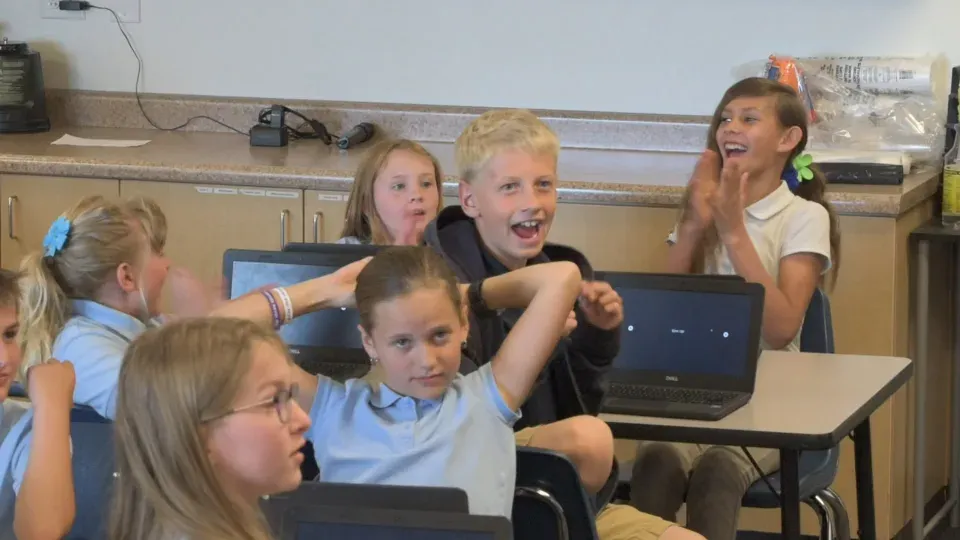
    A class of elementary students at their laptops cheers, arms up and mouths open.
    A class cheering at their laptops.

    Ziggy, a fishy friend of the crew, is trapped underwater, tangled in seaweed. The class assesses different solutions and works out the best way to rescue him with the materials on hand. The story plays on the projector, and every child makes the calls on their own screen; there are no crews or stations in this one.

    Every child weighs the rescue ideas and makes a choice. The story goes the way most of the class chooses, and each child’s own choices and answers go into their report. The screens carry the story, so you’re free to walk the room, asking what the problem is, which tool could reach Ziggy, and what could go wrong with that one.

    It’s built to the first K to 2 engineering code (K-2-ETS1-1), and the vocabulary is the unit’s: observation, develop, solution. Run the cup tower first, and tell the class why: Ziggy needs a crew that can say what counts as rescued before it grabs a tool. The lesson prepares them. The Mission is what they’re preparing for.

    “Observe a mission in another classroom. It will change the way you think about them.”

    Danica Puente, Teacher, Holbrook Elementary, UT

    Will it work in my room?

    Students join with a class code: no student accounts, no student email, no passwords. Chromebooks, laptops, or tablets, plus your projector. Free for teachers, no credit card. Student data is covered by COPPA and FERPA, and we signed the Student Privacy Pledge. At about 10 minutes, Tools of the Trade fits inside the average K to 2 science block of about 17 minutes.

    START FREE →

    Communication first, then the year's two

    What the report shows

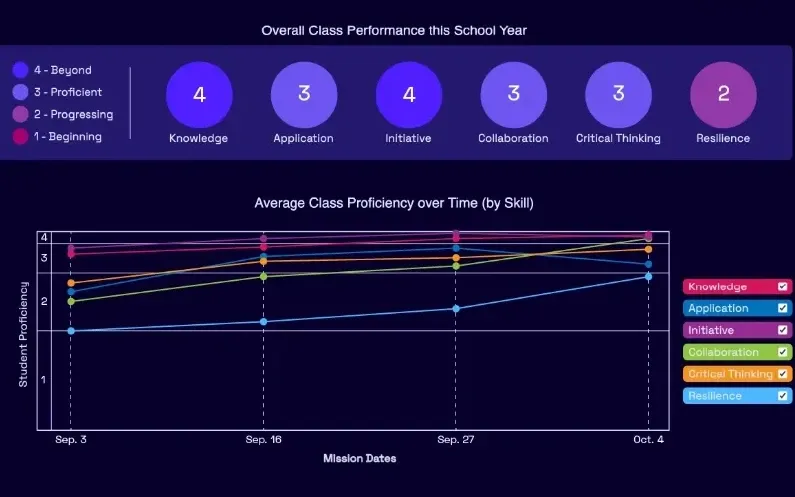
    A Mission.io class report: the class score in each of six skills, from knowledge and application to collaboration, critical thinking, and resilience, with the class chart across the year below.
    A class report from a real Mission: the class score in each of six skills, then each skill across the year.

    Every Mission produces a report for every student, built from what that student did across the whole Mission, on the skills the Mission captured. The six it can capture are Knowledge, Application, Initiative, Collaboration, Critical Thinking, and Resilience. The first two are what a test already sees. The other four are the human skills every school promises. The test shows what they know. The report shows the rest. SEE THE EVIDENCE →

    You taught it. Now find out who can use it.

    Who's behind it

    Mission.io is a research and design organization with one job: make collaborative, active learning something a teacher can run every unit instead of once a semester, and put a report in your hands when it’s over. Over a million students have run a Mission. The research behind them is funded by the National Science Foundation and the U.S. Department of Education’s Institute of Education Sciences, and Mission.io meets ESSA Level II standards, as validated by Instructure.

    1st grade engineering Missions by NGSS standard

    Tools of the Trade is one of two. There are 2 engineering Missions at 1st grade, numbered 7 and 8 below, both built to the K to 2 engineering design standards, and both run from kindergarten through 2nd grade. Each code links to its standard on nextgenscience.org.

    Engineering design (K-2-ETS1)

    Between them, the two cover all three K to 2 design codes, and both fit inside a 17-minute block.

    Engineering design Missions for 1st grade, by NGSS code.
    NumberThe standardMissionMinutes
    7K-2-ETS1-1 Define a simple problem, then choose the best rescue with the materials on hand (grades K to 2). On this page: 2. The clothespin bridge.Tools of the Trade10
    8K-2-ETS1-2, K-2-ETS1-3, K-2-ETS1-1, K-PS3-1, K-PS3-2, 1-PS4-3 Compare designs that shade a robot from the sun, and how each one changes his temperature; the light code (1-PS4-3) is 1st grade’s own (grades K to 2). On this page: 1. The cup tower, 2. The clothespin bridge, 3. The index card structure, 4. The newspaper tower, and 5. The raft.Beach Frenzy15
    START FREEMISSION BRIEF →

    Free teacher account, no card. Start with the Communication Mission, marked Start here in your library, then Tools of the Trade and Beach Frenzy, in that order, each after its 5-minute Teacher Preview.

    Also at this grade

    The 1st grade science activities page maps 17 science and engineering Missions by NGSS code, these two among them; the 1st grade STEM activities page rebuilds the foil boat penny challenge; and for math, see 1st grade math activities.

Questions 1st grade engineering teachers ask

I get 17 minutes for science in 1st grade. Where does engineering fit?

Tools of the Trade is 10 minutes and Beach Frenzy is 15, so either one fits a 17-minute block. The cup tower runs 35 minutes, or 45 with the drawing step, so it needs a longer stretch of the day.

Which 1st grade engineering standards does this page map?

The three K to 2 design standards, in the band’s middle year: K-2-ETS1-1 (define a simple problem), K-2-ETS1-2 (a sketch or model that shows how shape helps), and K-2-ETS1-3 (compare two tested solutions), each with a Mission and a challenge here. First grade’s own design standard, 1-LS1-1, gets a challenge too: 6. The animal part solution.

Why does the 1st grade cup tower lead to Tools of the Trade, then Beach Frenzy?

The tower gives the class a problem with criteria it can say out loud: clear the tape line, and hold the lookout for a count of five. Tools of the Trade is built to that move, defining a problem (K-2-ETS1-1). Beach Frenzy builds on Tools of the Trade and carries the tower’s own two codes, shape and comparing tests (K-2-ETS1-2, K-2-ETS1-3).

How do I grade a design challenge with 1st graders?

Grade the test and the behaviors. Did the lookout stay up for a count of five, and can the team say which shape did it? That’s one look. The four-behavior tally over two or three challenges is the other. A team whose tower fell, with a Shape Caller who can say why, has learned more than a team whose tower stood by accident.

Do 1st grade engineering Missions match my state's standards, not just NGSS?

Each Mission page lists its NGSS codes and the state sets it maps to. Tools of the Trade maps to ten state science sets, from Alaska to Wyoming, and Beach Frenzy to 28.