1st grade math activities

Measuring the room rebuilt so 1st graders measure for a real order, five more activities by standard, a free printable, and the standards each one teaches.

Who we are. Mission.io makes Missions: teacher-led, whole-class simulations where students use what they’re learning to work through a real scenario together.

Everything on this page works without us. The standards this page teaches are at the end, with a Mission where one exists, free. (There’s one, The Flying Machine: space pelicans have clogged the pushinator, the moon is coming down, and nobody has to measure a rug.)

On this page

What 1st grade math looks like

First grade math activities are problems where the class has to use the math to decide something, argue about whether the numbers are right, and leave each student answerable for a piece. This page teaches 10 of the 21 1st grade Common Core math standards, with an activity for seven of them and a Mission for four.

The year has four big jobs. Adding and subtracting within 20 (1.OA). Place value: tens and ones, and counting to 120 (1.NBT). Measuring length by laying units end to end (1.MD.A). And reasoning about shapes and putting them together (1.G). Around them sit telling time to the half hour and sorting data into up to three categories (1.MD.C).

You know the activity that usually stands in for measuring: a bag of paper clips, a desk, and a number on a worksheet nobody needs. Put a rug order behind that number and it has to be right, or three readers end up on the floor.

Six things that turn an exercise into math

Math isn’t short on time: grades K to 2 average about 55 minutes a day on it (2018 NSSME+). It’s short on talk. Observers in more than 2,500 first, third, and fifth grade classrooms found about 90% of instructional time was whole-group lecture or seatwork, and under 10% was small groups (Pianta and colleagues, 2007). That’s the gap worth closing, and first grade is one of the grades they watched.

  1. 1. A real problem with stakes the class can feel.

    “How many paper clips long is the desk?” is an exercise. “The rug order goes in today, measured in craft sticks” is a problem.

  2. 2. Apply, don't recall.

    A second round in a different unit, so the class has to explain why the number changed. If the measuring can be finished without anyone checking for gaps, it isn’t a math activity.

  3. 3. Group goals with individual accountability.

    The one most measuring activities miss: one child laying clips, one child counting them. When the group shared a goal and each student answered for a part, 84% of studies found a positive effect; without both, 17% (Slavin, 1991).

  4. 4. The teacher leads the thinking.

    Three questions on the floor beside the line (any gaps, why more cubes than sticks, which unit should the catalog use) beat a worksheet of twenty at the desk.

  5. 5. A debrief where the class argues it out.

    The measuring is the setup. The argument afterward, about why two pairs got different numbers for the same rug, is the practice the standards name: use tools strategically (MP5) and attend to precision (MP6).

  6. 6. A way to see who did what.

    If you can’t tell which student laid the sticks end to end and which one only wrote the number down, you can’t teach measuring. You can only record it.

Any line of clips gives a number. No gaps gives a length.

The sheet at the end of the next section puts all six on the floor: role cards, the record card, the catalog slip, and the tally. Get the sheet →

Measuring the room, rebuilt for 1st grade (1.MD.A.2)

Pairs measure desks, rugs, and doorways in paper clips, cubes, or their own feet, and record the lengths. It’s the 1.MD.A.2 lesson in nearly every curriculum, because in 1st grade the room is the manipulative. The way it usually runs is one child laying clips, one child counting, and a number with no reason to be right. Here’s the version that hits all six.

Time
40 minutes, inside an average K to 2 math block of about 55.
Groups
Pairs. With 25 children, twelve pairs and one trio, where the third child is a second Checker.
Supplies
12 bags of 30 paper clips, 12 bags of 30 cubes, 12 bags of 15 craft sticks, and masking tape to mark the rug space in four or five spots around the room, so pairs aren’t on top of each other. About $4 beyond what’s in the room.
Standards
1.MD.A.2 (length as a whole number of same-size units laid end to end, with no gaps or overlaps), with 1.MD.A.1 in the debrief (compare two lengths by using a third) and the practices MP5 (use tools strategically: which unit fits the job) and MP6 (no gaps, no overlaps).
  1. Teach first, 8 minutesApply

    Measure the whiteboard tray with paper clips, leaving gaps on purpose, and ask what’s wrong. Then overlap two clips and ask again. Name the rules: no gaps, no overlaps, and the unit has to be the same size every time. Then show the three units on the tray: paper clips, cubes, and craft sticks.

  2. The problemStakes

    The class is getting a new reading rug. The catalog asks for the length of the space in units, and the catalog’s unit is a craft stick. The pair measures the rug space in craft sticks so the order is right, then in cubes, to show the manager why the number is different. Say the stakes out loud: a rug that’s too long blocks the door, and one that’s too short puts three readers on the floor.

  3. Two roles, one job eachAccountability

    Names on the cards. Swap roles for the second unit.

    • Layer

      The only hands on the units: lays them end to end, and says "no gaps" as they go.

    • Checker and Recorder

      Walks the line looking for gaps and overlaps, says "fix" when one shows up, then counts aloud and writes the number.

  4. You lead the thinkingTeacher leads

    Three questions, on the floor beside the line: Are there any gaps I can see? Why is the number different in cubes than in sticks? Which unit should the catalog use, and why? The hard part is not nudging a stick into place yourself.

  5. Two rounds, so the unit has to matterApply

    Round one is the rug space in craft sticks. Round two is the same space in cubes, roles swapped. If there’s time, a third short measure: the doorway in sticks, to compare with the rug (1.MD.A.1).

  6. The debrief, 8 minutesDebrief

    On the rug. Did every pair get the same number of sticks, and if not, where did the difference come from? Why are the cube numbers bigger than the stick numbers? Which unit would you tell the catalog to use for a rug, and which for a pencil? First graders will name the kid who said “cubes are small so you need more.”

  7. See who did whatSee who did what

    The observation sheet, four behaviors per child: laid units with no gaps, caught a gap or an overlap, counted and recorded accurately, gave a reason for a unit choice. Pairs spread out around the room, so walk a loop; a tally catches about half the room.

(The whole kit runs about $4, which is cheaper than one wrong rug.)

Send the catalog slip for real if you can. A class that measured its own rug will check the delivery.

The reading rug measure, free

Emailed now, ready to copy: the teacher page, the Layer and the Checker and Recorder role cards, the record card for sticks and cubes with its which-is-more line, the catalog order slip, and the four-behavior tally.

It’s on its way.

Check your inbox for the reading rug measure.

Email me the sheet. It comes as a PDF, ready to print. Unsubscribe anytime.

Five more 1st grade math activities, by standard

Five more on every 1st grade list: what each one is, how it usually runs, and what it needs to be a math activity, in the order the standards run.

Adding, place value, data, shapes

2. The number line hop (1.OA.C.5)

Needs a tape number line on the floor.

A tape number line runs across the floor, and children take turns hopping a sum: start on 6, hop 3, land on 9. The math is in their feet, and counting on starts to make sense to the child who still counts from 1. You’re leading it, calling the problems and asking how they knew. As usually run, though, one child hops while the rest of the class watches, and you can’t tell who could have done it.

The fix

  1. Tape two or three more number lines, so pairs can hop at the same time.
  2. Give each pair two jobs: the Hopper hops the sum, the Caller says each number landed on, and they swap every problem.
  3. Have each pair write the equations it hopped on a card you collect.

No page for this one; the two misses are the fix.
3. Shake and spill to 10 (1.OA.C.6)

Needs ten two-color counters, a cup. A station.

At a station, a child spills ten two-color counters and writes down the split: six red and four yellow, then three and seven. It’s honest practice with the ways to make ten that adding within 20 leans on. As usually run, though, it’s a solo station with nothing riding on the splits, and the sheet can’t show who knows every spill still makes ten.

The fix

  1. Give the spills a question, like whether the class can find every way to make ten by the end of the week.
  2. Work in pairs: one child spills, the other records, and they swap every five spills.
  3. Have each child write one spill as an equation, like 6 + 4 = 10, on a card with their name.

No page for this one; the three misses are the fix.

4. Ten-frames and counters to 20 (1.NBT.B.2)

Needs ten-frames, cubes or counters. A worksheet.

Children build teen numbers on two ten-frames, filling one frame and putting the rest on the next, then write 14 as a ten and four ones. The cubes get used, and a full ten you can see is the whole idea of place value. As usually run, though, it’s a worksheet with cubes on it, there’s no reason to build any one number, and you can’t tell who sees the ten and who copied the frames next door.

The fix

  1. Give the building a reason, like packing the class’s loose cubes into bags of ten so the room knows how many it has.
  2. Pair children: one fills the ten and lays out the extras, and the other checks that the ten is full and writes the number.
  3. Before they leave, have each child tell you one number as a ten and some ones.

No page for this one; row 7 below is the Mission on this standard.

5. The coin sort (1.MD.C.4)

Needs a handful of real coins. A station.

At a station, children sort a handful of real coins into pennies, nickels, and dimes, and count each pile. Real coins are a hit, and sorting into three groups is the data work the standard asks for. As usually run, though, the sort is the whole activity, with no question to answer and no talk afterward, and nothing shows which child sorted and which one watched.

The fix

  1. Ask a question the sort has to answer, like which coin the class jar has the most of.
  2. Give pairs two jobs, a Sorter and a Counter who writes each pile’s number on a card with both names, and swap halfway.
  3. End on the rug with the piles in a simple chart, and ask how many more pennies there are than dimes.

See the classroom store rebuilt for 2nd grade →

6. Pattern block puzzles (1.G.A.2)

Needs pattern blocks, outline cards. A station.

Children fill a picture outline, a rocket or a cat, with pattern blocks: hexagons, trapezoids, triangles, rhombuses. Putting shapes together to make a new shape is the standard’s own work, and children find out fast that two trapezoids make a hexagon. As usually run, though, it’s a solo station, and a finished rocket can’t tell you which child knew the shape names and which one matched colors.

The fix

  1. Put children in pairs, where the Placer is the only one who touches the blocks.
  2. The Namer says each shape’s name, trapezoid or rhombus, before it goes down, and the pair swaps jobs on the next outline.
  3. Stop at each station for a minute and listen to the Namers.

See tangram puzzles rebuilt for 1st grade →

  • Our part · We make Missions

    Then the unit has somewhere to go

    Plenty of teachers rebuild these by hand every unit, and it works. A Mission is a teacher-led, whole-class simulation built from a unit you teach. The rug is length (1.MD.A.2), and no Mission carries a measurement code. The ten-frames are place value, and so is The Flying Machine. After the ten-frames, run The Flying Machine.

    You're at the helm, not on the hook.

    The Flying Machine: adding and comparing, as a Mission

    The Flying Machine · 1st grade · About 18 minutes · One device per student, plus your projector · Free with a teacher account

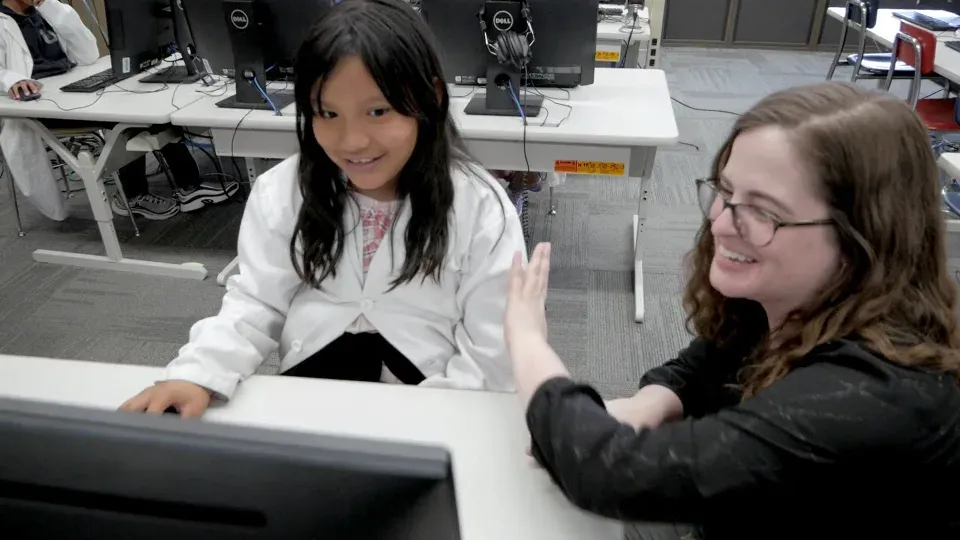
    A teacher sits beside a smiling young student in a white lab coat at a computer station.
    A teacher beside one student at her station.

    Space pelicans have clogged the pipes of the pushinator, and the moon is coming down on the planet Sundras. To clear the pipes safely, the class has to count and compare the birds in two chambers, counting with tens along the way, then add the two chambers together to set the fan to the right setting. The story plays on the projector.

    There are no crews or stations in this one. Every student works on their own screen. The story goes the way most of the class chooses, and each child’s own choices and answers go into their report. You’re at the helm, asking how many birds are in each chamber, which one has more, and what the total is.

    It’s built to adding within 20 in word problems (1.OA.A.1) and to place value (1.NBT.B.2, 1.NBT.B.3, 1.NBT.C.4), and the vocabulary is the unit’s: compare, greater than, less than, sum, total. It expects students who can add within 20 and add a one-digit number to a two-digit one. Run the ten-frames first, and tell the class why: the pipes only clear for a class that knows which chamber has more. The lesson prepares them. The Mission is what they’re preparing for.

    “My students ask every time they walk in the door, ‘IS IT A MISSION DAY?’”

    Kate Fallon, Teacher, St. Amelia School, NY

    Will it work in my room?

    Students join with a class code: no student accounts, no student email, no passwords. Chromebooks, laptops, or tablets, plus your projector. Free for teachers, no credit card. Student data is covered by COPPA and FERPA, and we signed the Student Privacy Pledge. At about 18 minutes, The Flying Machine fits inside the average K to 2 math block of about 55 minutes, with time left for the debrief.

    START FREE →

    Communication first, then The Flying Machine

    What the report shows

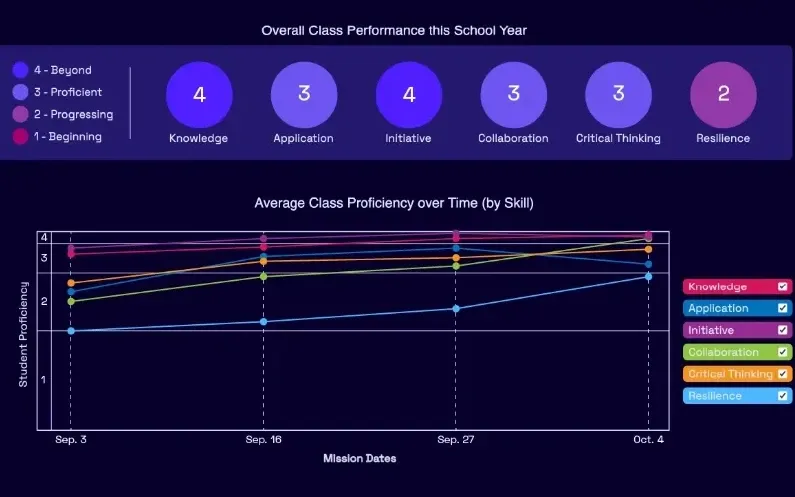
    A Mission.io class report: the class score in each of six skills, from knowledge and application to collaboration, critical thinking, and resilience, with the class chart across the year below.
    A class report from a real Mission: the class score in each of six skills, then each skill across the year.

    Every Mission produces a report for every student, built from what that student did across the whole Mission, on the skills the Mission captured. The six it can capture are Knowledge, Application, Initiative, Collaboration, Critical Thinking, and Resilience. The first two are what a test already sees. The other four are the human skills every school promises. The test shows what they know. The report shows the rest. SEE THE EVIDENCE →

    You taught it. Now find out who can use it.

    Who's behind it

    Mission.io is a research and design organization with one job: make collaborative, active learning something a teacher can run every unit instead of once a semester, and put a report in your hands when it’s over. Over a million students have run a Mission. The research behind them is funded by the National Science Foundation and the U.S. Department of Education’s Institute of Education Sciences, and Mission.io meets ESSA Level II standards, as validated by Instructure.

    1st grade math standards and the Missions on them

    Ten of the 21 1st grade Common Core math standards, each with the Mission or the activity on this page that covers it. Four have the year’s one Mission, The Flying Machine, numbered 7. Each code links to its standard on thecorestandards.org.

    Operations and algebraic thinking (1.OA)

    Adding and subtracting within 20, the year’s biggest job. The Flying Machine starts here and carries three place value standards (1.NBT) with it, and the number line hop and shake and spill teach two more.

    1st grade operations and algebraic thinking standards, with the Mission and the activities on this page.
    NumberThe standardMissionMinutes
    71.OA.A.1, 1.NBT.B.2, 1.NBT.B.3, 1.NBT.C.4 Word problems within 20; tens and ones; compare two-digit numbers with >, =, and <; add within 100The Flying MachineOn this page: 4. Ten-frames18
    1.OA.C.5 Relate counting to adding and subtracting, like counting on 2 to add 2On this page: 2. The number line hop
    1.OA.C.6 Add and subtract within 20, fluently within 10, with strategies like making tenOn this page: 3. Shake and spill

    Measurement and data (1.MD)

    Comparing and measuring length, and sorting data. The rug teaches the two length standards, and the coin sort teaches the data one.

    1st grade measurement and data standards, with the activities on this page for the ones they teach.
    NumberThe standardMissionMinutes
    1.MD.A.1 Order three objects by length; compare two lengths by using a thirdOn this page: 1. Measuring the room
    1.MD.A.2 Length as a count of same-size units laid end to end, with no gaps and no overlapsOn this page: 1. Measuring the room
    1.MD.C.4 Sort data into up to three categories, and answer how many more or lessOn this page: 5. The coin sort

    Geometry (1.G)

    Putting shapes together into new ones. Pattern blocks teach it.

    1st grade geometry standards, with the activity on this page for putting shapes together.
    NumberThe standardMissionMinutes
    1.G.A.2 Put shapes together into a new shape, flat or solidOn this page: 6. Pattern block puzzles
    START FREEMISSION BRIEF →

    Free teacher account, no card. Start with the Communication Mission, marked Start here in your library, then The Flying Machine, each after its 5-minute Teacher Preview.

    Also at this grade

    The kindergarten math activities and 2nd grade math activities pages have the neighboring years’ activities and their Missions; the 1st grade engineering activities page rebuilds the cup tower; and the 1st grade problem solving activities page rebuilds tangram puzzles.

Questions 1st grade math teachers ask

Which of these fits a math block?

Grades K to 2 average about 55 minutes of math a day. The Flying Machine runs about 18 minutes, so it fits with time for the debrief, and the rug runs 40.

Which 1st grade math standards does this page teach?

Ten of the 21 1st grade Common Core math standards, in three domain tables: 1.OA, 1.MD, and 1.G. The Flying Machine covers four of them, 1.OA.A.1 and three place value standards, all in its row in the 1.OA table, and seven are taught by an activity on this page.

Why is there only one 1st grade math Mission?

Because it’s the one built on 1st grade codes, and this page doesn’t pad the count. Kindergarten has two, Finding Will on counting and Dug’s Search and Rescue on shapes, and 2nd grade has A Blue Storm, on adding and subtracting within 100.

How do I grade a measuring activity fairly?

Grade the measuring and the behaviors, not whose number came out biggest. Is the stick count right, and can the Checker show the line had no gaps? That’s one grade. The four-behavior tally over two or three activities is the other. A pair whose cube number doesn’t match the class’s, and who can say why, has handed you the debrief.

Is this aligned to my state's standards, not just Common Core?

Each Mission page lists its Common Core codes and the state sets it maps to. The Flying Machine also maps to Texas (TEKS), Florida (B.E.S.T.), and North Dakota’s math standards.