2nd grade math activities

The classroom store rebuilt so 2nd graders count money that has to balance, five more activities by standard, a free printable, and the standards each one teaches.

Who we are. Mission.io makes Missions: teacher-led, whole-class simulations where students use what they’re learning to work through a real scenario together.

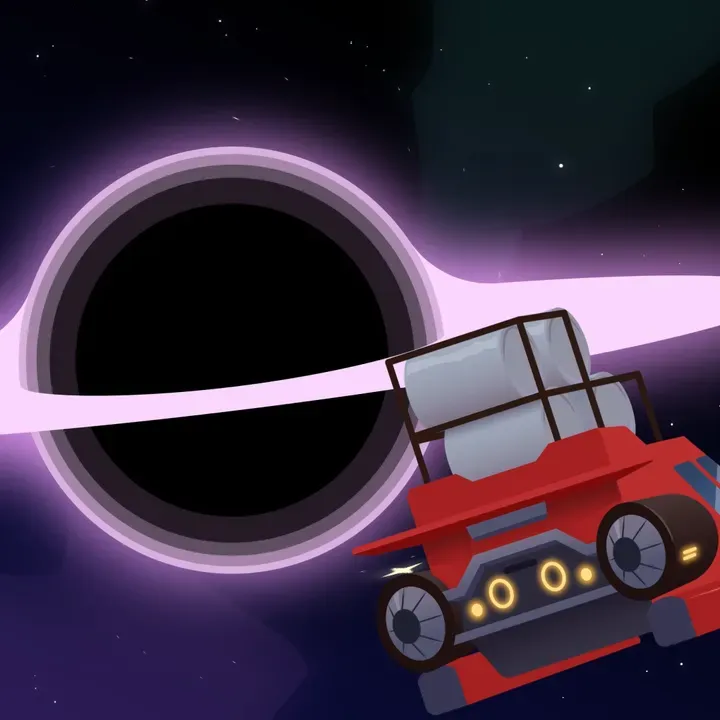
Everything on this page works without us. The standards this page teaches are at the end, with a Mission where one exists, free. (There’s one, A Blue Storm, where ships sink toward a black hole. It’s the same subtraction as making change, and the customer is Singularity City.)

On this page

What 2nd grade math looks like

Second grade math activities are problems where the class has to use the math to decide something, argue about whether the numbers are right, and leave each student answerable for a piece. This page teaches nine of the 26 2nd grade Common Core math standards, with an activity for seven of them and a Mission for two.

The year has four big jobs. Place value to 1000: hundreds, tens, and ones (2.NBT.A). Fluency with adding and subtracting: within 20 from memory, and within 100 with strategies (2.NBT.B). Measuring length in standard units (2.MD.A, 2.MD.B). And describing and analyzing shapes. Measurement and data also holds time to the five minutes and money (2.MD.C), and picture and bar graphs (2.MD.D).

You know the activity that usually stands in for money. A table of priced items, a bag of play coins, a line of shoppers, and one cashier. When the drawer comes up short, nobody can say which sale did it. Finding that sale is where the math is.

Six things that turn an exercise into math

Math isn’t short on time: grades K to 2 average about 55 minutes a day on it (2018 NSSME+). It’s short on talk. Observers in more than 2,500 first, third, and fifth grade classrooms found about 90% of instructional time was whole-group lecture or seatwork, and under 10% was small groups (Pianta and colleagues, 2007). That’s the gap worth closing, and a store with three jobs puts every child in one.

  1. 1. A real problem with stakes the class can feel.

    “Count the coins” is an exercise. “The drawer has to balance tonight, or the store closes” is a problem.

  2. 2. Apply, don't recall.

    A second round with bigger prices, so the first round’s counting has to hold up. If the sale can be finished without anyone adding, it isn’t a math activity.

  3. 3. Group goals with individual accountability.

    The one most store days miss: one cashier counting, a line of shoppers waiting. When the group shared a goal and each student answered for a part, 84% of studies found a positive effect; without both, 17% (Slavin, 1991).

  4. 4. The teacher leads the thinking.

    Three questions at the table (what’s the total, what change is owed, does the drawer match the ledger) beat a worksheet of twenty at the desk.

  5. 5. A debrief where the class argues it out.

    The store is the setup. The argument afterward, about which sale left the drawer short, is the practice the standards name: make sense of problems and persevere in solving them (MP1).

  6. 6. A way to see who did what.

    If you can’t tell which student made the change and which one only held the cup, you can’t teach the counting. You can only check the drawer.

Every sale writes a line. Every line has to add up.

The sheet at the end of the next section puts all six on the counter: role cards, price cards, the ledger, and the tally. Get the sheet →

The classroom store, rebuilt for 2nd grade (2.MD.C.8)

Priced items on a table, play coins and bills, and students buying and selling, counting out exact change. Second grade is the money grade in the standards (2.MD.C.8 is the only money standard before 4th grade), which is why nearly every 2nd grade room runs a store at some point. The way it usually runs is a line of shoppers, one cashier, and nothing lost when a count is wrong. Here’s the version that hits all six.

Time
45 minutes, inside an average K to 2 math block of about 55.
Groups
Threes. With 26 children, eight groups of three and one pair, where the Shopper also audits after paying.
Supplies for nine stores
9 bags of play coins (or real pennies, nickels, dimes, and quarters borrowed for the day), 9 sets of 8 priced item cards, 9 ledger sheets, and 9 cups as drawers. About $8 for play money if the room has none.
Standards
2.MD.C.8 (word problems with dollar bills, quarters, dimes, nickels, and pennies, using $ and ¢ correctly), with 2.NBT.B.5 (add and subtract within 100 fluently) for the totals, and the practices MP1 (make sense of the problem: what it costs, what I have, what’s left) and MP6 (the symbols and the cents).
  1. Teach first, 10 minutesApply

    Price three items on the board (14¢, 25¢, 32¢), hand a volunteer a mix of coins, and ask the class for two different ways to pay for one item. Name the rules: count the big coins first, write cents with ¢ and dollars with $, and change is what comes back. Then name the three jobs in a real store: the shopper, the cashier, and the auditor who checks the drawer.

  2. The problemStakes

    The store’s drawer has been coming up short at the end of the day, and the manager (you) is going to close the store if it happens again. Every sale today gets recorded and audited, so the drawer balances to the penny. The team runs four sales, with the drawer balancing every time. Say the stakes out loud: a drawer that doesn’t balance means the store closes, and nobody shops on the next store day.

  3. Three roles, one job eachAccountability

    Names on the cards. Rotate after every sale, so each child does every job at least once.

    • Shopper

      Chooses up to two items, and says the total aloud before paying.

    • Cashier

      Counts the payment, makes change, says the change aloud, and puts the coins in the drawer.

    • Auditor

      Writes each sale on the ledger (items, total, paid, change), and checks the drawer against the ledger after every sale.

  4. You lead the thinkingTeacher leads

    Three questions, at the table: What’s the total, and how did you add it? What change is owed, and how did you count it? Does the drawer match the ledger, and if not, which sale is wrong? The hard part is keeping your hands out of the cup.

  5. Two rounds, so the counting has to holdApply

    Round one is four sales with prices under 50¢. Round two is four sales with prices up to 99¢, and one item over a dollar. The audit after every sale is what keeps each child answerable.

  6. The debrief, 8 minutesDebrief

    Did any drawer come up short, and which sale was the mistake? What’s the fastest way to make change from a quarter for a 17¢ item? Who in your group caught a wrong count before it went in the drawer? Second graders will name the Auditor who said “that’s two dimes, not two nickels.”

  7. See who did whatSee who did what

    The observation sheet, four behaviors per child: counted a total correctly, made change correctly, wrote $ or ¢ correctly, caught or fixed an error (their own or a partner’s). The ledger does the recording, and the rotation puts every child in every job within a period, so the tally catches most of the room. Your walk catches about half.

(Expect to hear “keep the change” at least once. The Auditor won’t allow it.)

A store that balances all eight sales opens again next store day. Tell them so, and mean it.

The classroom store, free

Emailed now, ready to copy: the teacher page, the Shopper, Cashier, and Auditor role cards, the price cards for both rounds, the store ledger with the coin list, and the four-behavior tally.

It’s on its way.

Check your inbox for the classroom store.

Email me the sheet. It comes as a PDF, ready to print. Unsubscribe anytime.

Five more 2nd grade math activities, by standard

Five more on every 2nd grade list: what each one is, how it usually runs, and what it needs to be a math activity, in the order the standards run.

Arrays, place value, measuring, time, graphs

2. Arrays with tiles (2.OA.C.4)

Needs square tiles. A station.

At a station, children build rectangles of square tiles, like three rows of four, and write the repeated addition under each one: 4 + 4 + 4 = 12. The array turns equal groups into something you can see and count, which is what 3rd grade multiplication is built on. As usually run, though, it’s a solo station with no reason to build any one array, and a sheet of sums can’t show who sees the rows.

The fix

  1. Give the arrays a job, like setting out chairs for a class performance in equal rows, so each array answers how many.
  2. Pair children: one builds the array, the other writes the addition by rows and then by columns, and both totals have to match.
  3. Have each child show you one array and say its addition aloud before leaving the station.

No page for this one; the three misses are the fix.
3. Hundreds chart puzzles (2.NBT.A.1)

Needs a cut-up hundreds chart. A station.

A hundreds chart is cut into puzzle pieces, and children fill in the missing numbers on each piece: what goes above 47, what goes right after 59. Place value does the work, since one row down is ten more and one step right is one more. As usually run, though, it’s a quiet solo station where nothing depends on a piece being right, and you can’t tell who reasoned it out and who counted every square from 1.

The fix

  1. Give it a reason: the class hundreds chart came apart, and the class has to put it back on the wall.
  2. Pair children: one writes each number, and the other checks it first by saying ten more or one more.
  3. Have each pair initial its piece when it goes up on the wall.

No page for this one; the three misses are the fix.
4. Measure it in inches and centimeters (2.MD.A.2)

Needs rulers marked in inches and centimeters. A worksheet.

Children measure the same object twice, a pencil, a book, the desk, once in inches and once in centimeters, and write both numbers. Measuring with a real ruler is the right work, and watching the centimeter number come out bigger starts the idea that a smaller unit takes more of them. As usually run, though, it’s a solo worksheet, and two numbers on a line can’t tell you who lined the ruler up at zero.

The fix

  1. Put children in pairs, where the Measurer holds the ruler and reads the length aloud.
  2. The Checker looks at both ends, makes sure the ruler starts at zero, and writes the number only after that.
  3. Swap jobs on every object, so each child measures and each child checks.

No page for this one; the fix above is the whole of it.

5. Time to five minutes on a Judy clock (2.MD.C.7)

Needs a Judy clock. A drill.

You call out a time, children set the hands on a Judy clock, and then they read the times you set: 3:25, 7:50, quarter past 4. Children do need the reps, with an hour hand that drifts between numbers and a minute hand that counts by fives. As usually run, though, it’s a drill with no reason to know the time, nobody talks about why the hour hand sits past the 3, and you can’t see who read the clock and who copied.

The fix

  1. Tie each time to the class’s day, like when lunch starts or when the bus comes.
  2. Work in pairs: one sets the clock, the other reads it aloud and checks it, and then they swap.
  3. Stop for two minutes on a hard one, like 3:55, and ask why the hour hand is almost on the 4.
  4. Have each child set one time for you before they go.

No page for this one; the four misses are the fix.

6. The class bar graph (2.MD.D.10)

Needs chart paper, sticky notes. Whole class.

The class picks a question, like favorite fruit, each child adds a sticky note to a bar, and you lead the talk about which bar is tallest and how many more. The data is real, and the questions are the standard’s own: put together, take apart, compare. As usually run, though, the whole class builds and reads one graph, a few hands answer every question, and you can’t tell who could read it alone.

The fix

  1. Have small groups build one bar each, with one child counting the notes and one checking the count.
  2. When the graph is done, have each child write one how-many-more question about it and answer a partner’s.

No page for this one; the two misses are the fix.

  • Our part · We make Missions

    Then the unit has somewhere to go

    Plenty of teachers rebuild these by hand every unit, and it works. A Mission is a teacher-led, whole-class simulation built from a unit you teach. The store is money (2.MD.C.8), and no Mission carries a money code. Every sale adds and subtracts within 100, and so does A Blue Storm. After the store, run A Blue Storm.

    You're at the helm, not on the hook.

    A Blue Storm: adding and subtracting, as a Mission

    A Blue Storm · 2nd grade · About 21 minutes · One device per student, plus your projector · Free with a teacher account

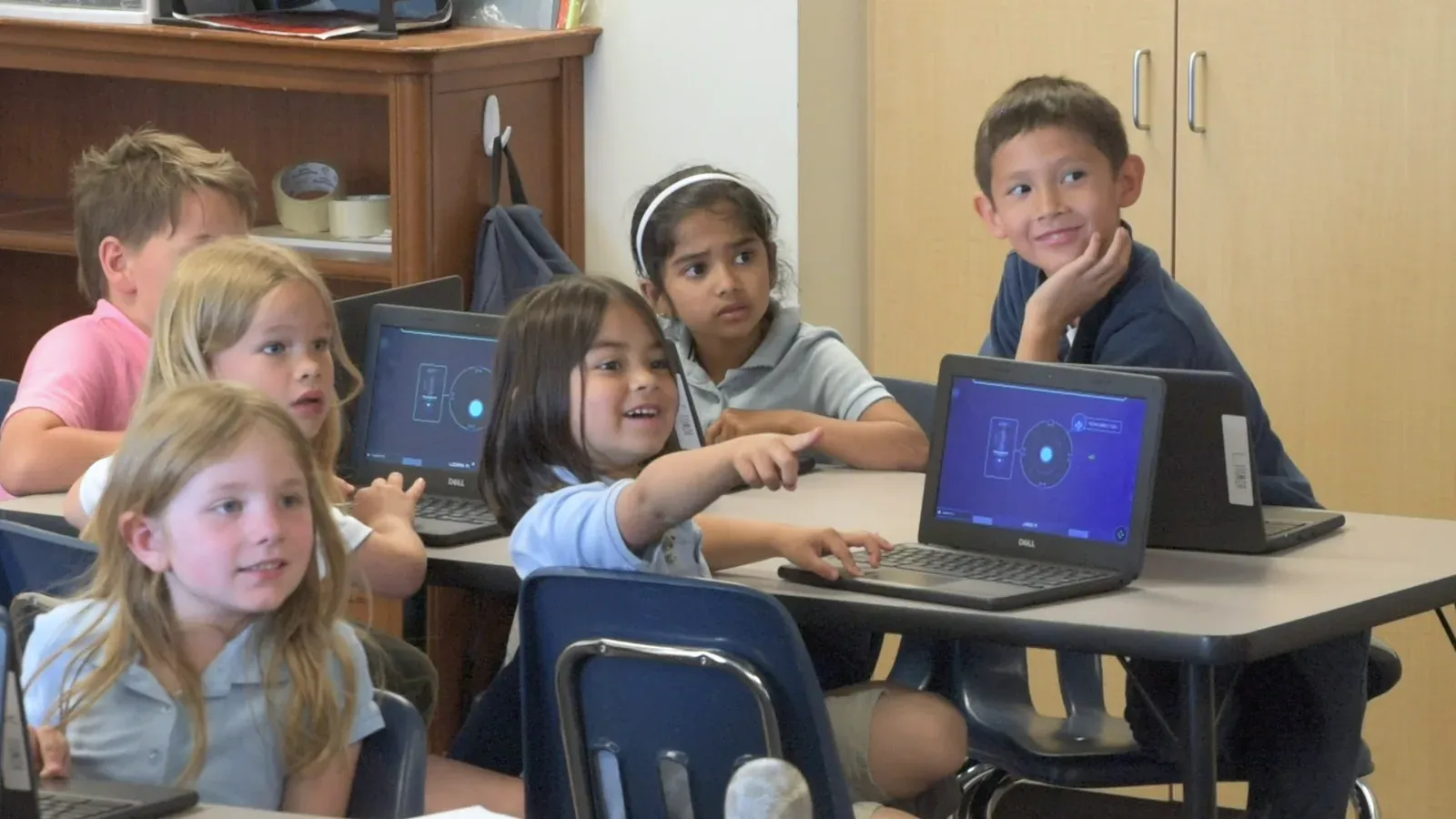
    Young students at a table of Chromebooks; one girl points at a classmate's screen while a boy beside her rests his chin on his hand and smiles.
    Young students at their Chromebooks, one pointing at a classmate's screen.

    A mysterious storm closes in on Singularity City, and after a cloud of ice hits, ships start sinking toward a black hole. The crew has to use each ship’s distance and its length to work out how far to lower a net, and protect the city from gigantic comets. The story plays on the projector. The work happens at seven stations (Command, Engineering, Medical, Security, IT, Operations, Science) and in the arguments between them.

    Every student is assigned to a team, and each team’s work is themed to it, from its own information and challenge to the same problem the rest of the crew is solving. The team gives a student a role in the story and people to lean on while you move between teams. You’re at the helm, asking how far away the ship is, how long it is, and so how far down the net goes.

    It’s built to word problems within 100 (2.OA.A.1) and to adding and subtracting lengths (2.MD.B.5), and the vocabulary is the unit’s: sum, add, subtract, missing number, length, difference. It expects students who can add and subtract one- and two-digit numbers and find a missing number, like x + 6 = 15. Run the store first, and tell the class why: the net only stops in the right place for a crew that can find the difference. The lesson prepares them. The Mission is what they’re preparing for.

    “I even sent an email to my whole building encouraging everyone to try it.”

    Jen, Veteran teacher, OH

    Will it work in my room?

    Students join with a class code: no student accounts, no student email, no passwords. Chromebooks, laptops, or tablets, plus your projector. Free for teachers, no credit card. Student data is covered by COPPA and FERPA, and we signed the Student Privacy Pledge. At about 21 minutes, A Blue Storm fits inside the average K to 2 math block of about 55 minutes, with time left for the debrief.

    START FREE →

    Communication first, then A Blue Storm

    What the report shows

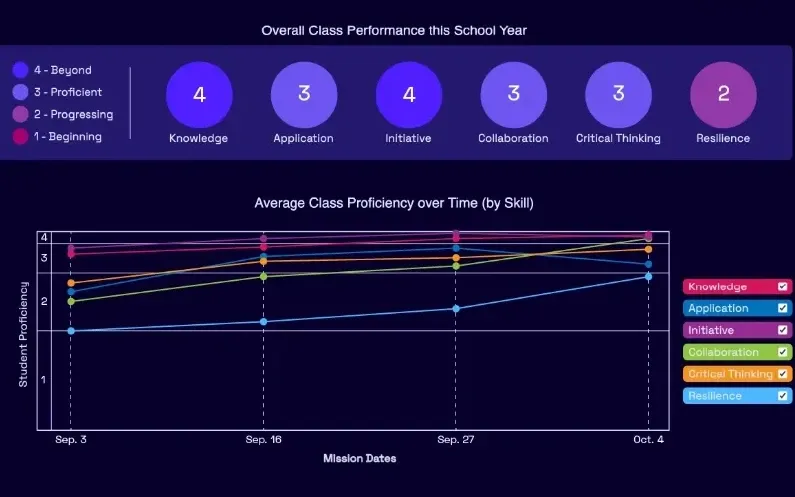
    A Mission.io class report: the class score in each of six skills, from knowledge and application to collaboration, critical thinking, and resilience, with the class chart across the year below.
    A class report from a real Mission: the class score in each of six skills, then each skill across the year.

    Every Mission produces a report for every student, built from what that student did across the whole Mission, on the skills the Mission captured. The six it can capture are Knowledge, Application, Initiative, Collaboration, Critical Thinking, and Resilience. The first two are what a test already sees. The other four are the human skills every school promises. The test shows what they know. The report shows the rest. SEE THE EVIDENCE →

    You taught it. Now find out who can use it.

    Who's behind it

    Mission.io is a research and design organization with one job: make collaborative, active learning something a teacher can run every unit instead of once a semester, and put a report in your hands when it’s over. Over a million students have run a Mission. The research behind them is funded by the National Science Foundation and the U.S. Department of Education’s Institute of Education Sciences, and Mission.io meets ESSA Level II standards, as validated by Instructure.

    2nd grade math standards and the Missions on them

    Nine of the 26 2nd grade Common Core math standards, each with the Mission or the activity on this page that covers it. Two have the year’s one Mission, A Blue Storm, numbered 7. Each code links to its standard on thecorestandards.org.

    Operations and algebraic thinking (2.OA)

    Word problems within 100, and arrays as the start of multiplication. A Blue Storm takes the word problems, and the arrays teach the rest.

    2nd grade operations and algebraic thinking standards, with the Mission and the activity on this page.
    NumberThe standardMissionMinutes
    72.OA.A.1, 2.MD.B.5 One- and two-step word problems within 100, and adding and subtracting lengths in the same unitsA Blue Storm21
    2.OA.C.4 Total an array of up to 5 rows and 5 columns with repeated additionOn this page: 2. Arrays with tiles

    Number and operations in base ten (2.NBT)

    Hundreds, tens, and ones, and adding and subtracting within 100. The hundreds chart teaches place value, and the store’s totals teach 2.NBT.B.5.

    2nd grade base ten standards, with the activities on this page for the ones they teach.
    NumberThe standardMissionMinutes
    2.NBT.A.1 The three digits of a three-digit number are hundreds, tens, and onesOn this page: 3. Hundreds chart puzzles
    2.NBT.B.5 Add and subtract within 100, fluentlyOn this page: 1. The classroom store

    Measurement and data (2.MD)

    The year’s biggest domain: length, time, money, and graphs. The store teaches money, and three more activities teach the rest. A Blue Storm, in the first table, also carries 2.MD.B.5.

    2nd grade measurement and data standards, with the activities on this page for the ones they teach.
    NumberThe standardMissionMinutes
    2.MD.A.2 Measure one object in two units, and say how the size of the unit changes the numberOn this page: 4. Inches and centimeters
    2.MD.C.7 Tell time to the nearest five minutes, with a.m. and p.m.On this page: 5. The Judy clock
    2.MD.C.8 Word problems with bills and coins, using $ and ¢On this page: 1. The classroom store
    2.MD.D.10 Picture graphs and bar graphs for up to four categories, and the problems they answerOn this page: 6. The class bar graph
    START FREEMISSION BRIEF →

    Free teacher account, no card. Start with the Communication Mission, marked Start here in your library, then A Blue Storm, each after its 5-minute Teacher Preview.

    Also at this grade

    The 1st grade math activities and 3rd grade math activities pages have the neighboring years’ activities and their Missions; the 2nd grade engineering activities page rebuilds the index card bridge; and the 2nd grade problem solving activities page rebuilds numberless word problems.

Questions 2nd grade math teachers ask

Which of these fits a math block?

Grades K to 2 average about 55 minutes of math a day. A Blue Storm runs about 21 minutes, so it fits with time for the debrief, and the store’s 45 minutes fits too.

Which 2nd grade math standards does this page teach?

Nine of the 26 2nd grade Common Core math standards, across three domains: 2.OA, 2.NBT, and 2.MD. A Blue Storm covers two of them, 2.OA.A.1 and 2.MD.B.5, and seven are taught by an activity on this page, from 2.OA.C.4 to 2.MD.D.10.

Why is there no Mission for money?

Because no Mission is built on 2.MD.C.8, and this page doesn’t stretch one to fit. The store carries money on its own. A Blue Storm picks up the adding and subtracting within 100 that every sale runs on, which makes it a good day two.

How do I grade the store fairly?

Grade the ledger and the behaviors, not the fullest drawer. Does every sale’s row add up, and can the Auditor show where a short drawer came from? That’s one grade. The four-behavior tally, with every child in every job, is the other. A group whose drawer came up short and found the sale did the math.

Is this aligned to my state's standards, not just Common Core?

Each Mission page lists its Common Core codes and the state sets it maps to. A Blue Storm also maps to Texas (TEKS), Florida (B.E.S.T.), and North Dakota’s math standards.