1st grade science activities

The rubber band guitar rebuilt so 1st graders prove sound comes from vibration, five more investigations by NGSS standard, a free sheet, and every 1st grade science Mission by standard.

Who we are. Mission.io makes Missions: teacher-led, whole-class simulations where students use what they’re learning to work through a real scenario together.

Everything on this page works without us. Every 1st grade science Mission is at the end, by standard, free. (The one we’d run in 1st grade dives into an ocean too dark to see in, which is the whole point.)

On this page

What 1st grade science looks like

First grade science activities are investigations in which the class gathers evidence about something the standards name, has to explain what that evidence shows, and leaves each child answerable for a piece. This page covers the 1st grade performance expectations, 1-PS4-1 to 1-ESS1-2, and the K to 2 engineering standards, with an investigation and a Mission for each where one exists. The 1st grade STEM activities page carries the build challenges.

The year opens on sound and light: vibrating things make sound, and sound can make things vibrate (1-PS4-1); in the dark you see only what’s lit (1-PS4-2); some materials let light through and some stop it (1-PS4-3); and light or sound can carry a message across a distance (1-PS4-4). Then how plants and animals use their parts to survive, and how people copy them to solve a problem (1-LS1-1), how parents and babies behave in ways that help the young survive (1-LS1-2), how young ones look like their parents but not exactly (1-LS3-1), and the patterns in the sky: the sun, moon, and stars (1-ESS1-1) and daylight across the year (1-ESS1-2).

You know the activity that usually stands in for the sound unit. Rubber bands over a tissue box, one kid plucking, and a craft that goes home in a backpack. That’s a build, and a build is a fine half hour. Science is what happens when the class has to say what was shaking every time there was a sound, and prove it.

Six things that turn a craft into an investigation

Inquiry-based science teaching outperformed traditional instruction across 37 studies, and the surprise inside the finding is who leads it: teacher-led inquiry beat student-led by a clear margin (Furtak, Seidel, Iverson, and Briggs, 2012). Hands-on helped most when students also had to think and talk about what they saw (Minner, Levy, and Century, 2010). The uncomfortable part is the clock: grades K to 2 average about 17 minutes a day on science, against 89 on reading (2018 NSSME+). That’s a master schedule, not a choice, and it means the 17 minutes have to be an investigation.

  1. 1. A real problem with stakes the class can feel.

    “Make a guitar” is a craft. “The back row has to hear the storm, the doorbell, and the giant” is a problem.

  2. 2. Apply, don't recall.

    A second round that only works with what the first round showed. If the activity can be finished without the science, it isn’t a science activity.

  3. 3. Group goals with individual accountability.

    The one most science classics miss: one box, one plucker, two kids watching. When the group shared a goal and each student answered for a part, 84% of studies found a positive effect; without both, 17% (Slavin, 1991).

  4. 4. The teacher leads the thinking.

    The inquiry finding above settles it. Three questions next to the box beat a worksheet of twenty at the desk.

  5. 5. A debrief where the class argues it out.

    The investigation is the setup. The talk on the rug afterward is where the class has to agree on what made the sound, and why.

  6. 6. A way to see who did what.

    If you can’t tell which child explained a sound with “vibrate” and which one just plucked harder, you can’t teach the practice. You can only hope for it.

Loud isn’t evidence. The rice jumping is.

The sheet at the end of the next section has the guitar ready to run: the role cards, the team’s sound card and back row test, and the tally. Get the sheet →

The rubber band guitar, rebuilt for 1st grade (1-PS4-1)

Rubber bands of different thicknesses stretched over a tissue box or a cup, plucked, with the sound and the shaking watched and changed. It’s on every 1st grade sound list because 1-PS4-1 is the vibration standard, and the way it usually runs is one box, one plucker, the word “vibration” said once at the start, and a craft that goes home. Here’s the version that hits all six.

Time
40 minutes, so it fits a 45-minute block as written. The two-day version for a 17-minute block: the teach-first and the build on day one; both back row tests and the debrief on day two.
Groups
Threes. With 23 children, seven groups of three and one pair, where the Plucker also watches.
Supplies for eight boxes
8 tissue boxes or plastic cups, 24 rubber bands in two thicknesses, 8 craft sticks for a bridge, a handful of rice, 8 balloons for the drum. About $6.
Standards
1-PS4-1 (vibrating materials make sound, and sound can make materials vibrate). The thick-versus-thin talk is an extension: pitch isn’t in the 1st grade standard, so the sheet says the sound changes.
  1. Teach first, 8 minutesApply

    Hold a ruler over the desk edge, twang it, and ask what they see and hear. Name it: a thing that shakes back and forth very fast makes sound. Put a few grains of rice on a drum (a balloon stretched over a cup) and hum into it. Name that too: sound can make a thing shake.

  2. The problemStakes

    The class’s puppet theater needs a sound-effects box, and the audience in the back row has to hear three different sounds: a low rumble for the storm, a high ping for the doorbell, and a loud thump for the giant. The sheet names the three sounds, and the Recorder draws the band for each. If the back row can’t tell them apart, the show is confusing, so say it out loud: the back row is counting on you.

  3. Three roles, one job eachAccountability

    One short job on each card, read aloud, with a name on it. Plucker and Watcher swap between rounds.

    • Plucker

      The only hands on the bands.

    • Watcher

      Watches the band and says "I see it shake" or "I don't."

    • Recorder

      Circles which band made the storm, the doorbell, and the thump, and draws the band.

  4. You lead the thinkingTeacher leads

    Three questions, asked next to the box: What is shaking right now? What did you change to make a different sound? Can you make the rice jump without touching it? The hardest part is not plucking it for them.

  5. Two rounds, with the back row as the testApply

    Seven minutes to build the three-band box and find the three sounds. Then the back row test: one teammate stands at the far wall, eyes closed, and names each sound. Two minutes to change one band, then a second back row test. The second test only goes better if the team listened to the first.

  6. The debrief, 8 minutes on the rugDebrief

    What was shaking every time there was a sound? What did the thick band do that the thin band didn’t? Who in your group figured out how to make the rice jump? First graders will name the kid who hummed into the cup.

  7. See who did whatSee who did what

    The observation sheet, four behaviors per child: said “vibrate” or “shake” to explain a sound, changed one thing on purpose, told a teammate what they noticed, tested from the back row honestly. A tally catches about half the room, because the test at the back wall and the build at the desk split each group up.

(Eyes closed at the back wall is the honest part. Expect at least one peeker, and expect a firm denial.)

The rubber band guitar, free

Emailed now, ready to copy: the teacher page, three role cards (Plucker, Watcher, Recorder), the team’s sound card (the three target sounds, a “which band” circle and a drawing box for each) with the back row test for both rounds, and the four-behavior tally.

It’s on its way.

Check your inbox for the rubber band guitar.

Email me the sheet. It comes as a PDF, ready to print. Unsubscribe anytime.

Five more 1st grade investigations, by standard

Five more on every 1st grade list: what each one is, how it usually runs, and the fix, in the order the standards run.

Sound, light, plants, and the sky

2. The water cup xylophone (1-PS4-1)

Needs cups, water to fill them to different levels, something to tap them with. Threes: a Tapper, a Pourer, and a Recorder at every set of cups.

Cups filled with different amounts of water get tapped with a pencil, and each one rings a different note. It’s the same standard as the rubber band guitar, sound from vibration, and first graders can hear the note change when the water changes. As usually run, though, it’s a demo, with one set of cups at the front and one adult doing the tapping.

The fix

  1. Run it after the guitar, while vibration is still fresh.
  2. Put a Tapper, a Pourer, and a Recorder at every set of cups.
  3. The Pourer changes one cup’s water, the Tapper plays it, and the Recorder marks whether the note went higher or lower.

No page for this one; the three roles are the whole fix.
3. Shine a flashlight through materials (1-PS4-3)

Needs a flashlight, wax paper, foil, plastic wrap, cardboard. One material per child.

First graders hold wax paper, foil, plastic wrap, and cardboard in a flashlight beam and sort each one: see-through, some light, or none. It puts the standard to work, since sorting what the light does is the lesson. As usually run, though, one flashlight goes around while a few kids call out answers, so you can’t see who thought what.

The fix

  1. Give each child one material to own.
  2. Before the light goes on, each child predicts see-through, some light, or none.
  3. Each child holds their own material in the beam, puts it in the pile the light says, and checks it against the prediction.

No page for this one; the fix above is the whole of it.

4. The string telephone (1-PS4-4)

Needs two cups, a long string, a message to deliver, and paper and a pencil for the Listener. Pairs: a talker and a Listener who writes the message down.

Two cups joined by a long string, pulled tight down the hallway: one child talks into a cup and the other listens. It fits the standard on sending sound over a distance, and the sound really does travel down the string. As usually run, though, it’s a hallway game: kids shout hello down the string, and nobody checks what got through.

The fix

  1. Give each pair a short message on a card that only the talker reads.
  2. The Listener writes down what they hear.
  3. Back in the room, hold each written message up against its card, so the class can check what made it across.

No page for this one; the message and the Listener are the fix.

5. Seeds in light and dark (2-LS2-1)

Needs seeds, a cup per pair of children, a window and a closet, a daily checkmark sheet. Pairs. Two weeks.

Two cups of seeds, one on the windowsill and one in a closet, watched for two weeks. It’s 2nd grade’s standard, and 1st grade runs it anyway, because it’s a comparison first graders can see for themselves. As usually run, though, it’s a two-week watch: the cups sit on the shelf, and no child has a reason to check one.

The fix

  1. Give each pair of children one cup, window or closet, with their names on it.
  2. Each pair checks its cup every day and puts a checkmark on the sheet.

See the plant investigation rebuilt for 2nd grade →

6. Shadow tracing with chalk (1-ESS1-1)

Needs chalk and a sunny patch of blacktop. Pairs: one stands, one traces, then swap. Three checks in one day, at 9, 12, and 2.

A child stands on the blacktop while a partner traces their shadow in chalk at 9, at 12, and at 2, and the class compares the three outlines. It puts the idea to work, and you’re there to lead the talk about what changed. As usually run, though, it’s a one-day sidewalk activity: the same few kids stand and trace, and nobody has to say what will happen next.

The fix

  1. Pair everyone up, one to stand and one to trace, and swap at each check.
  2. Trace the stander’s feet at the first check, so they stand in the same spot every time.
  3. Before noon, each pair predicts where the shadow will fall and how long it will be, so the noon shadow has to be argued from the morning one.

No page for this one; the fix above is the whole of it.

  • Our part · We make Missions

    Then the unit has somewhere to go

    Plenty of teachers rebuild these by hand every unit, and it works. A Mission is a teacher-led, whole-class simulation on the standard the unit was teaching: the story plays on your projector, every child makes the calls on their own screen, and the only way through is using what they just learned. The guitar and Ocean Light Search belong to the same sound and light unit. The guitar is the sound half (1-PS4-1), and the Mission is the light half (1-PS4-2). The nearest Mission to the guitar is In the Cards, in the sound and light table below.

    You're at the helm, not on the hook.

    Ocean Light Search: the light half of the unit, as a Mission

    Ocean Light Search · 1st grade · About 18 minutes · One device per student, plus your projector · Free with a teacher account

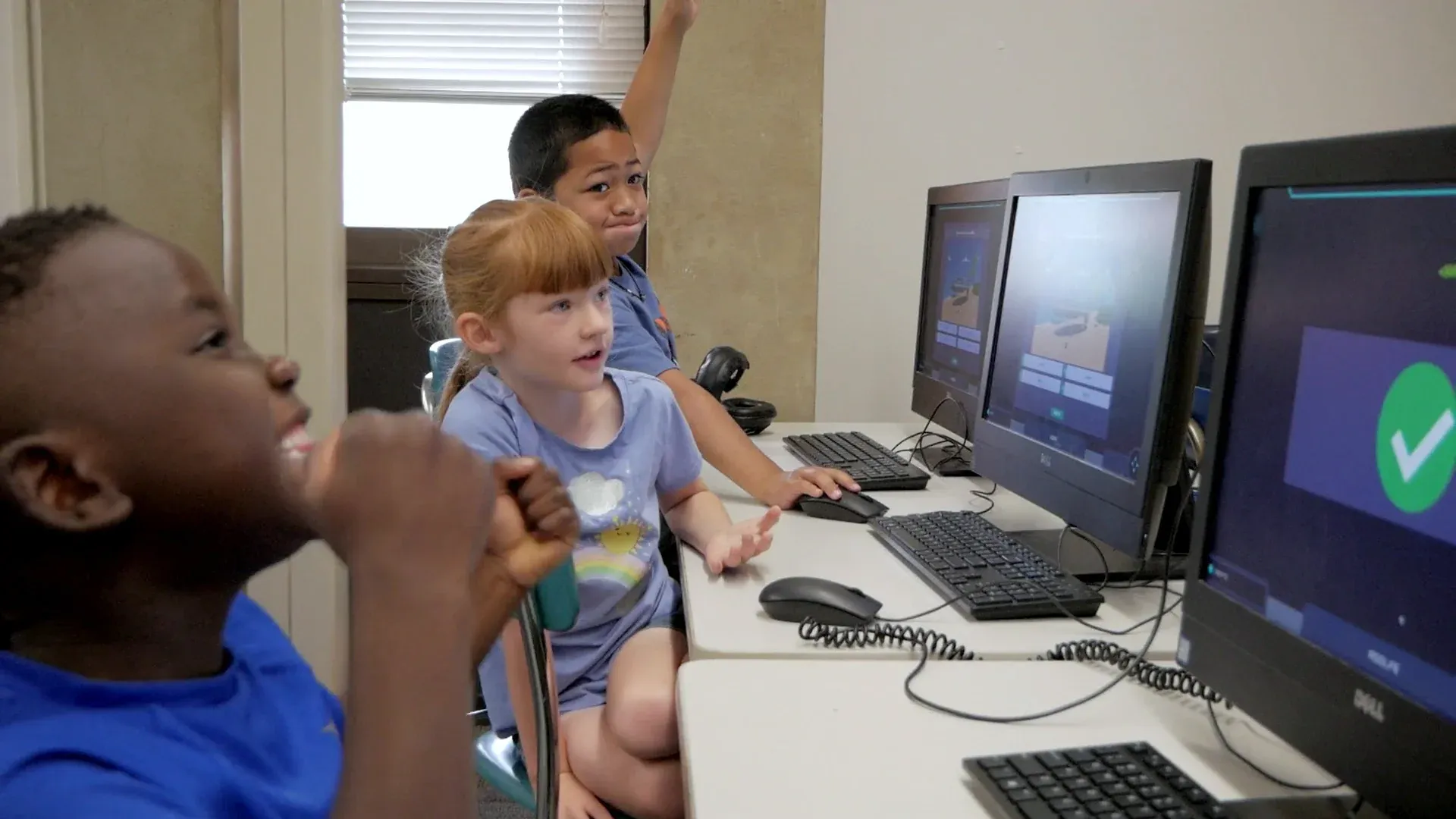
    Young students at a row of desktop computers in a lab. A boy in a blue shirt grins with both fists at his chin, a girl beside him smiles toward the screens, and a boy behind her has one arm straight up, while a big green check mark fills the nearest screen.
    What you'll see: a green check on one screen, a hand in the air behind it, and a big grin at the end of the row.

    On an exploratory dive into Tellenor’s ocean, the crew investigates objects in darkness and finds out that some give off their own light and can be seen in the dark, while others show up only when something lights them (1-PS4-2). The story plays on the projector, and every child makes the call on their own screen; there are no stations or crew teams in this one. The story goes the way most of the class chooses, and each child’s own choices and answers go into their report.

    We connect every screen and keep the dive moving. You walk the room and ask what a six-year-old needs asked out loud: Can you see it? What changed when the light hit it? Does it make its own light?

    The flashlight investigation above sets it up: a class that just watched a beam stop at cardboard knows that light has to get somewhere before you see anything. Run the flashlight first, and tell the class why: they’re going to need it when the ocean goes dark. The lesson prepares them. The Mission is what they’re preparing for.

    “I even sent an email to my whole building encouraging everyone to try it.”

    Jen, Veteran teacher, OH

    Will it work in my room?

    Students join with a class code: no student accounts, no student email, no passwords. Chromebooks, laptops, or tablets, plus your projector. Free for teachers, no credit card. Student data is covered by COPPA and FERPA, and we signed the Student Privacy Pledge. At about 18 minutes, Ocean Light Search runs one minute past the average K to 2 science block, so borrow a minute. On a shared cart it’s the day you have the cart, and that’s fine, as long as the class knows all week that cart day is where the unit is headed.

    START FREE →

    Communication first, then the sound and light unit's two

    What the report shows

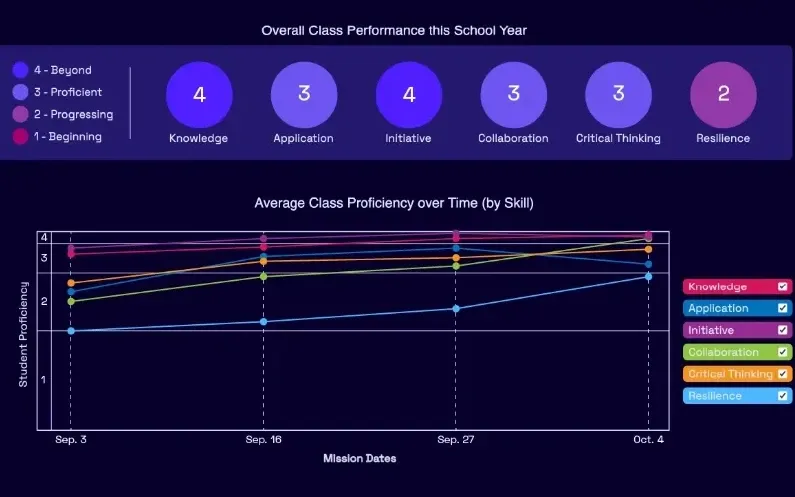
    A Mission.io class report: the class score in each of six skills, from knowledge and application to collaboration, critical thinking, and resilience, with the class chart across the year below.
    A class report from a real Mission: the class score in each of six skills, then each skill across the year.

    Every Mission produces a report for every student, built from what that student did across the whole Mission, on the skills the Mission captured. The six it can capture are Knowledge, Application, Initiative, Collaboration, Critical Thinking, and Resilience. The first two are what a test already sees. The other four are the human skills every school promises. The test shows what they know. The report shows the rest. SEE THE EVIDENCE →

    You taught it. Now find out who can use it.

    Who's behind it

    Mission.io is a research and design organization with one job: make collaborative, active learning something a teacher can run every unit instead of once a semester, and put a report in your hands when it’s over. Over a million students have run a Mission. The research behind them is funded by the National Science Foundation and the U.S. Department of Education’s Institute of Education Sciences, and Mission.io meets ESSA Level II standards, as validated by Instructure.

    1st grade science Missions by NGSS standard

    Ocean Light Search is one. There are 16 science and engineering Missions at 1st grade, numbered 7 to 22 below, and each one is where a unit can end: sound ends at In the Cards, light ends at Ocean Light Search, the moon ends at Dark Side of the Moon. Every lesson finally has somewhere to go. One standard has no Mission. Each code links to its standard on nextgenscience.org.

    Sound and light (1-PS4)

    Four Missions, one for each 1st grade sound and light standard, and none runs longer than 18 minutes.

    Sound and light Missions for 1st grade, by NGSS code.
    NumberThe standardMissionMinutes
    71-PS4-4 Light or sound that carries a message across a distance: build a light device when the ship can’t talk back (grades 1 and 2). On this page: 4. The string telephone.Botspace Boys18
    81-PS4-2 In the dark, you see only what’s lit or what makes its own lightOcean Light Search18
    91-PS4-1 Vibrating things make sound, and sound makes things vibrate (grades K and 1). On this page: 1. The rubber band guitar and 2. The water cup xylophone.In the Cards17
    101-PS4-3, K-PS3-1, K-PS3-2, K-2-ETS1-1, K-2-ETS1-2, K-2-ETS1-3 What different materials do in the path of light: shield a robot from the sun and compare tested designs (grades K to 2). On this page: 3. Shine a flashlight through materials.Beach Frenzy15

    Plants, animals, and their young (1-LS1, 1-LS3)

    Two Missions, both 15 minutes, and one standard with no Mission.

    Life science Missions for 1st grade, by NGSS code, with the standard that has no Mission.
    NumberThe standardMissionMinutes
    111-LS1-2 How baby animals signal what they need, and how their parents respondParents and Offspring15
    121-LS3-1 Young animals are like, but not exactly like, their parents: match the babies to their parents after a stormA Pawfect Pair15
    1-LS1-1 Solve a human problem by copying how plants and animals use their outside parts to surviveNo Mission

    The sun, moon, and stars (1-ESS1)

    Three Missions. Dark Side of the Moon is the one built for teams, and at 27 minutes it’s the longest on the page.

    Earth and space Missions for 1st grade, by NGSS code.
    NumberThe standardMissionMinutes
    131-ESS1-2 How much daylight there is at different times of year: help settlers get ready for a new planet’s seasons (grades K to 3)Season Search18
    141-ESS1-1 Track the sun’s daylight pattern to place the beach umbrellas (grades K and 1). On this page: 6. Shadow tracing.Dug's Beach Party21
    151-ESS1-1 Why Earth’s moon seems to be disappearing (grades K to 2)Dark Side of the Moon27

    Engineering design (K-2-ETS1)

    Built to the K to 2 engineering standard, which runs from kindergarten through 2nd grade. Tools of the Trade at 10 minutes is the shortest Mission on the page; Beach Frenzy, above, carries all three engineering codes. The 1st grade engineering activities page maps these standards with the design challenges that teach them.

    The engineering Mission for grades K to 2, by NGSS code.
    NumberThe standardMissionMinutes
    16K-2-ETS1-1 Weigh rescue ideas for a friend caught in seaweed, using the materials on hand (grades K to 2)Tools of the Trade10

    Also at 1st grade, on other grades' standards

    Six more that run at 1st grade on a kindergarten or 2nd grade code. Botanical Break-In is built for teams.

    Science Missions that run at 1st grade on other grades' standards.
    NumberThe standardMissionMinutes
    17K-ESS2-2 Polluted water: how plants and animals change their surroundings to cope, and a fix that helps everyone (grades K and 1)Tackling Toxins21
    182-ESS2-1 Compare fixes that keep wind and water from changing the land (grades 1 and 2)Wind and Water16
    192-ESS2-2 Name landforms and bodies of water from models to win a treasure hunt (grades 1 to 3)Treasure Hunt22
    202-PS1-1, 2-PS1-2 Sort a recycled playground’s materials by their properties, then pick the right ones for a fix (grades 1 and 2)Playground Peril20
    212-LS2-1 Do plants need sunlight and water to grow: find a stolen plant in a greenhouse (grades 1 and 2). On this page: 5. Seeds in light and dark.Botanical Break-In21
    22K-ESS3-2 What weather forecasts are for, and how to get ready for severe weather (grades K to 2)Forecast Fiasco22
    START FREEMISSION BRIEF →

    Free teacher account, no card. Start with the Communication Mission, marked Start here in your library, then the Mission for your unit, each after its 5-minute Teacher Preview.

    Also at this grade

    The 1st grade STEM activities page lists the math Mission and the rest by subject, and the 1st grade collaboration activities, 1st grade critical thinking activities, and 1st grade problem solving activities pages each pick the Mission we’d run for that skill.

Questions 1st grade science teachers ask

I get about 17 minutes for science. Which of these fits?

The guitar splits into two days: the teach-first and the build, then both back row tests and the debrief. The shadow tracing is three quick checks spread across one day. Five Missions on this page fit inside 17 minutes: Tools of the Trade (10), Beach Frenzy (15), Parents and Offspring (15), A Pawfect Pair (15), and Wind and Water (16).

Which 1st grade NGSS standards does this page map?

This page maps the 1st grade performance expectations across sound and light (1-PS4), plant and animal parts and behavior (1-LS1), traits from parents (1-LS3), and the sun, moon, and stars (1-ESS1), plus the K to 2 engineering standards. The tables map each code to its Mission and to the investigation on this page that teaches it; 1-LS1-1 has no Mission.

How do I grade a 1st grade science investigation?

Grade how they explain the sound. The Recorder’s circles and drawings show whether a team matched bands to sounds; the four-behavior tally over two or three investigations shows who can explain a sound with “vibrate” or “shake.” A team whose guitar sounded great and whose sheet says nothing about shaking is the one to talk to.

Most of my class is still learning to read. Can they do this?

The guitar runs on very few words: role cards you read aloud, three sounds named in a few words each, a band to draw, and two words, vibrate and shake. For the Mission, the story is narrated aloud and shown as text on the main screen, and the text on each student’s own screen can be read aloud to them.

Is the rubber band guitar about pitch?

Not on the 1st grade standard. 1-PS4-1 is about vibration making sound and sound making things vibrate; pitch isn’t in it, so the sheet says the sound changes. Talk about thick and thin bands all you like, and grade the shaking.