Immersive learning in education

The classroom transformation rebuilt around a decision and a role, eight more strategies with steps and the fix each needs, the research, and a free card to run it, K to 8.

Who we are. Mission.io makes Missions: teacher-led, whole-class simulations where students use what they’re learning to work through a real scenario together.

Everything on this page works without us. The place a whole-class Mission fits is near the end. (The Abyss takes the crew of the UCS Infini-D more than 23,000 feet down, where each team gets a creature to write about.)

On this page

What immersive learning is

Immersive learning puts students inside a story with stakes and a role to play, so the lesson is something they do as someone, not something they hear about. In K-8 classrooms its roots are in drama: Dorothy Heathcote’s Mantle of the Expert, developed at Newcastle University in the 1980s, and Scotland’s Storyline method, developed by a staff tutor team at Jordanhill after a 1965 report on primary education. In edtech the word usually means virtual reality.

You put on a pair of reading glasses, step into role as the museum’s director, and tell the class the museum needs a team of archaeologists. The room leans in. Whether it stays there depends less on the glasses than on what the museum asks the team to decide. This page is nine strategies with steps, and the fix each needs, because as usually run they miss the same two things: a decision the story turns on, and a way to see who did what. (Can the butcher paper stay on the walls? Yes. It just can’t do the teaching.)

Is immersive learning the same as virtual reality?

Virtual reality is a headset or a 360° scene that puts students somewhere else. ClassVR runs a room of headsets from one portal, and ThingLink builds tours for a computer or a phone. The research on headset VR is real, and it measures the headset.

A classroom transformation is the room dressed as somewhere else (a hospital, a detective agency, a space station), with the day’s content delivered as tasks inside the theme.

Immersive learning, as this guide uses it, is story plus stakes plus role. A headset can deliver it, and so can a teacher with a story card. In a K-8 room the useful distinction is this one: the setting can come or go, and the decision is the point (who the class has to help, and what happens if it gets it wrong). The thinking the decision asks for has its own guides, by grade: problem solving activities for students and collaboration activities for students.

The three, side by side

A classroom transformation, virtual reality, and immersive learning compared.
MethodWhat it isWhat makes it immersiveWhat each student doesWhat the research measuresWhat you watch for
Classroom transformationThe room dressed as a placeThe settingWhatever the tasks askTeachers’ own accounts (Edutopia, 2022)Whether the tasks changed, or only the walls
Virtual realityA headset or a 360° sceneThe sense of being thereLooks, explores, sometimes answers a questionLearning, with larger effects in K-12 than in higher education (Coban, Bolat, and Goksu, 2022)What they’ll do with what they saw
Immersive learningA story with stakes and a role for every studentThe decision the class has to makeA job and a recordLearning from simulations in K-12 STEM, g = 0.62 (D’Angelo and colleagues, 2014)Who made the call, and why

Story, stakes, role, and the six things to check

The four elements come first, then what the research says, then the six checks this guide runs on every strategy.

What makes learning immersive?

This guide’s definition, with the fourth element from Heathcote’s Mantle of the Expert, which every strategy below is judged against:

  1. A story. Something is happening, to someone, and it isn’t finished. “The human mind seems exquisitely tuned to understand and remember stories,” in Daniel Willingham’s words (as summarized by Tom Sherrington).
  2. Stakes. What happens next depends on what the class decides, and the class knows it.
  3. A role. Every student is someone inside the story, with a job only they hold.
  4. A way out. The teacher can stop the story, teach directly, and step back in. The Mantle of the Expert site calls consciously going in and coming out of the fiction “an important dimension” of the approach.

The setting (a headset, a costume, the streamers) isn’t on the list. None of the nine below needs it.

What the research says

Do simulations teach? Across 59 K-12 STEM studies, simulations beat instruction without them at g = 0.62, and simulations with scaffolding and feedback beat plain ones at g = 0.49 (D’Angelo and colleagues, 2014, SRI International). For headset VR, a 2022 meta-analysis of 48 studies found larger effects in K-12 (g = 0.61) than in higher education (g = 0.31) (Coban, Bolat, and Goksu, 2022).

The finding that matters most for a teacher is Wouters’s. Serious games beat conventional instruction on learning (d = 0.29) and retention (d = 0.36), and they were not more motivating. They worked better alongside other instruction, over several sessions, and played in groups (Wouters and colleagues, 2013, 77 studies). The story gets them in, and the teaching and the group do the work.

Six things that separate immersive learning from a theme

The four elements describe what immersion is. The six below are checks you can run on any immersive lesson in its first minute: whether being inside the story makes every student think.

  1. 1. A real problem with stakes the class can feel.

    “Welcome to the crime lab” is a theme. “The nurse won’t let anyone near the cabinet until the lab says what this powder is” is a problem.

  2. 2. Apply, don't recall.

    If the tasks inside the theme are the usual practice questions, the worksheet is wearing a lab coat.

  3. 3. Group goals with individual accountability.

    A squad with one clipboard leaves the role to whoever holds it. When the group shared a goal and each student answered for a part, 84% of studies found a positive effect; without both, 17% (Slavin, 1991).

  4. 4. The teacher leads the thinking.

    Heathcote’s teachers step out of the story to teach and back in to push. Let the roles carry the logistics, and your questions carry the thinking.

  5. 5. A debrief where the class argues it out.

    Out of role, every time. Wouters’s games worked better paired with other instruction, and the debrief is where the pairing happens.

  6. 6. A way to see who did what.

    If you can’t tell which Data Officer recorded the result and which one copied it, the role was a costume.

The story sets the scene, and a role gives each student work.

The crime lab below is the one to run first, and the card has everything students touch in it, ready to copy. Get the card →

1. The classroom transformation, rebuilt around a role

It’s what many K-8 teachers mean by immersive learning, and Hope and Wade King have created a range of ideas for it. As Allyson Buczyna plans one for Edutopia (2022):

  1. Pick the skills and the theme, two to three weeks out.
  2. Line up help: anyone who can assist, and any guests.
  3. Make the resources, then print and assemble them.
  4. Set up the room, the night before or that morning, in one to three hours.
  5. Host the day, then share it with colleagues.

As usually run, the walls change and the tasks don’t: the usual practice at every station, and one clipboard per squad. The version here hits all six: keep the room, add a story with a decision, give every student a role with one job and a record, and spend the setup hours on the problem instead of the streamers. (The lab is adapted from the 5th grade science page’s investigation: mystery powders, rebuilt for 5th grade.)

Time
55 minutes, or 45 with three tests. Setup is about 10 minutes, or 45 if you decorate.
Groups
Teams of four, one lab bench each.
Grades
Any grade. The example is 5th grade (5-PS1-3); the K to 2 version is in the jobs step.
Needs
Baking soda, cornstarch, salt, sugar, vinegar, iodine, cups, and spoons; the story card, job badges, and test protocols from the printable.
  1. The problemStakes

    Someone left an unknown white powder on the science cabinet, and the school nurse won’t let anyone near the cabinet until the lab says what it is and whether it’s safe. The lab has four tests (dissolving, vinegar, iodine, and heat, which you run), four known powders to compare, and 40 minutes before the nurse needs an answer. Say it out loud: the lab’s report decides whether the cabinet opens.

  2. Four jobs, one record eachAccountability

    The role is the immersion, with or without a lab coat. In K to 2, run one lab on the carpet with you as Lead Technician and a result card in every hand.

    • Lead Technician

      The only hands on the unknown; runs each test as the Protocol Officer reads it.

    • Protocol Officer

      Reads each test's steps aloud, and doesn't touch the materials.

    • Data Officer

      Owns the results table: the unknown against four knowns on four tests.

    • Reporting Officer

      Writes the lab report: the identity, the two tests that settled it, and one test that couldn't rule something out.

  3. The lab, 30 minutesApply

    Every test runs on the unknown and all four knowns, one cell of the table at a time. The identity comes from the table, by properties, which is the standard.

  4. You lead the thinking, as the lab directorTeacher leads

    Three questions, at each bench: Which test rules something out, and which doesn’t? What does the unknown match, and what doesn’t it? What would you need to be sure?

  5. The second sample, 8 minutesApply

    After the reports, the director reveals that the nurse found a second sample, a mixture. Teams have eight minutes to say what they can and can’t conclude from the tests they have.

  6. The debrief, out of role, 10 minutesDebrief

    Which test did the most work? What did the second sample teach you about identifying a material? Did the room being a lab change anything about the thinking, honestly?

  7. See who did whatSee who did what

    Four behaviors on the tally: ran or read a protocol step accurately, recorded a result, used a result to rule something in or out, named a limit of the evidence. You’ll catch about half the room by ear; the table and the report catch every team, at a glance, not a grade.

The crime lab card, free

Emailed now, ready to copy: the teacher page, the four job badges, the story card, the four test protocols, the results table and the lab report, the second-sample card, the answer key, and the four-behavior tally.

It’s on its way.

Check your inbox for the crime lab card.

Email me the card. It comes as a PDF, ready to print. Unsubscribe anytime.

Eight more strategies, with steps and a fix for each

Which strategies earn the name? The eight below are the canon: where each comes from, its steps as its originators publish them, how it usually runs, and the changes it needs. Numbered 2 to 9.

The canon

2. Mantle of the Expert (Heathcote)

Needs The whole class as one expert team · Grades 1 to 8 · A unit, in sessions · A client, a commission, and the unit's sources

You plan a fiction in which the class is a team of experts, and a client commissions the team (say, archaeologists excavating a tomb for the Cairo Museum). The commission generates tasks that need the curriculum, you pause the story to teach what the tasks need and then restart it, and students see their work take effect in the story. Heathcote built it for teachers who weren’t drama specialists (Mantle of the Expert), and the commission gives it stakes and puts the lesson to work while you lead. As usually run, though, a team of 28 experts has experts who watch, and nothing shows which expert did the work.

The fix

  1. Give every student a named specialty.
  2. Give each specialty one document that only that specialist signs.
  3. End with a last question from the client that each specialist answers alone.

3. Storyline (the Jordanhill staff tutor team)

Needs Whole class, then small groups · Grades K to 8 · Several weeks, an hour at a time · Paper, collage materials, and a wall

You design the line as a series of key questions, each student creates a character with a name and a simple biography, and the class builds the setting as a large wall picture. The story moves through a series of incidents, and a final chapter asks what students think they have learned in the topic (Storyline Scotland). The incidents give it stakes, the key questions keep you leading, and the final chapter is a debrief. As usually run, though, the wall picture belongs to everyone, and so to no one.

The fix

  1. Write an incident every character answers in writing, in role.
  2. Keep each student’s answers in a character file.
  3. Have every student answer the final question alone before the class answers it together.

4. Hot seating (after Drama-Based Pedagogy)

Needs Whole class and one character · Grades K to 8 · 10 to 15 minutes · A character from the text or the unit

From the University of Texas at Austin’s Drama-Based Pedagogy project (DBP): you prepare the person in the hot seat (who they are, the setting, and what they want), decide whether the audience asks in role or as themselves, and help them prepare questions. Then you seat the character, introduce the interview, moderate it, and steer toward questions that fit the situation, building on unclear answers. You lead the thinking by design, and when the character has something to lose, there are stakes. As usually run, though, hands decide who asks, and the class moves on without looking back at what the character revealed.

The fix

  1. In K to 2, take the seat yourself.
  2. Have every student write one question before the interview starts.
  3. Draw questions by number, not hands.
  4. End with an exit line on what the character revealed that the text didn’t.

5. Town hall meeting (after Drama-Based Pedagogy)

Needs Whole class in role · Grades 3 to 8 · 30 to 45 minutes · A problem or proposed change for a real or fictional community

You choose a compelling problem or proposed change for a specific community, and each student researches and picks a character, with a name, a job, and a reason for coming. In role, the leader introduces the issue and each side’s key points, the townspeople give their views (if the room tips one way, new information keeps the sides alive), and a vote, if you want one, makes each character say where they stand. DBP’s tip is to play the leader with some power and limited authority (DBP), and the meeting has stakes and puts the lesson to work with you leading. As usually run, though, the loudest townspeople carry it.

The fix

  1. Give each character a fact card that only they hold.
  2. Require every vote to cite another character’s fact.
  3. Collect the cards with names on them.

6. The trial (after Drama-Based Pedagogy)

Needs Whole class in assigned roles · Grades 3 to 8 · 45 minutes to two periods · A case from a story, history, or the unit

Students research the issue and the key characters’ points of view, roles are chosen or assigned (from the judge to the court stenographer), and the trial runs in an agreed format: each side’s case, witnesses, and cross-examination if you want it. It ends with a final vote or a pause for students’ own verdicts, then writing in role, an article or a character’s journal entry; DBP puts the wolf from a familiar story on trial, or, in math, an equation (DBP). With full roles, it has stakes, uses the lesson, and gives every student a part to answer for. As usually run, though, the jury sits and listens, and nothing shows what each juror weighed.

The fix

  1. Give every juror a scorecard.
  2. Each juror scores one piece of evidence and names the witness who moved them, and why.

7. The virtual field trip

Needs Whole class, a headset or screen each, or pairs · Grades K to 8 · 20 to 30 minutes · A 360° scene or tour from the unit

You select a trip tied to the unit, drop it into a playlist, and launch it from the class portal; students explore the scene on their own or as a guided tour while you monitor every student and pause the room to talk. That’s how ClassVR lays it out, and ThingLink builds scenes a class can view on a headset, a computer, or a phone. It gives the class a place to be, which is a weak kind of stakes. As usually run, though, students tour the scene and take the headsets off, and nothing they saw has to be used.

The fix

  1. Give each student one question before the trip.
  2. Give them something to find or measure in the scene.
  3. After the trip, ask for a decision that needs what they found.

8. The simulation lab (PhET)

Needs Pairs at one screen · Grades 3 to 8 · 20 to 40 minutes · A free PhET simulation and a learning goal

You write a learning goal (what students should be able to do afterward) and pose a question that sends students into the simulation to test ideas. Students explore and test ideas instead of hunting answers while you facilitate, and the class shares what it found. The University of Colorado’s PhET calls the sim “only one piece of the picture” next to activity design and the teacher’s facilitation (Teaching with PhET), and done this way the lesson gets used and you lead. As usually run, though, nothing is at stake, and at a shared screen you can’t tell which partner found what.

The fix

  1. Set the lab inside a story with a decision the simulation is evidence for.
  2. One partner drives while the other predicts before every click and records.
  3. Have partners swap roles halfway.

9. Classroom escape room

Needs Groups of four · Grades 3 to 8 · 60 minutes · A lockable box and four locks per group, or envelopes for the lockless version

As commonly run, a story sets the challenge and starts the clock, teams solve a chain of puzzles tied to the unit, each solved puzzle gives the combination to a lock, and the team that opens the last lock before time runs out has escaped. Breakout EDU’s kits supply the locks and hint cards, and the fullest version is on the problem solving guide. The clock gives it real stakes. As usually run, though, it’s review questions with a lock on the end, and the bell rings before anyone talks about who opened what.

The fix

  1. Give each student a lock only they own.
  2. Make a hint cost the team a minute.
  3. Write one puzzle with two defensible answers, which the team argues to you.
  4. Save the last few minutes for a debrief.

Two that get called immersive learning and aren't

A themed day with the usual handouts is a costume party for the worksheet, until the theme comes with a decision, as in the rebuild above. And a 360° video with no question to answer is a very good screensaver. The crime lab above is the one to try first, and its card is free. Get the card →

What immersive learning looks like, K to 8

K to 2. Six-year-olds enjoy group work and ask many questions, and seven-year-olds “dislike taking risks or making mistakes” (Responsive Classroom, 2024), which is the case for a role: the character’s mistake is safe. Storyline’s characters and hot seating with you in the seat fit this age, and the crime lab runs as one lab on the carpet.

3 to 5. Elementary students learning in VR scored higher than in traditional classrooms, SMD = 0.64 (Lara-Alvarez and colleagues, 2023). Ten-year-olds can appreciate others’ perspectives (Responsive Classroom, 2024), which is what a town hall asks for. Mantle of the Expert and the crime lab run here as written.

6 to 8. Twelve-year-olds can see both sides of an issue but like to argue one point, and thirteen-year-olds argue in groups and are reluctant to take risks (Responsive Classroom, 2024). The trial turns both into jobs, and a survival scenario is where the arguing becomes the lesson: Lost on the Moon, rebuilt for 6th grade.

  • Our part · We make Missions

    Where whole-class Missions fit

    Plenty of teachers run these strategies every week by hand, and they work. Every one of them runs on your story and your energy, and a small group is where you can see who did what, as long as you’re the one standing there.

    A Mission is a teacher-led, whole-class simulation that runs the same elements at the scale of the room: your class can become the crew, the problem is built from the unit you just taught, and the only way through is using it together. In The Abyss, two of the four elements come built in:

    • A story. The crew of the UCS Infini-D dives more than 23,000 feet into Tellenor’s Abyssal Zone, where no explorer has studied the marine life, and the Mission tells it on your projector.
    • A role. Every student is assigned to a team, and each team gets its own creature to read about and write on.

    Stakes depend on the Mission. The Abyss asks the crew to navigate the deep safely; Do No Harm turns on a decision, a treatment the crew chooses before it sees whether the horse stabilizes. The fourth element, the way out, is always yours: the teaching before the story starts and the debrief, out of role, after it ends. The thinking stays yours.

    In K to 2 the class runs as one crew with you leading the talk and modeling the thinking; from 3rd grade up the crew breaks into teams, and the team is where a student gets help while you move between them.

    What it is, and what it isn’t. Most Missions run 30 to 45 minutes, with one device per student and your projector; The Abyss runs about 50, so give it a long block. Not a multi-week project, and no headsets. Teacher-led: you run the room while the Mission carries the story, and it doesn’t replace the strategies above.

    You're at the helm, not on the hook.

    The same structure in writing and in veterinary science

    Two Missions side by side, because the strategy is the point and the subject isn’t. In both, the two criteria that are hardest to build by hand in a small group, stakes the class can feel and a way to see who did what, come built in: the story sets the stakes (a safe dive in one, a sick horse in the other), and the report is per student. The other four are in the scene.

    “Unlike other tech programs in the district that often have students working in isolation or in pairs, Mission.io emphasizes true collaboration.”

    Lorilee Johnson, District specialist, Alpine School District, UT

    The Abyss

    4th grade · About 50 minutes · Science and writing · Free with a teacher account

    The crew of the UCS Infini-D dives into Tellenor’s Abyssal Zone, more than 23,000 feet beneath the ocean, where no explorer has studied the marine life before. The crew has to navigate the deep safely and study what lives there. Then, after reading about the zone and its creatures, each team writes a paragraph on how its assigned creature uses its adaptations to survive (4-LS1-1, with W.4.2). Story and role, and no headset in the room. Run hot seating first, with you as a deep-sea biologist, and tell the class why: the crew is headed where no explorer has studied the life.

    MISSION BRIEF →

    Do No Harm

    Grades 5 to 12 · About 28 minutes · Veterinary science · Free with a teacher account

    Built with Colorado State University’s College of Veterinary Medicine. A research transport makes an emergency stop when a horse on board falls suddenly ill, and with little diagnostic equipment aboard, the crew shrinks down to investigate inside the animal. Teams analyze vital signs, lab results, and internal imaging, each team working a different possibility and sharing what it finds, until the crew decides on a treatment and sees whether it stabilizes the horse. It’s Mantle of the Expert with the expertise supplied: students need no veterinary background, because the Mission provides the context and reference information.

    MISSION BRIEF →

    A hundred more just like them

    These are two of more than 100 Missions, with new Missions added and in the works every week, across science, math, reading, writing, and social studies, each one built the same way and each one where a unit can end. Start with the Communication Mission, then Collaboration in K to 1, The Abyss in 3rd to 5th, or Do No Harm in 6th to 8th.

    What the report shows, for every student

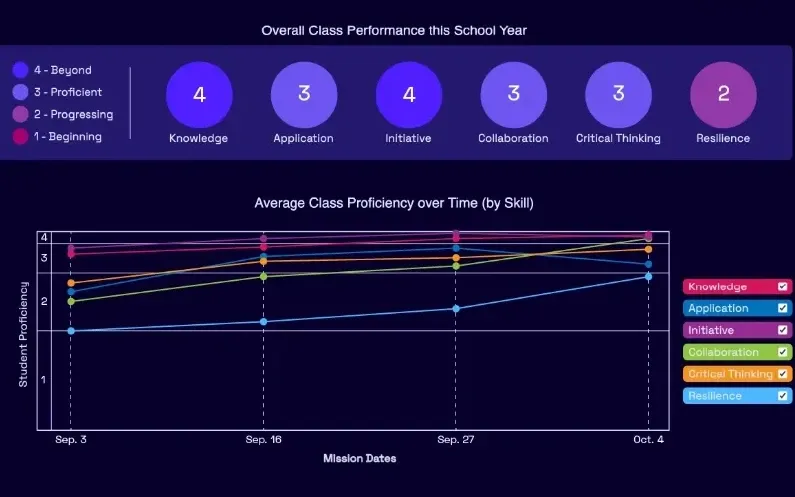
    A Mission.io class report: the class score in each of six skills, from knowledge and application to collaboration, critical thinking, and resilience, with the class chart across the year below.
    A class report from a real Mission: the class score in each of six skills, then each skill across the year.

    Every Mission produces a report for every student, built from what that student did across the whole Mission, on the skills the Mission captured. What it can show: what they knew about the standard, whether they could apply what they learned as the problem unfolded, and the human skills every school promises (collaboration, critical thinking, initiative, and resilience). The test shows what they know. The report shows the rest. In the crime lab, your tally catches about half the room by ear, and the results table and the lab report catch every team. A Mission is the only place collaboration gets measured for every student at once. SEE THE EVIDENCE →

    You taught it. Now find out who can use it.

    Will it work in my room?

    Students join with a class code: no student accounts, no student email, no passwords. Chromebooks, laptops, or tablets, plus your projector; on a shared cart, it’s the day you have the cart. Free for teachers, no credit card.

    Who’s behind it. Mission.io is a research and design organization with one job: make this kind of structured, whole-class learning something a teacher can run every unit instead of once a semester, and put a report in your hands when it’s over. Over a million students have run a Mission. The research behind them is funded by the National Science Foundation and the U.S. Department of Education’s Institute of Education Sciences, and Mission.io meets ESSA Level II standards, as validated by Instructure.

    START FREE

    Free teacher account, no card. Start with the Communication Mission, marked Start here in your library, then The Abyss for grades 3 to 5 or Do No Harm for 6 to 8, each after its 5-minute Teacher Preview.

Questions teachers ask about immersive learning

Do I need VR headsets for immersive learning?

No. Headsets are one way to deliver a setting, and the research on them is real (Coban, Bolat, and Goksu, 2022). Story, stakes, and role need no hardware, and hot seating needs one chair.

What's the difference between immersive learning and a classroom transformation?

A transformation changes the room. Immersive learning changes what students are doing in it: a story with a decision, and a role for each of them. The two work well together, which is what the rebuild does. The comparison table has virtual reality beside both.

Is immersive learning just fun, or does it work?

It works when it’s built to. Serious games beat conventional instruction on learning and retention, weren’t more motivating, and worked better alongside other instruction and in groups (Wouters and colleagues, 2013). The teaching and the group do the work.

Which immersive strategy should I start with?

Hot seating, with you in the seat, because it takes 10 minutes and no props. The town hall next, once the class can stay in role for a whole period.

How do I keep role-play from turning into chaos?

Give every role a job with a record, and keep the way out: a signal that stops the story so you can teach, then starts it again. Heathcote’s teachers step out of the fiction on purpose.

References and sources

Nine strategies on your story, then one the Mission tells

In role first, by hand, with the crime lab card. Then a Mission, when the unit is ready: the Communication Mission first, then The Abyss for grades 3 to 5 or Do No Harm for 6 to 8, each after a 5-minute Teacher Preview. All free. Coaching a team on this, or building the PD?