Classroom culture

Morning Meeting rebuilt around a job the whole class has to finish together, eight more practices with steps and the fix each needs, what culture is made of and the research, and a free card to run it, K to 8.

Who we are. Mission.io makes Missions: teacher-led, whole-class simulations where students use what they’re learning to work through a real scenario together.

Everything on this page works without us. The place a whole-class Mission fits is near the end. (The Intro Mission pulls the crew’s ship into a fractured rift in spacetime, and the class can run it again and take a different path out.)

On this page

What classroom culture is

Classroom culture is the shared way a class works together: the norms, goals, values, relationships, teaching, and structures that decide what it feels like to learn in that room, and whether a student will risk a wrong answer in front of everyone else. The definition comes from the National School Climate Center’s work on school climate, scaled down to one room, and the practices most teachers use to build it come from Responsive Classroom (Morning Meeting, Interactive Modeling, Closing Circle) and the International Institute for Restorative Practices (circles and the restorative questions).

The talking piece comes around the circle to a student who hasn’t said a word all week. She holds it, says one sentence, and passes it on, and the room just listens. What made that safe was built earlier: norms the class wrote itself, practiced, and then tested on something hard together. (Who wrote the ones on your wall?) This page is the practices that build it, with steps, and the fix each needs. Run the usual way, most of them miss the same two things: a reason for the class to need each other, and a way to see who took part.

Is classroom culture the same as classroom management?

Classroom management is the routines and responses that keep the room running: how you get attention, where finished work goes, what happens when a rule breaks. You set it and you teach it, and a well-managed room can still be one where nobody says a wrong answer out loud.

Classroom culture is what the class does when you aren’t managing: whether students help each other, disagree with a reason, own a mistake. It gets built with the class, out of practices like the nine here, and it shows on the hard days.

School climate is the research term for the same thing at the scale of the building. The National School Climate Center calls it “the quality and character of school life.” In a K-8 room the useful line runs between the first two: management is the structure you run, and culture is what the class builds inside it, mostly out of collaboration and the nerve to try again. Collaboration has its own guide: collaboration activities for students.

The three, side by side

Classroom management, classroom culture, and school climate compared.
TermWhat it isWho builds itWhat each student ownsThe question it answersWhat you watch for
Classroom managementThe routines and responses that keep the room runningThe teacherFollowing the procedureWhat do we do when?Is the room running
Classroom cultureThe shared way one class works togetherThe teacher and the class, togetherA voice in the norms and a part in the workWho are we when it gets hard?Who helps, who passes, who changes their mind
School climateThe quality and character of school life (National School Climate Center)The whole schoolA place in the buildingWhat is it like to be here?Safety, relationships, and how the building runs

What culture is made of, and six things to check

The climate list first, then the research, then the six checks this guide runs on every practice.

What is classroom culture made of?

The National School Climate Center’s definition names what climate reflects. It’s written for a whole school, and every item on it also lives inside one classroom door:

  1. Norms. The agreements about how people treat each other here, written or not.
  2. Goals. What the class is working toward, and whether it’s shared.
  3. Values. What the class treats as worth doing: being right, being first, or helping someone else get there.
  4. Interpersonal relationships. Teacher and student, student and student.
  5. Teaching and learning practices. The way the work itself is run.
  6. Organizational structures. Seats, groups, roles, routines, and who decides.

What the research says

Does any of this show up in learning? The research answers mostly through relationships. Across 99 studies from preschool through high school, teacher-student relationships were related to engagement at a medium-to-large level and to achievement at a small-to-medium level, and negative relationships hurt more in primary school than in secondary (Roorda and colleagues, 2011). One study followed 179 children from kindergarten to 8th grade: kindergarten teacher-child conflict and over-dependency predicted poorer grades, test scores, and work habits in early elementary school, and behavior into middle school (Hamre and Pianta, 2001). The study is correlational, so the word is predicted. On Hattie’s list, teacher-student relationships sit at d = 0.52 and strong classroom cohesion at d = 0.44 (Visible Learning).

The finding a teacher can act on is about belonging. A one-hour belonging exercise with about 90 college freshmen cut the Black-White achievement gap by 52%. In 7th grade, two 15-minute writing exercises raised GPA from 2.85 to 2.91 (Walton and Cohen, 2011; the 7th grade trial, 2,316 students, 0.06 SD, p < 0.01). Modest, and it’s practice 7 below.

Six things that separate a culture from a rules poster

The climate list is the researchers’. The six below are checks you can run on any practice in its first minute, and the lens this guide uses on every one. Two of them (stakes, and the teacher leading) are ours, and stakes weigh most here: a class learns who it is by doing something hard together.

  1. 1. A real problem with stakes the class can feel.

    “Share something about your weekend” is a routine. “Pick the one norm we’ll hold each other to in the lab after lunch” is a problem. Students who wrestle with a problem before the teaching learn more from the teaching, in studies mostly with students 12 to 18 (Sinha and Kapur, 2021).

  2. 2. Apply, don't recall.

    A practice that would run the same whether or not the class learned anything this week is a ritual on a schedule. The strong ones borrow the lesson: the morning message asks a question the unit can answer.

  3. 3. Group goals with individual accountability.

    Culture is a group goal by definition. The half that goes missing is the individual one: something each student said, signed, or did, with a name on it.

  4. 4. The teacher leads the thinking.

    The routine carries the talk, and the questions stay yours. “Who changed your mind this morning?” does more than reading the norms aloud.

  5. 5. A debrief where the class argues it out.

    Closing Circle and the last go-around of a circle exist for this, and they’re the first thing cut when the bell is close. Five minutes on “which norm held today, and which one broke” is how a norm becomes the class’s own.

  6. 6. A way to see who did what.

    If you can’t tell which student has spoken in circle this week and which one has passed every time, you’re building the culture for the students who talk.

Norms get written in the circle and tested on the hard days.

The Morning Meeting below is the one to run first, and the card has everything students touch in it, ready to copy. Get the card →

1. Morning Meeting, rebuilt around a class job

It’s a start to the day, twenty to thirty minutes in a circle. As Responsive Classroom describes it:

  1. Greeting. Students and teachers greet one another by name.
  2. Sharing. Students share information about important events in their lives, and listeners respond.
  3. Group activity. Everyone takes part in a brief, lively activity that builds the group.
  4. Morning message. Students read and interact with a short message written by their teacher.

Run as written, it’s a warm start, and it works. When it drifts, the same few students share, the game has no reason behind it, the message turns into the schedule, and nobody can say afterward who spoke. The version here keeps all four parts and adds a job the class can only finish together, and a record of who did what, in about 20 minutes.

Time
About 20 minutes, inside Morning Meeting’s twenty to thirty.
Groups
Whole class in a circle, pairs for the sharing.
Grades
K to 8. The example is 4th grade; the K to 2 version is in the sharing step.
Needs
The class job card, the partner question card, and the share tally, from the printable.
  1. The class job, in the messageStakes

    Before students arrive, write into the message one job the whole class has to finish by the end of the meeting: pick the one norm the class will hold during the lab after lunch, with a reason, or solve one problem from the last lesson that nobody solved alone. Say the stakes out loud: whatever the class decides goes on the board, and it’s what everyone is held to after lunch.

  2. Greeting, 3 minutesAccountability

    Every student greets someone by name and is greeted by name, all the way around. One lap is a roll call of who’s here, and of who looks at whom.

  3. Sharing, 6 minutes, in pairsAccountability

    Pairs, with the sharing pointed at the class job: which norm, and why, or how you tried the problem. Each partner shares, then the other says it back and asks one card question. In K to 2 the share is a drawing, held up and explained to one partner.

    • Sharer

      Says what they think and one reason.

    • Listener

      Says it back and asks one card question: "What happened that made you think that?" or "What would change your mind?"

  4. Group activity, 6 minutes, with a reasonApply

    The activity is the class job. Students stand in the corner for the norm they’d pick, each corner sends one speaker with its best reason, and anyone can switch corners after hearing them. Still brief, still lively, and now it decides something.

  5. You lead the thinkingTeacher leads

    Three questions while you walk during the sharing: What did your partner say? What would change your mind? Who haven’t we heard from? The vote stays the class’s; the questions are your part.

  6. The message, read last, 4 minutesDebrief

    The class rereads the morning message, fills the blank with its decision, and you ask: which reason moved the most people, and who switched corners, and why? Everyone signs the message on the way to their seats.

  7. See who did whatSee who did what

    Four behaviors on the tally: greeted by name, shared a reason, said a partner’s idea back accurately, switched corners with a reason. The signed message and the corners catch everyone, at a glance, not a grade.

The Morning Meeting class job card, free

Emailed now, ready to copy: the teacher page, the Sharer and Listener cards, the morning message with the class job, the Listener’s questions, the corner signs, and the four-behavior tally.

It’s on its way.

Check your inbox for the Morning Meeting class job card.

Email me the card. It comes as a PDF, ready to print. Unsubscribe anytime.

Eight more practices, with steps and the fix each needs

Which practices actually build a culture? The eight below are the canon: where each comes from, its steps as its originators publish them, how it often runs, and the changes it needs. Numbered 2 to 9.

The canon

2. Interactive Modeling (Responsive Classroom)

Needs Whole class · K to 8 · 10 to 20 minutes · One routine or skill students will need

Responsive Classroom’s seven steps go in this order: say what you’ll model and why, model it exactly as you expect students to do it, ask what they noticed, invite a student or two to model it, ask again what everyone noticed, have all students practice, and give feedback. The steps work for academic skills as well as routines, and you lead the thinking at every one. As often run, though, it models lining up, and practice ends when the line is straight.

The fix

  1. Pick the one behavior the next hard task needs, like “disagree with a reason” or “ask a partner before you ask me.”
  2. Make step 6, the practice, that hard task itself.
  3. Tally who uses the behavior during the task.

3. Class norms, built in a circle (IIRP)

Needs Whole class · Grades 2 to 8 · 20 to 25 minutes · Chart paper and a talking piece

From the IIRP’s Charleston County guide: the class sits in a circle, warms up, and answers the guiding questions one at a time (What helps you learn in class? What stops you from learning? What can we agree on about how we’ll treat each other? How would you like me to treat each of you? What do we do if someone breaks an agreement?). You chart every answer, checking repeats, narrow the list to the 5 to 10 everyone agrees with, and everyone signs the chart. The signatures give every student a share in the norms. As often run, though, the chart goes up the first week and nothing tests it, so the norms never meet a hard moment and the class never talks about how they held.

The fix

  1. Within a week, give the class a hard task where the norms will matter.
  2. Afterward, circle up on which norms held and which broke.
  3. Revise the chart from what the circle said.

4. The proactive circle (IIRP)

Needs Whole class in a circle · Any grade · 15 to 25 minutes · A talking piece and one question

From the same guide: the class sits in a circle where everyone can see everyone, and only the holder of the talking piece speaks. You ask one question, give a minute to think, answer first yourself, and pass the piece around in order; anyone can pass, and the piece comes back to them at the end. Every student gets a turn, and you lead it. As often run, though, the question is something like favorite foods, so a circle runs the same in September and May, and nothing tracks who passes.

The fix

  1. Ask a question the lesson answers, like “Which explanation would you bet on, and why?”
  2. Keep a pass tally as the piece goes around, so a student who always passes shows up within a week.

5. Affective statements (IIRP)

Needs Anyone, anytime · Any grade · Under a minute · A sentence frame on the wall

You post the frame “I feel ___ when ___,” model one yourself about a specific behavior, good or bad, and students take turns making their own around the circle. After that, you use the frame in the moment, for what goes right as well as what goes wrong. It’s the most informal move on the IIRP’s restorative continuum, taught with this frame in the guide above, and you’re the one who models it. As often run, though, the frame lives on the wall and the moment passes, with no task behind it and nothing anyone does next.

The fix

  1. Teach the frame inside a real task, like a team that just lost a step.
  2. Have the student who used it name one thing they’ll do next, out loud, to the team.

6. The restorative questions (IIRP)

Needs One student or a small group · Any grade · 5 to 10 minutes · The questions on a card

The IIRP’s own questions, asked in order, leave the repair to the student: What happened? What were you thinking of at the time? What have you thought about since? Who has been affected by what you have done? In what way? What do you think you need to do to make things right? For calm weeks there’s a proactive set: What’s going well for you this week? Has anyone helped you recently? How? The questions hold each student to their own answer and end in a look back. As often run, though, nothing records the answer to the last question.

The fix

  1. Write down what each student said they’d do to make things right.
  2. Check back with each one within two days.
  3. Run the proactive set after hard tasks, so the questions are familiar before anyone needs them.

7. The belonging exercise (Walton and Cohen, 2011)

Needs Every student, alone · Grades 6 to 8 (the evidence is 7th grade and college) · Two 15-minute writing sessions · Short accounts from older students

Students read short accounts from older students: worries about fitting in were common at first, and they faded. Each student writes about why those experiences changed, with examples from their own life, then rewrites it as advice for the students who come after them. In the original study the advice became a videotaped speech, and the 7th grade trial ran two 15-minute writing exercises at the start of the year; every student writes, alone. By design it skips stakes and a class debrief, so what it needs is the right moment and privacy.

The fix

  1. Run it at a transition, like the first weeks of middle school.
  2. Keep it private: nobody says a word of it out loud.

8. Closing Circle (Responsive Classroom)

Needs Whole class · K to 5 · 5 to 10 minutes · About ten minutes before dismissal

From Responsive Classroom’s own example: once students are packed up, they gather at the meeting area, and after the attention signal and quiet you ask one reflective question, such as “What’s one way you helped others today?” After thinking time, students share, and the circle closes with a short celebration or a game before dismissal. It’s a daily debrief at a set time, run by you. As often run, though, the question isn’t tied to anything the class did with the lesson, and a few volunteers answer for the room.

The fix

  1. Ask the question the morning’s class job set up, like “Did we hold the norm we picked?”
  2. Have every student answer at once, thumb up or down, before anyone explains, so you see the whole class’s answer.

9. A shared high-stakes day

Needs Teams of four · Grades 3 to 8 · 45 to 60 minutes · A story, a locked box, and a clock

No one owns this one, so these are the escape room’s steps as commonly run: you build a story around the finished unit with a locked box at the end, and write a chain of puzzles that use the unit, each opening the next lock. Teams crack the puzzles before the clock runs out, and when the box opens or the clock wins, the class debriefs. The clock and the box are stakes the class can feel, and the team shares one goal. As often run, though, the puzzles are review questions, and the fastest student on each team turns every lock.

The fix

  1. Give every student a lock only they can turn.
  2. Make one puzzle a decision with two defensible answers.
  3. End the debrief on one question: “Who got us through?”

See the classroom escape room, fixed, on the problem solving page →

Two that get called classroom culture and aren't

The rules poster is management with a laminator: rules handed to a class instead of written by it, which is why practice 3 builds them in a circle. And the class reward jar is a group goal with nothing to learn on the way to the party. Both have a place in a room. Neither builds the culture on its own. The Morning Meeting above is the one to try first, and its card is free. Get the card →

What classroom culture looks like, K to 8

K to 2. Morning Meeting and short circles fit these years: a talking piece small hands can hold, the right to pass and get it back, and shares about something the child can point to. Seven-year-olds “dislike taking risks or making mistakes” (Responsive Classroom, 2024), so the first class jobs are ones nobody can get wrong, and the hard ones come later in the year. The relationships built here last: kindergarten teacher-child conflict predicted grades and work habits in early elementary school (Hamre and Pianta, 2001).

3 to 5. Eight-year-olds have a “growing awareness of fairness issues,” nine-year-olds can work in groups but with lots of arguing, and ten-year-olds “do well with group activities and cooperative learning” (Responsive Classroom, 2024). Class norms built in a circle and the restorative questions do the most here, because the fairness instinct gives the circle something to work with, and the shared high-stakes day starts to run as written.

6 to 8. Peer opinions outweigh adult opinions by 12, eleven is “the common age for cliques,” and thirteen-year-olds “often complain about fairness” (Responsive Classroom, 2024). This is where the belonging evidence sits (the 7th grade trial) and where circles move into an advisory period. The shared high-stakes day gives a middle school class a story about itself, and the restorative questions belong on a card in your pocket.

  • Our part · We make Missions

    Where whole-class Missions fit

    Plenty of teachers build culture every day by hand, and it works. Every practice above runs in a circle or a pair, at your pace, and you can see who’s in it, as long as you’re the one leading it.

    A Mission is a teacher-led, whole-class simulation that gives a class practice 9, the shared high-stakes day, without building the escape room yourself: your class becomes the crew, and the only way through is together. In the Intro Mission, three parts of what culture is made of come built in:

    • Goals. One goal, the whole crew’s: get the ship out of the rift in one piece.
    • Organizational structures. Seven crew teams, with every student assigned to one and working on their own screen.
    • Teaching and learning practices. The Mission runs the work at every station and moves the story forward, and every student gets a report on how well they did, shaped by what the Mission asked of them.

    Norms, values, and relationships stay yours. The circle is where the norms get written, and the Mission is where they get tested. What the class says to each other afterward shows whether they held. The thinking stays yours.

    What it is, and what it isn’t. Most Missions run 30 to 45 minutes, and the Intro Mission runs about 19, with one device per student and your projector. No multi-week project, no headsets, and you lead the room from the first screen to the last. The practices above stay the daily work, and the Mission is the hard day they’ve been getting ready for.

    You're at the helm, not on the hook.

    The same structure in STEM and in speaking and listening

    Two Missions side by side, because the structure is the point and the subject isn’t. In both, the two criteria hardest to build by hand in a circle, stakes the class can feel and a way to see who did what, come built in: the stakes are the story’s, and the report is per student. The other four are in the scene.

    “Unlike other tech programs in the district that often have students working in isolation or in pairs, Mission.io emphasizes true collaboration.”

    Lorilee Johnson, District specialist, Alpine School District, UT

    The Intro Mission

    Grades 4 to 12 · About 19 minutes · STEM · Free with a teacher account

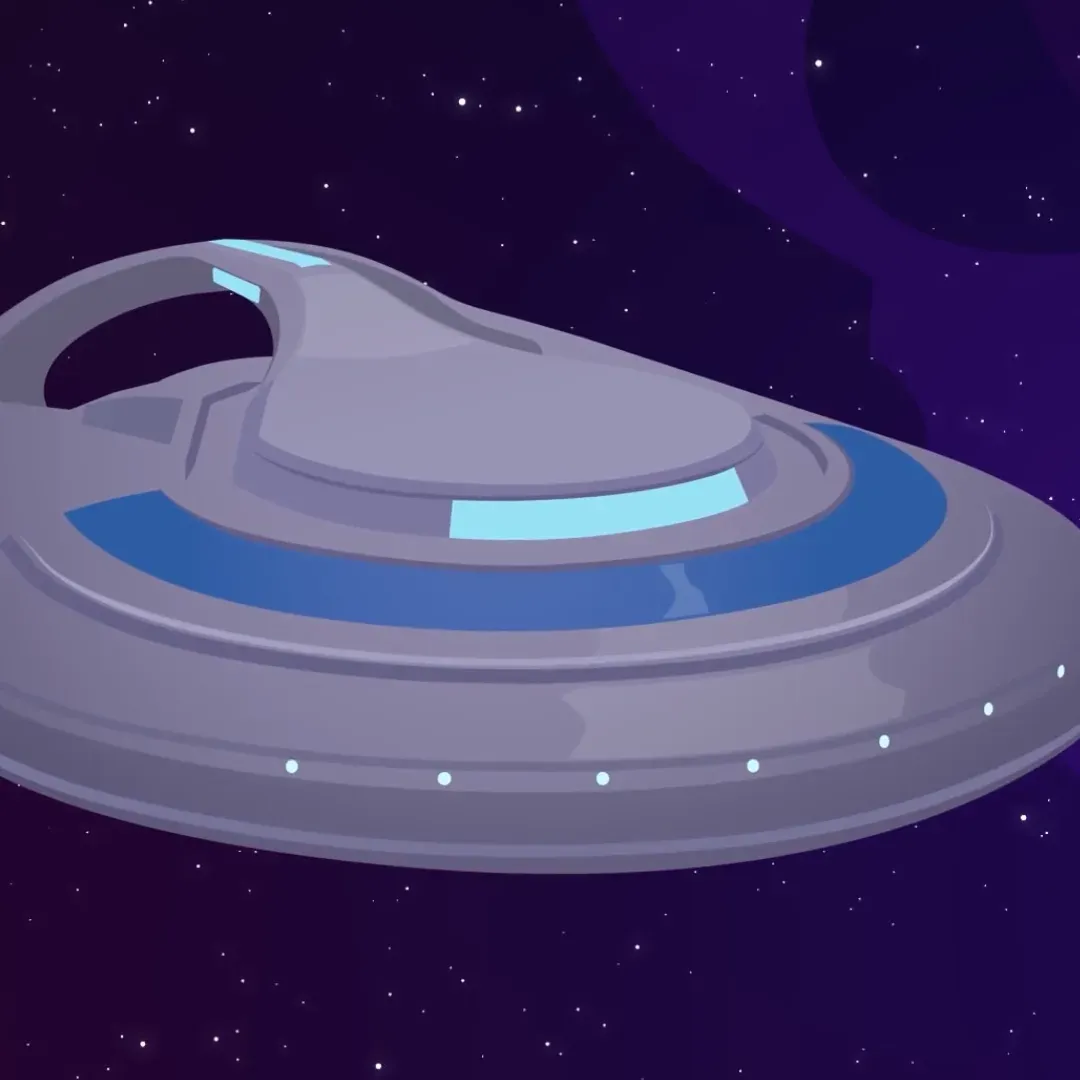
    A saucer-shaped ship in front of a swirling, fiery rift in space above a planet.

    On a Mission to explore an uncharted stretch of deep space, the crew’s ship is pulled into a fractured rift in spacetime. To get out, the class chooses between paths, each with its own environment, challenges, and risks, and has to work together, adapt quickly, and solve its way home. It’s built to be replayed, a different path each time, across seven crew teams: the shared high-stakes day with the escape room already built. At about 19 minutes, it’s shorter than most Missions: a quick first run at solving one problem together, and every student still gets a report on how well they did.

    MISSION BRIEF →

    Collaboration (4 and up)

    Grades 4 to 9 · About 24 minutes · Speaking and listening · Free with a teacher account

    GAL-Delilahs are wreaking havoc again. To lead a swarm of malfunctioning ones away from the planets they’re attacking, the crew has to re-program an old GAL-Delilah, and breaking into its processor has rules: seven crew teams have to collaborate to break the code. It’s written to the speaking and listening standards from SL.4.1 to SL.8.1, and it asks that students already know how to work with classmates. Build the norms in a circle first, and tell the class why: breaking that code takes every one of them.

    MISSION BRIEF →

    A hundred more just like them

    These are two of more than 100 Missions, with new Missions added and in the works every week, across science, math, reading, writing, and social studies, each one built the same way and each one where a unit can end. Start with the Communication Mission, then the Intro Mission, then the Collaboration Mission for your band.

    What the report shows, for every student

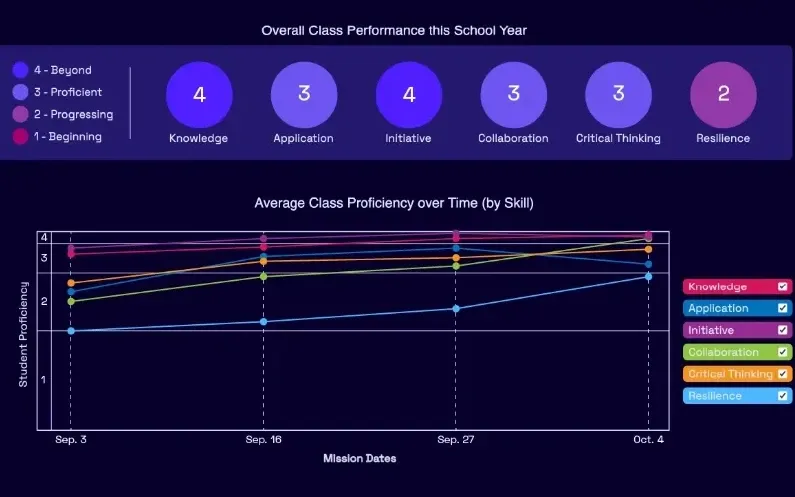
    A Mission.io class report: the class score in each of six skills, from knowledge and application to collaboration, critical thinking, and resilience, with the class chart across the year below.
    A class report from a real Mission: the class score in each of six skills, then each skill across the year.

    Every Mission produces a report for every student, built from what that student did across the whole Mission, on the skills the Mission captured. What it can show: what they knew, whether they could apply it as the problem unfolded, and the human skills every school promises (collaboration, critical thinking, initiative, and resilience). The test shows what they know. The report shows the rest. The pass tally and the share tally catch who spoke in circle, from your seat; the report is the only place collaboration gets measured for every student at once. SEE THE EVIDENCE →

    You taught it. Now find out who can use it.

    Will it work in my room?

    Students join with a class code: no student accounts, no student email, no passwords. Chromebooks, laptops, or tablets, plus your projector; on a shared cart, it’s the day you have the cart. Free for teachers, no credit card.

    Who’s behind it. Mission.io is a research and design organization with one job: make this kind of structured, whole-class learning something a teacher can run every unit instead of once a semester, and put a report in your hands when it’s over. Over a million students have run a Mission. The research behind them is funded by the National Science Foundation and the U.S. Department of Education’s Institute of Education Sciences, and Mission.io meets ESSA Level II standards, as validated by Instructure.

    START FREE

    Free teacher account, no card. Start with the Communication Mission, marked Start here in your library, then the Intro Mission, then the Collaboration Mission for your band, each after its 5-minute Teacher Preview.

Questions teachers ask about classroom culture

How do I build classroom culture in the first week?

Morning Meeting every day, and class norms built in a circle once, in the first few days. Then give the class one hard job to finish together before the second week is out, so the norms get used before they get laminated.

What's the difference between classroom culture and classroom management?

Classroom management is the routines and responses the teacher sets to keep the room running. Classroom culture is the shared way the class works together, built with the students, and it shows in what they do when nobody is managing them. A room needs both. The comparison table has school climate beside them.

Does classroom culture affect achievement?

Through relationships, yes. Across 99 studies, teacher-student relationships were related to achievement at a small-to-medium level (Roorda and colleagues, 2011), and strong classroom cohesion sits at d = 0.44 on Hattie’s list. The belonging exercise moved 7th grade GPA modestly in a randomized trial.

What do I do when the culture breaks in the middle of the year?

Go back to the circle. Use the restorative questions with the students closest to what broke, then rebuild the norms with the whole class, using the same five guiding questions. A norm rewritten after it broke has a story behind it.

Do circles and Morning Meeting work in middle school?

The circle does, moved into an advisory period, with questions that matter to the age (fairness, mostly). Morning Meeting as written is an elementary practice. Middle school is where the belonging exercise has its evidence and where the shared high-stakes day does the most.

How can I tell whether the culture is working?

Count three things for two weeks: who passes in circle, who changes their mind with a reason, and who helps a classmate unasked. If the same names fill the first column and neither of the others, you know where to start. A class list with three columns is all it takes.

References and sources

The research

Nine practices in the circle, then one hard day together

In the circle first, by hand, with the Morning Meeting card. Then one hard day together, when the class is ready: the Communication Mission first, then the Intro Mission, then the Collaboration Mission for your band, each after a 5-minute Teacher Preview. All free. Building this across a school, or leading the PD?