Challenge-based learning

The nano challenge rebuilt so every student owns a question, eight more parts of the framework with steps and the fix each needs, what the research does and doesn’t show, and a free planner to run it, K to 8.

Who we are. Mission.io makes Missions: teacher-led, whole-class simulations where students use what they’re learning to work through a real scenario together.

Everything on this page works without us. The place a whole-class Mission fits is near the end. (Cliffhanger’s town of Oceana is sliding into the sea, quantum research facility and all. The wall is the crew’s job.)

On this page

What challenge-based learning is

Challenge-based learning is a framework in which students move from a big idea to a concrete challenge, investigate what they need to know to meet it, and act on a solution with a real audience. It began at Apple in 2008, in the Apple Classrooms of Tomorrow, Today project, where Mark Nichols and Karen Cator wrote the first white paper, and Digital Promise published the 2016 guide by Nichols, Cator, and Marco Torres.

In a challenge-based classroom, one word is off limits for a while: solution. The challenge goes up as a call to action (Keep the hill from washing onto the blacktop!), and the 2016 guide has you set dates for when students can and can’t say the S word, so the research comes before the fix. The method fits inside that rule: find out what you need to know, then decide what to do, and do it for someone outside the room. The framework grew out of a high school project, and as written it leaves two things to chance in a younger room: a part each student owns, and a way to see who found what. This page is the framework’s parts with steps and the fix each needs.

How is challenge-based learning different from PBL?

Project-based learning is, in PBLWorks’s formal definition, a method where students learn “by working for an extended period of time” on “an authentic, engaging, and complex question, problem, or challenge.” Its Gold Standard runs on seven design elements and ends in a public product.

Challenge-based learning starts one step earlier, with a big idea, and works down to the challenge. Its authors say the first difference was who picks the problem: “The original project based approach had the teacher identifying the project idea,” while challenge-based learning “starts with the teacher and student as partners.” They add, fairly, that “With the new Gold Standard PBL, this gap has narrowed” (Nichols, Cator, and Torres, 2016).

Design thinking is the design cycle (empathize, define, ideate, prototype, test), which the guide says fits the Act phase best. In a K-8 room, the project is the unit, the challenge is the call to action that starts one, and the design cycle is how the solution gets made. The skill under all three has its own guide by grade: problem solving activities for students.

The three, side by side

Project-based learning, challenge-based learning, and design thinking compared.
MethodWhat it isWhere it startsWho picks the problemHow it endsHow long it runs
Project-based learningA unit built around a projectA challenging problem or questionThe teacher designs it, with student voice and choiceA public productA week up to a semester (PBLWorks)
Challenge-based learningA framework in three phases: engage, investigate, actA big idea, then an essential questionTeacher and students, as partnersA solution carried out with a real audience, then evaluatedA day to a school year (Nichols, Cator, and Torres, 2016)
Design thinkingA design cycleWhat a user needsThe design teamA tested prototypeAs many cycles as the design takes

The framework, and the six things to check

The framework’s three phases come first, then what the research says, then the six checks this guide runs on every part.

What are the phases of challenge-based learning?

The framework has three phases with three steps each, and one practice that runs under all of them (Nichols, Cator, and Torres, 2016):

  1. Engage. A big idea, an essential question, and the challenge: the class moves from a broad concept to a call to action.
  2. Investigate. Guiding questions, guiding activities and resources, and analysis: the class learns what it needs to know to meet the challenge.
  3. Act. A solution, its implementation with a real audience, and an evaluation of whether it worked.

Under all three: document, reflect, and share, with every student keeping a journal from the first day of the challenge to the last.

What the research says

Is challenge-based learning proven? Not in K-8. The 2008 white paper introduced the framework without comparing it to project-based learning and without pilot sample sizes (Nichols and Cator, 2008). A review of 100 higher education articles found benefits in transversal skills and in work with community and industry partners, found that the label lacks standardization because so many hybrid approaches use it, and offered a classification rather than effect sizes (Gallagher and Savage, 2020).

As of 2025, a systematic review found just 16 K-12 studies of challenge-based learning, out of 1,209 records from 2004 to 2024 (Gandini and Morselli, 2026). Nine were in secondary schools and seven in primary, and ten were in STEAM subjects. Sixteen studies is a reason to run it carefully, with the fixes below.

Six things that separate a challenge from a handout

The framework is the authors’ list. The six below are six checks you can run on any part of it in its first minute, and they’re the lens this guide uses on every one. Two of them (the teacher leading, and seeing who did what) are ours, not the framework’s; the other four are the framework’s challenge, investigation, solution, and reflection, checked for a K-8 room.

  1. 1. A real problem with stakes the class can feel.

    “Learn about erosion” is a topic. “Keep the hill from washing onto the blacktop, and the principal reads the best three plans” is a challenge. Students who wrestle with a problem before the teaching learn more from the teaching, in studies run mostly with students 12 to 18 (Sinha and Kapur, 2021).

  2. 2. Apply, don't recall.

    If the solution could come from a search bar instead of the investigation, the challenge is a scavenger hunt. The guide’s rule: every solution is defended with the research.

  3. 3. Group goals with individual accountability.

    One solution the group signs, and one guiding question each student answered alone, with a name on it. The guide asks for both. A challenge on a handout can have the first and skip the second.

  4. 4. The teacher leads the thinking.

    The guide has you set the boundaries, narrow at first and wider as the class takes on more. The three questions on the planner, asked while you walk, keep the investigation on the standard.

  5. 5. A debrief where the class argues it out.

    Reflection runs under every phase, and a full period squeezes it out first. Five minutes on “which finding changed our solution” is where a challenge becomes a habit.

  6. 6. A way to see who did what.

    If you can’t tell which student answered a guiding question and which one copied the group’s poster, you can’t teach the skill. You can only hope for it.

Every question gets a name, and every fix needs a finding.

The nano challenge below is the one to run first, and the planner has everything students touch in it, ready to copy. Get the planner →

1. The nano challenge, rebuilt so everyone owns one

It’s the guide’s short form of the framework, scaffolding for longer challenges: one content area or skill, tight boundaries, and the teacher directing more of it (Nichols, Cator, and Torres, 2016). As the guide describes it:

  1. Challenge. Start with the challenge itself, without first identifying a big idea or an essential question.
  2. Investigate. Work the guiding questions and activities at a much lower intensity than a full challenge.
  3. Act. Develop a solution, often stopping short of carrying it out with an outside audience.

As written, it’s a sketch: a call to action with no audience, a group investigation with no part for each student, and no record of who found what. The version here hits all six. It takes a class period, and the example is 5th grade Earth science.

Time
45 minutes, or two 25-minute sessions split after the investigation.
Groups
Fours. The guide puts four to five per group.
Grades
3 to 8 as written. The K to 2 version is in the questions step.
Needs
The challenge card, the question cards, and the findings strip, from the printable, plus three guiding resources.
  1. The challengeStakes

    Post it as a call to action, the way the guide writes challenges: Keep the hill from washing onto the blacktop! The principal reads the three best plans. (Ask the principal first.) Say it out loud, so the plans are written for someone outside the room.

  2. Guiding questions, 4 minutes, aloneAccountability

    Each student writes three questions the group needs answered to fix the hill, one per card, with a name on each. Alone first, because the guide warns a group brainstorm can shut some students out. In K to 2 the class asks its questions out loud at the carpet, you write them on the chart, and each child signs the one they asked.

  3. Sort, 5 minutesApply

    The group merges the cards that ask the same thing and sorts the rest into must know and good to know, the guide’s own two piles. Then each student takes one must-know question to answer. Four questions, four names.

  4. Investigate, 15 minutesApply

    Three guiding resources on the table: a tray of soil and a cup of water for a two-minute rainstorm, photos of the hill after a storm, and a one-page reading on how water shapes land (5-ESS2-1). Each student answers their own question on the findings strip, with the resource that answered it. Nobody says the S word until the strip is full.

  5. You lead the thinkingTeacher leads

    Three questions, walking, while they investigate: Which sphere is doing the damage? What’s your evidence? Which question on your table is still open? The guide’s tip holds here: resist finding the solution for them.

  6. The solution, 8 minutesAccountability

    Each group picks one fix and writes it in two sentences, and every student signs beside the finding of theirs it rests on. A fix that no finding supports goes back to the investigation.

  7. Pitch and debrief, 6 minutesDebrief

    Three groups pitch, drawn from a cup, a minute each. Then the class argues: Which fix is best backed by its findings? Which finding changed a group’s plan? The three best go to the office.

  8. See who did whatSee who did what

    Four behaviors on the tally: wrote three questions alone, answered an owned question from a resource, signed beside a finding in the solution, changed the plan because of evidence. The cards and the strip carry names, so you see everyone without grading a thing.

The eroding hill challenge planner, free

Emailed now, ready to copy: the teacher page, the challenge with the two-minute rainstorm, the question cards, the reading on how water shapes land, the findings strip, the fix card, the numbered pitch cards, and the four-behavior tally.

It’s on its way.

Check your inbox for the eroding hill challenge planner.

Email me the planner. It comes as a PDF, ready to print. Unsubscribe anytime.

Eight more parts of the framework, each one fixed

Which parts make it challenge-based learning? The eight below are the framework, in the order a full challenge runs them: the step as the guide writes it, where it falls short as written, and the changes it needs. Every step comes from the 2016 guide. Numbered 2 to 9.

The framework

2. Engage: big idea to challenge

Needs Whole class, then groups · Grades 3 to 8 · One to two periods · A big idea

The class starts from a big idea that matters to the students and the community (the guide’s examples include health and resilience), and students ask personal questions about it until the class settles on one essential question. Then the question becomes a challenge, a call to action students can carry out; in the guide’s example, resilience becomes helping a community recover from a disaster. When the challenge is close to home, the stakes are real. As written, though, the big idea can float free of the unit, and no question carries a student’s name, so you can’t see who shaped the challenge.

The fix

  1. Start from the standard you’re teaching, and pick the big idea it lives inside.
  2. Have each student write an essential question on a card with their name on it.
  3. Let the class vote, with a reason behind every vote.

The planner has the question card.
3. Investigate: guiding questions

Needs Each student alone, then groups of four · Grades 2 to 8 · 15 to 20 minutes · Question cards or sticky notes

Each student writes as many questions as possible about what the group needs to know, alone, before any group brainstorm. Then the group merges the ones that ask the same thing, sorts them into categories, ranks each one must-know or good-to-know, and saves the list, because new guiding questions keep coming. The guide has you add questions for the standards, and the alone-first step puts every student to work. As written, though, nobody owns a question once the sort is done.

The fix

  1. As the sort ends, put one student’s name on every must-know question.
  2. That student answers it in the next step, so every must-know question has someone responsible for it.

The planner has the question card and the two piles.

4. Investigate: guiding activities and resources

Needs Groups of four, one owned question each · Grades 3 to 8 · One to several class periods · A starter set of credible resources

Students take the top questions and choose activities and resources to answer them; the guide lists simulations, experiments, and expert interviews among them. The class lines the questions up against the standards, with an “other” category for any standard the challenge misses, and then students research, record their findings, share them with the group and the teacher, and check in on schedule. The research puts the lesson to work by design. As written, though, the findings belong to the group, and there’s no telling who found what.

The fix

  1. Hand each group your starter set of three credible resources before they search on their own.
  2. Give the group a findings strip with one line per owned question, and on each line the student’s name and the resource that answered it.

The planner has the findings strip.

5. Investigate: analysis

Needs Groups of four · Grades 4 to 8 · 20 to 30 minutes · Everyone's findings in one place

The framework site now calls this step synthesis: with the guiding questions answered, the group pools its findings, looks for themes, and moves from findings to conclusions. It checks those conclusions with an outside expert or, if none is available, a peer group that hunts for gaps, and a report or presentation shows that every guiding question is answered and the standards are covered. The lesson has to be used, and the peer check turns the work into an argument. As written, though, one student can write the whole report from everyone’s notes.

The fix

  1. Require every conclusion to cite at least two students’ findings by name.
  2. Give the peer group one job: find the question nobody answered.

6. Act: solution development

Needs Groups of four · Grades 3 to 8 · One to two class periods · The conclusions, and materials for a prototype

Solution ideas come out of the investigation’s findings, and each group chooses one, defends it from its research, and pitches it to peers, teachers, family members, or experts. Once it’s approved, the group prototypes, tests, and refines it, which can send it back to investigate. The challenge is real, and the solution has to use what the group learned. As written, though, nothing says who designed what, and the guide itself warns against jumping to a solution students walked in with.

The fix

  1. Have every line of the solution point to a named finding, so a solution brought from home has to earn its way in.
  2. Give each student one test of the prototype to own.

The planner has the solution line with a finding beside it.

7. Act: implementation and evaluation

Needs Groups of four · Grades 4 to 8 · Days to weeks · A real audience and a way to measure

Each group writes an implementation plan (the audience, dates, activities, costs, likely difficulties, and each member’s responsibilities) and plans what it will measure, and when. Then the group carries out the solution with a real audience, analyzes the results, and refines the solution or writes a completion report. It has real stakes, it needs the content, and the plan names each member’s job. As written, though, the evaluation measures the solution and leaves the students out, so the class never looks back at what each part did.

The fix

  1. Pick an audience that will answer back, like the principal, the cafeteria, or a younger class.
  2. Add one line to the results for each member: what their part changed.

8. Checkpoints

Needs Each group, with you · Grades 3 to 8 · Five minutes a group · The six questions

You schedule checkpoints with teams and individuals, and between them teams post progress where you can check it. At each checkpoint you ask the guide’s six questions (Where are you in the process? What new knowledge or skills have you acquired? What has been your biggest success? What has been your biggest challenge? How is your group doing as a team? What are your top priorities for next week?) and use the answers to adjust the boundaries and the timeline. The questions are yours, and they give each team a regular look back. As written, though, one voice can answer for the group, and nothing records who said what.

The fix

  1. At each checkpoint, draw one student’s name from a cup.
  2. Ask that student two of the six questions, and let them answer for themselves.
  3. Log the answer on the tally.

9. Document, reflect, and share

Needs Every student · Any grade · A few minutes per phase · A journal, on paper or recorded

Through the whole challenge, students document the work in writing, photos, audio, or video, and every student keeps a journal with a reflection prompt at the end of each phase. Reflections can be private (the student only), process (shared with you), or public (shared beyond the class), and at the end students answer final prompts and tell the story of the challenge. Every student writes, and the prompts give the class something to look back on. As written, though, a journal prompt can be answered without using the lesson.

The fix

  1. Before each phase starts, write the prompt for its end, and make it one only the content can answer.
  2. For the investigate phase, that might be “Which finding changed your mind, and what does it say about how water shapes land?”

Two that get called challenge-based learning and aren't

The STEM challenge card (tallest tower, 18 minutes, go) is a design challenge with criteria and constraints, no essential question, and nothing to investigate. The 4th grade page rebuilds it: the marshmallow tower, rebuilt for 4th grade. And a unit with “challenge” in its title is a project, which has its own guide: project-based learning resources. The nano challenge above is the one to try first, and its planner is free. Get the planner →

What challenge-based learning looks like, K to 8

K to 2. Nano challenges only, with the class as one group and you holding the pen: one challenge from the room itself (the coats on the floor, the drooping plant by the window) and one solution the class tries together. Six-year-olds “may choose projects that are too hard” and seven-year-olds “dislike taking risks or making mistakes” (Responsive Classroom, 2024), which is why the boundaries start narrow and the challenge is yours to pick.

3 to 5. The band where the guide’s mini challenge, two to four weeks with the whole framework, first fits. Nine-year-olds look hard for explanations of how things work and why things happen as they do, which is what guiding questions run on (Responsive Classroom, 2024). Run the nano challenge above, then one mini challenge a year on a standard you’d teach anyway.

6 to 8. Twelve-year-olds are “increasingly able to plan, organize thoughts and work, and set short-term goals,” and fourteen-year-olds “respond well to academic challenges” and “enjoy tackling big ideas” (Responsive Classroom, 2024), so the full Engage phase, big idea first, belongs here. So does a real implementation, like the guide’s Windward School seventh graders, who end their year with a science challenge for their community. Struggling with a problem before the teaching has its best evidence here, in studies run mostly with students 12 to 18 (Sinha and Kapur, 2021).

  • Our part · We make Missions

    Where whole-class Missions fit

    Plenty of teachers run challenges like these by hand, and they work. Every part of the framework runs in a small group, and a small group is where you can see who found what, as long as you’re the one standing there.

    A Mission is a teacher-led, whole-class simulation that runs a challenge at the scale of the room: your class can become the crew, the problem is built from the unit you just taught, and the only way through is using it together. Three of the framework’s nine steps come built in:

    • The challenge. In Cliffhanger, a cliffside town and a quantum energy research facility about to drop into the ocean.
    • Guiding activities and resources. The Mission supplies what the crew needs to know about how Earth’s spheres interact, across seven teams.
    • The solution. The crew has to find the best protection wall, one that is both durable and environmentally friendly.

    The other six stay yours, from the big idea to the real audience: the parts above are how you run them, and the Mission is where the class has to use them. Every student gets a report on how well they did when it’s over.

    Every student is assigned to a team, with work themed to that team and teammates to lean on while you move between teams.

    What it is, and what it isn’t. A Mission is the challenge, played out in one class period with one device per student, your projector, no headsets, and you leading the room. Most run 30 to 45 minutes, and Cliffhanger runs about 19. It isn’t the weeks-long cycle from big idea to real audience, which stays with the framework.

    You're at the helm, not on the hook.

    The same structure in Earth science and in engineering

    Two Missions side by side, because the structure is the point and the subject isn’t. In both, the two criteria that are hardest to build by hand in a small group, stakes the class can feel and a way to see who did what, come built in: the scenario is the Mission’s, and the report is per student. The other four are in the scene.

    “What I love most is that it’s low-prep but high-impact.”

    Ginger Marsh, Middle school teacher, Cedar Middle School

    Cliffhanger

    Grades 5 to 6 · About 19 minutes · Earth science · Free with a teacher account

    A cliffside town called Oceana sits on the coastline of Exanis, and years of waves and strong currents have been eroding the cliff out from under it. The town is also home to a UCE research facility for quantum energy technology. The crew is recruited to build a protection wall, and to choose it, the class has to understand how the spheres interact and find the best solution that is both durable and environmentally friendly (5-ESS2-1). Seven teams, one wall, and you walking the room asking which sphere is doing the damage.

    MISSION BRIEF →

    Spine-Backed Globster

    Grades 6 to 12 · About 36 minutes · Engineering and life science · Free with a teacher account

    An invasive alien creature is wreaking havoc on a coral reef off the coast of Taipan. The crew first works together to analyze data on why the creature is causing so many problems, then writes a proposal for a solution to eliminate the infestation (MS-ETS1-1 to MS-ETS1-3, MS-LS2-4, MS-LS2-5). It’s investigate, then act, in one period: the data are the guiding resources, the analysis has to be agreed on, and the solution goes down in writing.

    MISSION BRIEF →

    A hundred more just like them

    These are two of more than 100 Missions, with new Missions added and in the works every week, across science, math, reading, writing, and social studies, each one built the same way and each one where a unit can end. Start with the Communication Mission, then the Collaboration Mission for your band.

    What the report shows, for every student

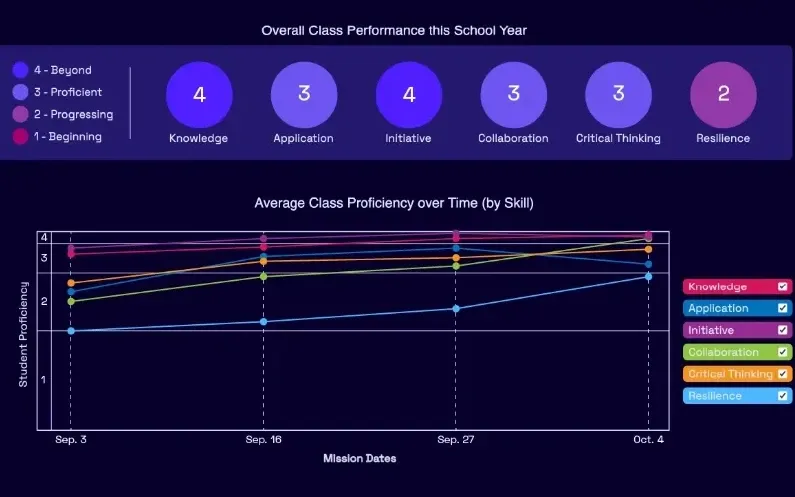
    A Mission.io class report: the class score in each of six skills, from knowledge and application to collaboration, critical thinking, and resilience, with the class chart across the year below.
    A class report from a real Mission: the class score in each of six skills, then each skill across the year.

    Every Mission produces a report for every student, built from what that student did across the whole Mission, on the skills the Mission captured. What it can show: what they knew about the standard, whether they could apply it as the problem unfolded, and the human skills every school promises (collaboration, critical thinking, initiative, and resilience). The test shows what they know. The report shows the rest. The framework’s parts above are where a challenge gets worked by hand, and the tally is you reading names off the question cards and the findings strip. The report measures those skills for every student at once. SEE THE EVIDENCE →

    You taught it. Now find out who can use it.

    Will it work in my room?

    Students join with a class code: no student accounts, no student email, no passwords. Chromebooks, laptops, or tablets, plus your projector; on a shared cart, it’s the day you have the cart. Free for teachers, no credit card.

    Who’s behind it. Mission.io is a research and design organization with one job: make this kind of structured, whole-class learning something a teacher can run every unit instead of once a semester, and put a report in your hands when it’s over. Over a million students have run a Mission. The research behind them is funded by the National Science Foundation and the U.S. Department of Education’s Institute of Education Sciences, and Mission.io meets ESSA Level II standards, as validated by Instructure.

    START FREE

    Free teacher account, no card. Start with the Communication Mission, marked Start here in your library, then Cliffhanger or the Collaboration Mission for your band, each after its 5-minute Teacher Preview.

Questions teachers ask about challenge-based learning

Is challenge-based learning the same as project-based learning?

They’re close cousins. The framework’s authors say challenge-based learning was informed by project-based learning and that the two have grown closer, with the first difference being who picks the problem: in challenge-based learning, teacher and students start as partners. Challenge-based learning also starts one step earlier, with a big idea. The comparison table has design thinking beside both.

How long does a challenge take?

The guide names a nano challenge (short, teacher-directed, starting at the challenge), a mini challenge of two to four weeks that runs the whole framework, and a standard challenge of a month and longer. It says some challenges take a day or a week and others a semester or a school year. Start with the nano challenge above.

Does challenge-based learning work in elementary school?

It can run there, and the guide’s own advice for any new class is narrow boundaries and short challenges first. The evidence is thin: as of 2025, a systematic review found 16 K-12 studies, seven of them in primary schools (Gandini and Morselli, 2026). In K to 2, run it as one class with you holding the pen.

Who created challenge-based learning?

Apple, in 2008, through the Apple Classrooms of Tomorrow, Today project, with a white paper by Mark Nichols and Karen Cator. Digital Promise published the 2016 guide, with Marco Torres. The framework and its guides are free at challengebasedlearning.org.

How do I grade a challenge without punishing the kid who did all of it?

Grade the part. The guide asks you to assess at both the group and the individual level, and every part here has a piece with one name on it (the question card, the findings line, the journal). That piece is the grade, and the group’s solution is the ticket to the pitch.

References and sources

One nano challenge in fours, then Cliffhanger’s wall

In fours first, by hand, with the eroding hill planner. Then the whole room, when the unit is ready: the Communication Mission first, then Cliffhanger or the Collaboration Mission for your band, each after a 5-minute Teacher Preview. Both free. Coaching a team on this, or building the PD?