How to Embrace Productive Struggle
Ryann Garland

What are some of your most rewarding moments? The end of a race? Finishing a tough school year? A long college paper? Finally closing 37 browser tabs after a long day?
We have moments of struggle every day, whether big or small. Although these moments of struggle can feel long and frustrating, they often leave us looking back with a feeling of accomplishment. This productive struggle doesn’t just have to be reserved for your Pinterest fails or surviving a staff meeting that could’ve been an email. Productive struggle can be a regular part of your classroom and build up your students, and we’re here to help you get started.
What Is Productive Struggle?
Productive struggle is a strategic challenge that pushes students to persevere, fail, and try again and again. When students struggle, they learn to value the process rather than just the right answers. This can include pushing students to give more attempts on a challenge than they may be used to, and the payoff is worth it. In the classroom, this could look like a seemingly impossible math problem, an open-ended writing prompt with no “correct” answer, or a science experiment with unexpected or unpredictable results.
Neuroplasticity is how our brain makes neural connections. Students develop their neuroplasticity when their brains struggle and are challenged in healthy ways. Neuroplasticity is what helps us think more deeply and complexly, use creative problem solving, and be compassionate human beings.
A productive struggle gives students the chance to experiment with trial and error. When students try out different strategies, solutions, and ideas, they move past passive learning into deeper understanding.
Why Productive Struggle Is the Secret Sauce of Real Learning
When students wrestle with challenging tasks, their brain pathways are actually strengthened. While in the process of a challenging task, the brain produces myelin, which is a protective covering surrounding nerve cells that controls thinking and muscles. An increase of myelin will enable students to better retain new skills. Some of these new skills the brain holds onto in a productive struggle include critical thinking, persistence, self-regulation, and flexible thinking.
Productive struggle helps students learn, and it also supports you as a teacher. Productive struggle supports classroom mathematics teaching by encouraging students to look at problems from new angles, try new methods, and embrace mistakes. It can also be applied to language arts, science, social studies, and more as we give students an opportunity to wrestle with a problem, a question, or an assignment. Having the right amount of difficulty can also help students retain more because they remember the challenge they experienced the first time they learned something or practiced it. When students have more complex problems in front of them, they will think deeper and eventually achieve mastery.
Productive Struggle in Action: What It Looks Like in a Mission.io Classroom
One of the best ways to introduce productive struggle into your classroom is through teamwork and tasks with clear goals. Through Mission.io, students take on real-world challenges, even if the path winds and has a few bumps.
Instructional tasks help students engage more deeply because they give students a structured chance to persevere, make mistakes, and try again. When students are part of the learning process, and not just spectators, they are more engaged. Students taking an active role in learning helps them see how these tasks can actually apply to their lives.
One of the best ways to give students an active role in learning is to give them problems worth caring about. Whether it’s helping plants and animals repopulate or saving a colony from a landslide, when students can see that their work matters, they’re invested. Through Missions, students collaborate, share ideas, and, most importantly, fail in a safe environment.
How to Encourage Productive Struggle Without Burning Your Students Out
Where do we begin with creating opportunities for productive struggle in the classroom? The key is to find challenges that are just-right for your students: stretching them, but not snapping them. The Zone of Proximal Development (ZPD) is a great example of this. The ZPD is the optimal learning zone, the gap between what a student can do on their own and what they can do with the help of a skilled partner.
Here are a few tips for finding the Goldilocks zone for your classroom:
-
*Don’t be afraid to fail yourself: *Every class is different, so a task that is a productive struggle for one class may be too difficult for another. Grant yourself some grace as you get to know your class and their capacity for struggle.
-
*Offer multiple entry points: *Use open-ended questions or tiered tasks so all students can participate, regardless of their skill level.
-
*Check in regularly: *Keep an eye on students. Are they experiencing a productive struggle, ready to try again? Or are they frustrated, feeling like a failure and that all hope is lost?
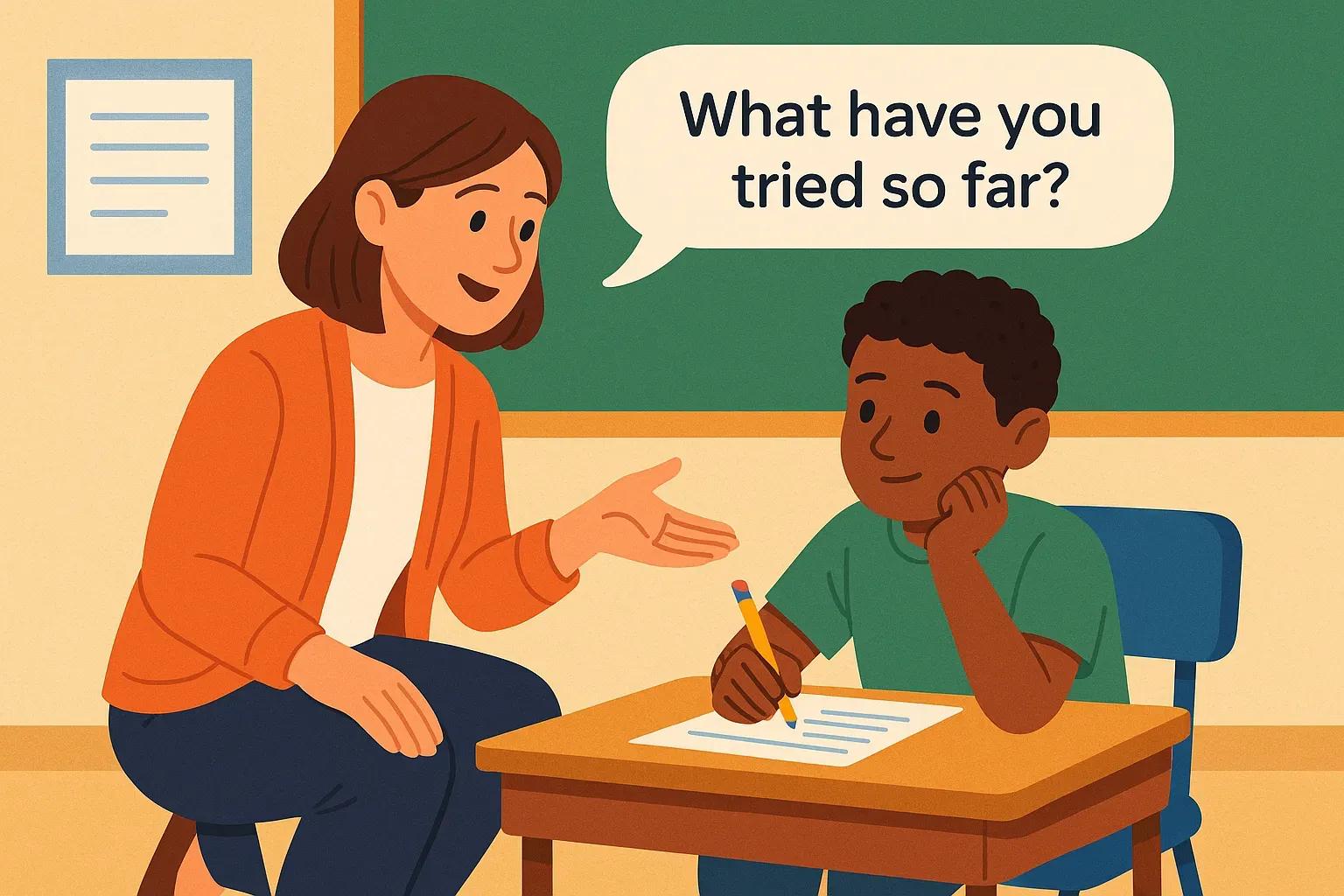
When students are in the midst of a productive struggle, sometimes we naturally want to help dig them out of the pit. But rather than giving them the answers, point them in the right direction. This is the best way to offer support without doing the task for them. Ask them questions that prompt deeper thinking (What have you tried so far? How can you do this differently?). Scaffolding can also help students feel supported in a struggle. Tools like checklists or sentence starters can help students feel confident when they hit those micro-wins.
Strategies to Foster Productive Struggle Every Day
Productive struggle doesn’t just have to be for big projects or the day of a Mission. You can build it into the classroom every day.
Frequent practice tests and open-ended questions are a great way to help students struggle. These kinds of activities promote memory retrieval while challenging students with small, achievable tasks. They’re also a great chance to interleave previous learning into new lessons. This will strengthen understanding and give students the chance to use past knowledge to solve new problems.
Practice for productive struggle can also feel overwhelming. To minimize burnout, space it out. When students space out their learning, they perform better than students who use longer learning sessions. As students overcome these different challenges, encourage them to reflect in a notebook or a test review so they can track their growth.
From “I Can’t” to “Watch Me”: The Role of Growth Mindset and Feedback
Encouraging students to embrace mistakes is just the trick that will fuel their academic ability. When mistakes are encouraged, they don’t feel like the end of the world. Letting go of perfectionism will help students of all ages realize that mistakes are *part *of the process, not a hindrance to the process.
Sometimes our growth and improvement seems to only be reflected in grades, making those mistakes feel like the end of the world. However, there is power in feedback beyond the A’s and B’s. Look for ways to give students real-time, actionable feedback. Instead of saying, “Let’s try and get a 90% on the next test!” try, “I loved how you showed your thinking on each question. This week, let’s focus on understanding adding and subtracting fractions to prepare for the next quiz.”
When we lay out the benchmarks in front of students, and even let them pick some of their own benchmarks, improvement doesn’t seem quite so daunting.
Creating a Culture of Challenge and Collaboration
Productive struggle through classroom mathematics will prepare students for real-world problem solving. Whether they go on to be a baker, a teacher, or a neuroscientist, their mathematical and problem solving skills will show up in their everyday lives.
Use collaborative tasks to boost engagement and support struggling students. This could look like giving team members designated roles, pairing stronger students with struggling students, or using online collaborative tools (read about eight of our favorites here). Knowing they don’t have to face the struggle alone is a great motivating factor for students to try harder and bounce back from mistakes.

Through teamwork and open discussion, students can develop an effective problem solving strategy for the challenge ahead. This may require some guidance from the teacher, but students will feel excited when their plans become part of the solution.
How Mission.io Supercharges Productive Struggle
Mission.io drops students into a challenge they have to work through together. Each Mission turns your classroom into a teacher-led, whole-class simulation.
You’re at the helm, and students do the thinking. They’ll struggle and they’ll be challenged, all while practicing human skills like resilience, initiative, and collaboration (and every student gets a report on how well they did, so you know where to help).
That means less guessing about where each student stands.
Ready to Take the Leap?
Classrooms are developing, and so should you. Take the leap from traditional, repetitive instruction into teacher-led Missions where students do the thinking. Create a free account at mission.io and start exploring our 100+ immersive Missions today! Show students that there is power in the struggle.