Is Too Much Screen Time in Schools Harming Our Kids?
Skyler Carr
I’ve always been a creature of impulse. You know, the classic human impulses like getting an extra plate of food, watching another episode on Netflix, and moving my family to France for a year.
It was a quick decision, made with the goal of helping our kids build a stronger relationship with my French wife’s family. It always felt more important than exciting, which helped when the dump truck of logistical hurdles unloaded on our lives.
Selling most of our possessions, navigating French bureaucracy (I wonder where that word comes from?) for visas, and finding an apartment have all paled in comparison to the culture shock of changing schools.
Here are my takeaways so far when unfairly comparing a middle-of-the-road downtown French public school with our high-performing STEM and language immersion public school in the U.S.:
POSITIVE: Schedule
I’ll lead with this one because I thought it was going to suck.
-
Start at 8:30
-
Lunch break at 11:30 (at home)
-
Back to school at 1:30
-
End at 4:30
-
No school on Wednesdays
It has kind of rocked. Breaking the day up together is way better than only catching each other when we’re all tired at the end of the day. No school on Wednesday (the thing I most groaned about) has been the perfect system for kids navigating a stressful change (consistently two days, break, two days, break). We’re no longer looking forward to only weekend adventures. Wednesdays have become our ritual mini-adventure day where we venture to the library, do day trips, and play D&D.
NEGATIVE: Obsession with cursive (and old-school, traditional methods)
I promise I’m not against cursive. (This is where the therapists in the room will point to the curvy lettering and ask, “Tell me how the mean letter hurt you.”) The whimsical way the letters roll into each other is something I have genuinely always enjoyed. It’s just that there seems to be this mentality at the school: “It was the way I learned, and it’s the way it’s always been done.”
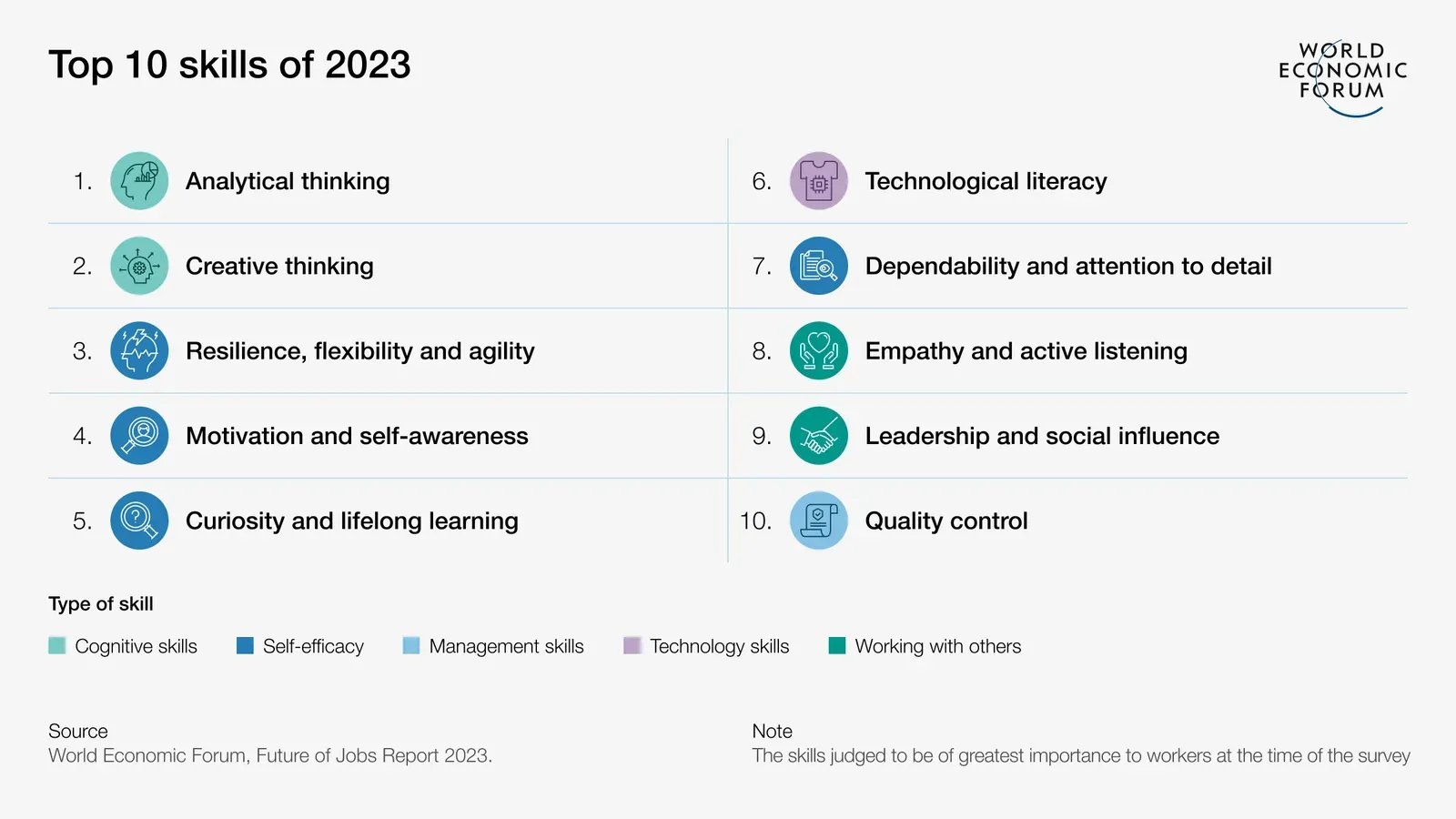
Therein lies my complaint. Education doesn’t exist to ensure everyone has the same baseline of essential knowledge. It should exist to try and equip us with the knowledge and skills we most need to reach our full potential. And since the world is constantly changing, so also should what we are teaching. The World Economic Forum recently published its 2023 Future of Jobs Report, which paints a clear picture of what students need in order to achieve in today’s world (and I don’t think cursive even made it in the top 20).
POSITIVE: Food
The bar may have been very low on this one, but a four-course meal served restaurant-style and where you’re sitting with your friends? chef’s kiss
NEGATIVE: Zero technology
There is not a single computer or device for students in the entire school. This is a dramatic shift from the 1-to-1 Chromebooks, VR labs, and robotics clubs my kids think are the norm.
Their reasoning is that kids get enough screen time, and school is not a place where they should be getting more. As a high-functioning screen addict, I can see where they are coming from. It’s hard to go anywhere in the world without looking at a screen.
Research also supports this claim. According to data provided by the CDC and New York-Presbyterian:
-
Children under 8 spend 2.25 hours per day in front of screens
-
Children under 8-10 spend around six hours per day in front of screens
-
Kids between 11 and 14 spend roughly 9 hours per day with screens, five watching television
-
Teenagers 15-18 years old are in front of screens for around 7.5 hours per day.
So with all of that information, this school decided on a zero-tech policy. The teachers support it. The parents support it. The data supports it.
I don’t.
cue gasp
I agree that the world spends too much time on screens, but the answer is NOT to eliminate all screen time.
It is more effective to focus on changing the nature of screen time.
Kids with an overabundance of screen time is not the technology’s fault.
It is our fault as parents.
Our kids are digital natives. Born into a world where the digital landscape is as familiar as the playground, they’ve learned to swipe before they scribble. In such a world, an entirely tech-free environment feels like an artificial vacuum. The intention to limit screen time is noble, but the approach misses the mark. Removing technology altogether doesn’t teach kids self-regulation. It creates a forbidden fruit scenario. When these kids eventually gain unrestricted access to technology, they’re more likely to binge, much like a dieter set loose in a candy store, simply because they haven’t been taught how to incorporate tech into their lives in a balanced, responsible way.
This is why school is the perfect place for technology! It is the ideal setting to broaden kids’ horizons about technology’s potential. Beyond gaming and passive media, we can show them how to use technology to create things, work more efficiently, and connect more meaningfully with the world.
When we show students the full range of what technology can do, screen time becomes a tool they use to make things, learn, and get work done.
A word of caution: this does not mean all screen time in schools is good. All screen time is not created equal. I can’t tell you how many times I’ve been frustrated by schools that implement VR, and after showing the kids a cool image, say, “Good job, you just learned!”
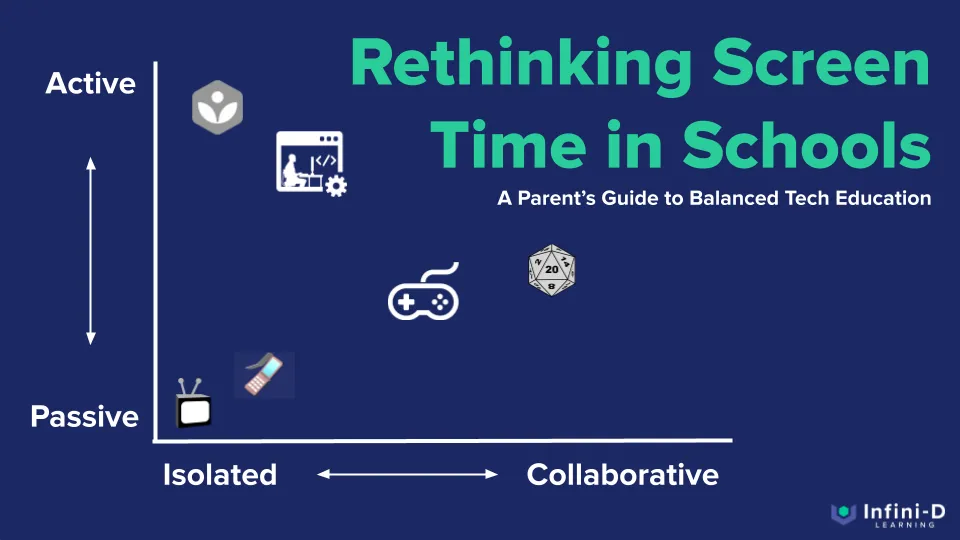
This is why I filter the quality of screen time based on where it lands within the following range:
-
Passive vs. Active
-
Isolated vs. Collaborative
Examining screen time through the lenses of “Passive vs. Active” and “Isolated vs. Collaborative” helps raise well-rounded, digitally savvy kids. “Active” use of technology involves critical thinking, problem-solving, and creativity, skills the job market values. “Passive” consumption usually lacks that benefit and can lead to issues with attention span and cognitive growth.
The “Isolated vs Collaborative” axis matters just as much. Collaborative digital activities build social interaction, teamwork, and emotional intelligence, skills students need to work with people anywhere in the world. Isolated activities aren’t bad on their own, but they can lack those benefits and, left unchecked, may lead to social detachment.
Together, the two axes give you a simple way to judge the quality of screen time, and using them helps kids build self-regulation, empathy, and adaptability.
Here’s an example of how it is applied in my home: D&D > Khan > Coding > Minecraft (collaborative game) > Legend of Zelda (solo game) > Cell Phone > TV
-
D&D: Dungeons and Dragons is a stellar example of ‘Active’ and ‘Collaborative’ screen time. It builds imagination, strategic thinking, and social skills as you work through complex stories and make decisions as a team. It also gives me the excuse to play with them.
-
Khan Academy: While it’s generally a solo venture, the educational content requires active engagement and builds mastery across subjects.
-
Coding: Coding is a brilliant exercise in logical reasoning and problem-solving. Though usually a solitary endeavor, the value of showing kids that they can create and shape the technology they encounter changes their entire perspective.
-
Minecraft (Collaborative Game): Minecraft encourages both creativity and teamwork. Players can build worlds together, requiring a blend of architectural creativity and cooperative planning. It also does a great job of teaching kids new swear words when I am attacked by a creeper.
-
Legend of Zelda (Solo Game): Despite the solo nature, the game involves strategic thinking, puzzle-solving, and quick reflexes, which makes it good exercise for a growing brain. It is also so satisfying to hear the delightful chime every time you find a Korok seed.
-
Cell Phones: In our household, cell phones are a closely-monitored experience, primarily for older kids who’ve earned the privilege. We adhere to a “no dumb games” policy, steering usage towards apps and games that build creative thinking or problem-solving skills.
-
TV: This medium usually sits in the ‘Passive’ and ‘Isolated’ corner, which is why I often prefer my kids to play interactive games instead. The focus here isn’t to eliminate TV but to be selective about the content, opting for educational shows or documentaries that can offer something more than mere entertainment. This way, even passive screen time serves a purpose.
Kids are far from oblivious. Give them a nudge in the right direction, and they’ll catch on and learn to value their time. A tech-free home is a pipe dream anyway. Our job is to teach kids how to judge the value of the technology they use. Be deliberate about the quality of screen time, and you do more than police usage: you build a habit that helps them make smart tech choices for life.
So, if you haven’t caught the drift by now, let me spell it out for you: you’ve got to roll up your sleeves and get in the digital sandbox with them. Seriously, don’t just delegate this grand mission to the kids and expect them to become screen-time sommeliers on their own.
Play that Minecraft game, engage in a family D&D quest, or even throw down in a cerebral phone puzzle challenge. Your enthusiastic participation makes these guidelines easier to swallow, and it gives you prime opportunities to drop some “tech wisdom” along the way.
Trust me, nothing says ‘quality screen time’ like Dad yelling, “I told you that fireball was a bad idea!”