How Do Emotions Positively and Negatively Influence Critical Thinking?
Ryann Garland
What are some of your favorite unexpected flavor combos? Peanut butter and pickles? Watermelon and feta? Strawberries and balsamic? Listen guys, don’t knock it until you try it.
Some of these unexpected flavor combinations might not make sense at first, but when paired together, they can help you see things in a different way. And that’s one of the best ways to approach learning: embrace the unexpected, and your life gets richer for it.
One of those unexpected “flavor” combinations when it comes to learning may be our critical thinking abilities and emotions. Combining critical thinking skills with emotion may seem like oil and water at first, but it actually mixes much better than that. So, how do emotions positively and negatively influence critical thinking? We’re here to get to the bottom of it with you.
Rethinking the Role of Emotion in Reasoning
What is critical thinking, and why does it matter so much in education? Critical thinking is purposeful, analytical thinking used in problem-solving and decision-making, and it’s a core cognitive skill. It requires both logical thinking and emotional awareness. Although it may start in the classroom figuring out how to finish a science project, critical thinking is an essential skill that students will need for the rest of their lives. While critical thinking appears to be all reason and logic, there’s more to it. We’re here to bust the myth that emotions are the enemy of reason. The two are intertwined.
Recent research reports that positive emotions can have a positive influence on learning. When students experience feelings of self-motivation and satisfaction toward their learning materials, they learn more deeply and have higher academic achievement. Emotional experiences and stimuli are remembered more vividly over time, which could help students remember more of what they learn.
And shouldn’t emotions be part of our everyday decision-making? Think about it: big or small, our decisions rarely come about in an emotion-free void. Choosing a college major, negotiating a contract to reach mutually beneficial agreements, or even deciding whether to hit “reply all” on that email (pro tip: don’t) all involve an element of emotional intelligence and awareness. Emotions help us recognize what holds personal value and stay motivated when the road ahead is uphill. Critical thinking without emotions is like a GPS with no sound. You’ll probably still end up in the right place, but you might miss a few turns.
So how do emotions positively and negatively influence critical thinking? Below, we’ll go over emotional duality, affect heuristics, emotional intelligence, and practical strategies for better reasoning.
The Dual Impact of Emotions on Critical Thinking
How Positive Emotions Enhance Thinking
Positive emotions expand mental flexibility and promote creative problem-solving skills, so students can tackle challenges more effectively. When students are excited, motivated, or happy about an assignment, they’re willing to give more effort and keep going when things get tough. That willingness to engage is where critical thinking comes in.
Think back to some of your worst college classes (I’m sorry, Chem 101. It’s not you, it’s me). How much effort did you put into those assignments? If you were like me, it probably got to the point where the effort was minimal and full of shortcuts just out of sheer spite. And better yet, I can hardly tell you anything I learned in Chem 101. You will not be catching me in a science classroom again anytime soon.
But as mentioned in that earlier research, positive emotions can improve memory retrieval and broaden students’ attention. If students feel enthusiastic, they’re more likely to remember the activity and the material. And when students get really excited about learning, they collaborate more, seeking out ideas from others and sharing their own.
How Negative Emotions Sharpen, or Impair, Thinking
Now negative emotions are a double-edged sword. They can sharpen critical thinking, perhaps by giving students greater attention to detail, increasing caution, or promoting skepticism. These can all be positive traits that help students make sound judgments or sidestep cognitive bias.
Negative emotions can also impair judgment through heightened anxiety, fear, and tunnel vision. This is part of what psychologists call “affective phenomena,” emotions that actively shape thought. For example, when someone becomes extremely angry, it can cause some impulsive reasoning. If a student feels angry towards another classmate, they might launch their pencil across the room like a javelin in the Olympics. When faced with fear, we might unrealistically magnify risks.
Psychological Mechanisms & Cognitive Shortcuts
To understand how emotions and logic work together, it helps to know the mental shortcuts we take when we rely on emotion.
Affect Heuristic
Affect heuristic describes how people often lean on emotion instead of logic when making decisions. Especially under pressure, it’s natural for us to rely on what we’re feeling rather than thinking. There are positives and negatives here: emotions can help us to reach conclusions quickly and easily, but they can also distort thinking if we’re not careful.
Negativity Bias
Negativity bias is our tendency to prioritize and store negative information and experiences rather than positive ones. The human brain tends to give more weight to negative input, just like how you tend to dwell on that one passive-aggressive Facebook comment from your middle school nemesis (it’s time to move on). When it comes to decision-making, though, this negativity bias can cause us to skew analysis and overemphasize risk.
Hot vs Cold Cognition
Katy Perry said it best: “You’re hot, then you’re cold. You’re yes, then you’re no. You’re in, then you’re out.” Finding the balance between emotional and rational thinking can feel like you’re getting whiplash. The key is understanding the differences between hot and cold cognition.
“Hot” cognition is our emotionally charged thinking. This often comes into play in situations that are considered high-risk, high-reward. “Cold” cognition is our neutral, rational processing. This is used more often for tasks like scheduling and evaluating approaches to a problem. Both have their place, and balanced reasoning comes from knowing which one fits the moment.
Emotional Intelligence: The Bridge Between Feeling and Thinking
Emotional Intelligence (EI) is the ability to recognize, understand, and regulate emotions in yourself and others. Higher EI correlates with improved decision-making, reduced bias, and better leadership. So how do you help students build it?
Three techniques help you and your students build EI. The first is emotion labeling. This is a big step towards helping students understand what’s going on inside their heads, beyond the aftereffects. For example, rather than saying, “I’m feeling ‘off’” you may say, “I feel frustrated.” Help students learn to name and understand their emotions through activities like reflective journaling after a difficult activity or checking in on an emotions board at the beginning or end of each day.
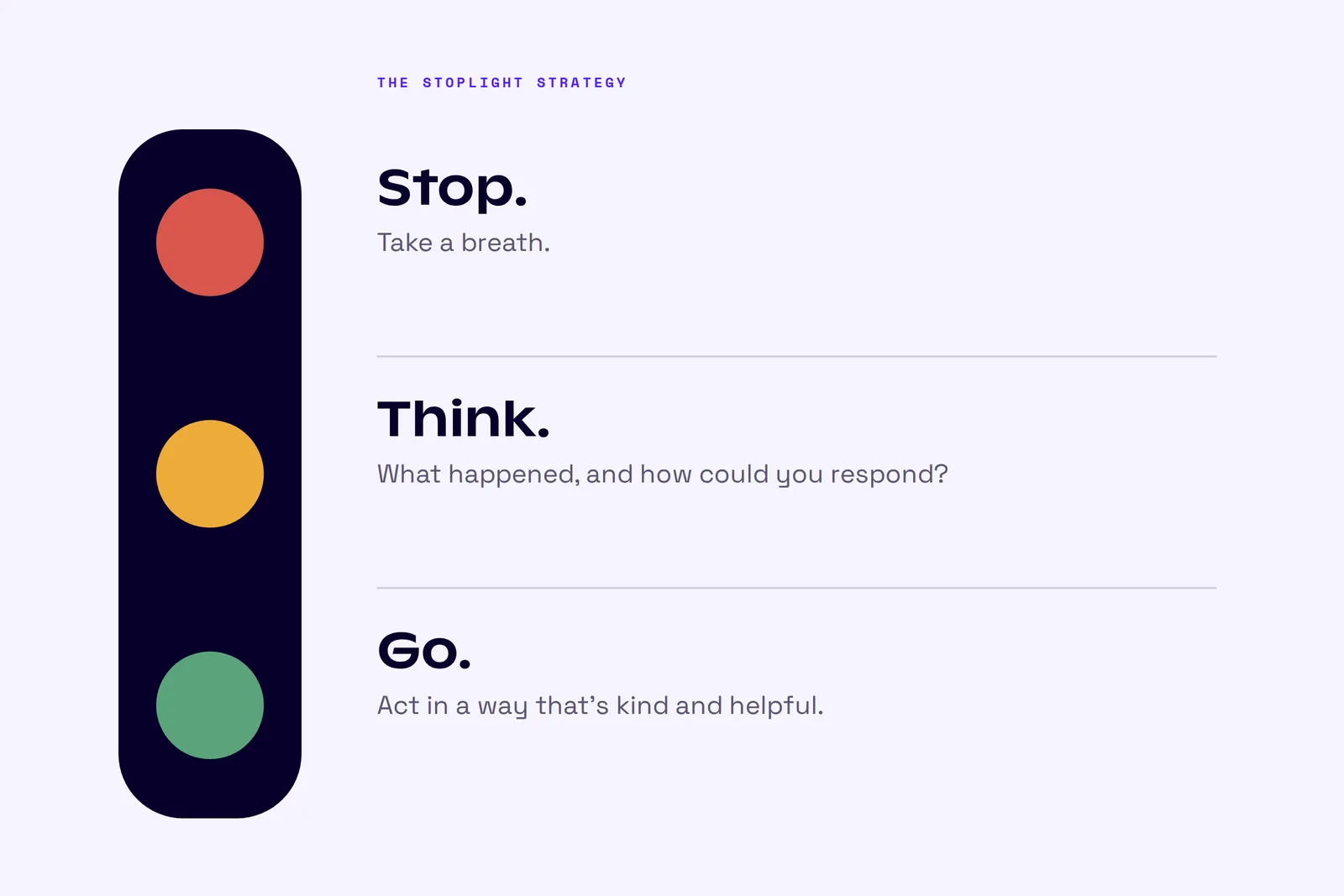
Another core skill is teaching students to pause. Pausing before a reaction is critical to finding a balance between hot and cold cognition. For younger students, teach the stoplight strategy. Whenever they feel an intense emotion, they should first engage the red light: stop and take a breath. Next comes the yellow light: think about what happened and possible ways to respond. Last comes green for go, meaning students can act on a response that is kind and helpful. Consider even giving students practice scenarios so they can walk through each step.
Lastly, students need to learn to reframe emotional cues as data, not distractions. Emotions are signals, just like notifications on a phone. They let you know that something is going on, but you get to choose what to do with that information. The goal is to help students notice, name, and interpret emotional cues before responding.
How Emotions Affect Cognitive Control & Information Processing
It’s clear by now that there are ups and downs to emotions, but cognitive control helps manage these shifts.
Positive moods encourage global thinking, meaning we see the big picture. Negative moods can help too: they promote local, detail-specific focus, which is useful for catching errors. Without balance, though, they can also amplify cognitive biases.
It doesn’t have to be all or nothing. Whatever the mood, emotional regulation is still the goal. It supports working memory and attention, and it leads to fewer distortions from confirmation bias. Put together, that makes for a strong critical thinker.
Individual Differences in Emotional-Cognitive Interactions
There are a lot of factors that influence our susceptibility. Our personality traits alone make a huge difference. Neuroticism (a trait causing people to see more negative things in the world) might cause someone to be less susceptible compared to a person who is more open. Neither is right or wrong; it comes down to knowing when each trait helps.
Cognitive style and emotional reactivity also affect someone’s susceptibility. Analytical versus intuitive people might rely on their emotions or logic differently to make sound decisions. Similarly, people with high versus low emotional reactivity may approach decision-making in different ways.
Some people benefit from emotional input in reasoning, while others are more prone to distortion. Helping students find a healthy balance takes practice.
Practical Strategies to Balance Emotion and Logic
1. Build Emotional Awareness
Teach students how to track mood patterns and recognize their emotional state before making decisions. This could be in an emotions journal, a dedicated reflection time, or even simple one-on-one check-ins.
2. Pause & Reflect
Create a buffer between emotion and action, especially in high-stakes moments. Think back to the stoplight method. Stop, think, consider, then choose the best course of action.
3. Leverage the Right Emotion for the Task
Use joy and optimism for brainstorming; use mild skepticism for quality control or risk assessment. Showing students the benefits of a range of emotions will teach them to face what they’re feeling, not run away from it.
4. Train Emotional Intelligence Daily
Journaling, morning check-ins, mindfulness, and structured self-reflection give students private, low-stakes moments to pause and think.
Turn Emotional Awareness Into Smarter Action
Emotions shape critical thinking more than they hinder it. With awareness and skill, students can use them to make better decisions.
The goal is balance: positive emotions fuel creativity, and negative ones sharpen caution. Emotional intelligence helps you think clearly under pressure, and simple daily strategies build awareness and control over your emotional influences.
Knowing how emotions affect your thinking is the first step. Using that insight every day is the harder part.
Mission.io gives students practice making hard decisions together, with you leading the thinking. Start with a free account today and bring emotional intelligence into your daily classroom activities.