Math Lessons for Life: Transforming Education
Grace Balena

Students often dread the mind-numbing multiplication sheets and plain lessons found in standard textbooks and the recommended curriculum. It’s disheartening as a teacher to watch them zone out, crunching numbers and fantasizing about problem-solving strategies for video games instead of engaging with your instruction.
Don’t they realize how important your lessons are?
The truth is, kids already love math. They don’t need to choose between you and their sugary budgeting. They just don’t know what they are doing is math.
Transforming Education through Math
Math not only helps students learn real life skills, it is a life skill. Managing a budget, mapping the shortest route home, finding precise measurements for a recipe? These are challenges your students are already facing.
Empowering Students to Change the World
They need you to show them that math can change their own path, and maybe the world. When we move beyond rote counting and adding, we unlock a child’s potential to innovate.
Mission.io is driven to meet the needs of today’s students, reimagining math with a focus on mathematical practice: quantitative reasoning, pattern recognition, and perseverance. While students may only encounter a handful of equations in a Mission, Mission.io builds Missions that push students to learn how to strategically approach mathematical problems in many different real-life contexts.

The Problem with the Status Quo
Too often, current math education fails because it is disconnected from real life situations. It harps on the failures and anxieties of students, is inaccessible for many, and works towards test scores instead of genuine understanding.
Understanding Math Anxiety
In a study on “math anxiety,” Dr. Ian Lyons and Dr. Sian Beilock found that anticipating a math task stimulated the part of the brain that generates pain responses. The brains of people with math anxiety perceive pain similar to “spontaneous seizure attacks.”
That explains why students seem to freeze when you put an equation on the board! How can we teach students if their bodies are in a “math seizure”?
Math as a Life Skill, Not Just a Subject
Mathematical literacy is foundational for helping develop students’ agency and decision-making. This translates to practical skills such as financial and digital literacy.
Beyond these hard skills, students can further become engaged in their local and global communities. By helping them understand sustainability issues using data and science, we are teaching meaningful, new ways to connect with their environment and community.
Core Principles for Transformation
There are four core principles that will help you transform math lessons for life in your classroom: relevance, mindset, equity, and interdisciplinarity.
-
Relevance: Make your lessons applicable in relevant, real-world situations.
-
Mindset: Shift the mindset students approach math with. Students should feel curious, not scared.
-
Equity: Make lessons accessible to all students so everyone feels they belong in the classroom. Every child deserves to feel that math is “for them.”
-
Interdisciplinarity: Incorporate science, art, technology, and social studies into your lessons. This gives students a stronger sense of how math connects to the world. Mission.io’s Missions situate math problems within the context of other subjects to help students understand math’s universal applications.

Case Studies and Stories of Change
Here are three real-world examples of educators changing their classrooms and their students’ lives.
Story 1: Solving the Climate Crisis with Data
Rebecca Newburn, a middle school teacher in California, teaches X and Y coordinates by asking her students to save the planet. Her project-based lesson plan, Drawdown!, transforms her students into citizen scientists, entrusting them to analyze real climate data. She makes these abstract math concepts applicable to urgent, real world problems.
Story 2: Growth Mindset = Math Mindset
Stanford University’s Professor Jo Boaler ran a summer camp emphasizing that math be accessible for all. By providing “high ceiling, low floor” problems, students began learning from the struggle instead of being frustrated with correctness. After just 18 of these lessons, students improved an astounding 50% on tests.
Story 3: Reimagining Engagement with Mission.io
In Alpine School District, teachers implemented Mission.io to turn classrooms into “mission control” centers. Instead of snoozing passively through traditional instruction, students took on active roles to solve crisis scenarios.
Jeni Boston, an elementary school teacher, testified: “This program is so engaging for students. They are always excited to have a mission. My classes have increased their teamwork and collaboration by participating in missions that build understanding of our core curriculum.”
A correlational study in the same district found that elementary schools completing 10 or more Missions in a year had significantly higher state science proficiency than schools with no usage (d = 1.00, p = .003; Mission.io, 2026).
The Role of Technology & Innovation
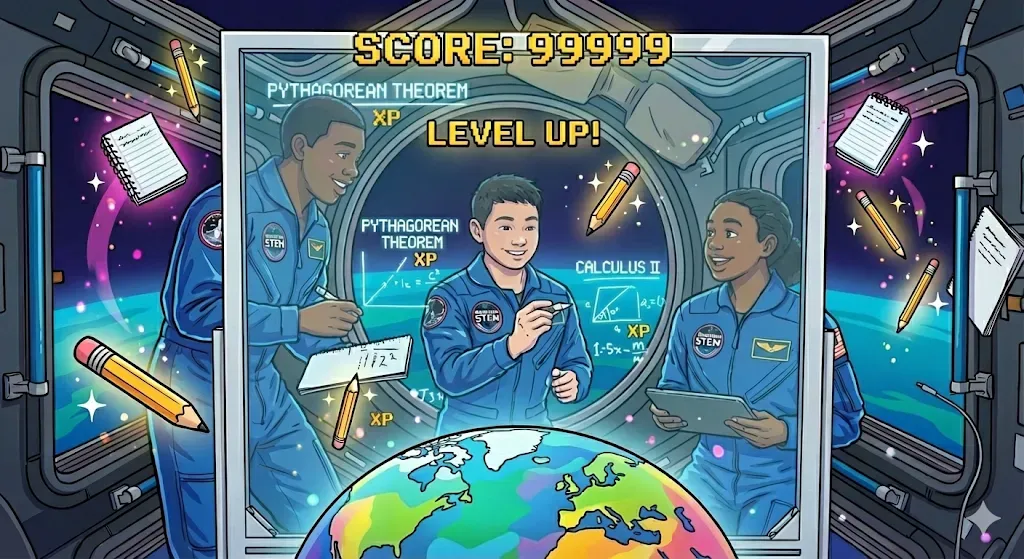
Beyond content, a change in form can help pique student interest. Artificial intelligence (AI), augmented and virtual reality (AR and VR), interactive whiteboards, games and apps: technology galore!
Technology can be a compass to guide you through the rocky waters of teaching difficult concepts. Mission.io strives to make math smooth sailing! We use technology to get students talking to each other and to give them real uses for their math skills. Mission.io prepares students for the future of math, whatever form it takes in their lives.
Overcoming Obstacles
Remember the math anxiety seizures? Ouch! That mindset won’t change overnight!
That’s why leaders need to rethink culture, policy, and teacher training in math education. At Mission.io, we keep building Missions that address these obstacles.
Implementation Framework
You can practically apply these suggestions today with Mission.io!
Each Mission gives students a real use for the skills they’ve been taught. Missions help students develop a curious mindset towards math, treating failure as an opportunity to learn, instead of despair.
The structure helps students and teachers alike: the Mission carries the story, you lead the thinking, and nobody gives up the fun!
The Future of Math Education
Think of what math classrooms might look like in 10 years. Instead of silent desks, imagine students collaborating via VR to visualize geometry, or AI to model economic systems.
Math is as much about asking the right questions as getting the right answers. Parents and educators are part of our mission to change teaching and shape the future.
If you want to change how math is taught, check out Mission.io’s interactive math resources. You’ll find a library of math lessons built to spark interest and deepen understanding.